
Lowest Price Guaranteed
Pages
307
Last Updated
September 2026
View Count
30298
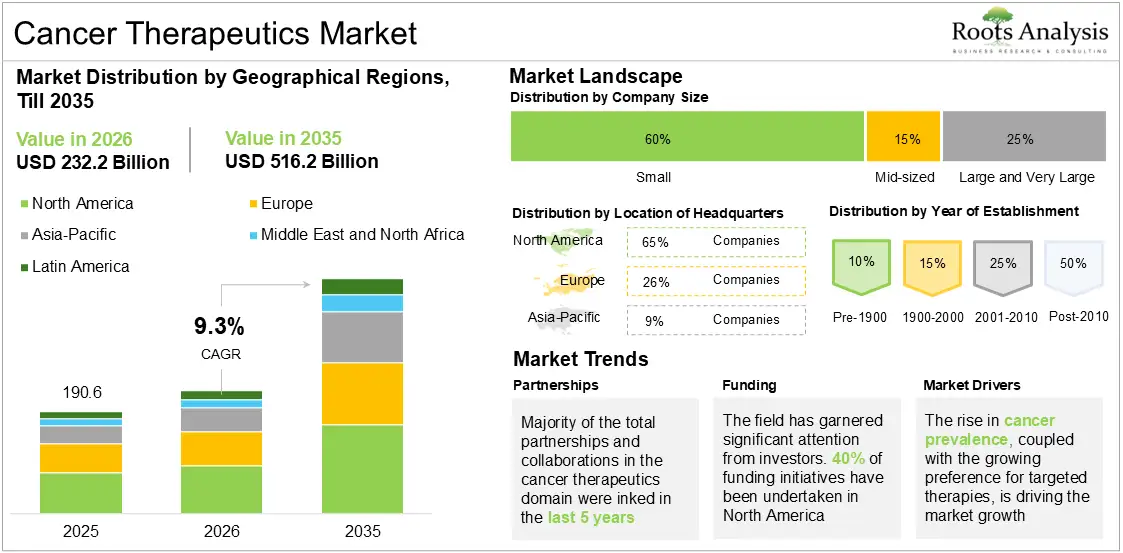
The global cancer therapeutics market, valued at USD 190.6 billion in 2025, is projected to reach USD 232.2 billion in 2026 and USD 516.2 billion by 2035, representing a CAGR of 9.3% during the forecast period 2026 to 2035.
To learn more about this report, request a free sample copy
Cancer remains a major clinical and economic challenge despite continuous advances in early detection and treatment. The American Cancer Society projects that approximately 2,114,850 new cancer cases and 626,140 cancer deaths will occur in the United States in 2026.
Although the 5-year relative survival rate for all cancers combined has increased to approximately 70% among people diagnosed between 2015 and 2021, the incidence of several major cancers continues to rise. This trend is sustaining demand for more effective, durable, and accessible treatment options.
Surgery, chemotherapy, and radiation therapy remain central to cancer management. However, treatment-related toxicity, disease recurrence, and therapeutic resistance continue to limit long-term outcomes for many patients.
Consequently, oncology research has increasingly shifted toward precision medicine and advanced therapeutic modalities, including targeted therapies, immunotherapies, antibody-drug conjugates, cell therapies, radiopharmaceuticals, bispecific antibodies, and targeted protein degraders. These approaches are designed to improve tumor selectivity and may reduce certain off-target effects compared with conventional systemic treatments. A complementary research direction involves cancer metabolism-based therapeutics, which target metabolic processes that support tumor growth and survival.
The clinical success of biomarker-driven therapies targeting BCR-ABL, HER2, and vascular endothelial growth factor pathways has validated the precision-oncology model. Nevertheless, targets such as RAS remain therapeutically challenging because of tumor heterogeneity, pathway complexity, and the development of treatment resistance. These challenges are accelerating the development of next-generation inhibitors and combination regimens.
Regulatory activity also reflects the pace of innovation across the cancer therapeutics market. In 2025, the FDA reported 17 oncology new molecular entity or original biologics license application approvals, including eight accelerated approvals and nine regular approvals.
The growing use of biomarker testing, genomic profiling, companion diagnostics, and novel treatment modalities is expected to support the continued expansion of the cancer therapeutics market.
| Drug / Product | Approval Date | Company | Cancer Type / Indication | Market Significance |
| Trodelvy® | June 24, 2026 | Gilead Sciences | First-line triple-negative breast cancer | Strengthens the TROP-2 ADC opportunity in aggressive breast cancer and reinforces ADCs as a major oncology growth class. |
| Ibrance® combination regimen | June 24, 2026 | Pfizer | HR-positive, HER2-positive metastatic breast cancer maintenance | Supports continued relevance of CDK4/6 inhibition beyond traditional HR-positive / HER2-negative breast cancer. |
| Truqap® + abiraterone + prednisone | June 12, 2026 | AstraZeneca | PTEN-deficient metastatic prostate cancer | Expands AKT-pathway targeting into biomarker-defined prostate cancer. |
| Welireg® + Keytruda® / Keytruda Qlex™ | June 12, 2026 | Merck | Adjuvant renal cell carcinoma | Reinforces Merck's strategy of combining immunotherapy with novel targeted mechanisms. |
| Imfinzi® + BCG | May 28, 2026 | AstraZeneca | High-risk non-muscle invasive bladder cancer | Moves immunotherapy deeper into earlier-stage bladder cancer treatment settings. |
| Decnupaz™ | May 27, 2026 | AbbVie | Blastic plasmacytoid dendritic cell neoplasm | Highlights continued innovation in ultra-rare hematologic malignancies. |
| Datroway® | May 22, 2026 | Daiichi Sankyo | Unresectable / metastatic TNBC | Strengthens Daiichi Sankyo's TROP-2 ADC positioning alongside its HER2 ADC leadership. |
Based on the research, we have segmented the cancer therapeutics market into type of therapy, application, key drugs, end user, and geographical regions.
By Type of Therapy
By Application
By Key Drugs
By End User
By Geographical Regions
Driven by the rising incidence of cancer worldwide, expanding investments in oncology research and development, favorable regulatory support, and the growing adoption of personalized medicine, the cancer therapeutics domain is expected to grow in the near future.
Judy Wang (Associate Director of Drug Development, Florida Cancer Specialists & Research Institute) stated, "These ADCs have been approved in advanced NSCLC, either in EGFR-positive disease or in patients with c-MET–high expressing disease, which is great, as these patients often get a positive response to platinum-based chemoimmunotherapy. Invariably, though, these patients will develop progressive disease. What we are using in the second-line setting, outside of a trial or these other approved targeted agents, are drugs like docetaxel. With single-agent chemotherapy in the second line for NSCLC, we're really looking at an objective response rate of 20%, which is underwhelming."
Discussions with multiple stakeholders in this domain influenced the opinions and insights presented in this study. The market report includes transcripts of the following discussions:
In addition, the market report includes transcripts of the following other third-party discussions:
This segment highlights the distribution of market value for cancer therapeutics across various types of therapies, such as chemotherapies, hormonal therapies, immunotherapies, targeted therapies and other therapies.
Targeted therapies currently account for the largest share, capturing close to 55% of the cancer therapeutics market. Its market leadership is primarily supported by the established clinical use of targeted agents across major solid tumors and hematological malignancies.
The growing integration of genomic profiling and companion diagnostics also allows oncologists to identify eligible patients more accurately. As a result, targeted cancer therapies are increasingly incorporated into first-line, maintenance, and combination treatment regimens.
Recent regulatory approvals continue to expand the addressable patient population for targeted therapies. In June 2026, the FDA approved capivasertib with abiraterone and prednisone for PTEN-deficient metastatic prostate cancer. Zongertinib received an expanded indication for HER2-mutated non-small cell lung cancer in February 2026, while encorafenib received traditional approval with cetuximab and mFOLFOX6 for BRAF V600E-mutated metastatic colorectal cancer during the same month.
Immunotherapy, however, is expected to register the highest CAGR during the forecast period. Growth is being driven by the rapid expansion of immune checkpoint inhibitors into earlier treatment lines and clinical development of cell therapies, cancer vaccines, bispecific antibodies, and cytokine-based treatments.
Recent FDA approvals demonstrate this expansion. Durvalumab, in combination with Bacillus Calmette-Guérin, was approved in May 2026 for BCG-naïve, high-risk non-muscle-invasive bladder cancer. In March 2026, nivolumab with doxorubicin, vinblastine, and dacarbazine was approved for previously untreated Stage III or IV classical Hodgkin lymphoma. ,
Based on the application, the global market is segmented into blood cancer, breast cancer, cervical cancer, colorectal cancer, glioblastoma, head & neck cancer, lung cancer, malignant meningioma, melanoma, mesothelioma, prostate cancer, and others.
Currently, the breast cancer segment is likely to account for the largest share of the cancer therapeutics market, owing to the large treatable population, well-established biomarker-based treatment pathways, and sustained use of therapies across early, adjuvant and metastatic disease settings. Moreover, as the most commonly diagnosed cancer in women, breast cancer offers a broad commercial base across developed and emerging markets.
Extensive molecular segmentation of breast cancer into HR-positive/HER2-negative, HER2-positive, HER2-low, HER2-ultralow, BRCA-mutated and triple-negative disease has supported the commercialization of multiple high-value drug classes. These include endocrine therapies, CDK4/6 inhibitors, PARP inhibitors, HER2-targeted agents and antibody-drug conjugates. Recent approvals, such as Datroway for previously treated HR-positive/HER2-negative metastatic breast cancer in January 2025, continue to expand the addressable population and treatment sequence.
Moreover, it is worth highlighting that, as per the cancer therapeutics market analysis, the market share for lung cancer is likely to grow at a relatively higher CAGR during the forecast period. This is driven by its rapid transition from a chemotherapy-centric market to a precision oncology landscape with multiple emerging druggable patient populations. As the leading cause of cancer incidence and mortality worldwide, lung cancer continues to present a significant unmet clinical need due to its frequent diagnosis at advanced stages. Market growth is being fueled by the widespread adoption of comprehensive genomic profiling for actionable biomarkers, including EGFR, ALK, ROS1, KRAS, MET, RET, and HER2, alongside the increasing availability of next-generation kinase inhibitors. This trend is further reinforced by recent 2025 regulatory approvals, including Datroway for EGFR-mutated NSCLC, Emrelis for tumors with high c-MET overexpression, and zongertinib for HER2-mutated NSCLC.
Based on the end user, the global market is segmented into cancer and radiation therapy centers, hospitals and specialty clinics.
According to our market analysis, the hospitals segment occupies the highest market share in the cancer therapeutics market, primarily due to their role as the primary point of diagnosis and treatment for cancer patients and their ability to deliver the full spectrum of oncology care in a single setting.
Hospitals possess multidisciplinary oncology teams, advanced diagnostic infrastructure, inpatient and outpatient chemotherapy facilities, surgical oncology capabilities, and intensive care support required for managing treatment-related complications. Moreover, the increasing adoption of high-cost targeted therapies, immunotherapies, antibody-drug conjugates (ADCs), radioligand therapies, and combination regimens often necessitates specialized monitoring, infusion infrastructure, and coordinated care, further reinforcing hospitals as the preferred treatment setting. NCI-affiliated institutions, for example, commonly provide chemotherapy, radiation therapy, surgery, genetic assessment, clinical trials, and supportive care within a single care network.
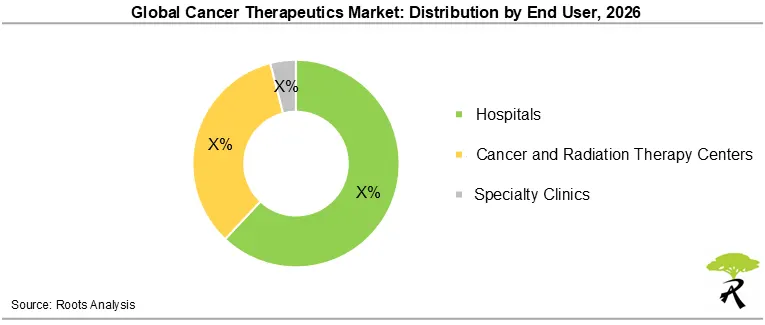
Driven by the growing need for advanced cancer treatments and facilities, cancer and radiation therapy centers are likely to grow at a higher CAGR during the forecast period. Moreover, the market is propelled by the global shift toward specialized, outpatient, and technology-enabled treatment settings. Increasing investments in precision radiotherapy platforms, integrated diagnostic and treatment centers, ambulatory infusion suites, and value-based oncology care models are enabling these facilities to manage a growing proportion of cancer patients outside traditional hospital settings. Moreover, the IAEA notes that radiotherapy is required by more than half of cancer patients, while access remains uneven in many countries, creating substantial scope for the establishment and expansion of dedicated treatment centers.
In terms of geographical regions, the market is segmented into North America, Europe, Asia-Pacific, Middle East and North Africa, and Latin America.
According to our cancer therapeutics market forecast, North America is likely to capture the majority (around 40%) of the global market share in the current year, and this trend is unlikely to change. The region's dominance is supported by a highly mature oncology ecosystem, rapid adoption of innovative therapies, and a well-established reimbursement framework that supports access to high-value cancer treatments. For instance, the US is home to 74 NCI-designated cancer centers, where nearly 400,000 patients are diagnosed with cancer annually, and thousands participate in oncology clinical trials.
Moreover, the US demonstrates one of the highest per capita utilization rates of PD-1 / PD-L1 inhibitors. This robust clinical and commercial infrastructure enables the rapid adoption of advanced modalities, including ADCs, bispecific antibodies, CAR T-cell therapies, and biomarker-driven precision medicines, allowing manufacturers to achieve significant commercial returns.
The market in Asia-Pacific is likely to grow at a high CAGR during the forecast period till 2035, fueled by the rapid conversion of a large, historically underpenetrated cancer patient population into commercially addressable demand. The region is also benefiting from rising healthcare expenditure, broader health insurance coverage, and continuous improvements in oncology infrastructure, enabling greater access to advanced cancer therapeutics.
Government-led cancer initiatives are accelerating the adoption of advanced therapies across Asia-Pacific. For instance, in China, the 2025 National Reimbursement Drug List added 114 medicines, including 50 innovative drugs, while a new commercial-insurance list included 19 treatments for tumors, rare diseases, and Alzheimer's disease.
| Key Report Attribute | Details | |
| Historical Trend | Since 2020 | |
| Forecast Period | Till 2035 | |
| Market Size 2026 | $232.2 Billion | |
| Market Size 2035 | $516.2 Billion | |
| CAGR (Till 2035) | 9.3% | |
| Segments Covered |
|
|
| Key Players |
|
|
| PowerPoint Presentation (Complimentary) |
Available | |
| Customization Scope | 15% Free Customization | |
| Excel Data Packs (Complimentary) |
Available | |