
Lowest Price Guaranteed
Pages
359
Last Updated
October 2025
View Count
12015
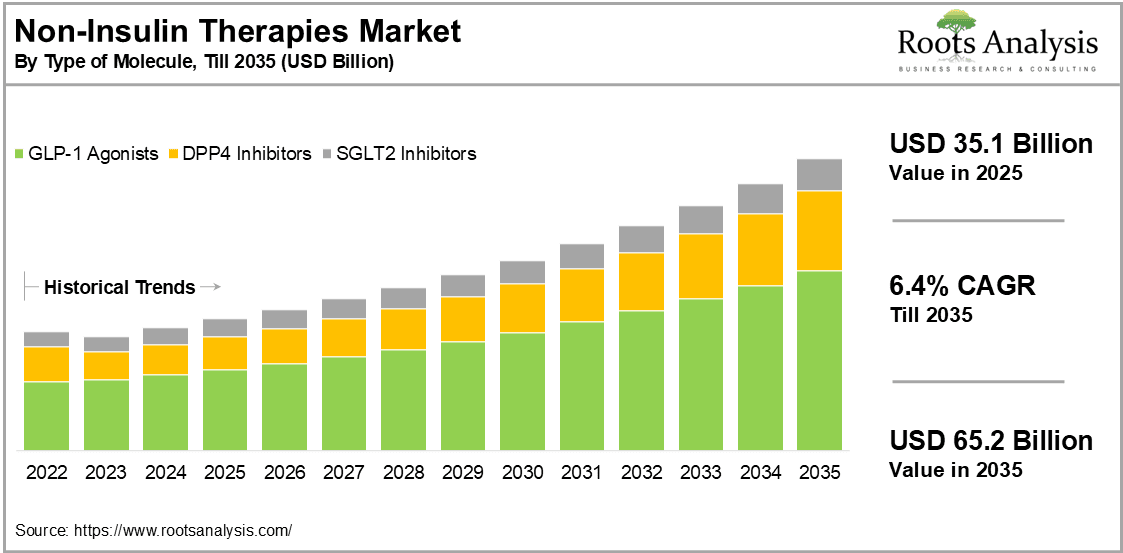
The non-insulin therapies market, valued at USD 32.8 billion in 2024, is projected to grow to USD 35.1 billion in 2025 and USD 65.2 billion by 2035, representing a CAGR of 6.4% during the forecast period.
 |
To learn more about this report, request a free sample copy
Diabetes, considered to be the most common metabolic disorder in humans, is ranked among the top ten fatal diseases in the US. The increasing incidence, growing prevalence and the progressive nature of the disease has spurred several pharmaceutical companies to develop novel approaches / therapies to provide better treatment options for diabetic patients worldwide. While insulin supplements and insulin based therapies represent a major portion of the anti-diabetic drugs market, non-insulin therapies are first line therapies designed especially for patients suffering from type II diabetes.
Sulfonylureas, biguanides, glinides, TZDs and alpha- glucosidase inhibitors were the first classes of non-insulin therapies to hit the market. Subsequently, incretin based therapies, such as GLP-1 agonists and DPP4 inhibitors, emerged as the standard of care for the treatment of type II diabetes. More recently, SGLT2 inhibitors have also been identified as an effective treatment solution for the same patient population. These three classes have captured a significant portion of the overall anti-diabetes market in a relatively short time span.
GLP-1 agonists and DPP4 inhibitors were introduced in the market over a decade ago while the first SGLT2 inhibitor was approved only in 2012. A number of drugs have emerged as blockbusters; examples include VICTOZA® (GLP-1 agonist), JANUVIA® / JANUMET® (DPP4 inhibitor) and INVOKANA® / INVOKAMET® (SGLT2 inhibitor).
Several companies, including both big pharmaceutical players and small to mid-sized companies, are active in this area. Companies engaged in developing anti-diabetic drug classes have actively entered into collaborations with other stakeholders to either acquire / develop / commercialize candidate therapies or for technology licensing. For instance, Tobira acquired the exclusive rights to develop and commercialize evogliptin from Dong-A ST in April 2016; Eli Lilly and Sumitomo Dainippon Pharma entered into a sales collaboration agreement for Trulicity® in July 2015; Novo Nordisk in-licensed Zosano’s technology to develop a transdermal patch formulation of Novo’s GLP-1 analogs, including semaglutide in February 2014; Takeda and Sanofi signed a co-promotion agreement for alogliptin in China in April 2013.
Recently issued FDA warnings specifically for DPP4 and SGLT2 inhibitors are likely to impact their adoption. However, new advances in drug development and the introduction of novel technologies are expected to help stakeholders operate within a proper framework and work towards eliminating the current gaps.
Several recent developments have taken place in the field of non-insulin therapies market. We have outlined some of these recent initiatives below. These developments, even if they took place post the release of our market report, substantiate the overall market trends that have been outlined in our analysis.
The “Non-Insulin Therapies Market for Diabetes: Industry Trends and Forecasts, Till 2035” market report provides a comprehensive analysis of the current market landscape, market size, market share, market growth, market trends, market value, market forecast, market outlook, statistics and future opportunities of the non-insulin therapies market. The anti-diabetic drugs market broadly comprises of insulin and non-insulin therapies. Non-insulin therapies are further classified under various categories based on their respective mechanisms of action. Of the different types of non-insulin therapies, GLP-1 agonists, DPP4 inhibitors and SGLT2 inhibitors have been the most popular in the last few years. As mentioned earlier, these therapeutic classes have captured the attention of a number of pharmaceutical companies and drug developers worldwide. Several companies, including pharmaceutical giants, mid-sized players and start-ups, have come up with innovative technologies and novel formulations of these drug classes. Such advances have generated and sustained significant momentum in this segment of the industry. Specifically, GLP-1 agonists, which have been researched for several years, have a rich pipeline of clinical and preclinical molecules. DPP4 inhibitors currently have a relatively larger market share; however, they are now giving way to other relatively newer and emerging classes such as SGLT2 inhibitors.
During the course of our study, we identified over 80 molecules belonging to these three drugs classes. More than 70% of the candidates are currently under clinical / preclinical development; the efforts are actively being led by several companies. Focused primarily on these three classes of drugs, this market research report features:
The key objective of non-insulin therapies market report is to provide a detailed market analysis in order to estimate the existing market size, market share, market growth, market trends, market value, market forecast, market outlook, statistics and future opportunity for non-insulin therapies market during the forecast period. Our forecast model was built based on an understanding of the existing market trends and likely future opportunities for GLP-1 agonists, DPP4 inhibitors, SGLT2 inhibitors and other non-insulin anti-diabetic drug classes. We have provided informed estimates of the expected future sales of marketed and late stage product candidates under each category, highlighting their share in the overall market over the next ten years.
The research, analysis and insights presented in this market research report are backed by a deep understanding of key insights gathered from both secondary and primary research. Actual figures have been sourced and analyzedfrom publicly available data. Unless otherwise specified, all financial figures are presented in USD.