Parkinson's Disease Market
Parkinson's Disease Market: Pipeline Review, Developer Landscape and Competitive Insights [Upcoming Report]
-
-
-
Last Updated
September 2026
-
-
Parkinson's Disease Market Overview
Parkinson’s disease is a chronic disorder that gradually leads to progressive deterioration of motor functions due to loss of dopamine-producing brain cells. It is presently the second most common neurodegenerative disease (after Alzheimer’s disease) and is characterized by symptoms such as shaking, rigidity, difficulty in walking / movement, and several other cognitive and behavioral problems. Parkinson’s disease is known to affect 1-2 per 1,000 individuals and has been shown to impact approximately 1% of the population aged above 60 years. It is also worth highlighting that, every year, nearly 60,000 Americans are diagnosed with Parkinson’s. The disease has been estimated to incur combined direct and indirect costs of close to USD 25 billion in the US annually. With increasing disease prevalence and the corresponding growth in socioeconomic burden, the field faces a pressing need for accurate diagnostic (predictive) tests, and efficient treatment options for slowing the progression of the disease. Despite the availability of several types of dopamine agonists, there still are a myriad of motor and non-motor symptoms that currently available therapies are unable to treat.
The unavailability of neuroprotective therapies remains one of the prime unmet needs in this domain. The disease is highly complex and is known to render any single therapeutic approach inadequate to deal with its multifaceted etiopathogenesis. Currently, several stakeholders in the pharmaceutical industry are engaged in efforts to advance the development of various types of disease modifying pharmacological interventions, therapies to offer symptomatic relief and drugs to try to cure the disease as well. In fact, there are multiple initiatives established by start-ups that are being backed by venture capital funding to expedite the development of potential therapeutic options for better disease management. The need for disease-modifying treatments also extends to amyotrophic lateral sclerosis, a distinct neurodegenerative condition affecting motor neurons.
Recent Developments in Parkinson's Disease
- In May 2026, Biogen and Denali Therapeutics announced topline results from the Phase 2b LUMA trial of BIIB122 in early-stage Parkinson’s disease, reporting that the study failed to meet primary and secondary endpoints.
- In January 2026, SynuSight Biotech, ABLi Therapeutics, and XingImaging entered a clinical collaboration to deploy alpha-synuclein PET imaging in trials evaluating risvodetinib for Parkinson’s disease. The agreement enables use of the FD4 tracer to monitor alpha-synuclein clearance in the brain, supporting development of disease-modifying therapies and improving biomarker-driven clinical trial assessment.
Scope of the Report
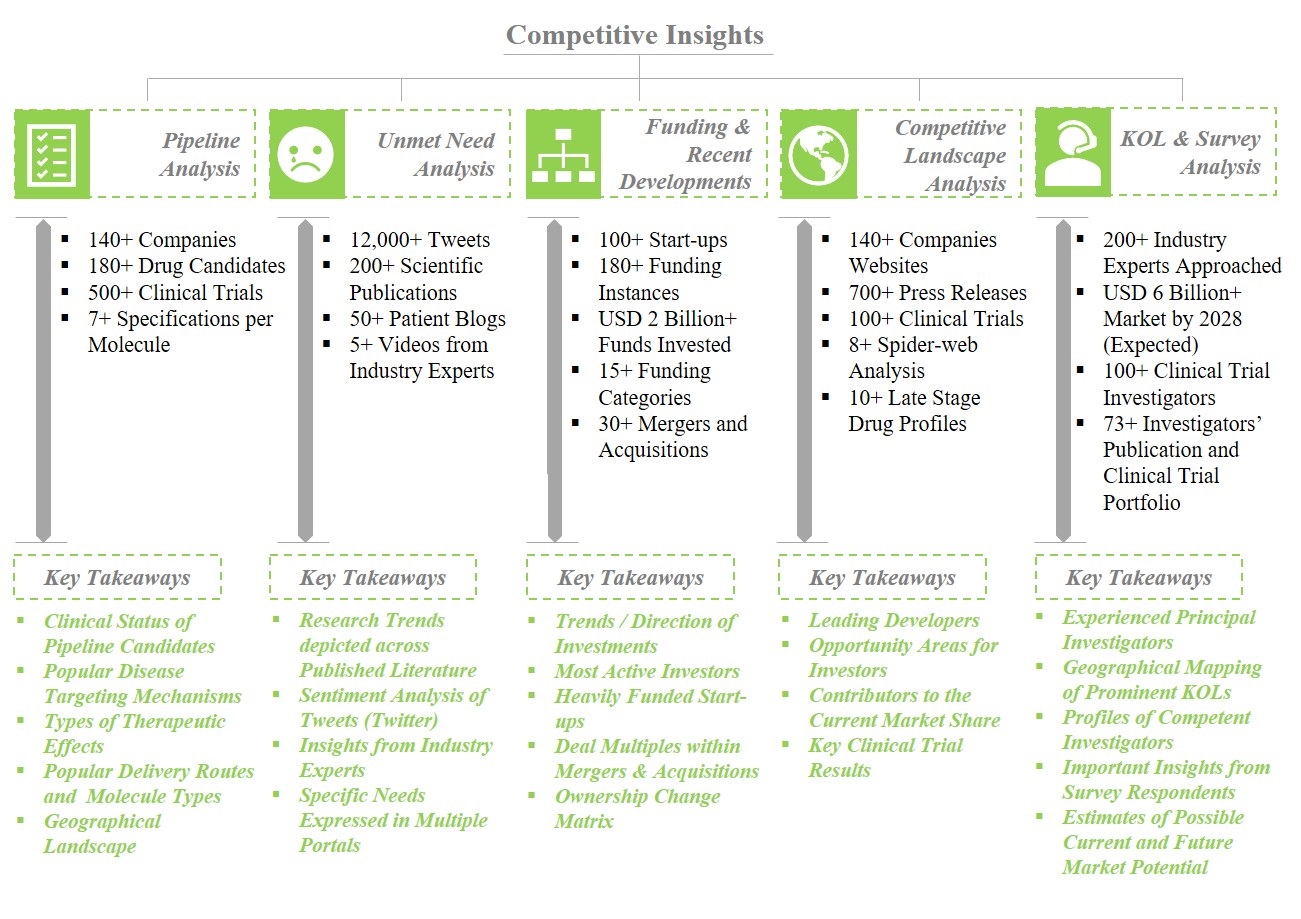
The “Parkinson’s Disease Market: Pipeline Review, Developer Landscape and Competitive Insights" report provides an extensive study on the marketed, clinical and preclinical molecules being investigated for the treatment of Parkinson’s disease. Figure 1 summarizes the scope of the report and the specific modules that have been covered in extensive detail.
Figure 1 Parkinson’s Disease: Scope and Competitive Insights
Amongst other elements, the report includes:
- A detailed assessment of the current market landscape of drugs being developed for the treatment of Parkinson’s disease, providing information on drug developer(s), phase of development (clinical, preclinical / discovery stage) of product candidates, type of molecule (small molecule, biologic or gene / cell therapy), treatment type (disease modifying agent, drugs offering symptomatic relief or drugs for curing the disease), mechanism of action, and route of administration.
- An in-depth analysis of the product pipeline and developer companies, featuring four schematic representations; these include [A] a heptagon representation highlighting the distribution of the marketed and development stage molecules based on their mechanisms of action, [B] a 2X2 grid analysis, representing the distribution of drug candidates across various molecule types and stages of development, [C] a funnel analysis highlighting the distribution of molecules (segregated by stage of development) based on route of administration and treatment type, and [D] a logo landscape of the various industry players involved in the development of drugs, distributed on the basis of location of headquarters and company size (small-sized, mid-sized and large).
- An analysis highlighting the key unmet needs across Parkinson’s disease, featuring insights generated from real-time data on unmet needs as identified from social media posts, recent publications, patient blogs and the views of key opinion leaders expressed on online platforms.
- Comprehensive profiles of drugs in phase III of clinical development, with information on the developer, specific target patient population, mechanism of action, clinical trials, current status of development, and recent developments (if available).
- An insightful competitive analysis, highlighting the key players in the domain on the basis of the strength of their development portfolio. For all companies that emerged as important players in this field, we have presented a five-dimensional spider web analysis, taking into account the company’s size, activity on Google Trends, stage of development of lead molecule, strength of the Parkinson’s disease pipeline and the (present) number of clinical trials being conducted by the player.
- A detailed analysis of the mergers and acquisitions that have taken place in this space, highlighting the trend in the number of companies acquired in the last few years, along with the geographical distribution of this activity. The analysis features an ownership change matrix and presents a financial evaluation of these deals (revenues and respective deal multiples) as well.
- A detailed analysis identifying the key opinion leaders (KOLs), featuring a 2X2 analysis to assess the relative experience of certain KOLs who were shortlisted based on their contributions (in terms of involvement in various clinical studies) to this field, and a schematic world map representation, highlighting the geographical locations of eminent scientists / researchers involved in the development of molecules in this domain.
- An analysis of the investments made at various stages of development in companies that are focused in this area, including seed financing, venture capital financing, debt financing, grants, capital raised from IPOs and subsequent offerings.
- A survey analysis featuring inputs solicited from various experts who are directly / indirectly involved in development of anti-Parkinson’s therapeutics.
The research, analysis and insights presented in this report is backed by a deep understanding of insights gathered from both secondary and primary sources. The opinions and insights presented in this study were influenced by inputs (through a comprehensive survey) of several key players in this domain. All actual figures have been sourced and analyzed from publicly available information forums and inputs from primary research. Financial figures mentioned in this report are in USD, unless otherwise specified.
You may also be interested in the following titles:
Angelman Syndrome Market
Tardive Dyskinesia Market
Demyelinating Polyneuropathy Market
