
Lowest Price Guaranteed
Pages
997
Last Updated
August 2026
View Count
22189
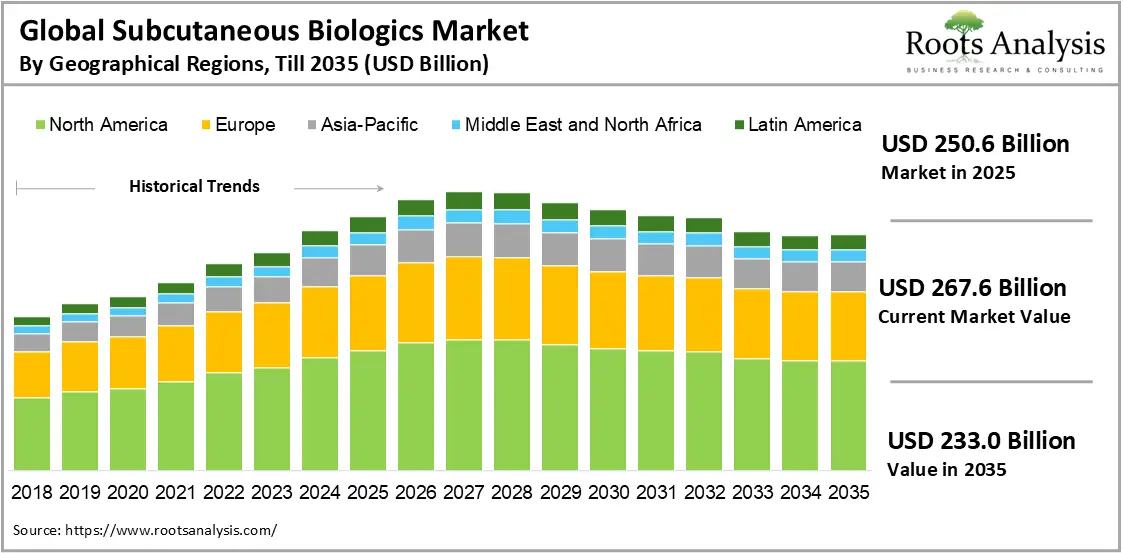
The global subcutaneous biologics market, valued at USD 250.6 billion in 2025, is projected to reach USD 267.6 billion in 2026 and USD 233.0 billion by 2035, during the forecast period 2026 to 2035. The long-term decline in value is primarily linked to patent expiry and revenue erosion across a number of currently marketed originator biologics, even as clinical activity, subcutaneous conversion programs and patient adoption continue to expand.
Kindly note that this report evaluates two distinct markets: the approved subcutaneous biologics market which captures product revenues from marketed therapies, while the separate subcutaneous formulation technology market captures the licensing and platform opportunity that enables subcutaneous delivery. The formulation technology market is projected to reach USD 2.7 billion by 2035. These two figures should be read and cited separately rather than combined.
To learn more about this report, request a free sample copy
| Key Report Statistics | Details | |
| Historical Trends | Since 2018 | |
| Forecast Period | Till 2035 | |
| Approved Subcutaneous Biologics Market Size 2035 | $ 233 Billion | |
| Formulation Technologies Market Size 2035 | $ 2.7 Billion | |
| Largest Approved-Biologics Region | North America | |
| Fastest Growing Region | Asia-Pacific | |
Subcutaneous biologics are gaining strategic importance as pharmaceutical and biopharmaceutical companies seek to move suitable therapies away from hospital-based intravenous administration toward more convenient injection-based formats. This trend is supported by the growing number of biologic therapies, including monoclonal antibodies and protein therapeutics, alongside continued innovation in formulation science and drug delivery.
Biologics present development and delivery challenges that are different from conventional small-molecule medicines. Their high molecular weight, structural complexity, susceptibility to degradation and manufacturing requirements can make high-concentration, low-volume subcutaneous formulation technically difficult. Developers are therefore using approaches such as conjugation, amino-acid interaction and encapsulation, together with autoinjectors, prefilled syringes, needle-free systems and large-volume wearable injectors, to make high-dose and high-viscosity biologics more suitable for subcutaneous administration.
The clinical case is also well established in chronic immune-mediated disease. Longstanding subcutaneous products such as Humira (adalimumab), Enbrel (etanercept) and Stelara (ustekinumab) helped establish the role of self-administered biologics in autoimmune and inflammatory disorders. Infliximab, historically associated with infusion-based administration, illustrates that conversion to the subcutaneous route depends on the molecule, formulation, dosing requirements and clinical context.
The opportunity is now broadening beyond autoimmune disease. Oncology, hematology, neurology and metabolic disease are becoming more important areas for subcutaneous development as companies evaluate faster administration, home-use potential and reduced facility burden. The recent expansion of subcutaneous antibody therapies and checkpoint-inhibitor conversions reflects this wider shift.
Digital health is increasingly embedded in the delivery-device layer. Connected autoinjectors, smart pen injectors and wearable technologies can support dose reminders, administration tracking and data sharing with healthcare providers, strengthening adherence monitoring for chronic therapies managed outside hospitals.
The subcutaneous biologics market also intersects with, but is distinct from, the biosimilars market. Biosimilar competition can affect the revenue trajectory of established originator biologics, but this report separately evaluates approved subcutaneous biologics and enabling formulation technologies rather than the broader biosimilars opportunity.
The report evaluates the subcutaneous biologics opportunities across product, technology, therapeutic and commercial dimensions. The structure is designed to support pharmaceutical and biopharmaceutical companies, investors, business-development teams, R&D teams, procurement functions and hospital or health-system stakeholders evaluating market opportunity, delivery strategies and potential technology partners.
This report is authored by Pemba Lahmo. The study was developed through a structured methodology combining secondary research, proprietary databases and primary stakeholder interviews. Secondary research included company disclosures, regulatory information, clinical-development sources, technology and partnership activity, and publicly available market data. Findings were triangulated across market sizing, approved and clinical-stage products, formulation technologies, delivery devices and regional adoption before finalization.
The opinions and insights presented in the market report were influenced by discussions held with stakeholders in the industry. The report features detailed transcripts of interviews held with the following industry stakeholders:
Commenting on this, Tony Bedford, Director of Front-End Innovation at Phillips Medisize, stated, "There is definitely a trend towards SC administration, which has been ongoing for some time. Of the top 10 selling drugs, eight are in a SC format; that in itself tells a story. The move towards SC reflects a combination of IV reformulation programmes and therapies that are designed for SC administration from the outset."
Antibodies currently occupy the highest share of the approved subcutaneous biologics market, reflecting their target specificity and extensive use across chronic immune-mediated and oncological indications. The nucleotides segment, though smaller today, is expected to witness substantial growth during the forecast period.
The global market for approved subcutaneous biologics is segmented across monotherapy, combination therapy, and both monotherapy and combination therapies. The both (monotherapies and combination therapies) category currently holds the largest market share and is expected to witness substantial growth during the forecast period.
The injection segment currently captures the majority of the approved subcutaneous biologics market, supported by its convenience for patients and healthcare professionals. For certain products, subcutaneous administration may reduce specific infusion-related burdens compared with intravenous administration; safety outcomes remain product-specific.
Autoimmune disorders currently occupy the highest share, supported by long-term use of subcutaneous biologics in rheumatoid arthritis, psoriasis, ankylosing spondylitis, ulcerative colitis and Crohn's disease. Metabolic disorders are expected to capture a larger share over the forecast period, driven by increasing use of subcutaneous administration in diabetes mellitus and obesity, where long-term therapy is common.
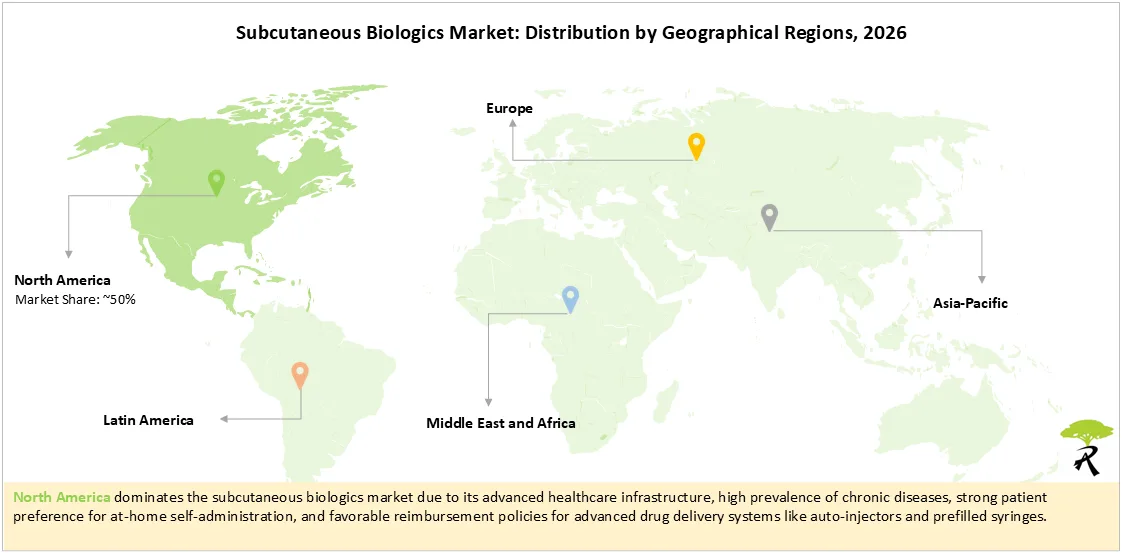
North America is likely to capture a majority share (~50%) in the overall market. The market in Asia-Pacific is expected to grow at a relatively higher CAGR, during the forecast period, till 2035 due to the rapidly growing patient population, rising incidence of chronic disorders (including neurological disorders, genetic disorders and autoimmune disorders), and the rising demand for effective and advanced therapeutics. The increasing investments and initiatives taken by regulatory bodies in the Asian countries to promote the adoption of biologics among patients and physicians is likely to drive the market in future.
Revenues generated through the licensing of encapsulation-based technologies currently account for the largest share and are expected to remain dominant during the forecast period. Encapsulation can improve the solubility of hydrophobic biologics, support absorption and help reduce systemic exposure through more controlled delivery.
Pharmaceutical and biopharmaceutical companies currently account for the largest share; however, biotechnology companies are expected to grow at a relatively higher CAGR during the forecast period.
Oncological disorders hold the largest share of the current formulation-technology market. For instance, the American Cancer Society estimated approximately 2.00 million new cancer cases in the US in 2024, increasing to approximately 2.04 million in 2025. The market for formulation technology for autoimmune disorders is estimated to grow at the highest CAGR, during the forecast period.
Based on payment method employed, the global subcutaneous formulation technology market is segmented into milestone payments and upfront payments. It is worth mentioning that milestone payments occupy the majority share in the current market and this trend is unlikely to change in the future.
The subcutaneous formulation technology market spans North America, Europe and Asia-Pacific. North America currently captures close to 65% of the market, while Asia-Pacific is expected to register the highest CAGR during the forecast period. Growth in Asia-Pacific is supported by an increasing number of regional technology developers entering licensing and development partnerships with drug developers.
The administration of biologics (and small molecules) via the subcutaneous route has emerged as a transformative approach to treat patients suffering from various diseases (specifically chronic diseases). This can be attributed to the fact that subcutaneous administration of drugs is relatively simple and can be self-administered by patients, making them suitable for home use. This reduces the need for healthcare professionals, which is often required for other routes of administration (including intramuscular and intravenous). Subcutaneous administration delivers medicine into the tissue beneath the skin, from which absorption is generally slower than direct intravenous administration. Its pharmacokinetic profile, efficacy and safety depend on the molecule, formulation, dose and patient characteristics.
During our research, we came across more than 150 unique subcutaneous biologics that are currently approved for the treatment of various therapeutic areas. More than 35 subcutaneous biologics have been approved post-2022. In May 2024, the European Commission granted EU marketing authorization for Novo Nordisk's Awiqli® (insulin icodec), a once-weekly basal insulin for adults with diabetes. Further, around 50% of the subcutaneous biologics approved are proteins; of which 30% are being used for the management of metabolic disorders, such as diabetes mellitus and obesity.
The current subcutaneous biologics market landscape features the presence of nearly 120 drug developers that have clinical-stage subcutaneous biologics in their pipeline. The landscape is well-fragmented, featuring the presence of small, mid-sized, large and very large companies having the required expertise to develop and commercialize these therapies. Further, more than 50% of the drug developers are headquartered in North America; notable examples (in alphabetical order) include Apellis Pharmaceuticals, Eli Lilly, Pfizer and TuHURA Biosciences.
Despite the advantages associated with the subcutaneous route, formulation constraints remain important. Subcutaneous injections are commonly limited by injection volume, viscosity and absorption variability across injection sites and patient characteristics. To address these challenges, developers are advancing formulation platforms based on encapsulation, hydrogel systems, liposomes and other lipid-based carriers, and nanoparticle approaches to improve solubility, stability, controlled release and delivery consistency for high-concentration biologics.
The current technology landscape features the presence of over 40 companies engaged in the development of subcutaneous formulation technologies. It is worth mentioning that around 20% of the technologies operate via encapsulation technology for the delivery of biologics and small molecules. Further, a number of these technologies are also used for the preparation of formulations that are intended for delivery via the intramuscular and intravenous routes.
Stakeholders involved in development of subcutaneous biologics have forged several partnerships with other stakeholders to drive technological advancements for the development of subcutaneous biologics, in order to support the safe, effective formulation and delivery of highly-viscous biologics. These include technology licensing agreements, technology evaluation agreements, research and development agreements and product development and commercialization agreements. It is worth highlighting that multiple agreements were forged in the past three years. Recently, in May 2024, Serina Therapeutics entered into an agreement with Enable Injections for the development and commercialization of SER-252 (POZ-apomorphine) using the latter company's enFuse wearable drug delivery platform for the treatment of Parkinson's disease.
Subcutaneous drug delivery systems have evolved significantly in recent years, offering a range of advantages over traditional administration routes. Various drug delivery platforms, such as large volume injectors, autoinjectors, pen-injectors, needle-free injection systems, drug reconstitution systems and prefilled syringes aim to enhance patient convenience and medication adherence. Within the wearable injectors domain, on-body injectors can enable controlled administration over a defined period, depending on the device and prescribed therapy. In addition, large volume wearable injectors have been proven to improve medication adherence by simplifying the administration process. Further, autoinjectors are spring-loaded syringes working on various mechanisms (ranging from simple push-on-skin devices to fully automated button activated technologies) and include pre-measured medication, which eliminates the need to draw medication from a separate vial, thus resolving various injection-related compliance issues faced by the patients.
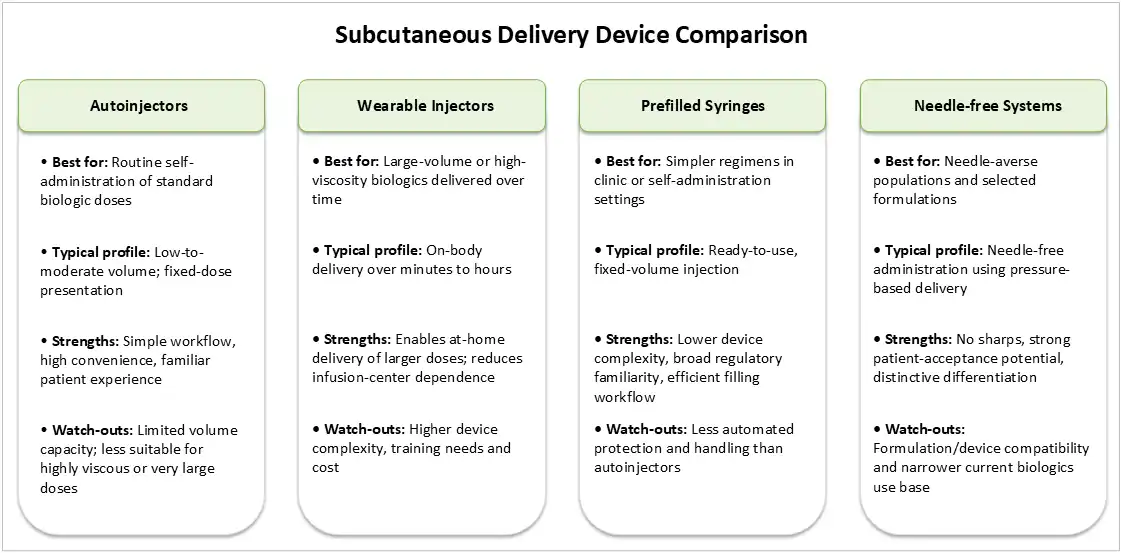
Prefilled syringes are another type of primary packaging system that are pre-loaded with a precise dose of parenteral medication (in a ready to inject format), eliminating the need for manual filling. Presently, different types of prefilled syringes are available in the market, including dual chamber prefilled syringes (such syringes store liquid and lyophilized components in different chambers), flush syringes, and safety syringe and safety needles (syringes equipped with mechanisms that prevent needlestick injuries and ensure safety of the healthcare worker).
Over the years, there has been an increased trend towards smart drug delivery devices, including connected autoinjectors and smart pen injectors. These devices allow for the tracking of medication administration, dose reminders, and data sharing with healthcare providers, ultimately improving patient adherence and management of chronic conditions.
The shift from intravenous infusion to subcutaneous administration can alter the total cost of care by reducing infusion-center utilization, nursing time and chair-capacity requirements. As a result, payer coverage, reimbursement pathways and formulary decisions increasingly influence the adoption of subcutaneous alternatives alongside clinical efficacy, safety and convenience.
For hospitals and health systems, suitable subcutaneous therapies can also support site-of-care optimization by shifting treatment from infusion centers toward outpatient or self-administration settings. Procurement teams, specialty pharmacies and home-care providers therefore evaluate drug-acquisition cost alongside administration burden, patient training, adherence support and the broader operational impact of moving treatment outside facility-based infusion.
Examples of key players engaged in development of subcutaneous biologics or formulation technologies (have been profiled in full report, arranged in alphabetical order) include Adocia, Alteogen, Ascendis Pharma, CD Bioparticles, Creative Biolabs, Creative BioMart, Foresee Pharmaceuticals, Pacira Biosciences, The Wyss Institute, and Xeris Biopharma. Full list of technology developers captured is available in the report. Kindly note that Roots Analysis is an independent market research and consulting firm. Company names and product brands referenced in this report are included solely for factual, market-sizing and competitive-analysis purposes. Roots Analysis is not affiliated with, endorsed by or sponsored by any company, regulator or individual named, profiled or quoted in this report.
Alongside the core market report, clients receive complimentary Excel data packs covering market landscape for approved subcutaneous biologics, approved subcutaneous biologics success protocol analysis, market landscape for clinical subcutaneous biologics, subcutaneous formulation technology landscape, technology competitiveness analysis, partnerships and collaborations (subcutaneous formulation technology), approved subcutaneous biologics market forecast and opportunity analysis, subcutaneous biologics market forecast and opportunity analysis for formulation technologies. A complimentary PowerPoint presentation summarizing the full report is also included, and 15% free customization scope is available on request.
Roots Analysis is an independent secondary and primary market research publisher. This report is not affiliated with, endorsed by, or produced on behalf of any company named or profiled within it, including all key players, CDMOs, and industry expert interviewees referenced above.
Roots Analysis' findings draw on a combination of secondary research and primary interviews with industry experts, of the kind referenced above, to validate market sizing, segment shares, and forecast assumptions independently of any single company's disclosures.