


 Download Free Sample
 Buy Now
Market Size
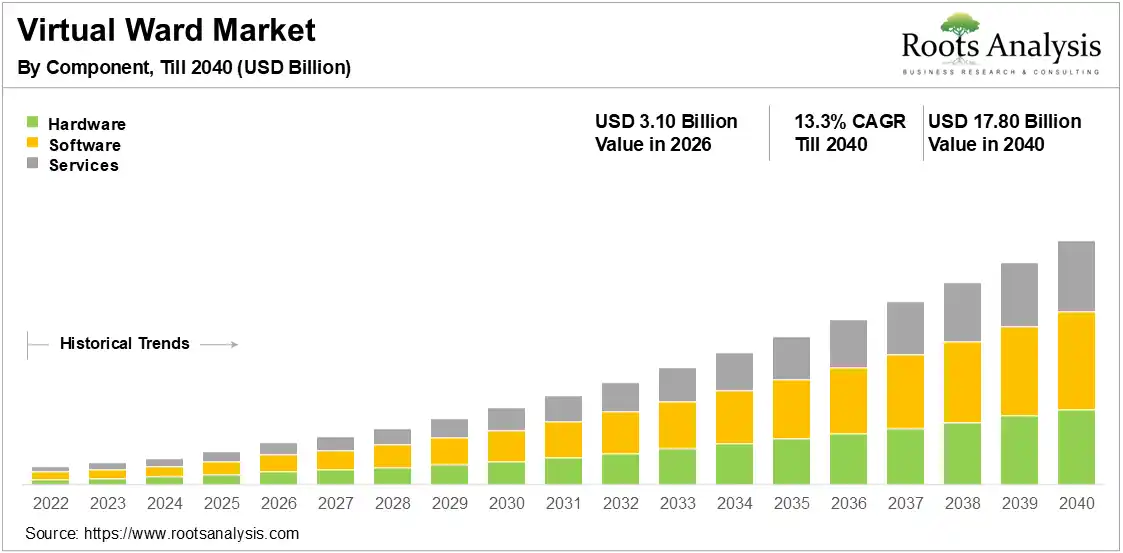
The global virtual ward market is expected to rise from USD 3.10 billion in 2026 to reach USD 17.80 billion by 2040, growing at a CAGR of 13.3% over the forecast period 2026 to 2040, driven by hospital capacity pressure, remote monitoring maturity, and payer support for hospital-at-home models.
See What’s in the Full Report – Request Your Complimentary Insights!
Market Report: Key Takeaways
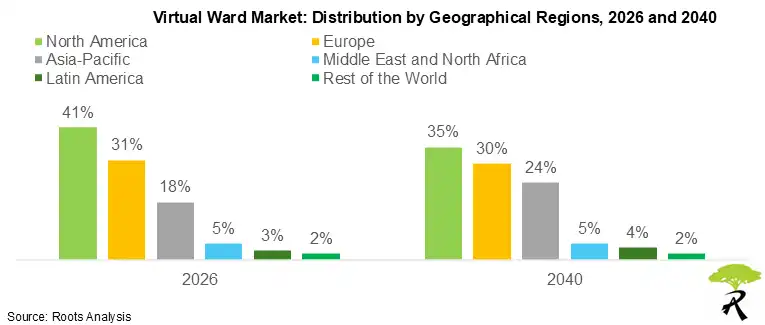
- Based on geography, North America captures 41.4% market share in 2026, whereas Asia-Pacific registers a 15.6% CAGR through 2040, driven by digitalization and hospital-capacity localization.
- Based on component, Software captures 40.0% market share in 2026, whereas Services registers a 14.3% CAGR through 2040, driven by outsourced monitoring and workflow operations.
- Based on service type, Chronic Disease Management captures 31.0% market share in 2026, whereas Acute Care at Home registers a 15.0% CAGR through 2040, driven by admitted-care substitution.
- Based on patient demographics, Adults capture 55.0% market share in 2026, whereas Senior Citizens register a 15.0% CAGR through 2040, driven by frailty and multimorbidity demand.
- Based on application, Cardiology captures 24.0% market share in 2026, whereas Geriatric Care registers a 15.5% CAGR through 2040, driven by frailty-focused hospital avoidance.
- Based on end user, Hospitals capture 47.0% market share in 2026, whereas Home Healthcare Providers register a 15.8% CAGR through 2040, driven by home-based care delivery expansion.
Virtual Ward Market Outlook
Virtual wards are moving from pilot capacity relief into scaled, bed-substitution infrastructure across hospital systems. Early demand centered on remote patient monitoring platforms for selected chronic pathways, but current adoption now covers acute care at home, virtual nursing services, care coordination software, and clinical command center workflows. Hospital bed pressure, staff shortages, and discharge delays are pushing providers toward connected medical devices and home-based hospital care.
Policy support is accelerating current virtual ward market growth because reimbursement and urgent-care planning now recognize admitted-level care outside hospital walls. CMS confirmed Acute Hospital Care at Home waiver flexibilities through September 30, 2030, materially strengthening payer confidence in hospital at home care models. Doccla supported NHS Greater Glasgow and Clyde’s 1,000 virtual beds in April 2025.
Through 2040, adoption will remain high growth as platforms combine wearable vital signs monitoring, EHR integration, and escalation workflows. Competitive advantage will shift from device supply toward service reliability, data routing, and clinician adoption. Medway NHS Foundation Trust launched a Feebris digital platform in June 2025 to scale its SMART virtual hospital model. The outlook remains positive, but execution quality will separate winners.
Virtual Ward Market Dynamics
Virtual Ward Market Drivers
Hospital capacity pressure is pushing virtual wards from optional pilots into planned capacity infrastructure. CMS extended Acute Hospital Care at Home waiver flexibilities through September 30, 2030, supporting North American reimbursement visibility. NHS England’s June 2025 urgent-care plan asked systems to optimize virtual ward capacity. These policy signals support the virtual ward market forecast and strengthen hospital procurement confidence.
Virtual Ward Market Restraints
Integration burden restrains adoption because virtual wards depend on reliable EHR links, device logistics, escalation rules, and clinical governance. Hardware loses share from 31.0% in 2026 to 24.0% in 2040 because standalone devices cannot solve workflow friction. Hospitals also need command-center staffing and patient onboarding capability. Vendors with monitoring services, implementation teams, and interoperable software will overcome access barriers faster than device-only suppliers.
Virtual Ward Market Opportunities
Acute care at home creates the clearest commercial opening because it will grow at 15.0% CAGR through 2040. The model converts hospital bed pressure into demand for remote patient monitoring platforms, connected medical devices, and care coordination software. The September 2025 Donegal CARE Virtual Ward evaluation reported 934 bed days avoided, fewer COPD admissions, fewer readmissions, and savings above EUR 4.2 million.
Virtual Ward Market Challenges
Clinical accountability remains the hardest scaling challenge because home-based hospital care still requires inpatient-level escalation discipline. Senior citizens will post 15.0% CAGR through 2040, driven by frailty and multimorbidity demand. The British Geriatrics Society highlighted Hospital at Home for older people with frailty in August 2025. Providers must balance risk scoring, caregiver support, and staffing availability before expanding high-acuity pathways.
Virtual Ward Market Size Estimation Methodology
- As a starting point, the forecast consolidated direct virtual ward estimates from multiple credible secondary sources. Broader hospital at home and virtual ward management figures were treated as upper-bound checks, because those scopes include wider inpatient-substitution services. The working scope retained remote patient monitoring platforms, connected medical devices, virtual nursing services, care coordination software, hardware, software, and services.
- Moving forward, the market model used hospital utilization signals to test whether reported growth matched operational demand. Relevant inputs included virtual ward beds, patients onboarded, avoided bed-days, COPD admission reductions, and CMS Acute Hospital Care at Home program continuity. These indicators helped align the virtual ward market forecast with real capacity relief rather than software adoption alone.
- Building on this, each segment was sized through share allocation across geography, component, service type, patient demographics, application, and end user. Segment shares reflected where procurement responsibility sits, including hospitals, home healthcare providers, government healthcare agencies, patients, clinics, insurers, and software vendors. CAGR assumptions were then adjusted by segment maturity, reimbursement visibility, pathway readiness, and operational cost.
- Drawing upon these, the competitive set was validated against company-level evidence across patient apps and hospital-at-home platforms. Additional checks covered clinical dashboards, cloud infrastructure, device connectivity, and remote monitoring solutions. Vendors were grouped by market role rather than revenue size alone. This step separated full virtual ward platform providers from device suppliers, telehealth infrastructure providers, and workflow specialists.
- The projected value was then stress-tested against adoption curves for acute care at home, chronic disease management, and virtual nursing. Application checks covered cardiology, pulmonology, oncology, geriatric care, orthopedics, neurology, and general medicine. Faster growth was assigned where clinical pathways show repeat monitoring value and clear bed-avoidance economics. Slower growth was applied where workflow complexity, staffing limits, or narrow pathway applicability constrain deployment.
- Finally, the forecast was reviewed for consistency across annual growth, regional share migration, and segment-level CAGRs. North America and Europe were modeled as larger early adopters. Asia-Pacific, Latin America, and Middle East and Africa gained share through digital hospital expansion. The final methodology kept one logical level per segmentation dimension to avoid double counting across technologies, services, and users.
Virtual Ward Market Share Insights
Market Share by Component
According to our analysis, Software leads because virtual wards require dashboards, EHR links, escalation rules, and workflow orchestration. In August 2025, Doccla partnered with South West London ICB on virtual wards, care homes, devices, and EHR integration.
Services will expand fast as providers outsource monitoring, kit logistics, onboarding, and escalation support. In April 2025, Doccla supported NHS Greater Glasgow and Clyde’s first 1,000 virtual beds.
Market Share by Application
Cardiology leads because heart-failure, arrhythmia, and post-event pathways use frequent vitals and medication review. Doccla and Happitech, August 2025, launched remote atrial-fibrillation monitoring using smartphone-based cardiac monitoring.
Geriatric Care will expand fastest as virtual wards become frailty and admission-avoidance infrastructure. British Geriatrics Society, August 2025, described Hospital at Home as a core model for frailty care.
Want Information on Specific Region / Segment?
Regional Analysis: North America Leads the Market and Asia-Pacific is Likely to Register Higher CAGR
Presently, North America leads because hospital systems have mature capital access, enterprise IT, and payer-linked innovation channels. The region also benefits from regulatory continuity around inpatient-level care delivered at home.
On the contrary, Asia-Pacific will grow fastest as hospitals digitize capacity management and localize care delivery outside facilities. Demand will rise across aging societies, high-density cities, and systems facing hospital-bed shortages.
Market Ecosystem Analysis
The scoped ecosystem concentrates commercial weight in 21 established companies: 12 Tier 1 leaders and nine Tier 2 specialists. Five emerging entrants target gaps in sensors, digital pathways, patient engagement and AI-enabled hospital-at-home workflows. Platform convergence dominates because EHRs, device-data platforms, telehealth vendors and cloud providers now compete around monitored home care.
- Doccla launched Virtual Ward Plus with Lewisham Health and Care Partnership in March 2026 for asthma and COPD residents. The move raises the service bar from remote monitoring to clinical monitoring, health coaching, medicines optimisation and prescribing. It strengthens Chronic Disease Management, Pulmonology and adult senior pathways for NHS hospital and government buyers.
- Inhealthcare partnered with Leeds Children’s Hospital in May 2025 to launch virtual wards for paediatric oncology patients. The pathway allows earlier discharge while specialist teams review daily information submitted by parents through a smartphone app. It pressures generic providers to support paediatric oncology governance and strengthens Children, Oncology and Hospitals segments.
- Clinitouch documented Leicester’s diabetes virtual ward in August 2025, covering Type 1 and Type 2 diabetes after acute contact. Its app captures glucose, blood pressure, weight and symptoms, then risk-scores updates for same-day escalation. This strengthens General Medicine and Chronic Disease Management while raising the pathway-configuration bar for Tier 2 specialists.
- Validic integrated wearable activity data into Epic and Oracle Health workflows in January 2025. The integration adds daily insights from more than 350 wearable models into patient records. It lowers bring-your-own-device friction and strengthens Software, Hardware and Preventive Care for RPM-enabled virtual wards.
- AWS and Validic published a September 2025 connected care architecture linking more than 600 devices with EHR workflows. Validic Impact uses Amazon Bedrock for care plans and dashboards, while AWS supports scalable health data processing. This strengthens cloud infrastructure, Software and Chronic Disease Management for multi-device virtual ward operations.
- Oracle Health launched a medical device validation program in February 2026 to standardize connectivity, functionality and workflow alignment. The framework supports continuous monitoring, spot checks, alarms and waveforms across connected care settings. It raises procurement barriers for unvalidated devices and strengthens Hospital, Hardware and Acute Care at Home segments.
- Current Health returned to founder control in June 2025 after Best Buy divested the care-at-home business. The transaction exposed pressure on retail-owned hospital-at-home models under scaling and reimbursement uncertainty. It strengthens specialist positioning in Acute Care at Home and North American hospital programs.
- Caregility raised $25.1 million in September 2025, led by Star Mountain Capital, for AI and sensor-based virtual care. Its platform supports virtual nursing, e-sitting, hospital-at-home and specialty consults across 1,500 hospitals and 75 health systems. The funding raises the workforce-relief benchmark and strengthens Virtual Nursing Services, Hospitals and Home Healthcare Providers.
- Caregility partnered with MOD3RN Care in November 2025 to distribute its platform and edge AI devices across Australia. The partnership supports inpatient, outpatient, long-term care and home settings through localized deployment. It strengthens Asia-Pacific, Virtual Nursing Services and Acute Care at Home for workforce-constrained health systems.
Startup Companies and their Key Highlights
- Isla Health
- Event type: European headquarters launch in Ireland.
- Month and year: April 2026.
- Strategic partner name: Irish government through IDA Ireland.
- Stated purpose of the event: Take Isla’s Digital Pathway Platform beyond the UK into broader European and global markets.
- Market implication: Accelerates Europe, Software and Care Coordination Services through local R&D and customer success capacity.
- Vivalink
- Event type: Acute remote care patient survey publication.
- Month and year: June 2026.
- Stated purpose of the event: Examine patient sentiment around acute care at home and remote patient monitoring.
- Market implication: Accelerates Hardware and Acute Care at Home because adoption depends on comfortable wearables and active oversight.
- myPatientSpace
- Event type: Irish Healthcare Awards 2025 recognition and CARE Virtual Ward presentation.
- Month and year: November 2025.
- Market implication: Accelerates Europe, Software and Pulmonology virtual wards because Letterkenny’s CARE Virtual Ward used the platform.
- Datos Health
- Event type: Recognition as one of TIME’s World’s Top HealthTech Companies of 2025.
- Month and year: September 2025.
- Market implication: Strengthens Software, Chronic Disease Management and Post-Operative Care through hybrid remote care and AI-enabled monitoring.
Virtual Ward Market Trends / Opportunities
Virtual Ward Market Scaling from Beds to Virtual Hospitals Strengthening Platform Procurement
Virtual ward programs are shifting from single discharge pathways toward managed capacity networks. In May 2026, HSE reported six active regions and more than 3,000 supported patients since 2024. This scale favors vendors that can support multiple sites, device logistics, monitoring protocols, and clinical escalation.
Bed-day recovery is becoming a core commercial proof point for hospital buyers. In June 2026, NHS England South East said Medway saved almost 5,000 bed days in three months. Providers can use those results to justify larger virtual-bed procurement and executive-level funding
Integrated Remote Monitoring and EHR Workflows Raising Switching Costs
Workflow integration is becoming the main differentiator for remote patient monitoring platforms. In August 2025, Doccla covered virtual wards, care homes, devices, and EHR integration with South West London ICB. Integrated platforms will gain share because hospitals prefer fewer handoffs across patient apps, dashboards, and escalation teams.
Procurement consolidation is tightening access for vendors that lack managed-service depth. In November 2025, HSE tendered for one vendor-managed national remote health monitoring supplier. The scope covered virtual wards and chronic disease pathways. This trend rewards providers with service capacity, not only software features.
Virtual Ward Market Expansion into Specialist Pathways Opening Disease-Specific Growth
Specialist pathways are widening the addressable base beyond adult general medicine. In May 2025, Inhealthcare and Leeds Children’s Hospital launched cancer virtual wards using parent-submitted daily app updates. Disease-specific workflows create openings for vendors with configurable clinical content and caregiver engagement tools.
Cardiology and frailty pathways are raising demand for disease-specific monitoring logic. In August 2025, Doccla and Happitech launched remote atrial-fibrillation monitoring using smartphone-based cardiac monitoring. Vendors that combine vital signs, risk scoring, and pathway templates can defend stronger clinical positioning.
Your Business is Unique – Why Shouldn’t Your Report Be?
Market Access Considerations
National Procurement and Managed Service Capability
National procurement models can compress supplier choice and raise qualification requirements. HSE’s November 2025 tender sought one vendor-managed national remote health monitoring supplier for virtual wards and chronic disease pathways. Centralized buying favors companies with service coverage, security controls, implementation resources, and evidence across multiple regions. Smaller specialists may need partnerships to compete. Tender scale also makes reference sites and implementation proof commercially decisive. This favors established platform operators over pilots.
EHR Integration and Device Logistics
EHR integration and kit logistics shape commercialization speed more than device availability alone. Doccla’s August 2025 South West London work covered virtual wards, care homes, devices, and EHR integration. That behavior shows buyers want joined-up workflows from patient onboarding to clinical review. Vendors with interoperable software and managed device logistics can scale across pathways faster. Integration depth also protects incumbents from lower-cost device challengers.
Clinical Governance and Escalation Ownership
Clinical governance limits access because virtual wards move hospital risk into patient homes. NHS England’s June 2025 urgent-care plan asked systems to optimize virtual ward capacity, making escalation discipline part of operational planning. Hospitals will favor suppliers that support triage protocols, command-center workflows, audit trails, and clinician oversight. Weak governance tools reduce trust in high-acuity expansion. This raises commercialization costs for vendors entering acute care at home.
Reimbursement Continuity for Hospital-at-Home Care
Reimbursement continuity determines whether hospitals treat home-based inpatient care as a strategic line item. CMS extended Acute Hospital Care at Home waiver flexibilities through September 30, 2030, which supports North American procurement visibility. Clear payment pathways enable larger programs, longer contracts, and platform standardization. Vendors without reimbursement evidence will face slower conversion in hospital budget cycles. This factor also shapes investor confidence in recurring virtual ward revenue and channel partnerships.
How Stakeholders Benefit from the Key Focus Areas of Our Virtual Ward Market Report
Hospital capacity pressure makes virtual wards commercially urgent because admitted-care demand now extends beyond hospital walls. The report links segment shares, CAGRs, pathway adoption, and vendor roles to practical decisions on investment, procurement, partnership, and platform design. It also clarifies where reimbursement, governance, and integration shape defensible growth.
- Unmet Needs and Market Gaps in Virtual Ward Market: The report identifies where capacity gaps remain hardest to solve. Priority areas include acute care at home, chronic disease management, virtual nursing, and geriatric care. Hospital executives can use these gaps to prioritize pathways with measurable bed-day relief. Product teams can align patient apps, connected medical devices, and escalation dashboards with the highest-friction workflows.
- Funding and Venture Investment Opportunities in Virtual Ward Market: The report shows which segments support venture-scale expansion. Services will grow at 14.3% CAGR, while home healthcare providers will grow at 15.8% CAGR through 2040. Investment committees can compare platform-led, service-led, and device-enabled models before allocating capital. This supports decisions on minority investments, acquisition targets, and partnership-led market entry.
- Technology Innovation and Adoption Trends: The report tracks adoption across remote patient monitoring platforms, EHR integration, wearable vital signs monitoring, clinical command centers, and smartphone-based cardiac monitoring. Technology leaders can see where innovation is moving from hardware supply toward workflow orchestration. This supports decisions on product roadmaps, integration priorities, cybersecurity review, and build-versus-partner strategy.
- Virtual Ward Market Competitive Landscape and Industry Analysis: The report maps Doccla, Current Health, Philips, GE HealthCare, Masimo, Oracle, Microsoft, AWS, Medtronic, and specialist vendors by role and tier. Commercial leaders can compare platform breadth, managed-service capability, device connectivity, and cloud infrastructure depth. This supports decisions on competitive positioning, sales messaging, channel strategy, and account prioritization.
- Mapping Strategic Partnerships and Ecosystem Synergies: The report identifies where partnerships help vendors cross implementation barriers, including virtual-bed deployment, EHR integration, care-home support, and national monitoring services. Business development teams can use this ecosystem view to find complementary platform, cloud, device, and consulting partners. This supports decisions on alliance targets, joint bids, and regional commercialization.
- Virtual Ward Market CAGR and Growth Trends: The report explains the 13.3% market CAGR alongside faster segments. These include Asia-Pacific at 15.6%, geriatric care at 15.5%, and acute care at home at 15.0%. Planning teams can separate mature early-adopter regions from faster-growth expansion markets. This supports decisions on forecast assumptions, sales territory design, pricing strategy, and long-range capacity planning.
Virtual Ward Market: Scope of the Report
| Key Report Attributes | Details | |
| Forecast Period | Till 2040 | |
| Market Size 2026 | USD 3.10 Billion | |
| Market Size 2040 | USD 17.80 Billion | |
| CAGR (Till 2040) | 13.3% | |
| Segments Covered |
|
|
| Geographical Regions Covered |
|
|
| Key Sections Covered |
|
|
Market Segmentation
The Virtual Ward Market report presents an in-depth analysis, highlighting the capabilities of various stakeholders, based on different segments, such as component, service type, patient demographics, application, end user, geographical regions, and leading players.
By Component
- Hardware
- Software
- Services
By Service Type
- Chronic Disease Management
- Post-Operative Care
- Preventive Care
- Acute Care at Home
- Virtual Nursing Services
- Care Coordination Services
By Patient Demographics
- Children
- Adults
- Senior Citizens
By Application
- Cardiology
- Neurology
- Pulmonology
- Oncology
- Orthopedics
- General Medicine
- Geriatric Care
By End User
- Patients
- Hospitals
- Clinics
- Home Healthcare Providers
- Insurance Companies
- Government Healthcare Agencies
By Geographical Regions
- North America
- US
- Canada
- Mexico
- Rest of North America
- Europe
- Austria
- Belgium
- Denmark
- France
- Germany
- Ireland
- Italy
- Netherlands
- Norway
- Russia
- Spain
- Sweden
- Switzerland
- UK
- Rest of Europe
- Asia-Pacific
- China
- India
- Japan
- Singapore
- South Korea
- Rest of Asia-Pacific
- Latin America
- Argentina
- Brazil
- Chile
- Colombia
- Venezuela
- Rest of Latin America
- Middle East and Africa (MEA)
- Egypt
- Iran
- Iraq
- Israel
- Kuwait
- Saudi Arabia
- UAE
- Rest of MEA
- Rest of the World


