
Lowest Price Guaranteed
Pages
702
Last Updated
September 2026
View Count
5771
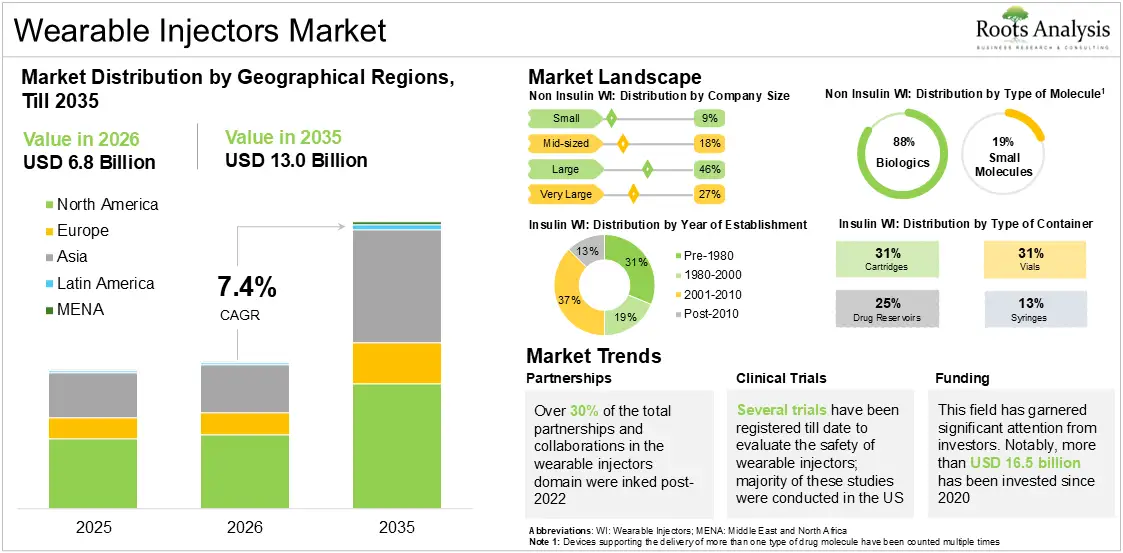
The global wearable injectors market, valued at USD 6.5 billion in 2025, is projected to reach USD 6.8 billion in 2026 and USD 13.0 billion by 2035, representing a CAGR of 7.4% during the forecast period 2026 to 2035. The total market combines two clinically and commercially distinct segments: wearable injectors used for insulin delivery and wearable injectors used for non-insulin drugs. The insulin segment is centered on diabetes management and continuous or automated insulin delivery, while the non-insulin segment spans oncology, cardiovascular, autoimmune, neurological and other therapeutic areas. These two segments should be interpreted separately when discussing device type, automation, therapeutic use and regional adoption.
To learn more about this report, request a free sample copy
The wearable injectors market is expanding as chronic disease prevalence rises, and healthcare systems place greater emphasis on self-administration, home-based care and treatment adherence. Diabetes, cancer, autoimmune disorders and cardiovascular disease often require repeated or sustained dosing, creating demand for delivery systems that can reduce dependence on hospital or infusion-center visits.
Wearable injectors, including patch pumps and on-body delivery systems, can provide sustained basal, bolus or continuous dosing while allowing patients to remain mobile during administration. For large-volume biologics, the category is particularly relevant where conventional syringes or short-duration devices become impractical. Autoinjectors should be treated as a distinct self-injection category: they are generally designed for shorter, single-dose administration, whereas wearable injectors and patch pumps are better suited to prolonged, repeated or larger-volume delivery.
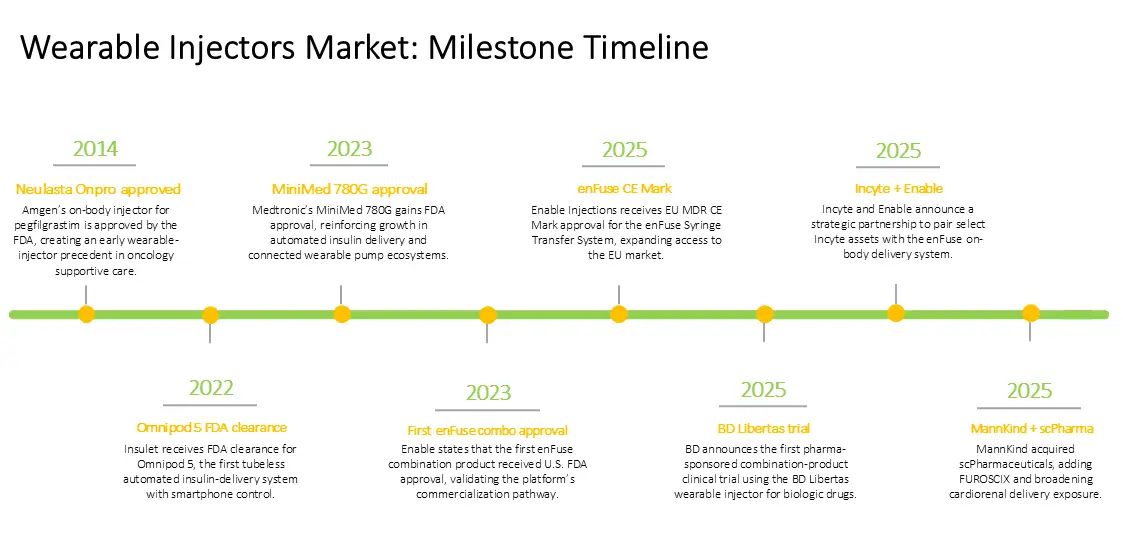
Commercial momentum is increasingly visible. In July 2025, BD announced the first pharma-sponsored combination-product clinical trial using the BD Libertas wearable injector for subcutaneous delivery of complex biologics, signaling broader pharmaceutical interest in large-volume, patient-ready systems for home and outpatient use.
Device engineering is also evolving. Spring-based mechanisms use stored mechanical energy to drive delivery at a controlled rate, while motor-driven systems, including rotary-pump architectures, can support more programmable infusion profiles. Reservoir design has become increasingly important because many high-concentration biologics require larger fill volumes and higher viscosity handling than standard self-injection devices.
Human factors and usability engineering are central to development because patients may operate these systems independently at home. Device developers must demonstrate that intended users across relevant ages, dexterity and experience ranges can prepare, activate and complete delivery safely and consistently. These requirements add development time and cost but are critical for regulatory acceptance and real-world adoption.
The regulatory environment is global. In addition to US FDA requirements for medical devices and drug-device combination products, developers seeking European market access must consider European regulatory requirements, including EMA requirements for the medicinal product component and applicable medical-device requirements. This reinforces the importance of integrated regulatory, human-factors and engineering expertise.
The market landscape is highly competitive and features the presence of established medical devices and pharmaceutical companies offering broad wearable injector portfolios across various drug delivery formats. Kindly note that the company names and product brands are referenced solely for market analysis and competitive landscape purposes. Their inclusion does not imply affiliation, endorsement or sponsorship by Roots Analysis.
| Company | Year of Establishment | Headquarters | Company Type | Device Name | Type of Device | Compatibility with High-Viscosity Drugs | Primary Focus |
| Becton Dickinson (BD) | 1897 | US | Global medical technology company | BD Libertas™ Wearable Injector | Patch Pump | Yes | Medical devices, diagnostics, laboratory equipment, biologics delivery |
| Enable Injections | 2010 | US | Healthcare technology company | enFuse™ | Patch Pump | Yes | On-body drug delivery for biologic therapies, high-volume medications |
| Insulet | 2000 | US | Global medical device company | Omnipod DASH Insulin Management System and Omnipod 5 | Patch Pump | No, compatible with specified rapid-acting U-100 insulins only | Diabetes management, chronic disease technologies |
| West Pharmaceutical Services | 1923 | US | Global pharmaceutical packaging provider | ULTOMIRIS (ravulizumab-cwvz) smartdose Injector | Patch Pump | Yes | Injectable drug administration, containment & delivery components |
| Ypsomed | 1984 | Switzerland | Medical technology company | YpsoDose, and mylife YpsoPump | Patch Pump and Infusion Pump | No | Self-medication injection/infusion systems, chronic disease management |
The report is structured to support pharmaceutical and medical-device companies, investors, business-development and R&D teams, procurement functions, payer and reimbursement stakeholders, and other decision-makers evaluating the wearable injectors opportunity. Based on the research, we have segmented the wearable injectors market into type of device, degree of automation, usability, therapeutic area, and geographical regions.
The rising burden of diabetes, cancer, rheumatoid arthritis, cardiovascular disease and other chronic conditions is increasing demand for devices that can support repeated dosing outside traditional care settings. Smart Insulin Pens bring connectivity to pen-based delivery by recording dose information and supporting data-informed diabetes management. Wearable injectors can reduce treatment disruption, support home administration and improve adherence for therapies that otherwise require frequent injections or infusion-center visits.
High device cost and uneven reimbursement remain important barriers, particularly in emerging markets and for patients with limited insurance coverage. Wearable injectors also face complex regulatory pathways because they combine device performance, drug compatibility and real-world usability requirements. Human-factors validation, software or connectivity features, and combination-product development can increase timelines and development expenditure.
Wearable systems are becoming smaller, more connected and easier to use. Bluetooth, Wi-Fi and companion applications can support dose tracking, reminders and remote data sharing. In diabetes, systems such as Omnipod 5, MiniMed 780G and Tandem Mobi increasingly integrate glucose-sensor data with automated insulin delivery. For non-insulin biologics, device innovation is focused on large-volume reservoirs, high-viscosity compatibility, hands-free administration, controlled delivery rates and simpler patient activation.
Amgen's Neulasta Onpro on-body injector is a well-established precedent for the oncology use case. The system enables pegfilgrastim administration after chemotherapy without requiring a separate next-day clinic visit, illustrating the category's core value proposition: replacing a facility-based administration step with timed, on-body delivery. As additional monoclonal antibodies and other complex biologics move toward subcutaneous administration, wearable delivery systems may become relevant to a broader set of oncology and immunology programs.
The findings and opinions presented in this report were informed by secondary research and discussions with nine industry stakeholders spanning small, mid-sized, large and very large organizations in the US, Denmark, Israel and Switzerland. The interview panel includes chief executive officers, a former president and CEO, a vice president and chief scientist, a former vice president and general manager for biologics, an engineering project manager / senior systems engineer, a vice president of marketing and alliance management, and one anonymous participant. Discussions with multiple stakeholders in this domain influenced the opinions and insights presented in this study. The wearable injectors market report includes transcripts of the following other third-party discussions:
Commenting on this, Michael D. Hooven (CEO of Enable Injections), stated that, "By continuing to collaborate closely with our pharmaceutical partners, we remain steadfast in our mission to improve the lives of patients and caregivers through our wearable enFuse technology, minimizing disruption to their daily lives."
Kindly note that Roots Analysis is an independent market research and consulting firm and is not affiliated with, endorsed by or sponsored by Becton Dickinson, Enable Injections, Insulet, West Pharmaceutical Services, Ypsomed, Medtronic, Tandem Diabetes Care, MannKind, scPharmaceuticals, Incyte, Abbott or any other company or individual named or quoted in this report. Named quotes and stakeholder interviews are included solely for factual and analytical context.
The insulin wearable injectors market is categorized primarily into patch pumps and infusion pumps. Infusion pumps account for the large majority of the current market, reflecting their established role in precise and continuous insulin delivery. Patch pumps are expected to grow faster as their tubeless, discreet and skin-adhered designs support convenience and self-administration.
North America accounts for close to 70% of the insulin wearable injectors market, supported by advanced diabetes-care infrastructure, high adoption of pump therapy and sustained healthcare investment. Asia is expected to register the fastest growth, supported by rising income, urbanization, aging populations and improving access to advanced diabetes technology.
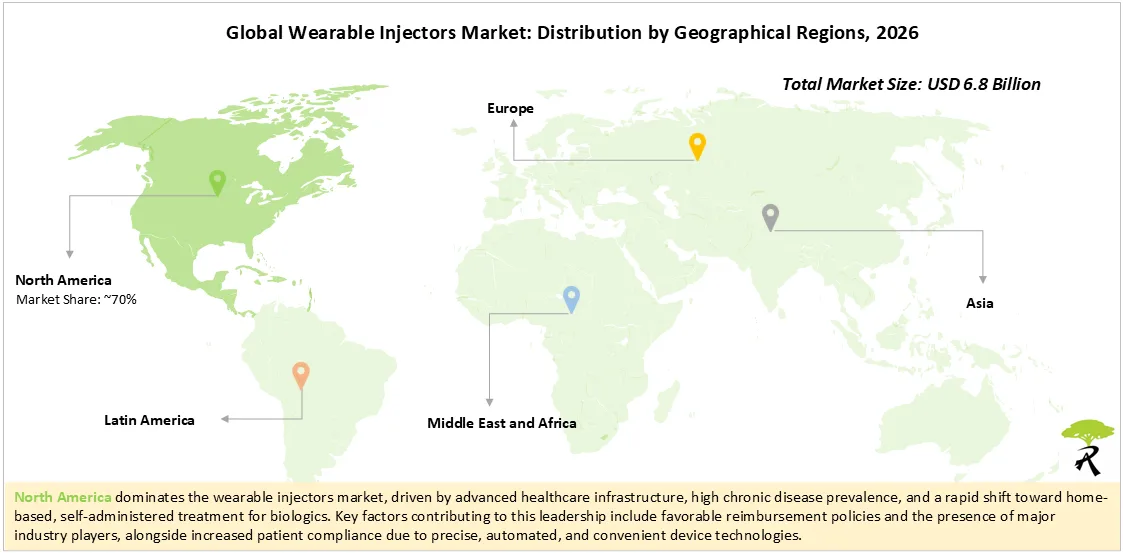
The Asian market is expected to register the highest CAGR through 2035, driven by rising middle-class incomes, rapid urbanization in countries such as China and India, and an expanding older population. Favorable government policies, such as China's investments in healthcare infrastructure, and improved access to advanced technology are fueling the adoption of medical devices in the region.
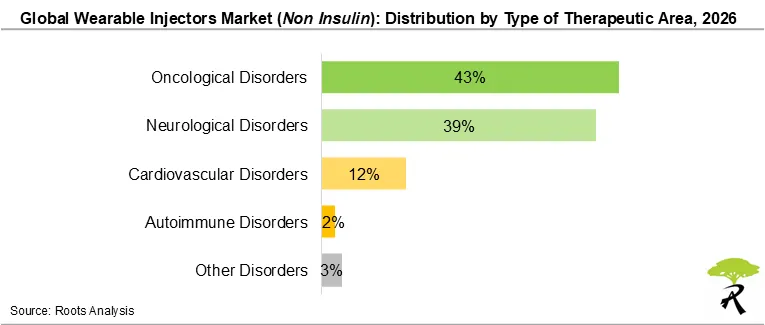
The non-insulin wearable injectors market spans oncology, cardiovascular, neurological, autoimmune and other disorders. Oncology currently represents the leading therapeutic-area opportunity, supported by the suitability of wearable systems for complex biologics and treatments that can replace or reduce infusion-center visits. Monoclonal antibodies and other large-molecule therapies are particularly relevant to this opportunity. Neurological disorders are expected to expand strongly as additional therapies move toward home-based administration.
Alongside the core market report, clients receive complimentary Excel data packs covering market landscape analysis for non-insulin drugs, drug-device combinations for non-insulin drugs, and for insulin, product competitiveness analysis, partnerships and collaborations analysis, key acquisition targets, patent analysis, likely drug candidates, clinical trial analysis, funding and investments analysis, and market sizing and opportunity analysis. A complimentary PowerPoint presentation summarizing the full report is also included, and 15% free customization scope is available on request.
This report was authored by Pemba Lahmo, member of the Roots Analysis healthcare and pharmaceutical research practice. Her work focuses on therapeutic-market assessment, competitive intelligence, clinical-pipeline analysis and market forecasting.
This report is an independent work of market research and analysis published by Roots Analysis. It is not affiliated with, sponsored by, endorsed by, or reviewed by Becton Dickinson (BD), Enable Injections, Insulet, West Pharmaceutical Services, Ypsomed, or any other pharmaceutical company, drug brand, or regulatory body referenced within it. No content in this report should be construed as medical advice. Roots Analysis maintains its own proprietary primary research process, and does not receive compensation from any company profiled within the report, in exchange for inclusion or favorable characterization.