
Lowest Price Guaranteed
Slides
241
Last Updated
October 2025
View Count
10207
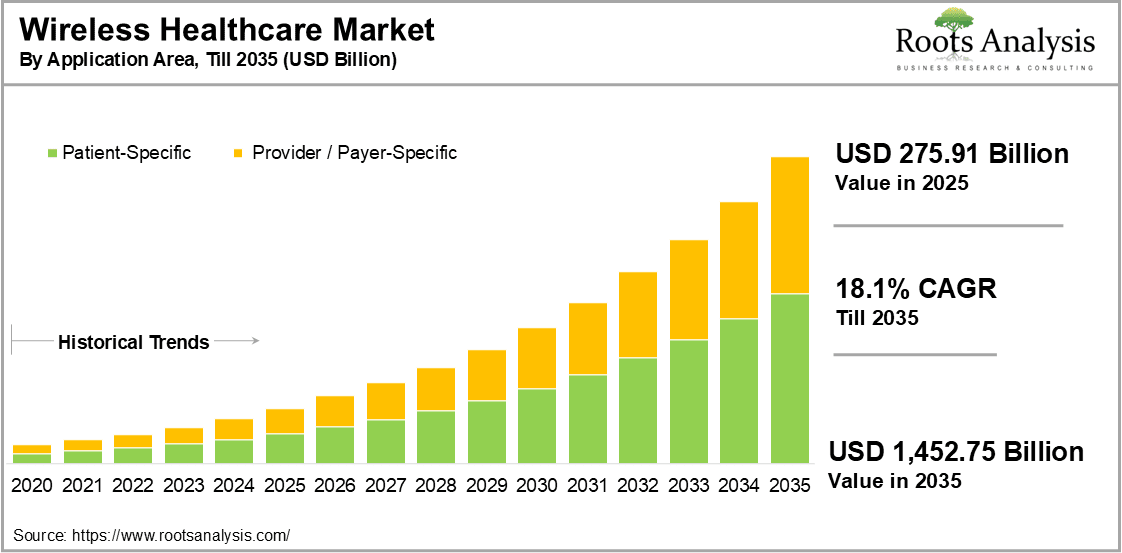
The global wireless healthcare market, valued at USD 223.83 billion in 2024, is projected to reach USD 275.91 billion in 2025 and USD 1,452.75 billion by 2035, representing a CAGR of 18.1% during the forecast period.
 |
To learn more about this report, request a free sample copy
Wireless technology has become an unprecedented part of healthcare industry driven by the growing adoption of wearable devices, telemedicine and mHealth applications to treat and monitor patients. These technologies offer several significances, such as remote patient monitoring from any location, remote diagnosis, streamline documentation process, and offer remote consultation to reduce patient readmission.
Additionally, the penetration of smart sensor-based technologies, such as smart watches, smart wearables and 5G connectivity to maintain health has further fueled the adoption of wireless technologies in healthcare industry. Notably, the widespread acceptance of wireless technologies to monitor patients, enhance working efficiency and streamline clinical workflows has opened a pathway for driving innovations in this field.
For instance, in March 2025, Vave health introduced latest Universal wireless, handheld and whole-body ultrasound probe. This probe has been designed to enhance precision, efficiency, and diagnostics in wide array of clinical settings. Moreover, this wireless probe combined linear and phased imaging technology that offers high-quality imaging without subscription fees, allowing remote diagnosis of diseases. Additionally, tech-giants like Apple, Medtronic, and Qualcomm are focusing on the development of advanced technologies, such as wi-fi connectivity, 6G connectivity, wireless patient monitoring devices. Owing to the ongoing innovations, we believe that wireless healthcare market will continue to expand steadily during the forecast period.
The market report provides comprehensive information on industrial players who are currently active across various segments of the industry as mentioned in the table below.
| Key Report Attributes | Details | |
| Historical Trend | Since 2020 | |
| Forecast Period | Till 2035 | |
| Market Size 2025 | USD 275.91 Billion | |
| Market Size 2035 | USD 1,452.75 Billion | |
| CAGR (Till 2035) | 18.1% | |
| Type of Wireless Technology |
|
|
| Type of Component |
|
|
| Type of Product |
|
|
| Application Area |
|
|
| End User |
|
|
| Geographical Regions |
|
|
| Key Companies Profiled |
|
|
| PowerPoint Presentation (Complimentary) |
Available | |
| Customization Scope | 15% Free Customization | |
| Excel Data Packs (Complimentary) |
Available | |
One of the key objectives of wireless healthcare market report was to estimate the current size, opportunity, and the market growth potential, over the forecast period, till 2035. We have provided informed estimates on the likely evolution of the market for the forecast period.
The global wireless healthcare market analysis report also features the likely distribution of the current and forecasted opportunity within the market across various segments, such type of wireless technology (wireless personal area network (WPAN), Wi-Fi, worldwide interoperability for microwave access (WiMAX), and wireless wide area network (WWAN)), type of component (hardware, software and services), type of product (wearable monitors, mobile health applications, healthcare communication devices, healthcare management software and remote monitoring platforms), application area (patient-specific (physiological monitoring and patient communication) and provider / payer-specific), end user (providers, payers and patients / individuals), geographical regions (North America, Europe, Asia Pacific, Middle East and North Africa, and Latin America) and leading players.
In order to account for future uncertainties associated with some of the key parameters and to add robustness to our model, we have provided three market forecast scenarios, namely conservative, base, and optimistic scenarios, representing different tracks of industry’s evolution.
All actual figures have been sourced and analyzed from publicly available information forums and primary research discussions. The financial figures mentioned in this market report are in USD, unless otherwise specified.
Based on the type of wireless technology, the global market is segmented into wireless personal area network (WPAN), Wi-Fi, worldwide interoperability for microwave access (WiMAX), and wireless wide area network (WWAN). According to our wireless healthcare market report, presently wireless personal area network accounts for the highest share (37%) of the market. This can be attributed to the fact that WPAN, such as RFID and Bluetooth, is user-friendly and cost-effective compared to other wireless technology.
However, it is worth mentioning that wireless wide area network segment is likely to register a higher CAGR during the forecast period. This unprecedented growth is due to the significances offered by WWAN technology, such as better interoperability, long-range communication, and seamless connectivity with other medical device for remote monitoring, telemedicine, and virtual consultation.
This segment highlights the distribution of global market across different types of components, such as hardware, software, and services. According to our projection, currently software segment holds the highest share (40%) of the market for wireless healthcare. Several factors, such as increasing adoption of software solutions to deliver value-based care to the patients and significant advancement in artificial intelligence based software to achieve precision in treat are contributing to the highest share of this segment.
It is worth noting that, services segment is expected to register a substantial CAGR during the forecast period. This lucrative growth is driven by the rising adoption of third-party services for technical support, cost-reduction and optimizing working efficiency with installing hardware components in hospital settings.
Based on the type of product, the global market is bifurcated into wearable monitors, mobile health applications, healthcare communication devices, healthcare management software and remote monitoring platforms. Among these, wearable monitors segment is dominating the wireless healthcare market size driven by the widespread adoption of wearable technologies to monitor patient healthcare data. Moreover, wearable monitors are easy to use and allow users to share information to healthcare professionals for on-time clinician support. It is worth mentioning that this segment will continue to expand at a steady CAGR during the forecast period.
On the basis of application area, this segment is categorized into patient-specific (physiological monitoring and patient communication) and provider / payer-specific. According to our wireless healthcare market analysis, currently patient-specific segment holds 55% of the overall revenue share. Several factors, such as increasing technological advancements, wireless connectivity, and integration of artificial intelligence to deliver personalized treatment to the patients.
However, in the long run, provider / payer specific segment is expected to grow at a higher CAGR during the forecast period. Wireless technologies along with healthcare management software empower providers to deliver value-based care and facilitate management of financial operations.
Based on the end user, the global market is segmented into providers, payers, and patients / individuals. Currently, the patients / individuals segment accounts for the highest share (nearly 50%) of the wireless healthcare market trends. This dominance is due to the increasing shift towards remote patient monitoring devices and wearable technologies to monitor, diagnose and treat patients.
Additionally, the increasing adoption of telehealth services, mHealth applications and digital healthcare services among patients is likely to fuel the demand for wireless technologies. Driven by the ongoing adoption, this segment will continue to grow at the fastest CAGR during the forecast period.
The global market is segmented across different geographical regions, such as North America, Europe, Asia-Pacific, Middle East and North Africa, and Latin America. According to our projection, North America occupies the highest share (46%) of the wireless healthcare market. This can be attributed to the increasing technological innovations, expenditure on healthcare IT infrastructure and growing adoption of digital technologies to monitor diseases and offer value-based care is likely to fuel the demand for wireless technologies in this region.
However, it is important to highlight here that the market for wireless healthcare is expected to grow at a higher CAGR during the forecast period. This lucrative growth is driven by increasing preferences for smartphone and wearable technologies to provide personalized care and offer remote consultation to patients with chronic conditions.
The “Wireless Healthcare Market Analysis Report: Industry Trends and Global Forecasts, till 2035” market report features an extensive study of the current market landscape, market size, market share, market growth, market trends, market value, market forecast, market outlook, statistics, and future opportunities for wireless healthcare industrial players. The market research report lays emphasis on the wireless healthcare products that are being developed. Key takeaways of the market report are briefly discussed below.
Driven by the widespread adoption of wireless healthcare technologies, several market players have shown active interest in this field, making market immensely competitive. Currently, the market landscape is witnessing the presence of several small, mid-sized and large companies who are accelerating innovations and launching new products. For instance, in July 2024, Samsung Electronic launched new Galaxy Watch7, Galaxy Ring and Galaxy Watch Ultra expanding the Galaxy AI2 power to enhance digital health experience, offering personalized insight to health parameters to maintain overall wellness. As more market players continue to accelerate their efforts for product innovation, we believe that this market will remain competitive and progressive during the forecast period.
One of the potential drivers of wireless healthcare market is rising demand for wearable technologies to manage chronic conditions. Notably, wireless technologies-based products, such as remote patient monitoring platforms, telehealth services, mHealth applications and wearable medical devices help to track patient health remotely, thereby allowing healthcare practitioners to offer consultation to manage health conditions without visiting hospitals in real-time. Additionally, the growing initiatives by government organizations to support digital healthcare infrastructure to address the growing burden of chronic conditions is likely to be a key growth factor for the market.
Despite the heightened demand, several factors that are restraining market growth include data security challenges and high initial investment. It is important to highlight here that the implementation of wireless health technologies, wearable sensors and remote patient monitoring platforms require high initial investment, which may limit the adoption of wireless technologies specifically in low to middle income countries. Furthermore, additional expenditure, such as technology upgrade and training staff may enhance the overall expenditure. Moreover, complex regulatory guidelines for the approval of wireless technologies for healthcare and risk of data breaching through open networks may impede the market growth.
The market for wireless healthcare is expected to be driven by the rising penetration of telehealth, shift towards home based healthcare and adoption of wearable devices. Contrastingly, the market players are aiming to accelerate the development of sensor-based technologies and wearable medical devices for remote monitoring and diagnostics. Additionally, the rapid innovation in wireless connectivity to enhance data transmission safely across healthcare platforms is likely to offer lucrative opportunities to industrial players for innovations.
In 2025, the global wireless healthcare market is valued at USD 275.91 and is projected to reach USD 1,452.75 billion by 2035. With a transformative shift towards medical devices and telehealth services to offer remote consultation, there has been a surge in the demand for wireless healthcare technologies. In order to leverage competitive edge, several market players are leveraging collaborations and partnerships. For instance, in February 2025, Altair L&T Technology Services conjointly launched 5G-6G Wireless Center of Excellence. This ground-breaking platform will leverage 5G and 6G networks to address the connectivity challenges for applications in automotive, healthcare, telecommunication, and manufacturing.
Examples of key players engaged in this domain (which have also been captured in this report) include Alcatel-Lucent, Epic Systems, IBM, Oracle, OMRON, Philips, Qualcomm Technologies, Stryker and Veradigm. This market report includes an easily searchable excel database of all the companies focusing on the development of wireless healthcare technologies.
The market report presents an in-depth analysis, highlighting the capabilities of various companies engaged in this domain across different segments. Amongst other elements, the market report includes:
Several recent developments have taken place in the field of wireless healthcare. We have outlined some of these recent initiatives below.