Rheology Modifiers Market by Type of Modifier (Organic (Synthetic and Natural) and Inorganic (Clays, Silicas, and Others)), Type of Function (Thickeners, Stabilizers, Suspending Agents, and Dispersants), By Distribution Channel (Direct Sales, Distributors, and E-commerce / Online Stores), End Use Industry, Geographical Regions, and Key Players – Trends and Forecasts 2026-2040
Market Size
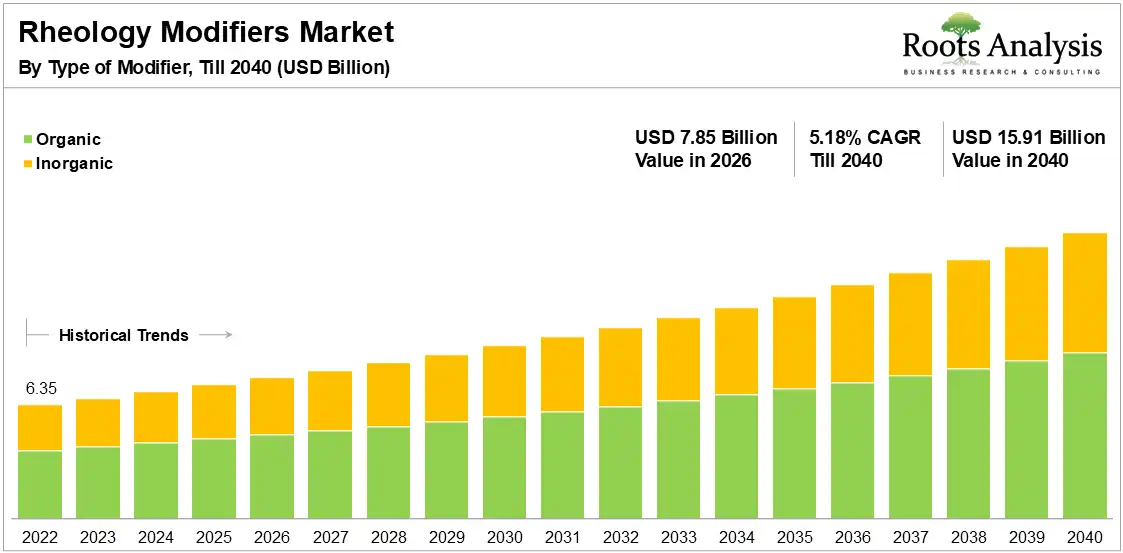
The global rheology modifiers market is projected to reach USD 7.85 billion in 2026 and USD 15.91 billion by 2040, representing a CAGR of 5.18% during the forecast period 2026 to 2040.
See What’s in the Full Report - Request Your Complimentary Insights!
Market Overview
The rheology modifiers market encompasses a specialized category of chemical additives engineered to regulate the viscosity, flow behaviour, and structural stability of liquid and semi-solid formulations. These essential materials include diverse solutions such as synthetic polymers, natural hydrocolloids, and inorganic substances like fumed silica. By integrating these modifiers, manufacturers can effectively prevent sagging, refine product textures, and extend shelf life, ensuring reliable application performance in sectors where precise material handling and fluid consistency are fundamental to product quality.
The global rheology modifiers market growth momentum is currently fueled by a shift toward high-performance, waterborne systems across the paints, coating additives, personal care, and construction sectors. Increasingly strict environmental regulations targeting volatile organic compounds are forcing a transition away from solvent-based products, necessitating sophisticated rheology control to maintain functional standards. A clear illustration of this rheology modifiers market trend occurred in late 2025 and early 2026, when several major chemical producers introduced bio-based thickeners for waterborne architectural coatings to satisfy both sustainability requirements and performance needs within expanding construction markets.
Future industry growth is increasingly defined by the development of sustainable, bio-based modifiers derived from renewable feedstocks to minimize ecological footprints. Innovation is particularly concentrated in specialized niches such as high-solids formulations and additive manufacturing. For instance, companies are actively investing in research to optimize modifiers for 3D printing pastes, which is critical for maintaining material integrity and precision during complex builds. This ongoing technical evolution ensures a positive long-term outlook as modern formulations require greater chemical sophistication.
Market Report: Key Highlights
- Leading Players in Industry: The recent period has been defined by strategic restructuring among market leaders, such as DoW, BASF, Ashland, and Lubrizol. These industrial players emphasize sustainable product launches, water-based solutions intended to meet upcoming regulatory deadlines, and technological innovations. In January 2026, Lubrizol announced a multi-million-dollar investment to elevate its global headquarters in Ohio. This move is part of a broader strategy to centralize innovation and technical support for its specialty chemical divisions, particularly in the personal care and industrial fluids sectors.
- Startup Ecosystem: The startup ecosystem in 2026 is acting as a primary catalyst for the depetrolization of the rheology modifiers market. These agile firms are leveraging biotechnology and circular economy principles to challenge the dominance of traditional synthetic polymers. Recently, BIOWEG, a German biotechnology firm secured €16 million to build Europe’s first large-scale industrial bacterial cellulose plant located in Germany, marking a significant step toward phasing out fossil-based polymers and develop rheology modifiers that offer exceptional suspension stability at dosages as low as in shampoo formulations.
- Core Market Growth Engine: The rheology modifiers industry growth is propelled by a synergy of industrial expansion, regulatory pressure, and technological breakthroughs. The primary drivers include the revitalization of the global construction industry, the rapid expansion of the personal care and cosmetics sector, and the increasing complexity of oil and gas extraction processes.
- Synthetic Rheology Modifiers Market Dominance: Based on our market forecast analysis, synthetic rheology modifiers hold a dominant 67.6% share, supported by their high-performance maturity, precise rheological profiles, and cost-efficiency in demanding applications like industrial coatings and adhesives. However, this segment is projected to grow at a modest 3.4% CAGR (2026-2040), trailing the broader market average as it faces de-selection in high-volume consumer sectors due to microplastic regulatory scrutiny and cost volatility in petroleum-derived monomers.
- Sustainability Imperatives of Key Companies: Major corporations face ESG mandates requiring bio-based content. BASF, Dow, and Clariant have launched bio-derived rheology modifier lines, with bio-based products growing 18% year-over-year, underscoring the future trends in natural rheology modifiers market. This creates premium pricing opportunities but also threatens margins for conventional petroleum-derived products.
- Partnerships and Collaborations: Collaboration has become a key mechanism for addressing the embodied carbon in industrial products. Recently, a landmark partnership between AkzoNobel, Arkema, and BASF highlighted key focus on lowering the carbon footprint of architectural powder coatings by up to 40% through the integration of bio-attributed resins and optimized manufacturing processes.
Pay Only for What You Need – The Best Way to Optimize
Recent Industry Development
- January 2026: Caldic announced an official distribution partnership with BASF to strengthen BASF’s presence in the South Asian market and expanding Caldic’s product portfolio of high-performance additives. This deal covers a comprehensive range of formulation additives, specifically including rheology modifiers, defoamers, and dispersing agents.
- November 2025: Elementis showcased its latest advancements for high-performance, sustainable biodegradable film-former and natural rheology modifiers at In-Cosmetics Asia 2025.
- October 2025: Ashland developed Nathrathix™ Big Cellulose, a nature-derived biodegradable rheology modifier and emulsion stabilizer, designed for sun care and skin formulations.
Market Dynamics
Rheology Modifiers Market Growth Drivers
- Acceleration of Waterborne Systems and Sustainable Formulation Standards: It is worth mentioning that the waterborne coatings and adhesives require sophisticated rheology modifiers to replicate the performance of traditional systems, specifically to manage viscosity profiles, ensure pigment suspension, and provide critical application properties such as anti-sagging and levelling in high-performance environments. The global transition from solvents chemistries toward aqueous systems, mandated by rigorous VOC emissions standards and a strategic pivot toward green chemistry is a primary catalyst for market expansion.
- Escalating Requirements for Sensory Differentiation and Product Aesthetics: In the consumer-facing personal care and cosmetics sectors, rheological control is the definitive factor in achieving premium product positioning. Modifiers are indispensable for engineering specific tactile experiences, including glide, absorption rates, and non-tacky textures in high-end formulations. As global brands move toward premiumization, the demand for additives that provide both structural stability and a superior sensory signature becomes a critical rheology modifiers market growth driver for specialty rheology portfolios.
- Lightweighting Initiatives and Advanced Adhesive Bonding in Automotive Engineering: The automotive industry’s pursuit of fuel efficiency and carbon reduction through vehicle lightweighting has led to the widespread replacement of mechanical fasteners with structural adhesives. These high-performance bonding agents require precise rheological characteristics to accommodate automated robotic application while maintaining bond-line integrity. Rheology modifiers enable the necessary shear-thinning behaviour for rapid processing and the high green strength required for structural safety.
Market Restraints
- Raw Material Volatility and Geopolitical Supply Chain Fragility: The production of rheology modifiers is highly susceptible to price fluctuations in both petrochemical feedstocks and natural precursors like cellulose and guar. Supply chain instability, driven by geopolitical shifts or climate-induced crop failures in key sourcing regions, creates significant cost-in-use uncertainty. These pricing pressures can force manufacturers in price-sensitive segments to seek lower-cost alternatives, limiting the adoption of premium, specialized modifiers.
- Performance Trade-offs within Multifunctional Chemical Matrices: Achieving optimal rheological behaviour often introduces secondary performance compromises in complex formulations. High-efficiency thickeners can inadvertently degrade properties such as water resistance, gloss retention, or mechanical film strength. The technical friction involved in balancing rheological control with the holistic performance of the final product remains a significant barrier, often resulting in sub-optimal formulation choices to preserve core product integrity.
- Competitive Pressure from All-in-One Multi-Functional Additives: Market maturity in several end use industries has spurred the development of multi-functional ingredients that provide thickening alongside emulsification or stabilization. As manufacturers seek to streamline supply chains and reduce formulation complexity, these "all-in-one" solutions pose a direct threat to dedicated rheology modifiers. Suppliers must continuously justify the value-added performance of specialized modifiers against the cost efficiencies of consolidated additive packages.
Get an Instant Quote in 10 Minutes. Lowest Price Guaranteed
Market Share Insights
End Use Industry Analysis: Paints & Coatings Hold Highest Share in Rheology Modifiers Market
Based on the rheology modifiers market segmentation analysis, paints & coatings lead the market, accounting for 42.5% of the overall revenue share in 2026, though it is projected to experience a share loss by 2040 as the market matures and pivots toward high-solid formulations. This dominance is driven by the growing construction activities and infrastructure projects, specifically in Asia-Pacific and Middle East regions, that demand high-performance rheology modifiers in paints and coatings. Moreover, the increasing vehicle production in emerging markets necessitate high-performance industrial coatings.
Conversely, the cosmetics & personal care sector is poised for the fastest growth in the rheology modifiers market, achieving a high CAGR through 2040. This expansion of rheology modifiers in personal care and cosmetics industry is driven by the structural shift toward premium, bio-based rheology solutions, fueled by clean beauty trends and accelerated by the EU's 2025 microplastics ban (starting October 2025) with new SPM reporting mandates. Major suppliers are rapidly scaling fermentation-based biopolymers like PHAs as biodegradable alternatives to plastic glitter and micro-exfoliants, with reports confirming these as a functional reality by early 2026.
Regional Rheology Modifiers Market Analysis: Asia-Pacific Dominates the Market and North America Holds 2nd Largest Market Share
Future Trends and Growth Potential for Waterborne Rheology Modifiers in Asia Pacific
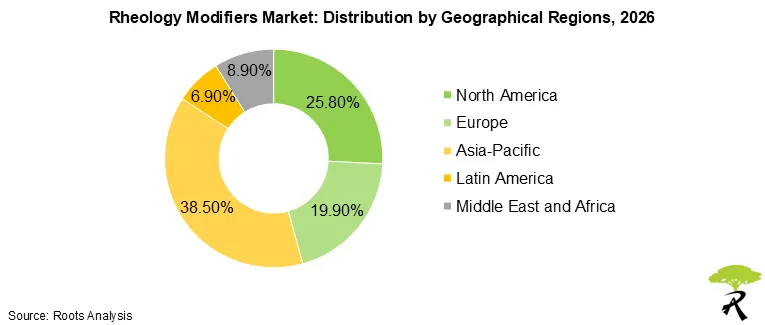
Based on the rheology modifiers market forecast, Asia-Pacific region currently leads the market, accounting for 38.5% of the global market share. This region is also projected to be the fastest-growing segment, expanding at a CAGR of 6.4% through 2040 to reach a dominant 45.4% share. Some other collaborative factors (across various countries) that are contributing to the region’s market growth are outlined below:
- China: Despite a slowing broader economy, China's focus on sustainable manufacturing and advanced coatings for electronics and electric vehicles (EVs) continues to drive demand.5 The commissioning of mega-complexes like the BASF Verbund site in Zhanjiang underscores China's role as both a primary producer and consumer of high-end additives.
- India: Emerging as a significant growth engine, India’s chemical industry projected to reach USD 300 billion by late 2025. The government's "Make in India" initiative and massive infrastructure investments have created a surge in demand for concrete admixtures and premium architectural coatings.
- Southeast Asian Countries: Given the expansion of manufacturing hubs for consumer electronics and automotive parts, which require specialized rheology modifiers for adhesives and industrial coatings, the market in countries like Vietnam and Thailand is expected to see rapid growth.
Rheology Modifiers Market in North America
According to the rheology modifiers market share analysis, North America is likely to hold 21.8% of the market share respectively by 2040. Well-established chemical manufacturing sector with advanced R&D capabilities, stringent EPA and FDA regulations driving innovation in low-VOC and biodegradable modifiers, and strong presence of global manufacturers (Dow, Ashland, and Lubrizol) with integrated supply chains are the key reasons for expanding market in North America.
While this region maintains a technological lead in high-efficiency synthetic thickeners and bio-sourced high-performers, their influence is diluting due to industrial maturity and the high costs of regulatory compliance, including aggressive REACH and VOC restrictions.
Want Information on Specific Region / Segment?
Market Ecosystem Insights
Rheology Modifiers Competitive Landscape
The global rheology modifiers industry is characterized by a moderate level of concentration, with top players, such as BASF, Dow, Arkema, Ashland, and Lubrizol, collectively holding nearly 40% of the market revenues. This tier of multinational giants is distinguished by vast R&D budgets, global distribution networks, and the ability to navigate complex regulatory landscapes.
Key Players in the Rheology Additives Market
- BASF: The company maintains a clear leadership position by leveraging its integrated Verbund sites to achieve economies of scale and cross-segment innovation. Its strategy is heavily anchored in sustainability, as evidenced by the successful commissioning of a steam cracker in China that runs on renewable energy (the first of its kind) that provides the basic chemical building blocks for its greener additive lines.
- Ashland Global Holdings: It dominates the cellulosic segment, particularly in the pharmaceutical and personal care markets. Its Viatel™ bioresorbable polymer platform is a critical enabler for nanomedicine and parenteral applications, where purity and controlled degradation rates are essential for drug delivery.
- Elementis: The company remains a significant force in the inorganic segment, particularly in hectorite clay technology. In December 2025, the company expanded its organic natural rheology portfolio through a USD 22 million acquisition deal with Alchemy Ingredients, a firm specializing in natural alternatives to synthetic thickeners for the personal care industry.

Rheology Modifiers Industry Trends
- Integration into 3D Printing and Advanced Additive Manufacturing: The industrialization of 3D printing across the aerospace, medical, and electronics sectors creates a high-value frontier for rheology modifiers. These manufacturing processes depend on inks and pastes with highly specific non-Newtonian flow behaviours, specifically rapid recovery, and precise deposition control. Developing modifiers tailored for high-solids additive manufacturing represents a significant opportunity for market leaders to capture high-margin, specialized revenue streams.
- Expansion into Conductive Inks and Smart Coating Technologies: The rise of the Internet of Things (IoT) and smart materials necessitates the development of coatings with self-healing, anti-corrosive, or conductive properties. These advanced materials require rheological additives that do not interfere with electrical or chemical functionality while ensuring precise film thickness. As these next-generation technologies scale, the demand for highly specialized, inert rheology modifiers will create substantial opportunities in the electronics and advanced materials sectors.
- Digitalization Impact: Digitalization is revolutionizing the rheology modifiers industry through AI-driven predictive modeling and Digital Twins. These innovations enable precise optimization of bio-based formulations, ensure complete PCF transparency, and accelerate speed-to-market via virtual molecular simulations for sustainable coatings and personal care solutions.
Impact of Regulatory Policies on Rheology Modifiers Market
Stricter VOC regulations under REACH in Europe and tightening emission norms in North America are accelerating the transition from solvent-based to waterborne, high-solids, and low-VOC formulations, sharply increasing demand for next-generation aqueous rheology modifiers that can deliver performance without regulatory risk.
At the same time, evolving rules on hazardous substances (such as APEOs and certain solvents) are pushing suppliers toward bio-based, zero-VOC, and food-contact-compliant rheology technologies, raising compliance costs but creating a premium innovation segment. In parallel, the EU’s broader critical raw materials strategy and related industrial alliances aim to de-risk chemical and additives supply chains, encouraging regional sourcing, diversification of imports, and long-term partnerships across the rheology modifiers value chain.
Sustainable Synergies: Re-engineering Rheology for the Low-Carbon Era
The Value Chain Pull: Additive Performance in Transition
The global coatings industry is undergoing a systemic shift where decarbonization at the binder level is creating a profound value chain pull for the additives market. As Tier-1 manufacturers move toward sustainable resin architectures, rheology modifiers are being redefined. They are no longer viewed as isolated functional components; instead, they have become critical variables in the total product carbon footprint (PCF) calculation.
Recent landmark industrial collaboration between AkzoNobel, Arkema, and BASF for the integration of bio-attributed neopentyl glycol (NPG) and polyester resins to achieve 40% carbon reductions in architectural coatings serve as a vital validation point. It demonstrates that high-performance finishes are achievable through sustainable feedstocks, effectively setting a new carbon benchmark that the entire additive supply chain must now meet.
The Technical Shift: Addressing the Loose Ends in Fossil-Based to Bio-Attributed Formulation Ecosystems
- The Compatibility Mandate: The introduction of bio-attributed and mass-balance resins often alters the polarity and molecular interaction within a coating. This is driving an R&D surge in bio-to-bio compatibility, where rheology modifiers (such as modified celluloses or bio-sourced polyamides) are specifically engineered to stabilize sustainable binder systems without compromising sag-resistance or levelling.
- The Rise of Data-Centric Rheology Modifiers: A significant gap in current market reporting is the reliance on industry-average carbon data. The market is pivoting toward supplier-specific data transparency. Rheology modifier manufacturers are increasingly required to provide ISO-verified, batch-specific life cycle assessment (LCA) data to close the carbon gap left by green resin innovation.
- Functional Circularity: There is a growing emphasis on high-efficiency association. As formulations become leaner to accommodate the economics of bio-based raw materials, rheology modifiers must offer higher thickening efficiency per gram to offset the total cost of the sustainable formulation.
The Decarbonization Domino Effect
The market has moved past the pilot phase of sustainability. When major players successfully validate the integration of bio-attributed feedstocks at scale, it triggers a decarbonization domino effect across the additives landscape. For the rheology modifiers market, this represents a shift from price-per-kg competition to value-per-carbon-reduction competition. Suppliers who fail to provide bio-attributed or low-PCF alternatives risk exclusion from the emerging green architectural value chain.
Your Business is Unique – Why Shouldn’t Your Report Be?
Rheology Modifiers Market: Scope of the Report
| Key Report Attributes | Details | |
| Historical Trend | Since 2022 | |
| Forecast Period | Till 2040 | |
| Market Size 2026 | $ 7.85 Billion | |
| Market Size 2040 | $ 15.91 Billion | |
| CAGR (Till 2040) | 5.18% | |
| Segments Covered |
|
|
Market Segmentation
Based on our research, we have segmented the rheology modifiers market into type of modifier, type of function, distribution channel, end use industry, geographical regions, and key players.
Market Share by Type of Modifier
- Organic
- Synthetic
- Natural
- Inorganic
- Clays
- Silicas
- Others
Market Share by Type of Function
- Thickeners
- Stabilizers
- Suspending Agents
- Dispersants
Market Share by Distribution Channel
- Direct Sales
- Distributors
- E-commerce / Online Stores
Market Share by End Use Industry
- Adhesives & Sealants
- Paints & Coatings
- Personal Care & Cosmetics
- Pharmaceuticals
- Oil & Gas
- Construction
- Other End Use Industries
Market Share by Geographical Regions
- North America
- US
- Canada
- Mexico
- Rest of North America
- Europe
- Austria
- Belgium
- Denmark
- France
- Germany
- Ireland
- Italy
- Netherlands
- Norway
- Russia
- Spain
- Sweden
- Switzerland
- UK
- Rest of Europe
- Asia-Pacific
- Australia
- China
- India
- Japan
- New-Zeeland
- Singapore
- South Korea
- Rest of Asia-Pacific
- Latin America
- Brazil
- Chile
- Colombia
- Venezuela
- Rest of Latin America
- Middle East and Africa (MEA)
- Egypt
- Iran
- Iraq
- Israel
- Kuwait
- Saudi Arabia
- UAE
- Rest of MEA


