Rocket and Missiles Market by Type of Product (Missiles, Rocket and Torpedoes), Type of Speed (Hypersonic, Subsonic and Supersonic), Type of Propulsion (Hybrid, Liquid, Ramjet, Solid and Turbojet), Type of Platform (Airborne, Ground and Naval), Type of Launch Mode (Air-to-air missiles, Air-to-Surface, Sea-to-Sea, Subsea-to-Surface, Surface-to-air missiles and Surface-to-Surface), Type of Guidance, Geographical Regions, and Leading Players – Trends and Forecast 2026-2035
Market Overview
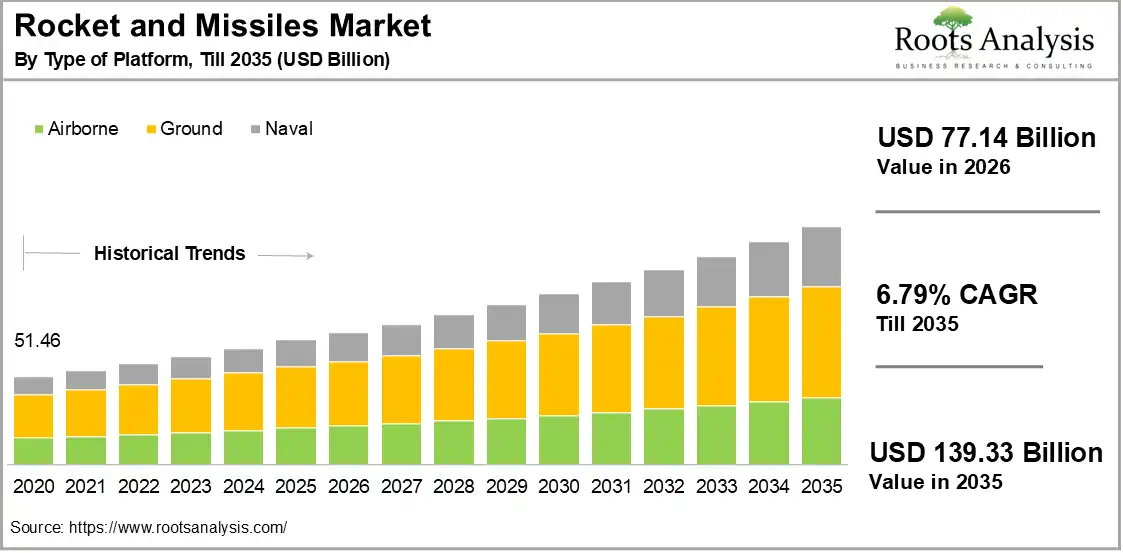
The global rocket and missiles market, valued at USD 77.14 billion in 2026, is projected to reach USD 100.32 billion in 2030 and USD 139.33 billion by 2035, representing a CAGR of 6.79% during the forecast period.
See What’s in the Full Report – Request Your Complimentary Insights!
Rockets and missiles are crucial for space exploration, military defense and scientific research. Rockets are essential for launching satellites and spacecrafts into space. On the other hand, missiles are primarily used for military purposes such as defense and attacks.
The development of precision guided munitions for reduced collateral damage and civilian casualties and enhanced mission success rates is continuously aiding the expansion of military missile market.
In addition, rocket and missile markets are rapidly growing due to the introduction of artificial intelligence in missile systems for higher accuracy and precision and enhanced situational awareness and real-time decision making. This technology offers the ability to detect, track and prioritize multiple targets simultaneously.
Adding to the growth factors, the rising demand for telecommunication, Earth observation, navigation and national security systems are driving the demand for space launch rockets.
Rocket and Missile Markets Share Insights
Which Type of Product Will Dominate the Market?
Based on the global rocket and missile market forecast, the missiles segment is set to take the lead, holding a significant market share of over 42.36% of the market. Further, this segment is also expected to grow with a relatively higher CAGR of 8.34% in the forecasted period.
This ballistic missile market growth is largely a result of increased demand in modern warfare for high precision, speed and adaptability in weapons systems. It is worth highlighting that the development of advanced guidance systems that offer accuracy in striking target is accelerating the missile defense systems market growth.
Which Type of Speed is Leading the Global Market?
Based on the rocket and missiles market report, the hypersonic segment really stands out as the dominant application area with 41.37% market share. In fact, it’s expected to grow with a rocket and missile market growth rate of 7.31% during the forecast period.
Here’s how; hypersonic missile technology is five times faster than the speed of sound, that makes them extremely difficult to intercept by existing missile defense systems. Besides the speed, these have high accuracy and can penetrate heavily fortified defenses that is crucial for neutralizing high-value targets forwardly boosting hypersonic missile market growth.
Which Type of Platform will Witness the Fastest Growth Rate?
According to the rocket and missile market analysis, the ground segment is expected to own 40.31% of the overall market share. In fact, this segment is also forecasted to grow a relatively faster with a projected CAGR of 8.66% during the forecast period.
Here’s why: ground platforms are heavily used for launching land-attack cruise missiles and for territorial defense. Further, the significant rise in missile defense programs and the development of advanced missiles to counter security threats are contributing to expansion of the domain.
Pay Only for What You Need – The Best Way to Optimize
Which Type of Launch Mode will Witness the Fastest Growth Rate?
According to our analysis, the surface-to-surface segment is expected to have largest space technology market share. Further, this segment is also forecasted to grow a relatively faster with a projected CAGR of 7.06% during the forecast period.
The prominent reason for this growth is precision and range: these missiles are designed to engage land-based targets from considerable distances with high accuracy. Furthermore, SSMs are capable of being launched from a variety of platforms. This feature allows targeting both stationary and moving objects including enemy vehicles and infrastructure.
Which Regions Dominate the Rocket and Missile Market?
According to our rocket and missile technology market analysis, the North America rocket and missile market currently exhibit dominance with 45.73% of the overall market share. In addition, this region is also expected to grow with a relatively higher intent data tools market CAGR 7.11% in the coming decade.
This is mainly because of the high defense budget increase, especially in the US. For instance, the US Department of Defense allocates billions of dollars annually for missile and munitions programs including hypersonic weapons and advanced missile defense systems.
Another key driver for rockets and missiles in North America is home to leading technological and space organizations such as Lockheed Martin, Boeing and SpaceX. These companies are rapidly growing the rocket propulsion market through innovations in missile and rocket technologies.
Have Questions? Let’s Get Them Answered.
Rocket and Missile Market Key Insights
Growth Drivers for Hypersonic Missile Systems Market
The effects of defense budget increases on missile technology development are revolutionizing the hypersonic missile systems in various countries, particularly in countries like US, China, India and Russia are continuously investing to enhance national security and military capabilities.
Various countries around the world are mandating rockets and missiles due to the advancements in missile propulsion technologies and warhead technologies such as hypersonic missiles, AI-enabled targeting and missile system miniaturization technology.
In addition to drivers, international defense agreements and partnerships are fostering innovation and interoperability among allied nations.
What Strategies are Companies Using to Gain Rocket and Missile Market Share?
Rocket and missile suppliers are using smart strategies to stay ahead. Big players are focusing on partnerships, acquisitions, joint ventures, and innovations to strengthen their position while also investing in R&D to bring innovative and novel products to the market. Launching new technologies and expanding into regions where industry automation is growing are key moves helping them capture more market share.
What are the Main Challenges in Missile System Development and Integration?
The major challenges in rocket and missiles are complex missile system integration requirements like combining propulsion, guidance, control and missile warhead development demand high precision and coordination that result in increased costs and risks. While missile testing challenges add further complexities.
Another major challenge is international arms export regulations and initiatives to limit exports of missiles. Rockets and unmanned aerial vehicles. For reference, 35 countries around the world have formed the Missile Technology Control Regime (MTCR) to prevent the spread of missiles.
How do Hypersonic Missiles Impact the Defense Market?
The rising global demand for futuristic and fast weapons and defense technology is a major factor in the defense industry. In addition, the ability to launch and deploy hypersonic missiles with long ranges and high maneuverability provides a significant strategic advantage to countries as it makes it easier to evade current defense systems and strike targets effectively.
What Role do Geopolitical Tensions Play In Market Growth?
The role of geopolitical tensions in rocket and missile market expansion is obvious. As global conflicts, territorial disputes and regional rivalries prompt governments to increase defense budgets, modernize military arsenals and invest in advanced missile and rocket systems to bolster security and deter potential adversaries.
Your Business is Unique – Why Shouldn’t Your Report Be?
How do Export Regulations Affect the Rocket and Missile Industry?
International export regulations and their impact on the global missile market can be defined as that these limit the development and trade. For example, regulations established by Missile Technology Control Regime (MTCR) are focused on restricting the international transfer of sensitive technologies and components.
What are the Key Technological Innovations in Missile Propulsion?
Few of the key technological innovations in missile propulsion are as follows:
- Advanced Solid and Liquid Propellants
- Air-Breathing Propulsion
- Hybrid Propulsion Systems
- 3D Printing
- Reusable and Insensitive Munitions
How is the Market Evolving with the Rise of Reusable Rocket Technology?
Reusable rockets are revolutionizing the space industry by significantly lowering launch costs and enabling more frequent and affordable access to space. In addition, reusability supports sustainability efforts by reducing space debris and environmental impacts of rocket launches.
Recent Developments in Rocket and Missile Market
- In November 2025, Blue Origin spent billions of dollars to develop New Glenn (heavy-lift-class rocket).
- In October 2025, Exolaunch and Skyroot Aerospace entered into a strategic partnership to provide end-to-end launch services for satellites and expand access to orbit for commercial, institutional, and government customers worldwide.
- In April 2025, Northrop Grumman, a US-based multinational aerospace and defense company, launched Minotaur rocket family that consists of repurposed intercontinental ballistic missiles.
- In September 2024, China tested launches of intercontinental ballistic missiles.
Rocket and Missile Market: Report Attributes / Market Segmentations
| Key Report Attributes | Details | |
| Historical Trend | Since 2020 | |
| Forecast Period | Till 2035 | |
| Market Size 2026 | $ 77.14 Billion | |
| Market Size 2035 | $ 139.33 Billion | |
| CAGR till 2035 | 6.79% | |
| Type of Product |
|
|
| Type of Speed |
|
|
| Type of Propulsion |
|
|
| Type of Platform |
|
|
| Type of Launch Mode |
|
|
| Type of Guidance |
|
|
| Geographical Regions |
|
|
| Leading Market Players |
|
|
| PowerPoint Presentation (Complimentary) | Available | |
| Customization Scope | 15% Free Customization | |
| Excel Data Packs (Complimentary) |
|
|


