


 Download Free Sample
 Buy Now
Market Size
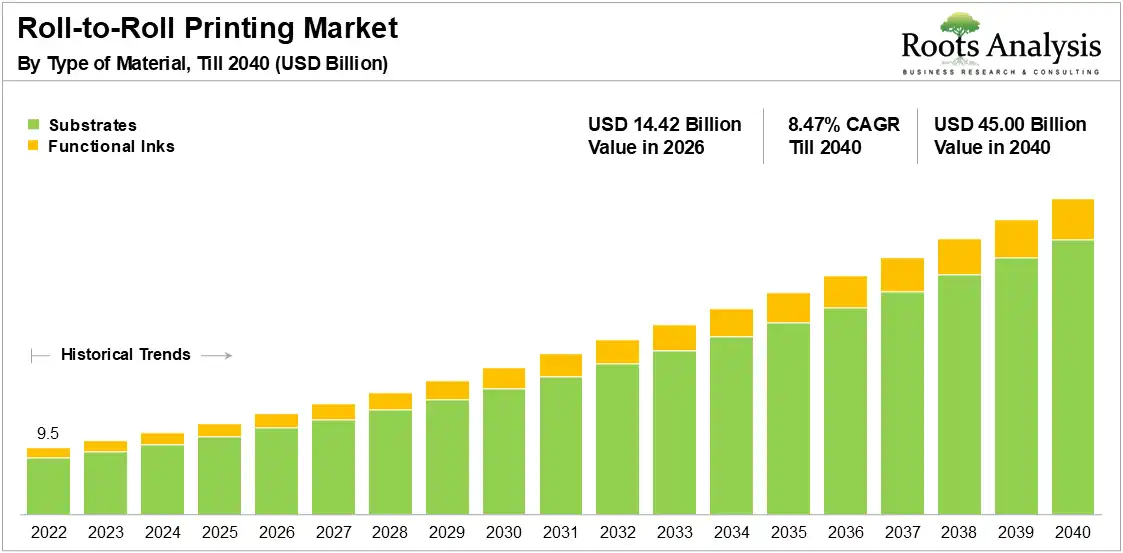
The roll-to-roll printing market is projected to reach USD 14.42 billion in 2026 and USD 45.00 billion by 2040, representing a compounded annual growth rate (CAGR) of 8.47% during the forecast period 2026 to 2040.
See What’s in the Full Report–Request Your Complimentary Insights!
Market Overview
The roll-to-roll (R2R) printing market comprises a specialized manufacturing ecosystem focused on the continuous processing of flexible substrates through sequential functional layer deposition. By utilizing methods like gravure, screen printing, inkjet, and flexography adapted for continuous web handling, this high-volume technique applies functional inks to various films, foils, and fabrics. This industrial-scale approach defines the use cases for developing flexible electronics, smart packaging, and sophisticated sensors across diverse global sectors.
Sustained market expansion is fuelled by rising demand for high-speed, cost-effective production of flexible electronic components and smart consumer applications. Key adoption drivers include the integration of displays, sensors, and intelligent labels into automotive and healthcare hardware, where manufacturers achieve superior material efficiency and lower operational overhead.
The future industry outlook emphasizes hybrid manufacturing systems that combine R2R processing with precise material handling to optimize throughput and sustainability. Innovation trends prioritize the development of biodegradable substrates and eco-friendly inks to align with global green initiatives. Notably, strategic commercialization of R2R methods for flexible perovskite solar cells signals a major transition toward high-volume, low-cost renewable energy production, ensuring long-term market maturity and scalability.
Market Report: Key Takeaways
- Leading Players Competitive Footprint: Roll-to-roll printing manufacturers like 3M, Bobst, Canon, Coatema, FlexEnable, Fujikura, Koenig & Bauer, LG, Manz, Nissha, NovaCentrix, Optomec, Pragmatic Semiconductor, Samsung, SCHMID, SCREEN Holdings, Siegwerk, SUSS, Uteco, Ynvisible hold strong market positions with extensive geographic presence in various regions.
- Startup Ecosystem and Innovation Hotspots: Startups are responding to growing demand through roll-to-roll printing, unlocking scalable manufacturing of printed electronics and functional materials, with early deployments focused on flexible devices, smart labels, and next-generation energy and sensing solutions.
- Regional Penetration and Adoption Trend: Rapid industrialization, rising infrastructure investments, and expanding desalination projects drive roll-to-roll printing adoption in Asia Pacific. Meanwhile, pilot-scale deployments across countries such as the Netherlands and France are accelerating regional growth in Europe, supported by EU funding initiatives and strong R&D in printed electronics, functional materials, and sustainable manufacturing technologies.
- RFID Tags holds Highest Market Segment: In terms of the application, RFID tags hold the maximum market share of 27.80% in 2026. RFID growth is accelerated by retail compliance mandates and European product passport regulations. To meet these massive tracking needs, manufacturers utilize roll-to-roll printing for its fast, highly economical continuous production capabilities.
- Opportunities in the Roll-to-Roll Printing Market through hybrid manufacturing that integrates complex functionalities, roll-to-roll printing seamlessly integrates silicon components with conformable sensors, enabling the scalable, cost-effective production of medical-grade wearable diagnostics and distributed sensor networks.
- Funding and Investment Momentum: The roll-to-roll printing market trends show strong investment across advanced materials, scalable pilot lines, and printed electronics integration, backed by venture capital, private equity, and government funding supporting flexible, and cost-efficient manufacturing innovation.
Pay Only for What You Need – The Best Way to Optimize
Recent Industry Developments
- January 2026: E Ink and AUO announced a strategic partnership to accelerate the mass production of flexible ePaper displays using advanced roll-to-roll (R2R) manufacturing processes. The collaboration aims to scale up high-volume manufacturing capabilities for flexible electronic components, addressing growing demand from logistics and retail sectors.
- November 2025: DuPont DuPont completed the strategic separation of its electronics business into Qnity Electronics, a standalone leader in advanced materials. This transition allows for dedicated investment in high-precision roll-to-roll (R2R) processing, strengthening the supply chain for flexible electronics used in AI-driven substrates and next-generation display packaging.
- September 2025: TracXon secured $4.75 million in seed funding led by Invest-NL’s Deep Tech Fonds. The capital is being deployed to automate R2R production lines and industrialize its Hybrid Printed Electronics process. A key focus is the development of its patented R2R VIA Printer, designed to produce double-sided flexible circuits.
Market Dynamics
Key Market Drivers
- Transition Toward Resource-Efficient and Sustainable Production Models: R2R processing leverages additive manufacturing principles that drastically minimize material wastage compared to conventional subtractive techniques like photolithography or chemical etching. This inherent material efficiency, coupled with high-throughput capabilities, allows manufacturers to optimize operational expenditure while aligning with global regulatory mandates for greener, low-carbon industrial practices.
- Accelerated Innovation in High-Performance Functional Inks: The roll-to-roll printing market is advancing through innovative conductive, semiconducting, and dielectric inks with improved stability and electrical performance, enabling direct printing of active components and complex circuits on diverse substrates beyond traditional graphic applications.
- Commercialization Catalyst for Next-Generation Photovoltaics: Roll-to-roll printing is a foundational technology for the industrial-scale deployment of emerging energy solutions, such as perovskite and organic solar cells (OPV). By enabling the uniform, rapid deposition of thin-film layers over expansive surface areas, R2R provides the only commercially viable pathway for achieving the high-volume throughput necessary for global solar energy adoption.
Market Restraints
- Resolution Thresholds in High-Density Microelectronics: Despite its high throughput, roll-to-roll printing struggles to achieve the sub-micrometer resolution needed for advanced integrated circuits. The trade-off between web speed and precision limits its ability to replace vacuum or lithography-based semiconductor manufacturing for high-performance applications.
- Fragmentation and Lack of Industry-Wide Standardization: The R2R value chain is currently characterized by a lack of standardized protocols for substrate compatibility, ink rheology, and equipment interfaces. This technical fragmentation necessitates highly customized manufacturing setups for each specific use case, which elevates research and development costs and extends the time-to-market for new electronic products.
- Supply Chain Immaturity for Specialized Functional Materials: The availability of high-purity functional inks, such as those utilizing quantum dots or specialized conductive polymers, remains constrained by a limited supplier base. Inconsistent material quality and supply volatility create production bottlenecks, hindering the ability of manufacturers to scale R2R processes to full industrial capacity without compromising performance.
Market Share Insights
Market Share by Printing Technology: Flexographic Printing Hold the Largest Market Share
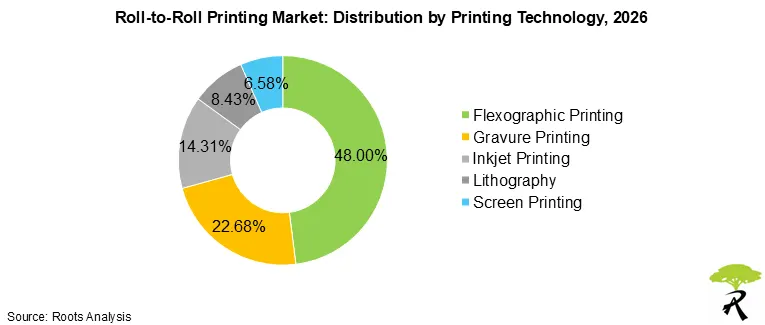
- According to our roll-to-roll printing market analysis, flexographic printing holds the largest market share of 48.00% in 2026. Growth is derived from its optimized cost-efficiency for massive-scale flexible packaging, it is losing relative share to inkjet's superior agility amid rising demand for mass customization and just-in-time delivery.
- There is growing industrial demand for roll-to-roll printing driven by regulatory alignment, the global expansion of flexible electronics manufacturing, and pilot projects demonstrating efficiency gains from hybrid printing configurations.
- The roll-to-roll printing market forecast indicates that inkjet printing is experiencing the fastest CAGR at 17.07%. This growth reflects inkjet’s move beyond the “economic crossover point” where it now competes with flexographic printing not only for short runs but also for medium-run commercial volumes.
Market Share by Geographical Regions: Asia Pacific to Dominate the Industry while Middle East and Africa (MEA) Growing Rapidly through 2040
- The regional analysis suggests that Asia Pacific is expected to hold the largest roll-to-roll printing market share of 39.00% while MEA expected to witness the fastest CAGR. The dominance of the Asia Pacific is supported by highly integrated supply chains, structurally lower operating costs, a robust electronics and textile manufacturing ecosystem, and sustained investments in advanced printing technologies.
- Meanwhile, the Middle East and Africa (MEA) region is emerging rapidly as a new growth pocket, supported by energy infrastructure expansion and the localization of membrane manufacturing. Conversely, mature markets like North America and Europe are strategically pivoting toward high-value, precision R2R applications such as automotive electronics, medical wearables, and sustainable smart packaging.
Want Information on Specific Region / Segment?
Market Ecosystem Insights
Leading Players Competitive Footprint
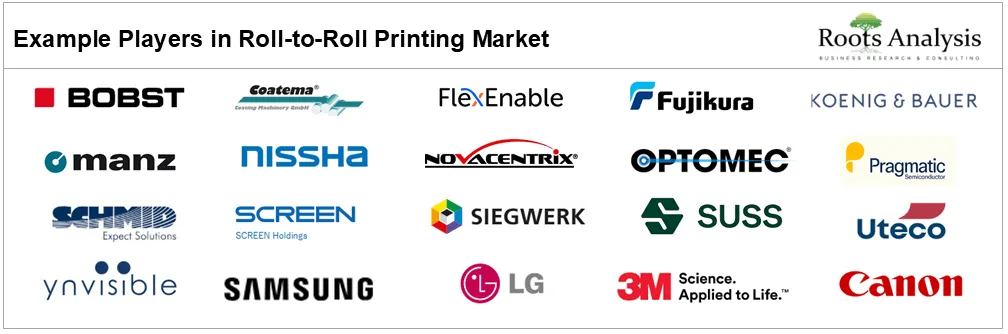
Competitive landscape of roll-to-roll printing key players 3M, Bobst, Canon, Coatema, FlexEnable, Fujikura, Koenig & Bauer, LG, Manz, Nissha, NovaCentrix, Optomec, Pragmatic Semiconductor, Samsung, SCHMID, SCREEN Holdings, Siegwerk, SUSS, Uteco, Ynvisible hold strong market positions through their extensive product portfolios.
In the roll-to-roll printing industry, leaders prioritize strategic technological integrations to rapidly accelerate market penetration. For instance, NovaCentrix partnered with SCHMID to seamlessly embed PulseForge photonic curing technology directly into high-speed R2R processing lines. This integration resolves thermal degradation bottlenecks, enabling the instantaneous curing of new polymer film materials without causing substrate deformation.
Simultaneously, massive capital injections are aggressively de-risking the supply chain. Pragmatic Semiconductor’s $231 million Series D funding explicitly scales its 300mm fabrication footprint to mass-produce flexible integrated circuits (FlexICs). For CTOs, these combined manufacturing milestones empower informed decision-making, ensuring a robust commercial ROI when deploying next-generation smart packaging.
Startup Activity and Innovation Hotspots
Startup activity in the roll-to-roll printing industry is accelerating, with early-stage firms advancing hybrid analog-digital platforms, functional & printed electronics, and high-performance nanomaterial inks. Innovation is focused on scalable, low-cost manufacturing for applications such as flexible sensors, smart packaging, energy devices, and next-generation IoT components.
To demonstrate real-world scalability, recent launches emphasize standardized pilot deployments. In the renewable energy sector, startups are bypassing rigid silicon for lightweight flexible photovoltaics. For example, Swift Solar recently secured a $27 million Series A funding round to aggressively scale the mass production of high-efficiency flexible perovskite solar cells utilizing continuous R2R deposition processes.
Meanwhile, sustainable IoT infrastructure is gaining traction. Innovators like Ligna Energy and Ynvisible are successfully commercializing R2R printed bio-based energy storage systems. For technical leadership and strategic investors, these validated pilot deployments fundamentally de-risk capital allocation. By bridging lab-scale prototyping with continuous mass production, these breakthroughs empower informed decision-making, ensuring long-term commercial ROI in smart packaging and sensor networks.
Funding and Investment Momentum
Capital allocation within the roll-to-roll printing sector has aggressively pivoted from early-stage research toward localized, high-volume industrial scaling. Driven by tightening supply chain economics and strict environmental mandates, institutional funding now prioritizes infrastructure that replaces rigid, traditional manufacturing with scalable microfabrication.
Funding now prioritizes industrial-scale roll-to-roll printing, moving beyond lab research to enable high-throughput, cost-efficient manufacturing of advanced functional materials for large-scale energy and electronics technology deployment. For instance, Fundings for sustainable packaging, German federal ministry for economic affairs and climate action granted funding to a consortium including Fraunhofer IVV and industry partners to develop R2R processes for sustainable packaging solutions, focusing on recycling and material optimization
In addition, public financing is mitigating the financial risks of eco-friendly material transitions. European consortiums, utilizing extensive Horizon grants, are funding institutions like Fraunhofer IVV to scale R2R nanocellulose barrier coatings for fully recyclable smart packaging. By resolving these critical unmet needs in production scalability, such financial instruments empower informed decision-making, allowing technical leaders to confidently de-risk supply chains and secure long-term commercial ROI.
Your Business is Unique – Why Shouldn’t Your Report Be?
Roll-to-Roll Printing Market: Scope of the Report
| Key Report Attributes | Details | |
| Historical Trend | Since 2022 | |
| Forecast Period | Till 2040 | |
| Market Size 2026 | $ 14.42 Billion | |
| Market Size 2040 | $ 45.00 Billion | |
| CAGR (Till 2040) | 8.47% | |
| Segments Covered |
|
|
Market Segmentation
Based on research, we have segmented the roll-to-roll printing market into types of material, printing technology, application, end user industry, geographical regions, and key players.
Market Share by Type of Material
- Functional Inks
- Substrates
Market Share by Printing Technology
- Flexographic Printing
- Gravure Printing
- Inkjet Printing
- Lithography
- Screen Printing
Market Share by Application
- Flexible Displays
- Flexible Sensors
- Flexible Solar Cells
- Medical Devices
- RFID Tags
- Smart Packaging
Market Share by End User Industry
- Aerospace & Defense
- Automotive
- Consumer Electronics
- Healthcare
- Retail
Market Share by Geographical Regions
- North America
- US
- Canada
- Mexico
- Rest of North America
- Europe
- Austria
- Belgium
- Denmark
- France
- Germany
- Ireland
- Italy
- Netherlands
- Norway
- Russia
- Spain
- Sweden
- Switzerland
- UK
- Rest of Europe
- Asia-Pacific
- Australia
- China
- India
- Japan
- New-Zeeland
- Singapore
- South Korea
- Rest of Asia-Pacific
- Latin America
- Brazil
- Chile
- Colombia
- Venezuela
- Rest of Latin America
- Middle East and Africa (MEA)
- Egypt
- Iran
- Iraq
- Israel
- Kuwait
- Saudi Arabia
- UAE
- Rest of MEA


