Satellite Communication Market by Component (Equipment (Transmitter / Transponder, Antenna, Transceiver, Receiver, Modem / Router, and Others) and Services), Type of Orbit (Low Earth Orbit (LEO), Medium Earth Orbit (MEO), and Geostationary Equatorial Orbit (GEO)), Frequency Band (C-Band, Ka-Band, Ku-Band, L & S-Band, Multi-Band, Q-Band, and X-Band), Application, End Use Vertical, Geographical Regions and Key Players - Trends and Forecasts, 2026-2040
Market Size
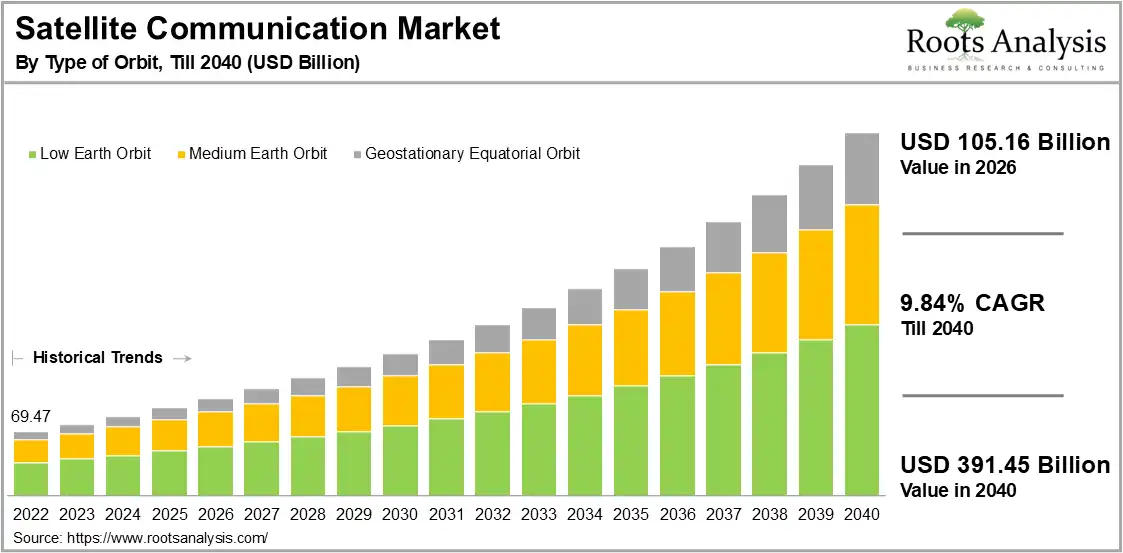
The global satellite communication market, valued at USD 94.81 billion in 2025, is projected to reach USD 105.16 billion by 2026 and USD 391.45 billion by 2040, representing a CAGR of 9.84% during the forecast period 2025 to 2040.
See What’s in the Full Report–Request Your Complimentary Insights!
Market Report: Key Takeaways
- In terms of components, the maximum (58.3%) current market share, within the satellite communication industry, is captured by equipment while services are expected to capture substantial share in the coming years.
- In terms of frequency band, Ku-Band holds the largest market share in the global SATCOM industry.
- In terms of geographical regions, currently, North America dominates the industry, accounting for 38.64% of the global market share. On the other hand, Asia is expected to grow at a higher CAGR through 2040.
- According to our global satellite communication market size estimates, the broadcasting applications currently dominate the industry, accounting for 31.33% of the current market share.
Market Overview
The satellite communication (SATCOM) market has emerged as a vital solution to meet the growing demand for fast, reliable networks, especially in remote and underserved areas. It integrates ground infrastructure with communication satellite technology to enable beamed signals that ensure high-speed data transmission, broad coverage, and robust bandwidth. Further, the market growth is driven by the integration of satellites with terrestrial networks, delivering consistent connectivity.
Initially rooted in the integration of satellites with legacy networks, this sector has recently expanded significantly, driven by advancements in military satellite communication solutions that support long-distance and high-frequency transmissions. Increasing investment in satellite technology and ongoing research in satellite internet services are key factors propelling growth, highlighting the sector’s enhanced data transfer speeds and frequency versatility.
The market stands as a pivotal element in global digital transformation, supported by government funding and extensive research efforts. Features such as increased data transmission rates, multi-spot beams, and frequency reuse are driving the evolution of the high throughput satellites market. Additionally, satellite technologies contribute to critical applications like climate change and wildlife monitoring through remote sensing. Enhancements in cyber security for satellite communication systems safeguard networks from unauthorized access and cyber threats, ensuring a secure communication future.
A recent industry development in January 2025 saw Quectel Wireless Solutions collaborating with NTN provider, Skylo to launch an NTN-enabled satellite communication module, BG95-S5. According to Nobert Muhrer, President and CSO of Quectel, satellite communication empowers businesses to realize IoT goals globally, emphasizing the technology’s pivotal role.
Overall, the growing reliance on satellite broadband and the emergence of numerous satellite internet system providers to meet global connectivity needs, make the satellite communication market a rapidly evolving and vital sector.
Recent Industry Developments
-
In November 2025, Airbus-built OneSat was selected for the Sultanate of Oman’s first national satellite, supporting high-throughput Ka-band services for diverse markets.
- In November 2025, Eutelsat Group expanded its LEO satellite connectivity in Angola through a partnership with MSTelcom, aiming to accelerate digital inclusion and enhance broadband access nationwide.
- In October 2025, Saudi Telecom Company (STC Group) announced direct-to-device satellite mobile services in partnership with AST SpaceMobile, enhancing mobile satellite connectivity across the Middle East.
- In February 2025, Vodafone launched a space-land mobile broadband research hub at its Malaga Innovation Centre to develop integrated 5G and satellite connectivity solutions.
- In January 2025, AST SpaceMobile, a US-based satellite manufacturer partnered with Indian Space Research Organization (ISRO) to launch direct smartphone calls from space.
Pay Only for What You Need – The Best Way to Optimize
Market Share Insights
Satellite Communication Market, by Components: Equipment Dominates, Services Show Rapid Growth
In the satellite communication (SATCOM) industry, the equipment sub-segment dominates (58.3%) the component distribution. This segment includes physical hardware such as transponders, transceivers, antennas, and receivers, which are essential for enabling satellite communication operations. The dominance of equipment is driven by ongoing technological advancements, including the development of smaller satellite technologies like CubeSats and SmallSats, which have broadened SATCOM applications to space and encouraged innovation and market entry by niche firms and startups.
On the other hand, the services sub-segment is projected to grow at a higher CAGR compared to equipment. This growth is fueled by increasing demand for managed services, leased satellite capacity, and customized communication solutions. As satellite networks expand and become more complex, customers prefer flexible, scalable service offerings to support evolving communication needs without the burden of direct infrastructure ownership. The rising adoption of services is further supported by government initiatives for rural broadband, defense satellite communication, and increasing commercial satellite connectivity.
Satellite Frequency Bands Market Share: Ku-band Holds the Largest Share While Ka-band Grows Rapidly Through 2040
The Ku-band sub-segment holds the maximum revenue share within the current satellite communication market, operating within the frequency range of 10.7 to 14.5 GHz. Its dominance stems from extensive usage in fixed satellite television services, where Ku-band offers an optimal balance between coverage and performance, providing robust and reliable satellite links that are less prone to atmospheric interference such as rain fade. This advantage ensures consistent, high-quality service delivery across diverse and challenging geographies.
Recent strategic initiatives underscore the critical role of Ku-band in expanding satellite broadband and fixed satellite television networks, reinforcing its leadership in the global satellite communication market through scalable infrastructure investments. For instance:
- In May 2025, Eutelsat Group extended its multi-year agreement with InterSAT to secure additional Ku-band capacity on the EUTELSAT 7C satellite, boosting connectivity across Central and Eastern Africa, including the most remote regions, and plans to add LEO capacity from OneWeb for low-latency and reliable services.
- In March 2024, Intelsat advanced its multi-orbit strategy by expanding its partnership with Eutelsat Group, leveraging Ku-band capacity and integrating GEO and LEO capabilities to enhance broadband and video services worldwide.
Meanwhile, the Ka-band sub-segment is projected to grow at the fastest CAGR in the coming years, covering frequencies between 17.3 to 30 GHz. The Ka-band’s ability to support higher data rates and greater bandwidth results in faster internet speeds and enhanced data throughput compared to lower-frequency bands such as Ku and C-band, fuels demand in satellite internet services and the satellite broadband sector.
Technological breakthroughs, including the deployment of Ka-band enabled high throughput satellites market payloads by providers like ViaSat (ViaSat-3 F2 (EMEA)) and SES (O3b mPOWER system) facilitate broadband connectivity with low latency and high reliability. The Ka-band’s increasing adoption for commercial and defense satellite communication applications further consolidates its market potential.
Broadcasting Applications Driving Satellite Communication Market Growth
The satellite communication market is segmented into airtime, asset tracking, broadcasting, data backup and recovery, drones’ connectivity, military applications, navigation and monitoring, telemedicine, and others, based on applications. According to our global satellite communication market size estimates, the broadcasting sub-segment is projected to dominate, accounting for 31.33% of the market share in current year. This is driven by the growing demand for satellite communication solutions in radio and subscription-based television applications.
The ubiquitous coverage offered by satellite communication systems enables broadcasting to reach remote and underserved regions, highlighting the transformative role of satellite technology in expanding access. For instance, expansive rollout of the LEO satellite internet constellation by Starlink exemplifies how global coverage, with low earth orbit satellites, enables high-quality, real-time broadcasting even in remote locations, overcoming traditional terrestrial limitations.
Similarly, Starlink’s innovative Direct to Cell technology, launched in 2025, allows standard 4G / LTE phones to connect directly to satellites without ground towers, expanding seamless connectivity across diverse geographies and supporting streaming services worldwide. Further, government initiatives, notably the EU satellite internet program under the European Commission’s Gigabit Society framework, are accelerating infrastructure investments and regulatory support to combat digital divides, stimulating the broadcasting sector’s market growth.
Regional Distribution and Growth Dynamics in the SATCOM Industry
North America Dominates the Current Industry
North America currently dominates the global satellite communication market, commanding 38.64% of the market share. This dominance is driven by substantial government and defense sector investments, the presence of major technology companies including SpaceX, Amazon, and Viasat, and advanced research and development capabilities. The region benefits from high internet penetration, technological sophistication, and strategic defense applications requiring precise location and timing capabilities.
The strong public-private sector collaborations facilitate continuous technology advancements and infrastructure expansion, reinforcing North America’s leading position. For instance, the Federal Communications Commission implemented streamlined licensing procedures and expanded broadband capital subsidy programs in January 2025 to accelerate large LEO constellation approvals, directly supporting SpaceX’s Starlink and Amazon’s Project Kuiper deployments.
Additionally, Amazon announced a commitment to invest up to USD 50 billion to expand AI and supercomputing infrastructure for US federal government agencies in November 2025, with satellite communication systems serving as critical enablers for connecting government operations across distributed locations. These coordinated efforts between regulatory bodies and commercial operators strengthen the deployment of advanced satellite broadband and satellite internet services, further underscoring North America’s strategic advantage in the rapidly expanding global satellite communication industry.
Asia’s Fastest Growth Trajectory During the Forecast Period Till 2040
Asia Pacific emerges as the fastest-growing region during the forecast period. Within Asia Pacific, China commands the highest revenue share, followed by India, which is experiencing particularly rapid growth in satellite communication infrastructure. The region’s growth is propelled by expanding telecommunications (next gen / 5G services), transportation, healthcare, and defense sectors, alongside substantial government investments in satellite infrastructure and broadband connectivity initiatives.
For instance, in April 2025, the Indian Space Agency announced its plan to launch 52 dedicated defense satellites by 2029, equipped with advanced Synthetic Aperture Radar, sensors, and imaging systems deployed across multiple orbits including LEO, MEO, and GEO to provide comprehensive coverage and real-time intelligence capabilities. This initiative, valued at approximately 26,968 crore, represents India’s commitment to achieving autonomous space-based surveillance and autonomous military capabilities through satellite communication systems.
Rising demand for reliable communication services to support military operations and critical infrastructure modernization further accelerates regional expansion. In November 2025, India mandated a shift from Chinese-linked satellites by March 2026 as a national security measure, requiring major broadcasters to migrate to India’s domestic GSAT satellites and trusted foreign providers, strengthening India’s technological sovereignty while boosting domestic satellite communication capabilities.
Want Information on Specific Region / Segment?
Market Dynamics
Key Market Drivers
- LEO Constellation Expansion for Global Broadband Access: These are rapidly expanding to address connectivity gaps in remote regions with low latency and high throughput capabilities. Companies like SpaceX, OneWeb, and Amazon Kuiper are actively deploying large-scale broadband constellations to extend satellite internet services to underserved populations, supporting the global satellite communication market growth and enabling seamless broadband satellite internet access worldwide.
- Rising Defense and Security Investment Demand: Increased military modernization, network-centric warfare capabilities, and seaborne security threats are driving substantial demand for secure, high-bandwidth military satellite communication solutions. Defense agencies globally are prioritizing satellite-based command and control systems, secure data transmission, and resilient communication networks to strengthen operational capabilities and strategic deterrence.
- Agricultural and Heavy Equipment IoT Ecosystem Integration: Emerging opportunities are materializing in agriculture and industrial equipment sectors through multi-orbit satellite communication systems. Strategic collaborations focus on advancing satellite-powered connectivity into broader mobile network infrastructures, enabling IoT ecosystem expansion, enterprise cloud applications, and connectivity solutions for equipment operating in remote locations requiring reliable data exchange.
Competitive Landscape of Key Players in Satellite Communication Industry
The satellite communication market is highly competitive, led by established companies such as SpaceX, Amazon, Apple, and Intelsat, alongside regional and specialized players expanding their footprints through innovation and strategic initiatives.
- For instance, in November 2025, SpaceX achieved 146 total missions in 2025, with Starlink deploying 2,600 satellites and maintaining over 8,000 active satellites in orbit. This unprecedented operational scale reinforces Starlink satellite internet dominance in the LEO satellite internet market, continuously expanding its satellite broadband and satellite internet services footprint globally and establishing the foundation for low earth orbit satellite internet leadership.
- Meanwhile, Amazon launched its Project Kuiper (rebranded as Amazon LEO) with 27 satellites in April 2025, from Cape Canaveral. The company has completed three additional successful launches till date, with a fourth scheduled for December 2025.
Collectively, these leading satellite communication companies are differentiating themselves through advanced antenna technologies, AI-driven optimization, multi-orbit integration, and customized service delivery. Large enterprises dominate with enterprise-grade satellite communication system solutions for defense and aviation, while emerging specialized players capture niche markets in IoT, remote monitoring, and satellite broadband expansion, driving sustained satellite communication industry growth across diverse application sectors.
What are the Market Opportunities in the SATCOM Industry?
5G and Non-Terrestrial Networks (NTN) Integration for Universal Mobile Coverage
The integration of satellite communication systems with 5G infrastructure represents a transformative opportunity to deliver ubiquitous connectivity globally. 5G NTN standardization through 3GPP enables satellite internet services to seamlessly extend broadband, voice, and video services to remote and underserved regions, creating new revenue streams through standardized interfaces and operational efficiency gains across satellite operators and mobile network operators.
In February 2025, Ericsson, Grupo Oesia, and UC3M successfully demonstrated portable 5G private network systems connected to LEO satellites, enabling remote location connectivity via advanced traffic steering technology. This proof-of-concept validates the seamless transition between mobile and satellite access for uninterrupted satellite communication applications in disaster response and remote operations, with commercial deployment expected through industry collaboration.
Direct-to-Device (D2D) Satellite Services and Consumer Smartphone Integration
Direct-to-device connectivity bridges the gap between terrestrial networks and space-based infrastructure, enabling smartphones to connect directly to leo satellite internet constellations without ground infrastructure. This emerging segment is attracting substantial investment from telecommunications operators and technology companies, positioning D2D as a critical growth vector in the global satellite communication market.
In May 2025, AccelerComm closed a USD 15 million funding round led by IP Group to accelerate 5G satellite technology deployment for direct-to-device communications. The funding supports implementations with Lockheed Martin’s advanced regenerative 5G NR NTN payload, scheduled as the first regenerative 5G NTN satellite payload on orbit. Simultaneously, Skylo expanded its Verizon partnership beyond D2D messaging, while smartphone vendors actively integrate native satellite communication capabilities, commercializing early D2D services widely.
Government and Defense Sector Strategic Investment Surge
Sustained government investment in satellite internet services and military communications solutions is expanding dramatically globally. For instance, in January 2025, the United States Space Force’s Commercial Satellite Communications Office allocated USD 2.3 billion in commercial SATCOM contracts prioritizing low earth orbit satellite internet broadband services. Meanwhile, in December 2024 the EU Commission awarded a grant to the IRIS2 consortium (which includes Deutsche Telekom and Orange) to deploy a secure satellite constellation aimed at enhancing Europe’s digital sovereignty and providing resilient communication services in all weather conditions across critical sectors.
These strategic investments from the US and EU demonstrate sustained government backing for satellite broadband infrastructure and autonomous space-based capabilities, signaling a multi-decade commitment to ensuring technological sovereignty and secure, resilient satellite communication systems independent of single-provider dependencies.
Apple and Tech Giants’ Strategic Investments in Satellite Constellation Expansion
Major technology corporations are actively investing in the expansion of satellite constellations, signaling strong confidence in the long-term viability and growth prospects of the satellite communication market. These investments accelerate the scaling of satellite internet systems while driving innovation in direct-to-device connectivity, essential for seamless, high-quality broadband coverage across various geographies.
For instance, in November 2024, Apple announced its commitment to invest USD 1.5 billion in Globalstar’s direct-to-device satellite constellation. This investment aims to expand satellite connectivity directly into consumer devices and enhance satellite broadband services. Meanwhile, in January 2024, AST SpaceMobile secured strategic investments (USD 206.5 million) from AT&T, Google, and Vodafone, with the goal of developing mobile-native satellite connectivity to expand satellite internet services beyond traditional networks.
Market Challenges
- Spectrum Management and Radio Frequency Interference: Radio frequency band competition is intensifying as satellite operators deploy expanded constellations. Effective spectrum coordination between terrestrial networks and satellite communication systems remains critical, with international regulatory bodies working to prevent signal interference, ensure service quality, and establish compliance standards for coexistence.
- High Infrastructure Capital Investment Requirements: Satellite communication infrastructure development requires significant capital investment in ground stations, user terminals, inter-satellite link systems, and network operations centers. These substantial upfront costs limit participation to well-capitalized operators and create barriers for new entrants seeking to establish satellite internet system services and satellite broadband networks.
- Cybersecurity and Operational Resilience in Satellite Networks: Defense and commercial satellite operators face escalating cybersecurity vulnerabilities, including jamming threats, unauthorized access attempts, and physical infrastructure sabotage. Operators must invest in advanced encryption, secure satellite communication systems, anti-jamming technology, and resilient network architectures to protect critical communication infrastructure and maintain operational continuity.
Have Questions? Let’s Get Them Answered.
Market Segmentation
Satellite Communication Market: Scope of the Report
| Key Report Attributes | Details | |
| Historical Trend | Since 2022 | |
| Forecast Period | Till 2040 | |
| Market Size 2026 | $ 105.16 Billion | |
| Market Size 2040 | $ 391.45 Billion | |
| CAGR (Till 2040) | 9.84% | |
| Segments Covered |
|
|
| Key Players Profiled |
|
|
| PowerPoint Presentation (Complimentary) | Available | |
| Customization Scope | 15% Free Customization | |
| Excel Data Packs (Complimentary) |
|
|
Market Segments
Based on research, we have segmented the satellite communication market into component, type of orbit, frequency band, application, end use vertical, geographical regions and key players.
Market Share by Component
- Equipment
- Transmitter / Transponder
- Antenna
- Transceiver
- Receiver
- Modem / Router
- Others
- Services
Market Share by Type of Orbit
- Low Earth Orbit (LEO)
- Medium Earth Orbit (MEO)
- Geostationary Equatorial Orbit (GEO)
Market Share by Frequency Band
- C-Band
- Ka-Band
- Ku-Band
- L & S-Band
- Multi-Band
- Q-Band
- X-Band
Market Share by Application
- Airtime
- Voice
- Data
- M2M
- Asset Tracking
- Broadcasting
- Data Backup and Recovery
- Drones Connectivity
- Military Applications
- Navigation and Monitoring
- Telemedicine
- Others
Market Share by End Use Vertical
- Agriculture
- Broadcasting and Media
- Energy & Utility
- Government and Defense
- Maritime
- Mining and Gasoline
- Telecommunication
- Transport and Cargo
- Others
Market Share by Type of Enterprise
- Large Enterprises
- Small and Medium Enterprises (SMEs)
Market Share by Geographical Regions
- North America
- US
- Canada
- Mexico
- Rest of North America
- Europe
- Austria
- Belgium
- Denmark
- France
- Germany
- Ireland
- Italy
- Netherlands
- Norway
- Russia
- Spain
- Sweden
- Switzerland
- UK
- Rest of Europe
- Asia
- China
- India
- Japan
- Singapore
- South Korea
- Rest of Asia
- Latin America
- Brazil
- Chile
- Colombia
- Venezuela
- Rest of Latin America
- Middle East and North Africa (MENA)
- Egypt
- Iran
- Iraq
- Israel
- Kuwait
- Saudi Arabia
- UAE
- Rest of the MENA
- Rest of the World
- Australia
- New Zealand
- Other countries


