


 Download Free Sample
 Buy Now
Market Size
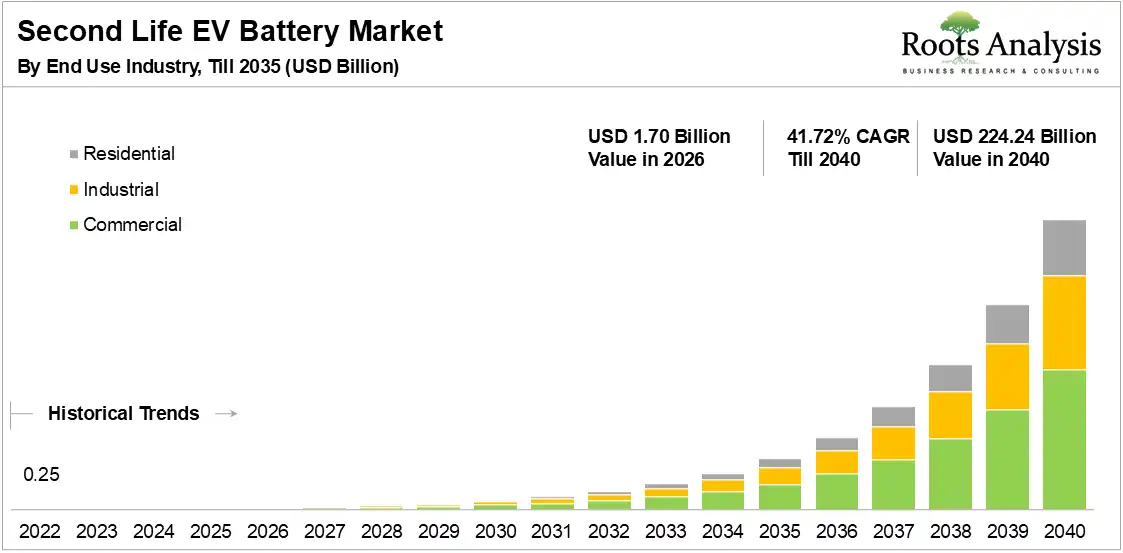
The global second life EV battery market, valued at USD 1.70 billion in 2026, is projected to reach USD 1.26 billion in 2035 and USD 224.24 billion by 2040, representing a CAGR of 41.72% during the forecast period 2026 to 2040.
Would Like to Preview the Actual Report?
The market represents transformative opportunities due to the growing focus on repurposing electric vehicles (EV) batteries for secondary applications. Second life EV batteries are disposed from electric vehicles after 8-10 years of service. The capacity of these batteries falls below 70-80% from its original specification. Despite being degraded, these batteries still holds substantial energy storage capacity which makes these batteries suitable for less-demanding applications.
The concept of transforming waste batteries into a valuable assets create a circular economy model that extend battery lifecycle post discarding from the vehicles to additional 1-15 years for secondary application. This innovative approach addresses multiple challenges, such as reducing electronic waste, reducing carbon footprint and lower energy storage costs.
Early initiatives of repurposing electric vehicles batteries was focused on small-scale residential storage and research projects. However, with growing awareness and government investments in renewable energy storage systems are propelling the second life EV battery market growth.
Renown market players, such as Nissan, Element Energy, Connected Energy and Fortum are actively repurposing EV batteries for renewable energy and advancing their innovations. Moreover, in June 2025, Redwood Materials (Ex-Tesla CTO’s recycling and materials company) launched a new business unit to repurpose second-life EV batteries for energy storage. The company also signed a strategic partnership with Crusoe to develop microgrid powered by second-life EV batteries and large-scale solar. These initiatives are creating a competitive environment for the second life EV battery market players for striking innovations, investments, and future partnerships.
Key Takeaways
- Leading Market Players Ecosystem: The global tech giants, such as Nissan, Mercedes-Benz, Hyundai Motor Company, Tesla, and Renault Group are deploying used EV battery for commercial, residential, and industrial energy storage purposes. Recently, Renault Group has collaborated with various partners, such as Powervault, Connected Energy, and Hitachi ABB Power Grids to give used batteries for electric vehicles for second-life energy storage systems.
- Regional Market Insight: The second life EV battery industry is growing at an unprecedented rate in Europe region. Factors such as European battery regulation and presence of well-established players, such as Mercedes-Benz, Renault, Fortum, RWE, and Enel X are leveraging partnerships, and collaboration, which is likely to fuel the market growth in this region.
- Advancements in Refurbishment and Management: The significant improvement in the refurbishment and battery management systems are enabling safer, reliable, and scalable evaluation and deployment of second life electric vehicle batteries.
- Startup Ecosystem for Second Life EV Battery Market Players: Several startup companies, such as Moment Energy and Voltfang are raising investment to expand the usage of second-life battery.
- Commercial Segment to Have the Highest Market Share: This sub-segment currently holds more than 50% of the market share due to the growing adoption of second-life EV batteries for energy storage purposes.
Have Questions? Let’s Get Them Answered.
Recent Developments in Second Life EV Battery Industry
- In October 2025, NavPrakriti launched Eastern India’s first ever advanced lithium-ion battery recycling facility that aim to empower India’s battery recycling ecosystem to meet with the growing demand for energy storage solutions and electric vehicles.
- In September 2025, Moon Power (a subsidiary of Porshe) launched RE:LIFE, a modular storage system that utilize second-life EV batteries from the MEB platforms to store solar power.
- In July 2025, General Motor signed a letter of intent with Redwood Materials and its subsidiaries redwood Energy. This collaboration aim to deploy stationary energy storage systems that utilized new GMA batteries and end-of-life battery / secondary EV battery packs from GM electric vehicles.
- In June 2025, Enel inaugurated 2.6 MW / 10 MWh second life battery project at Italian airport. This project has been inaugurated in collaboration with Aeroporti di Roma and is estimated to last for 10-15 years.
Market Dynamics
Key Market Drivers
Rising Adoption of Electric Vehicles: The second life EV battery market growth is driven by the rising expansion of electric vehicles globally. As per the recent report of European Automobile Manufacturing Association, within the first ten months of 2025, around 1,473,447 new battery-electric cars were registered. This rapid increase in the adoption trend also increases the volume of batteries reaching end-of-automotive life, creating need for repurposing these batteries in second-life applications.
- Demand for Cost-effective Stationary Energy Storage: It is worth mentioning that second-life EV batteries offer affordable alternative for stationary energy storage, community energy, solar / wind integration, and backup systems. With growing demand for cost-effective stationary energy storage, the market players are focusing on repurposing EV batteries for renewable energy, which is likely to drive the market.
- Supportive Regulations and Circular Economy Incentives: The supportive regulatory framework, such as Production-Linked Incentive (PLI) Scheme for Advanced Chemistry Cell (ACC) Battery Storage is encouraging EV battery recycling and reuse. In addition, the government organizations in Asian countries, such as China, and India are offering incentives for the manufacturing and recycling of battery components to support the electric vehicles industries.
Pay Only for What You Need – The Best Way to Optimize
Key Restraints
- Performance and Quality Variability: The stationary power second use batteries have varied chemistries, degradation histories, and capacities. Due to the varied chemistry, manufacturers may face challenges in assessment and repurpose for stationary use. Moreover, this varied chemistry may also impact the performance and quality of the second life electric vehicles.
- Economic Uncertainty and Cost-Benefit Barriers: It is important to note that the refurbishment, integration, and assessment of electric vehicle batteries enhance the cost which sometime create financial barriers to EV battery second life adoption. Moreover, the availability of alternative technologies and affordable energy storage solutions may limit the financial attractiveness of reused batteries for second-life applications.
- End-of-life Management and Recycling Challenges: When second-life batteries reach end-of-use, these batteries needs to be recycled safely. However, the recycling infrastructure and processes for mixed chemistries is under development in many regions. Therefore, the limited availability of recycling infrastructure create challenges in EV battery lifecycle management.
Market Share Insight
Market Share by Application Area: Power Backup Holds the Largest Market Share
- According to our analysis, the power backup segment accounts for the largest share (55.1%) of the global second-life EV batteries market in 2026.
- This highest share is driven by surging demand for backup solutions across residential, commercial, and industrial sectors. Businesses and industries rely heavily on second-life batteries as a cost-efficient alternative to new energy storage, particularly in data centers, manufacturing facilities, and telecom infrastructure where consistent power is non-negotiable.
- Climate-driven grid disruptions are further accelerating enterprise investment in second-life battery-based load balancing and peak demand management, cementing this segment's revenue leadership.
- Meanwhile, EV charging segment is projected to register the highest CAGR during the forecast period, fueled by rising demand for cleaner energy systems and rapidly expanding EV charging infrastructure across industrial, residential, and commercial sectors. Second-life batteries are being increasingly deployed for stationary energy storage at EV charging locations, enabling off-peak buffering and significant cost reduction at charging stations, creating a self-reinforcing demand loop as global EV adoption accelerates.
- With governments across the U.S., EU, and India mandating charging infrastructure rollout, this segment represents the strongest near-term growth opportunity for aggressive capital deployment.
Market Share by Geographical Regions: Asia-Pacific Holds the Largest Share
- According to our analysis, Asia-Pacific dominate the market, holding 51.75% of the revenue share in 2026. This highest share is underpinned by rapid EV adoption, large-scale battery manufacturing, and expanding renewable energy deployment across the region.
- China leads as the single largest national market, supported by government-mandated battery recycling policies, circular economy frameworks, and heavy investment in energy storage infrastructure, while Japan and South Korea further strengthen the region's supply chain depth through OEM-driven repurposing programs.
- Europe is projected to register the highest CAGR among all regions during the forecast period. This growth is propelled by stringent EU Battery Regulation and the European Green Deal, which together mandate battery traceability, carbon footprint labeling, and reuse-before-recycling obligations, creating a structural policy tailwind unmatched globally.
- The growing partnerships between automotive OEMs and energy utilities are accelerating second-life battery deployment into grid-balancing and residential storage initiatives, with Germany, France, and the UK leading adoption backed by ambitious renewable energy targets.
- Notably, Nissan and Stena Recycling signed a strategic partnership to scale second-life EV battery reuse in Norway, reflecting the region's fast-maturing commercial ecosystem that makes Europe the most attractive destination for forward-looking, policy-backed investment capital.
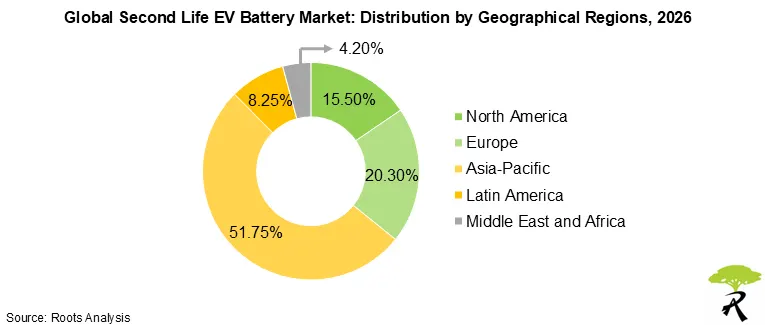
In Europe, the repurposed EV battery market is expanding at the fastest CAGR during the forecast period. Several factors, such as stringent regulations, such as EU battery regulation and the European green deal has strongly mandated the repurposing of electric vehicle batteries, and recycling. Moreover, the growing focus on decentralized energy needs has further fueled the second life EV battery integration in renewable energy systems.
Market Ecosystem Insights
Competitive Landscape for Industry Players in Second Life EV Battery Market
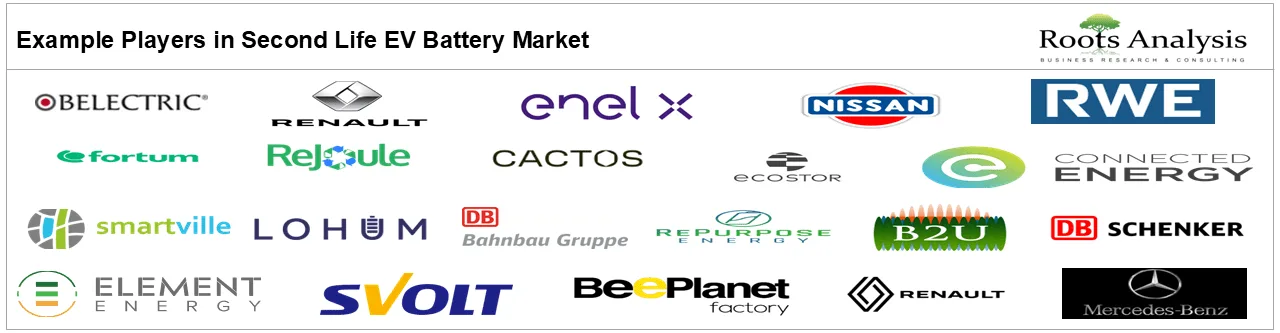
The second life EV battery industry is immensely competitive, featuring a diverse range of small, mid-sized, and tech giants. Some of the notable examples include Fortum, Nissan, Renault, and BELECTRIC are encouraging partnerships and collaboration. The primary focus of these industrial players will be on innovations in testing and grading for second life battery suitability.
For instance, in April 2025, Nissan and Stena Recycling signed a strategic partnership for the development and expansion of reusing second-life electric vehicle batteries in Norway. In addition, several market players are also emphasizing supply chain management for end-of-life and second life batteries for consistent flow of reuse battery supply.
Your Business is Unique – Why Shouldn’t Your Report Be?
Startup Ecosystem of Second Life EV Battery Market
Several startup companies are driving innovation in repurposing the second life electric vehicle batteries. Notably, the startup players, such as Voltfang, Moment Energy, Element Energy, and Refurb Battery are also securing investments and building custom designed battery energy storage systems.
- In March 2025, Moment Energy (British Columbia-based startup) build custom battery energy storage systems (BESS) by repurposing retired electric vehicle batteries.
- In June 2025, Voltfang (German cleantech startup) successfully raised 15 million in series B funding round. The company will use these funds to expand and open new second-life battery factory in Aachen, North Rhine-Westphalia. This facility will enable scaling up to 1 GWh with energy-dense storage solution.
These initiatives are creating compelling environment for the market players for innovations, which is likely to fuel the second life EV battery market growth.
Market Segmentation
Second Life EV Battery Market: Scope of the Report
| Key Report Attributes | Details | |
| Historical Trend | Since 2020 | |
| Forecast Period | Till 2040 | |
| Market Size 2026 | $ 1.70 Billion | |
| Market Size 2040 | $ 224.24 Billion | |
| CAGR (Till 2040) | 41.72% | |
| Segments Covered |
|
|
Based on the research, we have segmented the second life EV battery market forecast into type of battery, application area, end use industry, geographical regions, and leading players.
By Type of Battery
- Nickel-Metal Hydride
- Lead-Acid
- Lithium-ion
By Application Area
- EV Charging
- Grid Connected
- Power Backup
- Renewable Energy Storage
By End Industry
- Commercial
- Industrial
- Residential
By Geographical Regions
- North America
- US
- Canada
- Mexico
- Rest of North America
- Europe
- Austria
- Belgium
- Denmark
- France
- Germany
- Ireland
- Italy
- Netherlands
- Norway
- Russia
- Spain
- Sweden
- Switzerland
- UK
- Rest of Europe
- Asia-Pacific
- Australia
- China
- India
- Japan
- New-Zealand
- Singapore
- South Korea
- Rest of Asia-Pacific
- Latin America
- Brazil
- Chile
- Colombia
- Venezuela
- Rest of Latin America
- Middle East and Africa (MEA)
- Egypt
- Iran
- Iraq
- Israel
- Kuwait
- Saudi Arabia
- UAE
- Rest of MEA
Get an Instant Quote in 10 Minutes. Lowest Price Guaranteed


