


 Download Free Sample
 Buy Now
Market Size
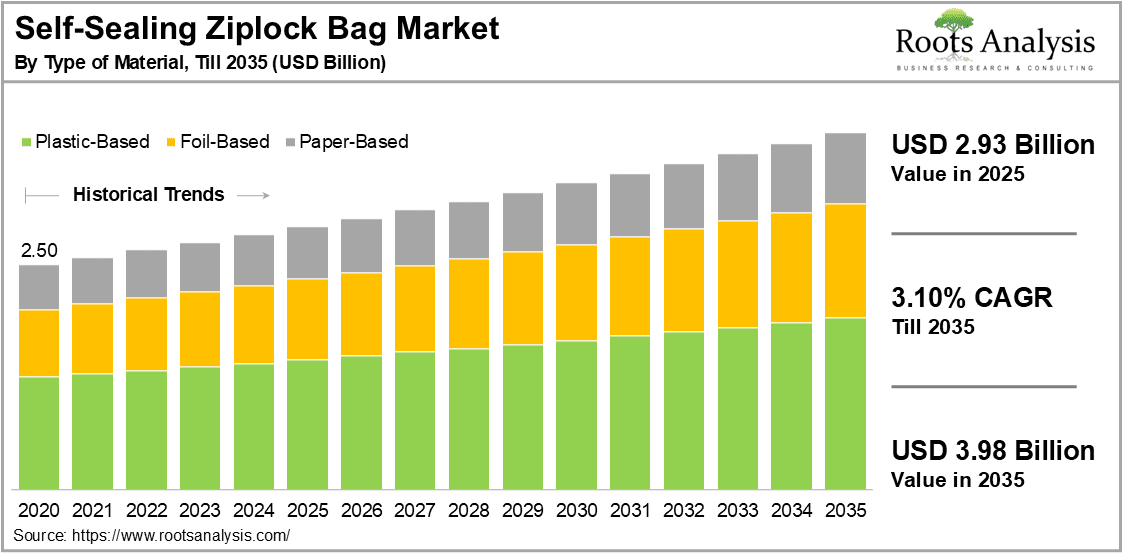
The global self-sealing ziplock bag market, valued at USD 2.93 billion in 2025, is projected to reach USD 3.52 billion in 2030 and USD 3.98 billion by 2035, with a 3.10% CAGR during the forecast period 2025 to 2035.
See What’s in the Full Report - Request Your Complimentary Insights!
Market Report: Key Takeaways
- In terms of type of product, the stand-up bag sub-segment secures 77.32% of the global market size.
- In terms of end-user, the food industry is leading the industry, holding majority (53.12%) of the current market share.
- North America dominates the current global self-sealing ziplock bag market, holding a market share of 42.12%.
- Key market drivers, propelling the growth of self-sealing packaging solutions globally, include the increasing demand for convenient packaging and growing preference for moisture-resistant packaging and airtight packaging technology.
Market Overview
Traditional packaging systems face critical environmental challenges, including pollution and increasing landfill waste, while also lacking resistance to moisture and dust, which shortens product shelf life. To overcome these limitations, demand is rising for self-sealing ziplock bags made from plastics or foil integrated with specialized zippers through advanced cutting and filming techniques.
These eco-friendly packaging materials offer superior flexibility, reusability, and resistance to contaminants. Their user-friendly zipper mechanism enhances convenience by allowing easy use and multiple reuses. Available in diverse formats, such as 3-side, standup and pillow pack ziplock bags, these bags address hygienic packaging trends across food and pharmaceutical sectors by maintaining product potency and preventing contamination.
Recent innovations have further propelled the global self-sealing ziplock bag market growth, enhanced flexible film lamination and multilayer sealant technologies improving zipper durability and bag reusability. The popularity of stand-up ziplock bags is rising due to their upright storage capability and superior retail shelf presentation, facilitating effective branding. While eco-conscious advancements in sustainable packaging, including the development of recyclable polyethylene and polypropylene films further facilitates in meeting circular economy goals without sacrificing barrier performance.
The surging trend of e-commerce and consumer demand for portable, convenient packaging fuels further adoption. Continuous investments in research and development are expected to unlock new materials, functionalities, and sustainable designs, sustaining robust market expansion and aligning packaging solutions with evolving environmental mandates.
Recent Developments
- In May 2024, Liquibox, a sustainable package solution company, launched a self-sealing cap to advance hygienic milk dispensing.
Pay Only for What You Need – The Best Way to Optimize
Market Share Insights
Stand-Up Bag to Drive the Industry Growth
The stand-up bag sub-segment dominates the industry with 77.32% of market share in 2025. The prominent reason for this is enhanced product safety as it keeps the food fresh for a longer time. In addition, these bags can be placed easily on a flat surface without any support. It is worth highlighting that stand-up ziplock bags have modular design for aesthetics forwardly boosting resealable bag market.
However, the 3-side seal bag segment is expected to grow with a relatively higher CAGR through 2035. This can be ascribed to the higher volume and lesser cost that allows industries to sell and save more. Further, the lightweight material and easy availability properties are driving the 3-side ziplock bags growth.
Plastic-Based Sub-Segment to Shape the Future of Self-Sealing Ziplock Bag Market
Currently, according to our analysis, the plastic-based segment is augmenting the segment's growth with a significant market share. This can be attributed to prevention against dust, dirt, moisture and other contaminants that keep the product safe. Moreover, reusability and long lifespan of plastic-based bags allow users to use it for longer time duration.
On the other hand, the foil-based segment is expected to grow with a relatively higher CAGR in the near future. This can be ascribed to their user-friendliness, compact design and light weight. Further, the airtight, UV rays and moisture-resistant nature of foil-based packaging, make them ideal for sensitive products and other applications.
Press-to-Close Sub-Segment Dominates the Closure Sector
The global self-sealing ziplock bag market forecast estimates suggest that the press-to-close sub-segment dominates the market. This is due to the user-friendly mechanism of such zipper bags, along with their leak-proof properties that allow easy storage of solids, powder and liquid.
However, the slider sub-segment is expected to grow with a relatively higher CAGR during the forecast period 2025 to 2035. This is due to the rising demand for easily usable zipper bags that are effortless yet with enhanced quality. In addition, its durable locking systems allow users to store elements secure from external elements, accelerating moisture-resistant packaging solutions.
Food Industry Plays a Key Role in the Self-Sealing Ziplock Bag Domain
The global self-sealing ziplock bag market report suggests that the food industry is leading the market with a major share of 53.12%. Further, this segment is also expected to grow with the relatively faster CAGR in the forecast period.
This can be attributed to high focus on hygienic and nutrient food, which has framed the dominance. It is worth highlighting that these bags reduce the risk of contamination and foodborne illnesses that forwardly have boosted the food self-sealing ziplock bags.
North America Leads Self-Sealing Ziplock Bag Market
Regional distribution of the market suggests that North America dominates the market by capturing 42.12% of the self-sealing ziplock bag market share in the global marketplace. This can be attributed to several factors, including rising demand for hygiene and quality packaging.
In addition, boosting market of packaged food, beauty and personal care products and medicines has played a pivotal role in the growth of self-sealing ziplock bag market. This region is home to prominent players such as Berry Global and Reynolds that are further driving the market through innovation and competition.
On the contrary, Asia- Pacific is projected to grow with a relatively higher CAGR in the forecast period as it’s a major market for food and automotive industries that will nurture the market growth for eco-friendly food packaging market.
Want Information on Specific Region / Segment?
Market Dynamics
Competitive Landscape of Key Market Players
The global self-sealing ziplock bag market is highly competitive, shaped by a mix of large multinational corporations and numerous small-to-mid-sized regional players. Industry leaders such as Amcor, Bemis, Berry Global, Coveris, Flair Flexible, Flexico, Glenroy, Mondi, Winpak, and Ziploc dominate the market. This is due to their contributions in developing smart packaging technologies with embedded freshness and temperature sensors, that promise to transform user experience and supply chain transparency, underscoring the industry’s commitment to sustainability and innovation.
Smaller and niche manufacturers are carving out positions by offering specialized designs, eco-friendly materials, or customized solutions to meet specific consumer and industrial needs. Across the market, players are enhancing competitiveness through strategic alliances, portfolio diversification, geographic expansion, and the introduction of differentiated features such as improved seal integrity, biodegradable plastics, and tamper-evident designs, which are setting new quality and sustainability benchmarks in the segment.
Key Market Drivers of Self-Sealing Ziplock Bag Industry
- Growing demand for sustainable and reusable packaging solutions is steadily increasing adoption across food, pharma, and personal care sectors.
- Rising e-commerce penetration is amplifying the need for convenient, durable, and portable packaging formats like ziplock bags.
- Technological advancements in multilayer film lamination and resealable zipper mechanisms enhance product performance and consumer appeal.
- Increasing investments in eco-friendly materials and smart packaging innovations support regulatory compliance and brand differentiation.
Self-Sealing Ziplock Bag Market Challenges
- Strict regulatory requirements on plastic use and recycling pose compliance challenges for manufacturers in global markets.
- Fluctuating raw material prices and supply chain disruptions impact production costs and market stability.
- Environmental concerns and rising consumer demand for fully biodegradable packaging intensify pressure on product innovation.
- Potential health risks such as suffocation hazards from improper use of ziplock bags limit market adoption in certain regions.
Your Business is Unique – Why Shouldn’t Your Report Be?
Market Segmentation
Self-Sealing Ziplock Bag Market: Scope of the Report
| Key Report Attributes | Details | |
| Historical Trend | Since 2020 | |
| Forecast Period | Till 2035 | |
| Market Size 2025 | $ 2.93 Billion | |
| Market Size 2035 | $ 3.98 Billion | |
| CAGR (Till 2035) | 3.10% | |
| Segments Covered |
|
|
| Key Players Profiled | ||
| PowerPoint Presentation (Complimentary) | Available | |
| Customization Scope | 15% Free Customization | |
| Excel Data Packs (Complimentary) |
|
|
Market Segments
Based on research, we have segmented the Self-sealing Ziplock Bag Market, 2025-2035 into type of product, type of material, type of closure, end-user, geographical regions, and key players.
Market Distribution by Type of Product
- 3-Side Seal Bag
- Gusseted Bag
- Pillow Pack Bag
- Pinch Bottom Bag
- Stand Up Bag
Market Distribution by Type of Material
- Foil-Based
- Paper-Based
- Plastic-Based
Market Distribution by Type of Closure
- Double Zipper
- Press-to-Close
- Slider
- Other Closure
Market Distribution by End-User
- Automotive Industry
- Chemical Industry
- Electrical and Electronics Industry
- Food Industry
- Personal Care and Cosmetics Industry
- Pharmaceutical Industry
Market Distribution by Geographical Regions
- North America
- US
- Canada
- Mexico
- Rest of North America
- Europe
- Austria
- Belgium
- Denmark
- France
- Germany
- Ireland
- Italy
- Netherlands
- Norway
- Russia
- Spain
- Sweden
- Switzerland
- UK
- Rest of Europe
- Asia-Pacific
- Australia
- China
- India
- Japan
- New-Zealand
- Singapore
- South Korea
- Rest of Asia-Pacific
- Latin America
- Brazil
- Chile
- Colombia
- Venezuela
- Rest of Latin America
- Middle East and Africa (MEA)
- Egypt
- Iran
- Iraq
- Israel
- Kuwait
- Saudi Arabia
- UAE
- Rest of MEA


