


 Download Free Sample
 Buy Now
Market Size
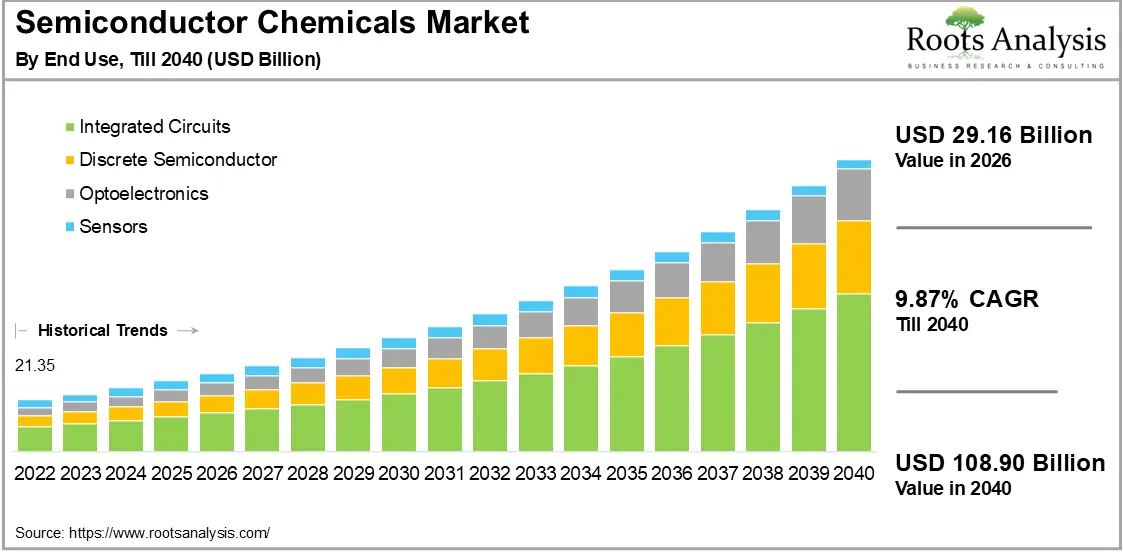
The global semiconductor chemicals market, valued at USD 24.79 billion in 2025, is projected to reach USD 29.16 billion by 2026 and USD 108.90 billion by 2040 with a 9.87% CAGR during the forecast period 2026 to 2040.
See What’s in the Full Report – Request Your Complimentary Insights!
Market Report: Key Takeaways
- Based on type of semiconductor chemicals, acid and base chemicals holds the highest share (39%) of the market.
- In terms of type of process, front end of line (FEOL) is highest in the market 2026.
- Substrate material is likely to dominate the industry.
- With respect to applications, photoresist is driving the market with highest market share.
- In terms of geographical regions, Asia Pacific holds the highest market share (35%), while North America is expected to grow at a relatively high CAGR.
Market Overview
Semiconductor chemicals are high purity chemicals that are used in the manufacturing of semiconductor devices and complex fabrication of microchips processors (wafer cleaning, etching, deposition, and patterning) in electronic devices. Owing to the consistent surge in the demand for semiconductor chemicals in electrical applications and advanced chip manufacturing for smaller nodes (artificial intelligence (AI), 5G, internet of things (IoT), and electronic vehicles (EVs)) is likely to drive the market growth in the coming years.
These materials must meet impurity thresholds and ultra-tight process, making them a technologically intensive, specialty chemicals segment tightly coupled to advances in semiconductor manufacturing.
Further, traditional silicon devices are stretched to their performance limits and wide bandgap materials (silicon carbide (SiC), and gallium nitride (GaN)) demand is shifting from generic electronic chemicals to highly engineered semiconductor wet chemical tailored for barrier metals, and advanced packaging. With technological advancement in next generation, SiC transforms through ability to encounter high temperatures, and design superior selectivity.
As sustainability accelerates across core design constraints, semiconductor chemicals demand driven by EVs, 5G, and data centers demand is anticipated to experience significant growth with higher efficiency to support global decarbonization goals. This is promoting the shift from lower-toxicity solvents, recyclable chemistries, and process routes that minimize dangerous by-products, considering the role SiC in lowering system-level energy losses.
The combination of investments is driving the strategic confidence among this sector growth. Expansion in wet chemicals, semiconductor photoresists are being directly related to material roadmaps including heterogeneous integration, and chip-based architectures. For instance, in December 2025, American chip resurgence invested USD 630 billion in semiconductor ecosystem to leverage the production of microelectronics and ensure access to a domestic supply chain of advanced semiconductors for national security. This leads to chip production and innovation in the benefit of the US economy with job creation, national security and technological leadership.
Unlock Deeper Insights – Schedule Your Personalized Workshop Today!
Recent Industry Developments
- In November 2025, BASF announced the launch of a new line of eco-friendly semiconductor materials designed to meet the growing demand for sustainable electronics. The expansion of carbon footprints with high purity ammonium hydroxide in semiconductor process chemicals market to strategically aligns with global sustainability trends but also positions BASF as a leader in environmentally responsible semiconductor solutions.
- In September 2025, Kayne’s Technology got highlighted as India and Singapore are collaborating in semiconductors, and AI industry to accelerate the manufacturing services and technological advancement to drive foreign investments, job opportunities in high-tech fields.
- In March 2025, Ainos a leader in AI-driven scent digitization, announced a strategic collaboration with Advanced Semiconductor Engineering (ASE), the world's largest provider of semiconductor packaging and testing services. This strategic collaboration leads to semiconductors manufacturers leverage technologies and analyze airborne chemicals, environmental safety and government compliance to support healthcare and industrialization digitally.
- In March 2025, Mitsubishi Chemical announced plans to expand its footprint in India by entering the country's semiconductor and electric vehicle (EV) supply chains. The company aims to collaborate with local partners to capitalize on India's rapidly growing demand in electronic chemicals for semiconductors.
- In February 2025, Fujifilm unveiled its plans to invest €25 million in semiconductor materials capacity in Flanders. This plan aligns with their proactive investments to support, European growing demand for automotive and industrial sector further leads to expansion in the semiconductor materials industry.
Market Share Insights
Purity Grades Dominates the Semiconductor Chemicals Market
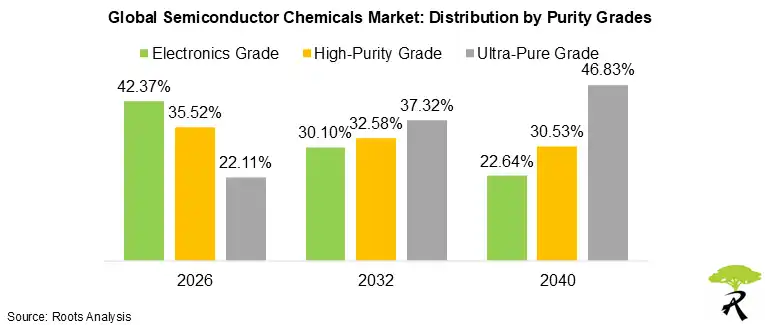
Based on purity grades, the global semiconductor chemicals market size is segmented into electronics grade, high-purity grade, and ultra-pure grade. Among these categories, the electronics grade currently holds the dominant position, capturing highest total market share. This electronic grade purity level is utilized in various manufacturing processes, owing to adequate level of purity to provide a wider range of applications, such as integrated circuits and photolithography.
On the other hand, the ultra-pure grade will grow at a higher CAGR. Ultra-pure grade is gaining attention driven by the industry's shift toward advanced technology nodes (7nm, 5nm, 3nm, and below). It is worth mentioning that the leading-edge fabs use approximately 40% more acids and bases per wafer than mature fabs. These advanced lines only use ultra-pure grades, the volume demand for ultra-pure chemicals is growing much faster than the demand for the chemicals used in legacy chipmaking
Regional Market Growth: Asia Pacific Dominates the Semiconductor Chemicals Market
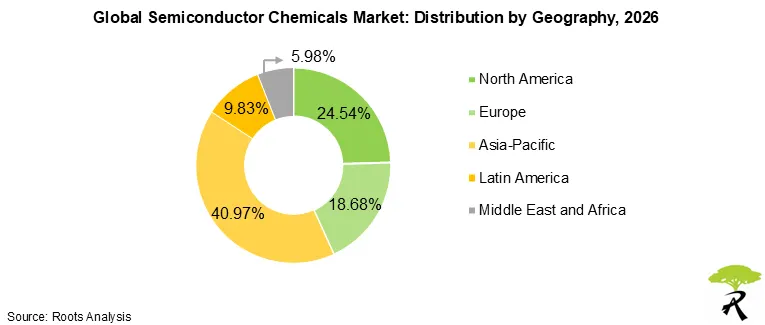
Currently, Asia Pacific dominates the semiconductor chemicals market by capturing 35% market share. This is due to the region’s advanced industrial base, technological process, and focus on meeting the demand for semiconductor materials in different industries.
Within Asia Pacific, South Korea, Japan, and Taiwan are having the strong position in enhancing the production that captures most of the market share, driven by high demand from strong government efforts to support the microprocessor chips sector. Further, China is second largest in capturing market share in the region Asia-Pacific that contributes to stimulate the expansion through increased adoption in microprocessor sectors.
Semiconductor Chemicals Market Grows at a High CAGR in North America
North America is expected to grow at a substantially faster pace during the forecast period, driven by substantial investments in manufacturing and technological progress. Within the continent the US market is rapidly growing because of the existence of big companies that leads to digital transformation in industries including healthcare, telecommunications, automotive, electronics, and manufacturing. As there are major hubs for microprocessor chips, the region is expanding and expected to dominate in the technology innovation in the forecast period by 2040.
Market Dynamics
Key Market Drivers
- Growing Demand for Advanced Chips in Electronics, Automotive, and Data Centers: Rising use of semiconductors in chip packaging chemicals, electronic devices, EVs, 5G services, AI accelerators, and cloud / data-center hardware is sharply increasing consumption of high-purity wafer cleaning chemicals process.
- Government Incentives and On-shoring of Semiconductor Manufacturing: Increasing government policy support such as the EU Chips Act, and similar programs in Asia are driving new fab investments, and demand for semiconductor-grade acids and solvents. In addition, the acts, such as US Chips Act, that was signed in 2022 by 'chips and science act' to lure the microchip manufacturing back in United states after offshoring the technologies are also increasing the semiconductor manufacturing. These initiatives also encourage market players for investments and partnerships.
- Expansion of IoT, 5G, and AI / Edge Devices: Proliferation of connected devices, IoT sensors and AI-enabled systems across industries is expanding the demand for semiconductor chemicals. In addition, the diversity of semiconductor chemicals for advanced chip manufacturing and extreme ultraviolet lithography in wafers, and printed circuit boards (PCBs) is further driving the demand for semiconductor chemicals.
Market Challenges
- Maintaining Ultra-High Purity and Consistency at Scale: High-purity wet chemicals for semiconductor wafer cleaning and etching defects and contaminates tolerances demand by continuous investment in (purification, monitoring, and quality control system) across global networks. Therefore, maintaining ultra-high purity and consistency at the same time can be challenging.
- Balancing Cost, Performance, and Sustainability: Customers expect chemicals that improve performance while also lowering environmental impact and cost, forcing difficult trade-offs in product and process design. IC fabrication chemicals requires high performance chips, that boost the demand by balancing the cost with the increase in demand there is also an increase in investment from government support to influences the high-purity semiconductor chemicals market.
- Adapting Portfolios to Rapid Technology Shifts: Frequent process and materials changes with EUV lithography chemicals (new dielectrics and 3D architecture) require ongoing reformulation, qualification, and capex helps to raise technical and financial risk adoption rates.
Your Business is Unique – Why Shouldn’t Your Report Be?
Key Market Insights
Competitive Landscape of Key Players in Semiconductor Chemicals Market
The industry is fragmented and is experiencing intense competition and changing dynamics, with the increasing demand for consumer electronics and advancements in industries like automotive, driven by the surge of electric vehicles. The industry spans from rapid technological advancements to increasing demand for high performance materials. Specialized regional players, all striving to capitalize the benefits of semiconductor chemicals and sustain their strong position in the global marketplace.
The market structure appears moderately fragmented, with several key players growing with the market share. These companies focus on product launches, merger and acquisitions that semiconductor chemicals are involved in to improve their positions across the globe.
Major players in the semiconductor chemicals market include ADEKA, Air Products and Chemicals, Avantor, BASF, Cabot Microelectronics, Daikin Industries, Eastman Chemical, Entegris, Fujifilm Holdings, JSR, Kanto Chemical, LG Chem, Linde, Merck, Mitsubishi Chemical, Shin-Etsu Chemical, SK materials, Solvay, Sumitomo Chemical, and Tokyo Ohka Kogyo. These companies are adopting aggressive competitive strategies centered on innovation, strategic alliances, and portfolio expansion.
For instance, in July 2025, Merck Group expanded its production in Asia by investing in new facilities and technologies derived in semiconductor chemicals market. The expansion was held strategically by Merck to enhance the regional presence and cater with the increasing demand in Asian market. The investment of €500 million is made to inaugurate the semiconductor sites in Taiwan, it will enable the market to rise as the production for next generation for AI chips is expected to produce in that industry. This investment leads to growth of Merck’s supply chain reliability and responsiveness to solidify the leadership position and meet with the competitive semiconductor chemicals market.
Pay Only for What You Need – The Best Way to Optimize
Increasing Partnerships and Mergers & Acquisitions Activity Shaping the Industry
Strategic partnerships in the semiconductor chemicals market are accelerating innovation and driving sustainable solutions. For instance, in September 2025, Tata electronics has collaborated with Merck Group in a million dollar push to advance India's semiconductor mission. The memorandum has been signed in a strategic move to enable focuses on semiconductor materials, IC fabrication chemicals, and the distribution of specialty chemicals and gases, directly supporting the India Semiconductor Mission.
Similarly, NXP accelerates AI with Kinara in October 2025, they both undergo strategic acquisition. With this move NXP boost its portfolio with high performance, discrete hardware & software stacks and applications, to scale AI edge systems. It offers support to customers and building protection ready solutions.
How is the Growth Driven by Photoresist and Ancillary Chemicals Market for Semiconductor Photolithography as subset of Semiconductor Chemicals Market?
The photoresist and ancillary chemicals market for semiconductor photolithography supports advanced chip manufacturing, driven by semiconductor chemicals demand by EVs, 5G, and data centers and computing applications. Asia Pacific leads the photoresist and ancillary chemicals market for semiconductor chemicals photolithography. This robust transformative shift is driven by the regulatory mandates, technological innovation, and 5G services, and AI and fab expansion. Furthermore, the market trends reflect semiconductor centers on ultraviolet adoption, systems for finer resolution, and integration with AI-driven manufacturing. The growth is also driven in the photoresist chemicals market, specifically tailored from photolithography processes in semiconductors.
Key Trends In Semi-Conductor Chemicals Market
- Node Shrinkage and EUV Adoption
This shift boost demands for high performance sub-5nm processes requires advanced EUV resistance rapidly growing in the ancillaries such as (photoacid generators, developers, and antireflections). - Supply Chain Resilience
The US Chips Act and regional investments spur localized production. This act revitalize semiconductor manufacturing and production for countering foreign dependencies, especially from Asia. It targets advanced nodes, packaging and supply chain components for chemicals and wafers aiming to raise chip outputs to foster innovation ecosystem. - Innovation in Materials
High-purity ancillaries for high-NA EUV enhance yield, with photoacid generators holding highest photolithography share. EUV exposures boosts, and resist sensitivity by reducing dose requirements.
Have Questions? Let’s Get Them Answered
Market Segmentation
Semiconductor Chemicals Market: Scope of the Report
| Key Report Attributes | Details | |
| Historical Trend | Since 2022 | |
| Forecast Period | Till 2040 | |
| Market Size 2026 | $ 29.16 Billion | |
| Market Size 2040 | $ 108.90 Billion | |
| CAGR (Till 2040) | 9.87% | |
| Segments Covered |
|
|
| Key Players Profiled |
|
|
| PowerPoint Presentation (Complimentary) | Available | |
| Customization Scope | 15% Free Customization | |
| Excel Data Packs (Complimentary) |
|
|
Market Segments
Based on research, we have segmented the semiconductor chemicals market into type of semiconductor chemicals, type of process, substrate material, purity grades, application, end use, geographical regions, and key players.
Market Share by Type of Semiconductor chemicals
- Acid & Base Chemicals
- Adhesives
- High-Performance Polymers
- Solvents
Market Share by Type of Process
- Back-End-of-Line (BEOL)
- Epiwafers
- Front-End-of-Line (FEOL)
Market Share by Substrate Material
- Gallium Arsenide
- Germanium
- Silicon
Market Share by Purity Grades
- Electronics Grade
- High-Purity Grade
- Ultra-Pure Grade
Market Share by Application
- Advanced Packaging
- Cleaning
- Deposition
- Doping
- Etching
- Photoresist
Market Share by End Use
- Discrete Semiconductor
- Integrated Circuits
- Optoelectronics
- Sensors
Market Share by Geographical Regions
- North America
- US
- Canada
- Mexico
- Rest of North America
- Europe
- Austria
- Belgium
- Denmark
- France
- Germany
- Ireland
- Italy
- Netherlands
- Norway
- Russia
- Spain
- Sweden
- Switzerland
- UK
- Rest of Europe
- Asia
- China
- India
- Japan
- Singapore
- South Korea
- Rest of Asia
- Latin America
- Brazil
- Chile
- Colombia
- Venezuela
- Rest of Latin America
- Middle East and North Africa (MENA)
- Egypt
- Iran
- Iraq
- Israel
- Kuwait
- Saudi Arabia
- UAE
- Rest of the MENA
- Rest of the World
- Australia
- New Zealand
- Other countries


