Semiconductor Manufacturing Equipment Market Overview
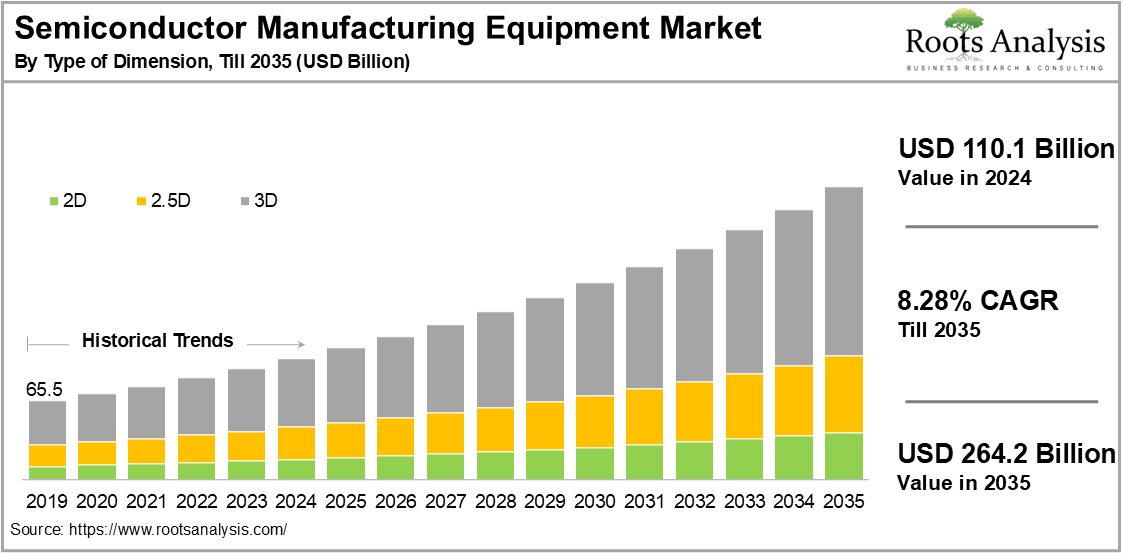
The semiconductor manufacturing equipment market size is projected to grow from USD 110.1 billion in 2024 to USD 264.25 billion by 2035, representing a CAGR of 8.28%, during the forecast period till 2035.
To learn more about this report, request a free sample copy
According to the Semiconductor Industry Association, global semiconductor sales witnessed a robust 18% year-over-year increase in Q2 2024, underscoring the sector’s upward trajectory. At the heart of this growth lies semiconductor manufacturing equipment, a category that includes advanced systems like lithography units, etching machines, and chemical mechanical planarization (CMP) tools. These specialized instruments each play a crucial role in the intricate semiconductor fabrication process.
What sets this equipment apart is its modular design, precision engineering, and integration of next-gen metrology tools. These features ensure rigorous quality control, making the equipment indispensable not only in electronics but also in automotive manufacturing, construction, and healthcare technologies.
The market for semiconductor manufacturing equipment is expected to expand steadily over the forecast period. This momentum is largely driven by factors, such as technological innovations, growing demand from emerging economies like China and India, and a global push toward eco-efficient manufacturing solutions.
One of the most transformative innovations in this space is Extreme Ultraviolet (EUV) lithography. This breakthrough technology enables the creation of ultra-compact and complex chip architectures, paving the way for more powerful and energy-efficient devices. EUV is becoming especially critical as industries demand lightweight, high-performance components, particularly in next-gen automotive design where reducing emissions and boosting fuel efficiency are top priorities.
Other innovations, such as atomic layer deposition (ALD) and advanced etching processes are also raising the bar. These technologies enhance precision during chip production, allowing manufacturers to fabricate highly detailed circuit patterns with improved efficiency and scalability. Additionaly, as chip geometries shrink, precision inspection tools from the 3D metrology are becoming essential to maintain yield rates
Industry leaders are not just innovating - they’re also collaborating. For instance, in September 2024, Intel and AWS deepened their strategic partnership to advance semiconductor manufacturing. By combining Intel’s chip expertise with AWS’s cloud infrastructure, the collaboration aims to streamline production processes and unlock new efficiencies across the supply chain.
Semiconductor Manufacturing Equipment Market Insights
The global semiconductor manufacturing equipment market research report presents an in-depth analysis of the various companies that are involved in offering semiconductor manufacturing equipment, across different segments, as defined in the table below:
Semiconductor Manufacturing Equipment Market: Report Attributes / Market Segmentations
| Key Report Attributes |
Details |
| Historical Trend |
Since 2019 |
| Forecast Period |
Till 2035 |
| Current Market Size |
$ 110.1 Billion |
| Market Size Value by 2035 |
$ 264.2 Billion |
| CAGR (Till 2035) |
8.28% |
| Type of Equipment |
- Back-end Equipment
- Front-end Equipment
|
| Type of Dimension |
|
| Type of Application |
- Semiconductor Electronics Manufacturing
- Semiconductor Fabrication Plant/Foundry
- Testing & Inspection
|
| Type of Distribution Channel |
- Direct Sales
- Distributors
- Retailers
|
| Geographical Regions |
- North America
- US
- Canada
- Mexico
- Other North American countries
- Europe
- Austria
- Belgium
- Denmark
- France
- Germany
- Ireland
- Italy
- Netherlands
- Norway
- Russia
- Spain
- Sweden
- Switzerland
- UK
- Other European countries
- Asia
- China
- India
- Japan
- Singapore
- South Korea
- Other Asian countries
- Latin America
- Brazil
- Chile
- Colombia
- Venezuela
- Other Latin American countries
- Middle East and North Africa
- Egypt
- Iran
- Iraq
- Israel
- Kuwait
- Saudi Arabia
- UAE
- Other MENA countries
- Rest of the World
- Australia
- New Zealand
- Other countries
|
| Leading Market Players |
- ASML
- Advantest
- Applied Materials
- Canon
- Ferrotec Holdings
- Hitachi High-Tech
- KLA Corporation
- Lam Research
- Modutek
- Nikon
- Nordson
- Onto Innovation
- Plasma-Therm
- QP Technologies
- SCREEN Semiconductor Solutions
- Teradyne
- Tokyo Electron
- Veeco Instruments
|
PowerPoint Presentation
(Complimentary) |
Available |
| Customization Scope |
15% Free Customization |
Excel Data Packs
(Complimentary) |
- Competitive Landscape
- Company Competitive Analysis
- Patent Analysis
- Funding Analysis
- Recent Developments
- Market Forecast and Opportunity Analysis
|
Semiconductor Manufacturing Equipment Market Segmentation
What Are the Leading Equipment Types Driving Growth in the Semiconductor Manufacturing Equipment Market?
When segmented by type, the semiconductor manufacturing equipment market is broadly categorized into front-end equipment and back-end equipment. According to recent market analysis, front-end equipment currently holds the lion’s share - accounting for over 60% of the global market.
This dominance is expected to continue, with the front-end segment projected to grow at a CAGR of 8.78% in the coming years. The upward trend is largely due to the segment’s central role in semiconductor chip fabrication and the rising adoption of advanced technologies like AI, IoT, and 5G. Investments in front-end tools - such as lithography and deposition systems - are critical for achieving the precision required in cutting-edge semiconductors.
Why is 3D Equipment Gaining Market Share in Semiconductor Manufacturing?
Looking at the market by equipment dimension, the segmentation includes 2D, 2.5D, and 3D semiconductor manufacturing equipment. Among these, 3D equipment is currently leading, contributing to over 50% of the market share.
The reason? 3D semiconductor technology offers design flexibility and complex architecture capabilities that traditional 2D systems simply can’t match. With a projected CAGR of 8.94%, this segment is poised for significant growth - especially in precision-driven sectors like aerospace, medical devices, and automotive electronics. As demand for miniaturized and multifunctional chips rises, so does the appeal of 3D fabrication solutions.
Which Applications Are Fueling Demand for Semiconductor Manufacturing Equipment?
By application, the market is segmented into three major areas:
- Semiconductor electronics manufacturing
- Semiconductor fabrication plants (foundries)
- Semiconductor testing and inspection tools
Among these, semiconductor fabrication plants dominate, expected to hold over 35% of the market share in 2024. The segment is also forecasted to grow at a CAGR of 8.85% through 2035.
This growth reflects the surging demand for next-gen semiconductor technologies, which has prompted substantial investments in new fabs and advanced process nodes. As foundries ramp up production to meet global chip shortages, the need for high-precision, efficient, and scalable equipment has never been greater.
How Are Distribution Channels Evolving in the Global Semiconductor Manufacturing Equipment Market?
Currently, the distributor channel leads the way with more than 60% market share. Distributors are expected to maintain this dominance thanks to their extensive global supply networks, specialized product handling, and ability to scale delivery across geographies.
The growing demand for high-performance semiconductors across industries like automotive, defense, and consumer electronics is fueling this trend. Distributors play a vital role by bridging the gap between manufacturers and end-users, ensuring timely delivery and technical support across diverse markets.
Which Regions Are Leading the Semiconductor Manufacturing Equipment Market?
The global semiconductor manufacturing equipment market demonstrates varied growth patterns across different geographies. Key regions driving demand include Asia, North America, Europe, Latin America, the Middle East, North Africa, and other emerging markets worldwide. Each region brings unique strengths to the table - ranging from technological capabilities to supply chain maturity.
Why is Asia Dominating the Semiconductor Manufacturing Equipment Industry?
Asia is currently the largest contributor to the global semiconductor manufacturing equipment market, holding a substantial ~45% market share. This commanding position is the result of several synergistic factors:
- Supportive government policies and infrastructure initiatives
- A robust economic and industrial base that supports end-to-end chip production
- High-volume R&D investments that lead to superior silicon technologies
- A diverse set of end-user industries adopting advanced semiconductors, from automotive to consumer electronics
In addition, Asia hosts global powerhouses like TSMC (Taiwan Semiconductor Manufacturing Company) and Samsung, which continue to drive innovation, scale, and international competitiveness.
India is also emerging as a noteworthy player. In a public address in New York, Prime Minister Narendra Modi signaled India’s semiconductor ambition by stating, “The time is approaching when you'll encounter semiconductor chips manufactured in India right here in America.”
This reflects Asia’s growing strategic influence - not just in manufacturing capacity, but also in shaping the future of semiconductor supply chains globally.
What’s Driving Growth in North America’s Semiconductor Equipment Market?
While Asia leads in volume, North America is projected to grow at a comparatively higher CAGR during the forecast period. This growth is powered by the region’s advanced technological infrastructure, high spending on semiconductor innovation, and policy-level initiatives aimed at boosting domestic chip production.
The U.S., in particular, is investing heavily in reshoring semiconductor manufacturing, with public and private sectors collaborating to reduce reliance on overseas suppliers. These moves, coupled with increased demand for AI, IoT, and 5G components, are pushing North America’s market potential upward.
What About Other Regions?
- Europe is showing steady growth, supported by innovation in automotive electronics and smart manufacturing.
- Latin America and the Middle East & North Africa (MENA) regions are still in the nascent stages but present untapped potential as local industries adopt digital technologies and modernize their production capabilities.
What Are the Key Insights Driving the Semiconductor Manufacturing Equipment Market Growth?
The “Semiconductor Manufacturing Equipment Market, Till-2035: Industry Trends and Global Forecasts" report features an extensive study of the current market landscape, market size and future opportunity within semiconductor manufacturing equipment market, during the given forecast period. The market report highlights the efforts of several stakeholders involved in this rapidly emerging segment of the service providers industry. Key takeaways of the global semiconductor manufacturing equipment market report are briefly discussed below.
What Are the Main Drivers Behind the Semiconductor Manufacturing Equipment Market Expansion?
Several trends are accelerating the growth of the semiconductor manufacturing equipment market, particularly the demand for high-performance chipmaking technologies across industries. Below are the top factors contributing to this market momentum:
Primary Growth Catalysts:
- Rising electronics consumption: Smartphones, laptops, and other consumer electronics continue to drive global chip demand.
- Expansion of renewable energy technologies: Semiconductor equipment is vital in solar panel and energy storage component production.
- Automotive sector evolution: The rise of electric vehicles (EVs) has led to greater reliance on silicon-based components and custom semiconductors.
- Industrial growth in emerging economies: Countries like India, China, and Japan are investing heavily in industrial infrastructure and chip manufacturing capacity.
- Advancements in AI, IoT, and 5G: These technologies require ultra-fast, compact, and efficient chips - prompting greater demand for precision fabrication equipment.
Industry Highlight: In July 2024, Nearfield Instruments raised $14.76 million in Series C funding, focused on enhancing their next-gen semiconductor manufacturing equipment offerings.
How Competitive Is the Semiconductor Manufacturing Equipment Market?
The competitive landscape is dynamic, characterized by both well-established multinational firms and smaller, innovative startups. Each type of player is actively pursuing different strategies to secure market share.
Market Structure Overview:
- Multinational corporations dominate global revenue, leveraging advanced R&D and global supply chains.
- Smaller and mid-sized players are gaining ground by targeting niche markets or offering specialized, modular equipment solutions.
Strategic Moves by Industry Leaders:
- Forming strategic partnerships and alliances to expand geographic and service reach.
- Investing in new product development, focusing on AI-integrated, energy-efficient fabrication tools.
- Enhancing global footprints through facility expansions, localized service networks, and regional manufacturing hubs.
Together, these efforts reflect a highly competitive environment where continuous innovation and agility are essential for long-term success.
Challenges in Semiconductor Manufacturing Efficiency
Despite strong market growth projection, the semiconductor manufacturing equipment market faces numerous challenges. The most common challenge is high equipment costs are increasing production costs of semiconductors. Talent shortage in semiconductor field hampers market growth, while rising operational costs and fluctuating demand across various sectors add further complexity. Further, semiconductor supply chain management disruptions, exacerbated by geopolitical events and the COVID-19 pandemic, have led to inconsistent product availability.
Leading Semiconductor Manufacturing Equipment Manufacturers
Examples of key player involved in the semiconductor manufacturing equipment market (which have also been captured in this market report, arranged in alphabetical order) include ASML, Advantest, Applied Materials, Canon, Ferrotec Holdings, Hitachi High-Tech, KLA Corporation, Lam Research, Modutek, Nikon, Nordson, Onto Innovation, Plasma-Therm, QP Technologies, SCREEN Semiconductor Solutions, Teradyne, Tokyo Electron and Veeco Instruments. This market report includes an easily searchable excel database of all the companies who have adopted the semiconductor manufacturing equipment market.
Recent Developments in Semiconductor Manufacturing Equipment
- In September 2024, Tata Electronics signed a memorandum with Tokyo Electron to procure semiconductor manufacturing equipment and services for its facilities in Gujarat and Assam.
- In February 2024, HCL Technologies expanded its collaboration with Intel Foundry to co-develop customized silicon solutions for semiconductor manufacturers and cloud service providers.
- In February 2024, Purdue University collaborated with Dassault Systèmes to develop virtual twin technology aimed at enhancing semiconductor education and research.
Semiconductor Manufacturing Equipment Market Report Coverage
The market report presents an in-depth analysis, highlighting the capabilities of various companies engaged in this domain, across different segments. Amongst other elements, the market report includes:
- A preface providing an introduction to the full report, semiconductor manufacturing equipment market, 2019-2023 (Historical Trends) and till-2035 (Forecasted Estimates).
- An outline of the systematic research methodology adopted to conduct the study on the semiconductor manufacturing equipment market, providing insights on the various assumptions, methodologies, and quality control measures employed to ensure the accuracy and reliability of our findings.
- An overview of economic factors that impact the overall semiconductor manufacturing equipment market, including historical global semiconductor manufacturing equipment market trends, currency fluctuation, foreign exchange impact, recession, and inflation measurement.
- An executive summary of the insights captured during our research. It offers a high-level view on the current state of the semiconductor manufacturing equipment market and their likely evolution in the mid-long term.
- A detailed assessment of the semiconductor manufacturing equipment market landscape, based on several relevant parameters, including years of experience, company size, location of headquarters, and ownership structure.
- Elaborate profiles of prominent players engaged in the semiconductor manufacturing equipment market, featuring information on their year of establishment, location of headquarters, company size, company mission, company footprint, management team, contact details, financial information, operating business segments, semiconductor manufacturing equipment portfolio, moat analysis, recent developments, and an informed future outlook.
- A qualitative assessment of the various megatrends ongoing in the semiconductor manufacturing equipment industry, including the increasing demand for electronics devices, research and development focus, and the evolving regulatory guidelines.
- An analysis highlighting the key unmet needs across semiconductor manufacturing equipment industry, featuring insights generated from real-time data on unmet needs as identified from social media posts, recent publications, industry blogs and the views of key opinion leaders expressed on online platforms.
- An in-depth analysis of various patents that have been filed / granted related to semiconductor manufacturing equipment and its components, based on various parameters, such as type of patent, patent publication year, patent age and leading players
- A detailed analysis of recent developments in the semiconductor manufacturing equipment domain, based on relevant parameters such as year of initiative, type of initiative (partnerships and collaborations, expansions, funding and product launches), geographical distribution and most active players (in terms of number of recent developments).
- Key winning strategies framework that helps in analyzing the level of competition within an industry, by tracing the key market activities including partnership, funding, expansion of leading players
- A qualitative analysis, highlighting the five competitive forces prevalent in semiconductor manufacturing equipment industry, including threats for new entrants, bargaining power of suppliers, bargaining power of customers, threats of substitution and rivalry among existing competitors.
- A discussion on affiliated global semiconductor manufacturing equipment price trends, key drivers and challenges, under a SWOT framework, which are likely to impact the industry’s evolution, along with a Harvey ball analysis, highlighting the relative effect of each SWOT parameter on the overall semiconductor manufacturing equipment market.
- A value chain analysis featuring a discussion on various stakeholders involved in the development of the semiconductor manufacturing equipment market, from semiconductor manufacturing equipment suppliers to end-users.
- A detailed estimate of the current semiconductor manufacturing equipment market size and share of the future growth potential of the market over the next decade. Based on multiple parameters we have provided an informed estimate on the market evolution during the forecast period 2024-2035. The report also features the likely distribution of the current and forecasted opportunity within the semiconductor manufacturing equipment market. Further, in order to account for future uncertainties and to add robustness to our model, we have provided three forecast scenarios, namely conservative, base, and optimistic scenarios, representing different tracks of the industry’s growth.
- Detailed projections of the current and future market across various type of equipment such as back-end equipment and front-end equipment.
- Detailed projections of the current and future market across various type of dimension such as 2D, 2.5D and 3D.
- Detailed projections of the current and future market across various types of application such as semiconductor electronics manufacturing, semiconductor fabrication plant/foundry and testing & inspection.
- Detailed projections of the current and future market across various types of distribution channel such as direct sales, distributor and retailers.
- Detailed projections of the current and future semiconductor manufacturing equipment market across various geographical regions, such as North America (US, Canada, Mexico and other North American countries), Europe (Austria, Belgium, Denmark, France, Germany, Ireland, Italy, Netherlands, Norway, Russia, Spain, Sweden, Switzerland, UK and other European countries), Asia (China, India, Japan, Singapore, South Korea and other Asian countries), Middle East and North Africa (Egypt, Iran, Iraq, Israel, Kuwait, Saudi Arabia, UAE and other MENA countries), Latin America (Brazil, Chile, Colombia, Venezuela and other Latin American countries) and rest of the world (Australia, New Zealand and other countries).
Author: Ronit Sharma and Rishav Thakur
Customization Opportunities
At Roots Analysis, we genuinely care about your success and understand that your business requirements are unique. While our market research reports provide valuable insights, we recognize that they might not cover every aspect you need to make well-informed strategic decisions. To account for that, we offer 15% free report customization tailored to your specific needs. Whether you require additional quantitative analysis, qualitative insights, or any other information related to the semiconductor manufacturing equipment market, reach out us today at: support@rootsanalysis.com
Frequently Asked Questions
What is semiconductor manufacturing equipment?
Semiconductor manufacturing equipment refers to the specialized machinery and tools used in the production of semiconductor devices, including integrated circuits (ICs) and microchips.How big is the semiconductor manufacturing equipment market?
The semiconductor manufacturing equipment market size forecast is estimated to be worth $110.1 billion in 2024.What is the projected semiconductor manufacturing equipment market growth forecast ?
According to semiconductor manufacturing equipment revenue forecast, the market is expected to grow at a compounded annual growth rate (CAGR) of over 8.28 % during forecast 2024-2035.What are the driving factors of the semiconductor manufacturing equipment market?
Driving factors for the semiconductor manufacturing equipment market are technological advancements that enable the production of smaller, more efficient devices, alongside the growing demand for semiconductors fueled by the adoption of IoT, AI, and the rollout of 5G networks.Which technologies are transforming the semiconductor manufacturing process?
Innovations such as Extreme Ultraviolet (EUV) lithography, atomic layer deposition (ALD), and advanced etching techniques are revolutionizing chip design. These technologies enable the production of smaller, faster, and more energy-efficient semiconductors.What are the leading companies in the semiconductor manufacturing equipment market?
Leading semiconductor manufacturing equipment market players includes ASML, Advantest, Applied Materials, Canon, Ferrotec Holdings, Hitachi High-Tech, KLA Corporation, Lam Research, Modutek, Nikon, Nordson, Onto Innovation, Plasma-Therm, QP Technologies, SCREEN Semiconductor Solutions, Teradyne, Tokyo Electron and Veeco Instruments companies are some of the prominent companies in the semiconductor manufacturing equipment market.What is the leading region in the semiconductor manufacturing equipment market?
Currently, Asia is dominating the semiconductor manufacturing equipment market.How is sustainability impacting semiconductor manufacturing equipment trends?
There is a growing focus on sustainable chip production. Manufacturers are developing energy-efficient equipment, optimizing material usage, and integrating circular economy practices to reduce the carbon footprint of semiconductor fabrication.