Semiconductor Market
Semiconductor Market by Type of Component (Memory Devices, Logic Devices, Analog ICs, MPU and Others), Technology (MOSFET, FinFET, Gate-First, Gate-Last, 3D Stacked and Others), Type of Packaging, Power Consumption, Type of Memory Device, Application Area, Node Size, Type of Fabrication Material, Geographical Regions, and Leading Players – Trends and Forecasts 2026-2040
-
Lowest Price Guaranteed
-
Slides
218 -
Last Updated
June 2026 -
View Count
31361 -
Semiconductor Market Size & Share
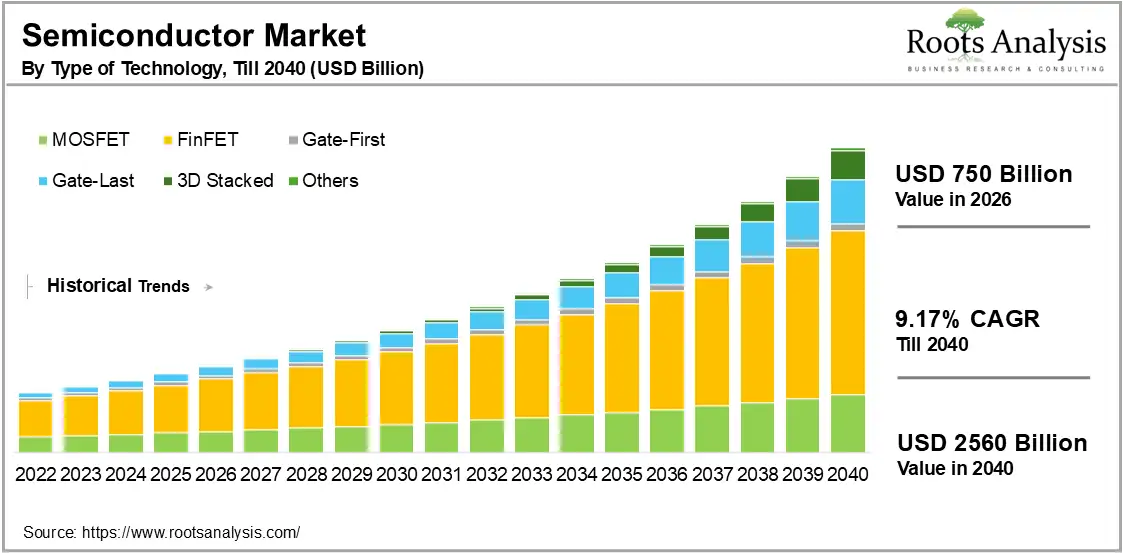
The global semiconductor market size is projected to rise from USD 750 billion in 2026 to USD 2,560 billion by 2040, representing a CAGR of 9.17%, during the forecast period, 2026-2040.
To learn more about this report, request a free sample copy
The fourth industrial revolution (Industry 4.0) is transforming manufacturing through smart systems, automation, and connected devices. Over the years, the global demand for electronic goods, data center chips, integrated circuit, battery and others has also increased to make human life easier. Owing to this fact, manufacturers are incessantly utilizing silicon and other elements to produce discrete semiconductors which are a vital part in electronic devices. Semiconductors are essential components that power modern electronic devices, enabling core functionality across industries.
From construction to aerospace and the telecommunications industry, semiconductors have found their application across a number of fields; automotive systems, such as stability control and traction control systems use advanced micro integrated circuits and memory integrated circuits to improve safety and performance of the vehicle. The global industry analysis indicates a robust recovery post pandemic, following a challenging 2026, with the market growth forecast projecting an impressive annual increase. Key semiconductor market trends include:
- Rising demand driven by generative AI.
- Inclusion of virtual reality for smart manufacturing.
- Cloud computing, and advanced automotive technologies, which are expected to reshape the semiconductor supply chain.
Further, the semiconductor market outlook for 2026 suggests a favorable environment for innovation and investment, as companies adapt to evolving semiconductor technology trends and a heightened use of logic integrated circuits. In June, Canon reported the development of high-performance semiconductor material to improve durability and mass production stability of perovskite solar cells.
Semiconductor Market Share Insights
In September 2024, the Semiconductor Industry Association (SIA) announced the appointment of Greg LaRocca as the director of industry research and economic policy. Following the appointment, SIA president and chief executive officer John Neuffer stated, “During this highly consequential time for the semiconductor industry, it is critical for SIA to provide accurate data and effective analysis to help guide government policies that will promote growth and innovation in our industry”.
It is interesting to note that the semiconductor supply chain in the US alone, employs over 250,000 workers and additionally supports over 1 million jobs within the country. Multifunctionality of the microprocessor chips, and the rising demand for semiconductors by companies engaged in the artificial intelligence (AI) and communication industry is expected to fuel the market further, over the next few decades. Consumers are increasingly seeking smaller sized chips for different semiconductor applications and greater number of transistors to support their devices. Moreover, driven by the incorporation of Internet of Things (IoT) in daily life, the demand for improved semiconductors is anticipated to rise over the forecast timeline.
The semiconductor market research report presents an in-depth analysis of various leading players involved in manufacturing innovative semiconductor chips, microprocessors and ICs, across different segments, as defined in the table below:
Semiconductor Market: Report Attributes / Market Segmentations
| Key Report Attributes | Details | |
| Historical Trend | Since 2022 | |
| Base Year | 2025 | |
| Forecast Period | 2026-2040 | |
| Market Size Value in 2026 | $ 750 Billion | |
| Market Size Value by 2040 | $ 2560 Billion | |
| Growth Rate | CAGR of 9.17% from 2026 to 2040 | |
| Type of Component |
|
|
| Technology |
|
|
| Type of Packaging |
|
|
| Power Consumption |
|
|
| Type of Memory Device |
|
|
| Application Area |
|
|
| Node Size |
|
|
| Type of Fabrication Material |
|
|
| Geography |
|
|
| Key Companies Profiled in the Semiconductor Market |
|
|
| PowerPoint Presentation (Complimentary) |
Available | |
| Customization Scope | 15% Free Customization | |
| Excel Data Packs (Complimentary) |
|
|
Semiconductor Market Key Segments
Market Share by Type of Component
The global semiconductor market is segmented into different types of components, such as memory devices, logic devices, analog ICs, MPU and others. Currently, memory devices are expected to capture around 35% share in the market. However, driven by the rapid demand for smart devices, including smart phones, watches and smart televisions, the market for analog ICs and other novel semiconductor technology is expected to grow at a higher CAGR over the forecast timeline.
Market Share by Technology
The global semiconductor market is segmented into different technologies, such as MOSFET, FinFET, Gate-First, Gate-Last, 3D stacked and others. Currently, metal oxide semiconductor field effect transistors are expected to capture the highest share in the market. However, owing to the fact that fin-field effect transistors (FinFET) show lower leakage of current which allows them to operate at a relatively lower power consumption, the market for FinFET technology is expected to grow at a higher CAGR during the forecast period, opening new avenues in the semiconductor supply chain.
Market Share by Type of Packaging
The global semiconductor market is segmented into different types of packaging, such as System-in-Package (SiP), System-on-Chip (SoC), System-on-Module (SoM), Chip-on-Board (COB), Chip-on-Flex (COF) and others. Currently, SoCs are expected to capture the highest share in the market. However, owing to the fact that SoP provides flexibility and customization options for the users, the market for SoP packaging is expected to grow at a higher CAGR over the forecast timeline.
Market Share by Type of Memory Devices
The global market is segmented into different types of memory devices, such as DRAM, SRAM, flash drives, ROM and others. Currently, DRAMs are expected to capture the highest share in the semiconductor market. However, owing to the faster data transfer speeds offered by SRAM, the market for SRAM devices is expected to grow at a higher CAGR over the forecast timeline.
Market Share by Application Area
The global semiconductor market is segmented into different application areas, such as telecommunication, defense and military, industrial, consumer electronics, automotive sector and others. Presently, semiconductors used in telecommunication devices are expected to capture the highest share. This can be attributed to the introduction of 5G technology enabling high speed data transfer with low latency across different cloud-connected devices.
Market Share by Node Size
The global semiconductor industry is segmented into different node sizes, such as 16/14nm, 10/7nm, 7/5nm, 65nm and other sizes. Currently, chips with a node size of 16/14nm capture the highest share in the semiconductor market. However, driven by the increasing demand for smaller transistor chips, the market for semiconductors with a node size of 7 / 5nm is expected to grow at a higher CAGR till 2040. Leading companies such as Samsung Electronics and the Taiwan Semiconductor Manufacturing Company (TSMC) have started producing 7nm processor chips, however, semiconductors with even smaller sizes are anticipated to be manufactured over the next few years.
Market Share by Type of Fabrication Material
The global semiconductor industry is segmented into different type of fabrication materials, such as silicon, germanium and others. Presently, silicon-based semiconductors capture the highest share in the semiconductor market and this trend is likely to remain the same over the forecast timeline. This can be attributed to the fact that silicon is relatively easy to purify and abundantly available along with the stable structure of the element.
Market Share by Geography
This segment highlights the distribution of the global semiconductor industry across various geographies, such as North America, Europe, and Asia-Pacific, Latin America, and the Middle East and Africa. According to our projections, currently, Asia-Pacific captures the majority share of the market opportunity. It is worth highlighting that the semiconductor market in North America is expected to grow at a relatively higher CAGR, during the forecast period, 2026-2040.
Semiconductor Market Key Insights
Key Growth Drivers of the Semiconductor Market
The global semiconductor market size growth is primarily attributed to the increasing adoption of smart devices and IoT over the last few years. Interconnected, daily-use home appliances and wearables are driving the demand for semiconductors that enable efficient data transfer and processing. It is also interesting to note that the demand for AI-related semiconductors is anticipated to grow significantly. AI applications require powerful microprocessors, which are provided by customized semiconductors. Further, the increasing adoption of electric vehicles is also fueling the demand for semiconductors used in batteries, motor control systems, and other components.
Regional Semiconductor Industry Highlights: Asia-Pacific Holds the Largest Share
Presently, majority of the market share is captured by Asia-Pacific. The higher demand for semiconductors in Asia-Pacific is driven by the recent shift of consumer electronics production to the region and the high disposable income for such goods. However, the market for these products in North America is expected to grow at a relatively higher CAGR, during the forecast period. According to the World Semiconductor Trade Statistics (WSTS), the US semiconductor companies dominate the sales market share across all the major geographies, this is further likely to drive the market within the region.

Leading Players in the Semiconductor Market
Examples of key companies involved in the global semiconductor industry (which have also been captured in this market report, arranged in alphabetical order) include Analog Devices, Broadcom, Infineon Technologies, Intel, Maxim Integrated Products, MediaTek, Microchip Technology, Micron Technology, NVIDIA and NXP Semiconductors. This market report includes an easily searchable excel database for the leading companies offering semiconductors along with information on their product portfolios.
Recent Developments in The Semiconductor Market
Several recent developments have taken place in the market, some of which have been outlined below.
- January 2026: Global semiconductor sales reached USD 82.5 billion, representing a 3.7% increase from December 2025 and a 46.1% increase compared to January 2025, driven largely by demand in China and the Asia-Pacific region.
- November 2025: The Semiconductor Industry Association (SIA) reported global chip sales of USD 75.3 billion for the month, a 29.8% year-over-year increase from November 2024.
- October 2025: Intel unveiled its Panther Lake advanced semiconductor technology, marking the first 2nm-class node (Intel 18A) produced at its Fab 52 facility in Arizona
- October 2025: UK-based Graphcore announced a USD 1.3 billion investment plan for India over the next decade to expand R&D capacity and support AI semiconductor development.