


 Download Free Sample
 Buy Now
Market Outlook
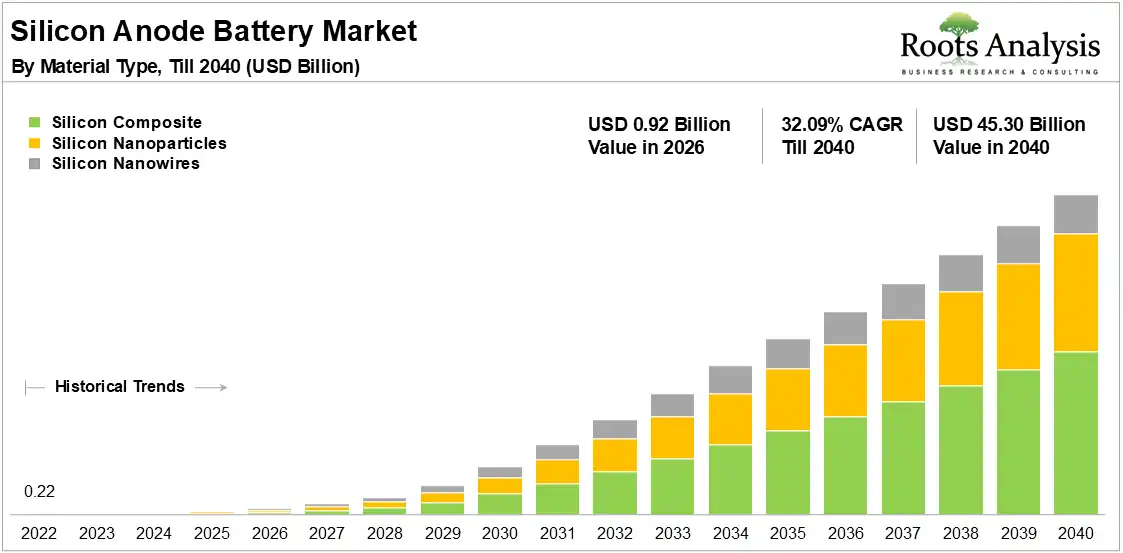
The silicon anode battery market is projected to reach USD 0.92 billion in 2026 and USD 45.30 billion by 2040, representing a compounded annual growth rate of 32.09% during the forecast period 2026 to 2040.
See What’s in the Full Report - Request Your Complimentary Insights!
The silicon-anode battery market covers materials and technologies that replace graphite with silicon in lithium-ion batteries to deliver higher energy density. Silicon provides a substantially greater theoretical capacity for lithium-ion storage than conventional anodes, enabling lighter and more compact batteries with improved performance. The scope of silicon battery includes anode material development, cell manufacturing processes, and integration solutions for demanding applications where premium pricing is acceptable. At its core, this market is defined by efforts to manage silicon instability during repeated charging cycles to unlock next-generation battery performance.
Growth is driven by rising requirements for extended driving range in electric vehicles (EVs) and longer battery life in premium consumer electronics and high-performance computing. Silicon anodes address these adoption drivers by offering a credible route to energy density gains beyond the limits of conventional lithium-ion chemistry. Commercial momentum is gaining traction, highlighted by Sila Nanotechnologies’ announcement that its silicon anode materials will power the Mercedes-Benz G-Class EV, signaling real-world validation of the technology.
Innovation in silicon anode batteries increasingly focuses on controlling silicon’s volume expansion through nanostructured designs and composite materials to enhance cycle life and reliability. This progress is being reinforced by battery giga factory development and pipeline expansion, as companies such as Amprius Technologies advance plans to deploy silicon batteries in high-altitude pseudo satellites and electric aircraft. The broader industry outlook indicates sustained R&D investment, alongside strategic partnerships and large-scale manufacturing initiatives, aimed at overcoming technical barriers and enabling eventual mass-market automotive adoption.
Market Report: Key Takeaways
- Leading Players Competitive Footprint: Key companies include Amprius, Anovion Technology, E-magy, Enevate, Enovix, Group14 Technologies, NanoGraf Corporation, Nanospan, NEO Battery Materials, Nexeon, OneD Battery Sciences, Samsung, Sicona Battery Tech, Sila Nanotechnologies, StoreDot, Svolt, XG Sciences, and Zenlab Energy. These firms hold strong market positions with extensive geographic presence in various regions.
- Startup Ecosystem and Innovation Hotspots: Early-stage companies are focusing on catering innovations addressing silicon's volume expansion challenges, with strong momentum in EV and consumer electronics applications. Companies are making advancements in areas, such as silicon-carbon composites and nanowires dominate, with firms like Sila achieving consistent production at new US facilities.
- Regional Penetration and Adoption Trend: Rapid industrialization, surging electric vehicle production, and expanding applications in consumer electronics and energy storage drive regional growth of the silicon anode battery market in Asia Pacific. Notably North America drives demand through robust R&D investments, automotive innovation, and government incentives for advanced battery technologies.
- Pouch Cell holds Highest Market Segment: In terms of market share distribution by battery type, pouch cell holds the maximum market share as their flexible packaging better accommodates silicon’s volume expansion during charging cycles. This ability to tolerate silicon swelling enables higher energy density and makes pouch cells well suited for consumer electronics and early electric vehicle applications.
- Opportunities in the Silicon Anode Battery Market: Integration with next-generation battery architecture is emerging as a key enabling pathway, particularly for solid-state batteries (SSBs). Silicon anodes in SSBs can benefit from the mechanical support of solid electrolytes, which may mitigate the volume expansion challenges associated with liquid electrolyte systems, thereby unlocking higher performance, improved safety, and greater durability for next-generation electric vehicles.
- Funding and Investment Momentum: The silicon industry sees steady investment from targeting model optimization and compiler ecosystems within private equity firms, government grants, and largely directed towards sustainable product innovation.
Recent Industry Developments
- May 2025: Enevate unveils silicon cell technology for fast charging, and high energy density batteries for electric vehicles.
- May 2025: BASF and Group14 developed a drop-in-ready solution that greatly enhances the performance of batteries with silicon anodes, delivering faster charging, and higher energy density with extreme durability even in the most challenging conditions.
- March 2025: Amprius has shipped its new 6.3 Ah SiCore cell to light electric vehicle segment. The battery is intended for applications that require more efficient energy storage solutions such as robotics as potential markets in addition to the EV market.
- February 2024: Enovix Corporation announced it had completed initial commercial shipments of its advanced silicon-anode batteries to a prominent U.S. technology company for integration into high-value consumer electronics.
Pay Only for What You Need – The Best Way to Optimize
Market Dynamics
Key Market Drivers
- Demand for Extended EV Range and Performance: Silicon anode technology enables higher energy density (Wh/L and Wh/kg) than traditional graphite anodes, directly addressing consumer demand for longer electric vehicle range without increasing battery pack size or weight. This capability is particularly crucial for premium EV segments and performance vehicles where a high power-to-weight ratio is essential.
- Miniaturization in High-Performance Consumer Electronics: As consumer electronics like smartwatches, AR/VR headsets, and smartphones integrate more power intensive features (such as 5G connectivity, advanced processors, high-resolution screens), demand grows for batteries that offer superior energy density in small form factors. Silicon Anodes allow for significantly longer runtimes in these constrained spaces, driving adoption among leading device manufacturers.
- Significant Venture Capital Investment and Commercial Milestones: The silicon anode space has seen substantial recent investment from major venture capital firms and strategic partnerships between battery manufacturers (e.g. CATL, SK Innovation) and material science startups (e.g. Sila Nanotechnologies, Group14 Technologies). This influx of capital and strategic alliances validates technology’s potential and accelerates the transition from laboratory prototypes to commercially viable solutions.
Market Restraints
- High Cost of Manufacturing and Materials: From a lithium-ion battery cost analysis perspective, silicon anodes currently exhibit a significantly higher cost structure than traditional graphite-based alternatives, driven by complex processing requirements, specialized material inputs, and lower manufacturing yields during scale-up. This cost disparity limits adoption in price-sensitive segments, particularly mass-market electric vehicles and stationary energy storage systems, where cost per kilowatt-hour remains the primary purchasing determinant.
- Limited Cycle Life and Durability Issues: Severe volumetric expansion during lithiation continues to undermine the long-term durability of silicon anodes, accelerating mechanical degradation and capacity fade. While composite approaches reduce these effects, achieving a high-silicon anode configuration with sustained cycle life suitable for mainstream EV use remains a major barrier to widespread commercialization.
- Lack of Standardization and Manufacturing Processes: The absence of standardized production methods and integration protocols across silicon anode variants introduces complexity throughout the battery value chain. Divergent material approaches increase engineering customization requirements for cell manufacturers and equipment suppliers, slowing adoption and raising implementation costs.
Market Share Insights
Market Share by Application: Consumer Electronics Hold the Largest Market Share
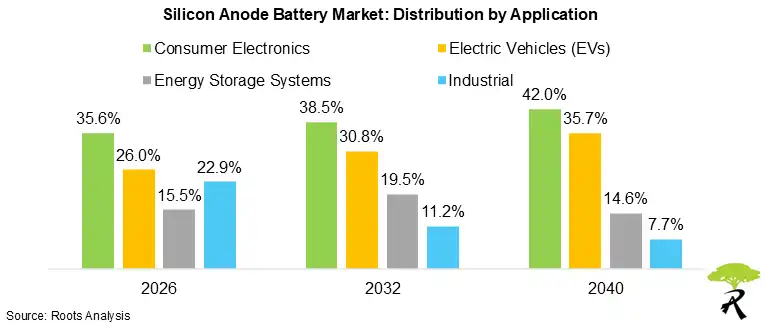
- According to our silicon anode battery market analysis, consumer electronics holds the largest market share of 35.60% in 2026. The growth is driven by strong near-term adoption driven by demand for compact, fast-charging batteries in smartphones, wearables, and other portable devices where silicon anodes deliver higher energy density without requiring disruptive manufacturing changes.
- There is a growing industrial demand for device miniaturization (wearables and IoT gadgets), and early commercialization by increasing production outpacing automotive as silicon matures for consumer volumes. The silicon anode battery market forecast indicates that deployment is being accelerated by sustainability-driven trends, alongside performance advantages that support higher capacity requirements.
- These benefits are particularly well suited to flagship consumer devices with AI-enabled features and extended runtime needs, while energy density gains enable compact form factors such as pouch cells. Together, these factors are expected to accelerate adoption and increase volumes, especially in wearables and other space-constrained applications.
- For instance, Group14 Technologies, a manufacturer of silicon battery materials, completed an additional funding round led by Porsche, with proceeds designated for expanding production capacity at its battery active materials plant in Washington.
Market Share by Geographical Regions: Asia-Pacific Dominates the Industry While North America is Expected to Grow Rapidly Through 2040
- The regional analysis suggests that Asia-Pacific is expected to hold the largest silicon anode battery market share of 55.00% while North America is also expected to witness the fastest CAGR by 50.00% by 2040.
- The Asia-Pacific dominance is supported by its strong concentration of battery manufacturing and EV production across China, Japan, and South Korea, supported by ongoing capacity expansions and deep supply-chain integration. Driven by a robust manufacturing ecosystem and rapidly growing electric vehicle demand, the region is expected to maintain sustained growth over the forecast period.
- In North America, the silicon anode battery market is growing fastest with 50.00% CAGR supported by accelerating adoption of sustainable materials, fuelled by robust policy support, including Inflation Reduction Act (IRA) incentives, rising R&D expenditure, and aggressive localization strategies.
Unlock Deeper Insights – Schedule Your Personalized Workshop Today!
Market Ecosystem Insights
Leading Players Competitive Footprint
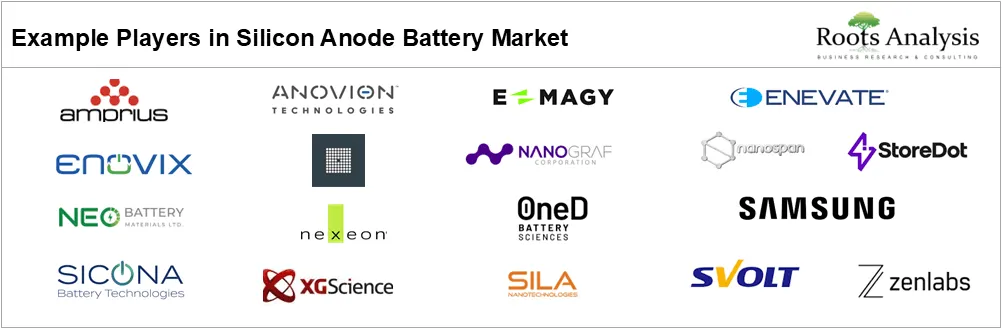
Leading players in the silicon anode battery industry include Amprius, Anovion Technology, E-magy, Enevate, Enovix, Group14 Technologies, NanoGraf Corporation, Nanospan, NEO Battery Materials, Nexeon, OneD Battery Sciences, Samsung, Sicona Battery Tech, Sila Nanotechnologies, StoreDot, Svolt, XG Sciences, Zenlab Energy which hold strong market positions through their extensive product portfolios and global reach.
Collaborations and expansions remain key growth strategies, with players accelerating innovation, market penetration, and scalability. For instance, Group14 and SK On expanded their joint venture to scale up production capacity for Group14’s silicon anode material for use in SK On’s high-energy density battery cells.
Similarly, Enovix announced a partnership with YBS International to establish high-volume production for its silicon anode battery technology in Southeast Asia. This expansion is intended to enable high-volume production of its 3D silicon-anode lithium-ion at a facility in Penang science park, Malaysia providing non-dilutive funding and scaling benefits.
Startup Activity and Innovation Hotspots
The startup activity within the silicon anode battery market domain is rapidly evolving with early-stage companies pioneering disruptive applications, primarily focused on silicon-carbon composite anode, and advanced metal alloy designs. Innovators are launching functionalized nanostructured silicon architectures such as (nanowires, porous, and graphene-enhanced) to combat 300% volume expansion. These advances enable faster charging, deliver up to 50% higher energy density compared with graphite anodes, and contribute to a lower overall carbon footprint.
Recent launches include investments focused on wearables, electric vehicles, and IoT, with High power pouch cells and solid-state synergies. For instance, Anovion Technology, plans to construct a large-scale synthetic graphite and silicon anode manufacturing facility in Georgia to serve the domestic EV supply chain.
Additionally, there are other startups such as those providing technological advancements and innovations as Enovix is developing 3D architecture for its silicon-anode batteries, which includes a patented "Brake Flow" technology designed to improve safety by preventing thermal runaway in high-capacity cells.
Funding and Investment Momentum
The silicon anode battery market has seen robust funding and investment momentum. Investment flows primarily from venture capitalists, private equity firms, and government grants which not only focus on developing sustainable innovations but also accelerate commercialization through pilot plants, OEM partnerships, and supply chain localization.
Emerging opportunities lie in EV and consumer electronics, drawing policy-backed investments. Key investors, including companies such as Enovix announced it received a USD 150 million investment from strategic investors to accelerate the scale-up of its high-volume production facility for silicon anode batteries. Similarly, Sila announced strategic investment from Mercedes-Benz to support the company's expansion and high-volume manufacturing of silicon anode materials.
In addition, government initiatives and grants predominantly support sustainability-focused innovations by companies in U S, Europe and India to receive grants for silicon-carbon composites, and defense and aerospace applications. For instance, Amprius announced the first commercial deliveries of its high-energy density silicon anode batteries to an unnamed aerospace customer for use in a new product line.
Your Business is Unique – Why Shouldn’t Your Report Be?
Silicon Anode Battery Market: Scope of the Report
| Key Report Attributes | Details | |
| Historical Trend | Since 2022 | |
| Forecast Period | Till 2040 | |
| Market Size 2026 | $ 0.92 Billion | |
| Market Size 2040 | $ 45.30 Billion | |
| CAGR (Till 2040) | 32.09% | |
| Segments Covered |
|
|
Market Segmentation
Based on the research, we have segmented the silicon anode battery market into battery type, capacity, material type, application, geographical regions, and key players.
Market Share by Battery Type
- Cylindrical Cell
- Pouch Cell
- Prismatic Cell
Market Share by Capacity
- 3,000 mAh to 10,000 mAh
- Above 10,000 mAh
- Below 3,000 mAh
Market Share by Material Type
- Silicon Composite
- Silicon Nanoparticles
- Silicon Nanowires
Market Share by Application
- Consumer Electronics
- Electric Vehicles (EVs)
- Energy Storage Systems
- Industrial
Market Share by Geographical Regions
- North America
- US
- Canada
- Mexico
- Rest of North America
- Europe
- Austria
- Belgium
- Denmark
- France
- Germany
- Ireland
- Italy
- Netherlands
- Norway
- Russia
- Spain
- Sweden
- Switzerland
- UK
- Rest of Europe
- Asia-Pacific
- Australia
- China
- India
- Japan
- New-Zealand
- Singapore
- South Korea
- Rest of Asia-Pacific
- Latin America
- Brazil
- Chile
- Colombia
- Venezuela
- Rest of Latin America
- Middle East and Africa (MEA)
- Egypt
- Iran
- Iraq
- Israel
- Kuwait
- Saudi Arabia
- UAE
- Rest of MEA


