


 Download Free Sample
 Buy Now
Silicon Carbide Market Size
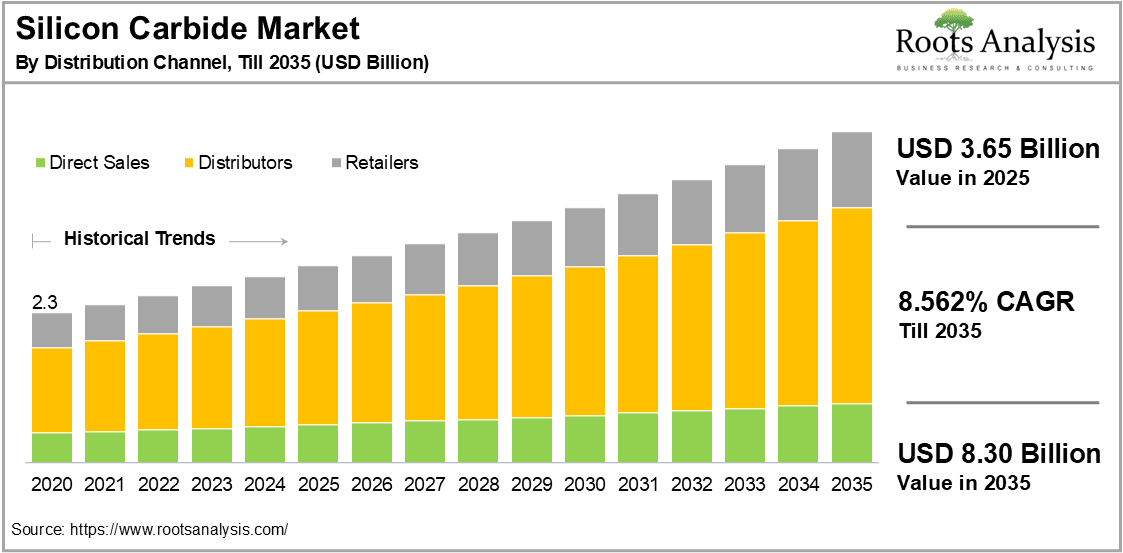
The global silicon carbide market size is expected to rise from USD 3.65 billion in 2025 to USD 8.3 billion by 2035, growing at a robust CAGR of 8.56%. This surge is primarily driven by increasing adoption in power electronics, electric vehicles (EVs), and renewable energy systems that require high efficiency and thermal endurance.
See What’s in the Full Report - Request Your Complimentary Insights!
This report covers market drivers, segmentation (product, forming method, end-user), regional outlook, recent investments and technology milestones, plus actionable recommendations for manufacturers, OEMs and investors.
Silicon Carbide Market Report: Key Takeaways
- SiC market value: USD 3.65 Bn (2025) → USD 8.3 Bn (2035); CAGR 8.56%.
- Over 170,000 patents related to SiC have been filed in the past five years, with more than 65% filed in the US, followed by China and European Patents.
- Black SiC held ~60% share (2025); green SiC grows fastest (~9.34% CAGR).
- Sintering leads forming methods (>40% share); reaction bonding fastest growing (~9.87% CAGR).
- Electronics & semiconductor end users account for ~45% share in 2025; automotive (EVs) shows rapid adoption.
- Asia-Pacific leads (>40% share); North America and Europe expand via policy support (CHIPS Act, EU IPCEI).
- Key players: Infineon, Wolfspeed, STMicroelectronics, Onsemi, ROHM, Cree, Toshiba, DOW.
- Near-term priorities: wafer scaling (200 mm), yield improvements, vertical supply chain investments.
Silicon Carbide Market Overview
The global silicon carbide (SiC) market is undergoing a rapid transformation, driven by the rising need for high-efficiency semiconductor materials that can sustain extreme temperatures, voltages, and switching frequencies. As industries accelerate toward electrification and renewable energy integration, silicon carbide has become the material of choice for next-generation power devices.
The Shift from Silicon to Silicon Carbide
Traditional silicon-based semiconductors are approaching their physical performance limits, particularly in high-power and high-temperature applications. Silicon carbide, with its wide bandgap (~3.2 eV) and superior thermal conductivity (3.7 W/cm·K), enables faster switching, lower losses, and smaller form factors in power electronics. These advantages have positioned SiC as a critical enabler of energy-efficient mobility, industrial automation, and clean energy systems.
Industry Transformation Driven by Electrification
The global move toward electrification of transport and manufacturing is reshaping silicon carbide demand. Beyond electric vehicles, SiC components are increasingly integrated into industrial drives, rail propulsion, and renewable inverters. In 2025, several Tier-1 suppliers, including ZF Friedrichshafen and Mitsubishi Electric, expanded SiC inverter partnerships to enhance drivetrain efficiency in hybrid and electric fleets.
Expansion in Semiconductor Manufacturing Ecosystem
The silicon carbide supply ecosystem is evolving fast. With growing global wafer shortages and production bottlenecks, manufacturers are localizing production to minimize dependence on limited suppliers. Major expansions include:
- STMicroelectronics’ 2025 plan to start SiC substrate production in Italy to reduce external sourcing dependency.
- ROHM’s new SiC epiwafer facility in Japan, aimed at vertically integrating wafer fabrication with power device production.
This trend reflects a clear movement toward domestic capacity building and supply chain resilience across major semiconductor hubs.
Innovation in Fabrication and Material Engineering
Recent research advances are pushing the boundaries of silicon carbide performance. Developments, such as 4H-SiC substrate optimization, grinding-based SiCOI techniques, and defect density reduction methods have significantly enhanced crystal uniformity and device reliability. Academic collaborations in South Korea and Germany are also exploring SiC-on-insulator structures that enable lower on-resistance and improved thermal management, crucial for 800V+ EV systems and high-frequency converters.
The Role of Sustainability and Energy Transition
SiC’s growing relevance extends beyond performance. Its role in the global sustainability transition is increasingly pronounced. The material’s ability to reduce power losses by up to 50% compared to silicon directly contributes to lower carbon footprints in EVs, smart grids, and renewable plants. As governments tighten emission norms and efficiency standards, SiC-based technologies are emerging as a strategic solution to meet net-zero goals and green manufacturing mandates.
Investment Momentum and Market Confidence
Rising capital investments underscore the industry’s long-term confidence in silicon carbide. In early 2025, Wolfspeed’s Mohawk Valley fab in New York entered high-volume production of 200 mm SiC wafers, marking a pivotal moment in the shift to large-diameter manufacturing. Concurrently, Europe’s IPCEI Microelectronics initiative and India’s Semicon program have earmarked incentives for domestic SiC fabrication and R&D initiatives, bolstering global capacity.
Recent Developments in Silicon Carbide Market
- In February 2025, Infineon Technologies launched its first power-semiconductor products built on its 200 mm silicon carbide (SiC) wafer production line in Villach, Austria as a part of its strategy to strengthen SiC leadership across high-voltage applications.
- In September 2025, the Government of India allocated strategic priority to SiC wafer manufacturing under the India Semiconductor Mission 2.0, signaling support for domestic SiC capability expansion.
- In June 2025, Mosel Vitelic (Taiwan) announced the launch of a new SiC wafer production line aimed at adding 3,000 units/month capacity by June, underlining Taiwan’s growing role in SiC supply chains.
- In April 2025, RIR Power Electronics announced it would build India’s first SiC semiconductor facility in Odisha, backed by an investment of INR 618 crore, focusing initially on wafer production for EV and renewable markets.
- In December 2024, Onsemi launched new silicon carbide power integrated modules aimed at enhancing efficiency in utility-scale photovoltaic systems. The company highlighted that these modules are designed to improve performance and reduce costs for solar energy applications.
- In October 2024, Wolfspeed announced a proposed funding of $750 million from the U.S. CHIPS Act, along with an additional $750 million from an investment group led by Apollo.
- In October 2024, Halo Industries secured $80 million in Series B funding to enhance its development of advanced optical technologies. The funding aimed to accelerate the company's growth and expand its product offerings in the optical sector.
- In June 2024, ZF and NXP partnered to develop silicon carbide (SiC) traction inverters for electric vehicles (EVs), enhancing efficiency and performance. The collaboration aimed to leverage SiC technology to improve power density and thermal management in EV systems.
- In April 2024, SweGaN AB announced a strategic partnership with RFHIC Corporation, a South Korean leader in GaN RF and microwave semiconductors.
Unlock Deeper Insights - Schedule Your Personalized Workshop Today!
Silicon Carbide Market Trends
Surge in Silicon Carbide Adoption for Electric Vehicles (EVs)
The EV sector remains the largest consumer of silicon carbide (SiC), driven by its superior energy efficiency and heat tolerance compared to traditional silicon-based systems. SiC MOSFETs and diodes enable faster charging, reduced energy losses (up to 70%), and lighter vehicle designs.
In 2025, companies such as Tesla, BYD, and Lucid Motors have integrated SiC power modules across inverter systems to extend EV range and accelerate charging performance. Similarly, ZF and NXP’s 2024 partnership on SiC traction inverters underscores the shift toward high-voltage 800V platforms. This trend continues to propel demand from both OEMs and Tier-1 suppliers, consolidating automotive as a core growth driver for the SiC industry.
Expansion of Renewable Energy Applications
Silicon carbide is rapidly gaining traction in solar inverters, wind turbines, and energy storage systems, where efficiency and durability are critical. SiC’s ability to handle higher voltages with minimal energy loss enhances grid reliability and reduces operational costs.
In December 2024, Onsemi introduced SiC power modules for utility-scale photovoltaic (PV) systems, achieving notable gains in conversion efficiency. Moreover, Infineon’s Kulim SiC fab in Malaysia now supplies SiC components for renewable energy and charging infrastructure, reinforcing the material’s pivotal role in the global energy transition.
This convergence of clean energy goals and high-performance materials is expected to elevate SiC deployment across the energy and power electronics ecosystem through 2035.
Increasing Wafer Size and Fabrication Capacity
The shift toward 200 mm SiC wafers marks one of the most transformative trends in semiconductor manufacturing. Larger wafers improve production yield, reduce defect density, and lower per-unit costs, which is the key to scaling mass adoption. Wolfspeed’s Mohawk Valley Fab and STMicroelectronics’ 200 mm SiC expansion in Catania, Italy represent significant steps in capacity building. Additionally, China’s Tankeblue Semiconductor and Sanan IC are investing heavily in domestic wafer production to support regional autonomy.
This transition is expected to reduce manufacturing costs by up to 25%, broadening accessibility to smaller players and accelerating global SiC supply chain maturity.
Rising Strategic Collaborations and Investments
Strategic alliances are reshaping competitive dynamics in the silicon carbide market. Companies are forming cross-industry partnerships to enhance innovation and vertical integration. For instance, in October 2024, Wolfspeed secured $750 million in U.S. CHIPS Act funding and another $750 million from Apollo-led investors to expand wafer capacity. Around the same time, Halo Industries raised $80 million in Series B funding to advance defect-free SiC substrate technology.
Such investments underscore investor confidence in the long-term scalability of SiC materials, particularly for automotive, aerospace, and power grid applications.
Technological Advancements in SiC Device Performance
Recent breakthroughs in crystal growth, sintering, and doping techniques have enhanced the mechanical strength and thermal efficiency of SiC components. The introduction of 4H-SiC and SiC-on-insulator structures has enabled higher voltage tolerance and reduced leakage currents.
In 2025, R&D initiatives across Japan, Germany, and South Korea have focused on defect-free wafer production and advanced epitaxy to meet next-generation requirements for EVs and fast-charging networks. These improvements are setting new benchmarks for reliability, power density, and performance consistency across high-demand environments.
Sustainability-Driven Innovation
With rising ESG priorities and government mandates for carbon-neutral manufacturing, silicon carbide is being recognized as a key enabler of decarbonization. By improving energy conversion efficiency, SiC devices contribute to significant power savings in EVs, industrial motors, and smart grids.
Manufacturers, such as ROHM Semiconductor and Infineon are actively integrating green production techniques, including reduced wafer waste and closed-loop recycling, to align with sustainability standards. This reinforces SiC’s positioning not only as a technological catalyst but also as a sustainability imperative within the semiconductor landscape.
Pay only for what your business needs
Silicon Carbide Market Segmentation Analysis
Market Share by Type of Product
The black silicon carbide segment holds a dominant position, accounting for over 60% of total market share in 2025, primarily due to its durability, high strength, and cost-effectiveness. Its extensive use in abrasives, metallurgy, and industrial cutting tools supports steady demand from the manufacturing and construction sectors. For instance, Saint-Gobain and Washington Mills continue to expand production capacities for black SiC to meet global industrial demand.
Meanwhile, green silicon carbide is emerging as the fastest-growing subsegment, projected to expand at a CAGR of 9.34% through 2035, supported by its growing role in semiconductors, ceramics, and optical applications. Its superior purity and thermal conductivity make it ideal for high-voltage and high-frequency components in EVs and aerospace electronics.
Market Share by Type of Forming Method
Among forming methods, sintering dominates with over 40% of the market share, owing to its ability to produce dense, high-performance SiC materials with excellent thermal resistance and mechanical integrity. This process is widely used in power electronics and defense-grade ceramics, where material reliability under stress is essential.
However, reaction bonding is expected to register the fastest growth rate of 9.87% by 2035, as it enables cost-effective manufacturing of complex geometries and ensures minimal material waste. The technique’s scalability has attracted adoption by manufacturers, such as Fiven ASA and Navarro SiC, which use reaction-bonded SiC for heat exchangers and semiconductor equipment components.
Market Share by End User
The electronics and semiconductor segment leads with a market share exceeding 45% in 2025, driven by the expanding use of SiC power modules in data centers, 5G base stations, and electric drives. Major players, such as Infineon Technologies and ROHM Semiconductor are integrating SiC in next-generation power management ICs to achieve higher efficiency and performance.
The automotive segment follows closely, fueled by strong growth in electric mobility. SiC enables smaller, lighter, and more energy-efficient inverters, essential for extending EV range. Governments in China, Japan, and Europe offering EV subsidies further accelerate SiC demand across vehicle platforms. Meanwhile, the energy and power sector is witnessing rising adoption of SiC components in solar inverters and smart grids, contributing to energy optimization in renewable power generation systems.
Market Share by Type of Distribution Channel
The distributor segment dominates the market, accounting for nearly 60% of the total share in 2025, supported by its role in connecting regional producers to end-user industries. Distributors, such as Wolfspeed’s authorized partners and Allied Electronics are strengthening logistics networks to ensure faster deliveries amid rising global demand.
In contrast, direct sales channels are expanding, particularly among established semiconductor companies, allowing better control over pricing, technical support, and client engagement. Direct-to-OEM partnerships are becoming standard practice among Onsemi, Cree (now Wolfspeed), and Toshiba, as they cater to high-volume customers in EVs and power electronics. Retail channels, though limited, serve niche industrial markets that demand small-batch, high-purity SiC materials for prototyping and R&D.
Regional Analysis of the Silicon Carbide Market
Asia-Pacific: The Global Hub for Silicon Carbide Production and Demand
The Asia-Pacific region continues to dominate the global silicon carbide market, accounting for over 40% of total market share in 2025, and is projected to expand at the fastest CAGR through 2035.
- China leads global production with extensive investments in SiC wafer fabrication and power semiconductor facilities. For instance, in April 2025, Tankeblue Semiconductor announced capacity expansion for 8-inch SiC wafers to meet growing domestic demand for EVs and renewable energy systems.
- Japan is advancing innovation in SiC-based power modules for electric vehicles and energy storage, supported by major players like ROHM Semiconductor and Toshiba. The Japanese government’s Green Innovation Fund continues to fund SiC R&D for next-generation mobility and decarbonization goals.
- India is emerging as a new growth frontier, driven by its booming EV industry and manufacturing incentives under the Production Linked Incentive (PLI) Scheme. Companies, such as Infineon Technologies and GeneSiC Semiconductor have announced collaborations with Indian automotive OEMs to localize SiC-based inverter production.
- South Korea and Taiwan are accelerating SiC chip adoption in consumer electronics and 5G infrastructure, with Samsung and SK Hynix investing in local supply chain capabilities.
Key Takeaway: Asia’s leadership is driven by a blend of industrial scale, government incentives, and rapid EV adoption, positioning the region as the nucleus of global SiC innovation and manufacturing.
North America: Strengthening Domestic Semiconductor Manufacturing
North America holds the second-largest share, representing approximately 30% of global market revenue in 2025. The region’s growth is bolstered by a strong semiconductor base, EV investments, and federal initiatives like the U.S. CHIPS and Science Act.
- In February 2025, Wolfspeed secured a $750 million investment through the CHIPS program to expand its Mohawk Valley SiC fab in New York, doubling wafer output for EV power systems.
- Onsemi launched high-efficiency SiC modules designed for utility-scale solar and fast-charging EV applications, marking a significant push toward renewable electrification.
- Canada’s government is also fostering advanced materials R&D, with Teledyne Technologies and 3M Canada exploring SiC integration in aerospace and defense applications.
- Mexico is strengthening its role as a SiC component manufacturing hub for North American automotive OEMs, benefiting from nearshoring and trade advantages under the USMCA agreement.
Key Takeaway: The US and Canada are strategically focusing on supply chain resilience and clean energy transformation, ensuring North America remains a high-value SiC innovation center.
Europe: Driving Growth through Green Energy and EV Policies
Europe represents around 20% of the global silicon carbide market share and is projected to maintain steady growth through 2035, driven by stringent carbon neutrality goals and EV adoption mandates.
- Germany continues to lead European SiC adoption, with Infineon Technologies expanding its Kulim and Dresden fabs for SiC MOSFETs and diodes.
- France’s Saint-Gobain has scaled production of high-purity SiC powders for industrial and renewable energy applications.
- Italy and the UK are investing in clean mobility programs, stimulating demand for SiC-based powertrain components.
- In March 2025, the European Commission introduced additional funding under the IPCEI on Microelectronics II, supporting SiC R&D for next-generation sustainable technologies.
Key Takeaway: Europe’s silicon carbide market is propelled by regulatory support, EV transition mandates, and green manufacturing policies, with Germany anchoring the region’s technological leadership.
Middle East and North Africa (MENA): Rising Demand for Energy-Efficient Infrastructure
The MENA region is emerging as a new demand hotspot for silicon carbide components, particularly in renewable energy, smart grids, and defense sectors.
- Saudi Arabia’s Vision 2030 and UAE’s Energy Strategy 2050 initiatives are driving SiC integration into solar power systems and grid infrastructure.
- In January 2025, Saudi Aramco Energy Ventures invested $56 million Series C funding round to supports Amogy's work in developing technologies that convert ammonia into electricity, helping to advance the use of sustainable energy.
- Israel is fostering R&D partnerships focusing on SiC in aerospace and advanced radar systems, supported by government innovation grants.
Key Takeaway: MENA’s silicon carbide adoption is accelerating due to its focus on energy diversification and sustainability-driven megaprojects.
Latin America: Emerging Market with Industrial Potential
While currently representing a smaller share, Latin America’s silicon carbide market is gaining traction through industrial modernization and clean energy investments.
- Brazil leads regional demand, particularly in electric mobility and renewable energy manufacturing.
- Chile and Colombia are investing in SiC-based solar inverters to support grid stability and electrification in remote areas.
Key Takeaway: With growing policy focus on green industrialization, Latin America is gradually positioning itself as a regional SiC manufacturing hub.
Rest of the World: Strategic Expansion in Australia and New Zealand
Regions, such as Australia and New Zealand are investing in advanced materials research and renewable energy projects, fostering SiC adoption.
- In May 2025, the Australian Renewable Energy Agency (ARENA) announced funding for research into SiC-based high-voltage converters for solar farms.
- New Zealand’s industrial labs are collaborating with European SiC companies to develop localized semiconductor production ecosystems.
Key Takeaway: Though nascent, these countries are positioning themselves as research-driven SiC innovation ecosystems for clean energy technologies.
Get an Instant Quote - Lowest Price Guaranteed
Silicon Carbide Market: Report Attributes / Market Segmentations
| Key Report Attributes | Details | |
| Historical Trend | Since 2020 | |
| Forecast Period | Till 2035 | |
| Market Size Value in 2025 | $ 3.65 Billion | |
| Market Size Value in 2035 | $ 8.3 Billion | |
| CAGR (Till 2035) | 8.56% | |
| Type of Product |
|
|
| Type of Forming Method |
|
|
| End User |
|
|
| Type of Distribution Channel |
|
|
| Geographical Regions |
|
|
| Leading Market Players |
|
|
| PowerPoint Presentation (Complimentary) | Available | |
| Customization Scope | 15% Free Customization | |
| Excel Data Packs (Complimentary) |
|
|


