Silicone Sealants Market
Silicone Sealants Market by Type of Silicon Sealants (Acetic, Acetoxy, Amino, Oximinics, and Other Sealants), Type of Technology (Pressure-Sensitive, Radiation Cured, Room Temperature Vulcanizing (Rtv), Thermoset, Uv Cured, and Other Technologies), Areas of Application, End User Industries, Type of Enterprise, Geographical Regions, and Leading Players – Trends and Forecasts 2026-2040
-
Lowest Price Guaranteed
-
Slides
211 -
Last Updated
March 2026 -
View Count
13214 -
Silicone Sealants Market Overview
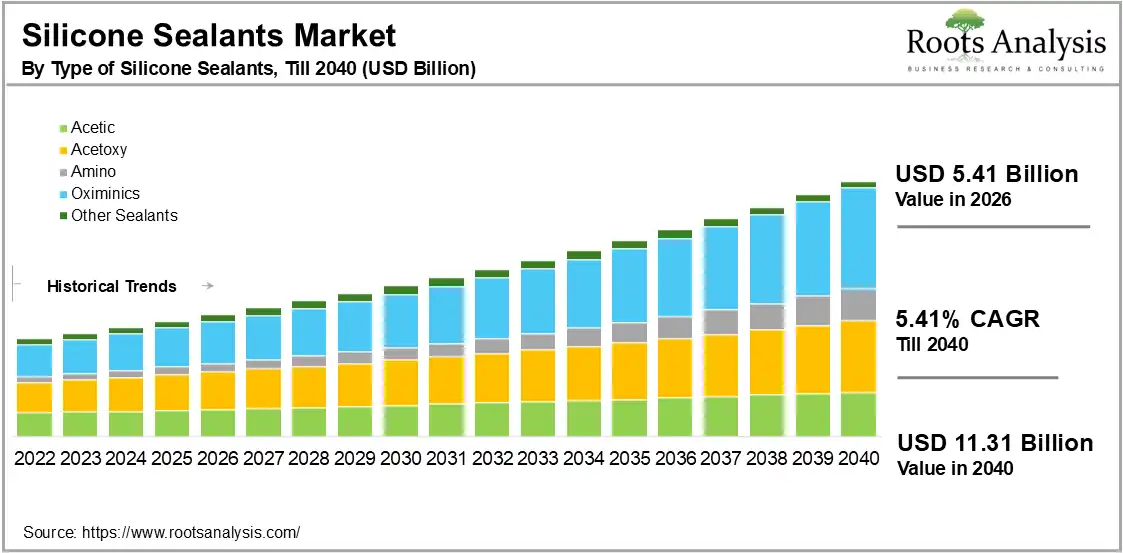
The global silicone sealants market is projected to rise from USD 5.41 billion in 2026 to USD 11.31 billion by 2040, representing a CAGR of 5.41% during the forecast period.
 |
To learn more about this report, request a free sample copy
The new research study consists of global silicone sealants market analysis, mega trends, patent analysis, porter five forces, SWOT analysis, value chain analysis and other strategic frameworks.
Silicone sealants are an adhesive of the liquid form used as a bonding agent, in building and construction, automobiles, electronic appliances, and others. Silicone sealants keep their elasticity at both high and low temperatures and are also resistant to other chemicals, moisture, and any weather. It is used as a connecting agent for various components of an automobile engine.
The global industry is experiencing significant growth in recent years and is expected to continue expanding due to various driving factors. One of the primary drivers of the market’s growth is the rapid urbanization and infrastructure development in emerging economies. As countries invest in infrastructure and large-scale construction projects, demand for silicone sealants continues to rise, the demand for UV-resistant silicone sealants for sealing joints, gaps, and cracks in buildings, roads, and bridges has surged.
Additionally, the automotive market’s growth has contributed to the increased use in vehicle assembly and component sealing. Another factor propelling the market growth is the growing focus on sustainable and energy-efficient buildings. Silicone sealants play a crucial role in enhancing a building’s energy efficiency by providing effective insulation and sealing, reducing energy consumption and improving indoor air quality.
Silicone Sealants Market Share Insights
The silicone sealants market report presents an in-depth analysis of the various companies that are involved in offering airline content solutions, across different segments, as defined in the table below:
Silicone Sealants Market: Report Attributes / Market Segmentations
| Key Report Attributes | Details | |
| Historical Trend | Since 2022 | |
| Forecast Period | Till 2040 | |
| Market Size 2026 | $ 5.41 Billion | |
| Market Size 2040 | $ 11.31 Billion | |
| CAGR till 2040 | 5.41% | |
| Type of Silicone Sealants |
|
|
| Type of Technology |
|
|
| Areas of Application |
|
|
| End User Industries |
|
|
| Type of Enterprise |
|
|
| Geographical Regions |
|
|
| Leading Market Players | ||
| PowerPoint Presentation (Complimentary) |
Available | |
| Customization Scope | 15% Free Customization | |
| Excel Data Packs (Complimentary) |
|
|
Silicone Sealants Market Segmentation
Which Type of Silicone Sealant Will Dominate the Market?
The oximinics segment is set to take the lead, holding a significant market share of over 34.4% of the market. The dominance of oximinics in the 2026 market is primarily due to their neutral-curing chemistry, which releases non-acidic byproducts that do not corrode sensitive metals like copper or brass. This makes them the "universal" choice for high-growth sectors like EV battery assembly and 5G electronics where traditional Acetic sealants would cause terminal damage.
It is worth noting that, the oximinics segment is likely to witness the fastest CAGR (7.12%) during the forecast period.
How is the Room Temperature Vulcanizing (RTV) Segment Dominating Types of Technology?
The room temperature vulcanizing (RTV) segment really stands out as the dominant player with a market share of 56.77% during the forecast period.
The expanding construction industry is driving demand for resilient, weather-resistant sealants for applications, such as sealing joints and weatherproofing buildings. In addition, RTV sealants are favored for their flexibility and ability to accommodate significant joint movement.
However, thermoset segment is expected to witness the fastest CAGR (7.59%) during the forecasted period.
Which Area of Application Will have the Fastest CAGR?
The glass segment is set to witness the fastest CAGR (8.73%) during the forecast period. It is also likely to dominate the market share by 35%. This substantial growth can be attributed to the extensive use of silicone sealants in glass bonding and glazing applications across construction, automotive, and related industries, where their resistance and durability are critical.
Which End-User Industry is Gaining the Most Traction in the Silicone Sealants Market?
When it comes to the end-user industries, the building & construction segment is set to take the lead, holding a significant market share of over 59.21% of the market.
This market growth is largely a result of the extensive use of construction sealants in both indoor and outdoor construction applications, including weatherproofing, gap filling, and window and door installations.
Further, healthcare segment is expected to witness the fastest CAGR (7.55%) during the forecasted period.
Why is Asia Leading the Silicone Sealants Market?
According to our silicone sealants market by region analysis, the Asian silicone sealants market currently exhibits dominance with 49.86% of the overall market share. This is mainly because of the region’s robust growth in construction activities and increasing automotive bonding sealants production. Countries like China, India, Japan, and South Korea are major contributors to regional demand. Growing urbanization, infrastructure development, and the adoption of modern construction techniques across the region continue to drive demand for silicone sealants.
Silicone Sealants Market Key Insights
Market Drivers and Trends
What are the Key Drivers for Demand in the Silicone Sealants Industry?
The silicone sealants market is experiencing significant growth due to the following market drivers.
- Expanding Construction Industry: Urbanization and infrastructure development worldwide increase demand for durable, weather-resistant sealants in buildings, windows, doors, and façades.
- Automotive Sector Growth: Use of silicone sealants for bonding and sealing automotive components to improve durability, reduce noise, and enhance vehicle performance.
- Environmental Regulations: Rising demand for low-VOC and eco-friendly sealants driven by stringent regulations in Europe, the US, and other regions.
- Technological Advancements: Technological advancements in silicone sealant formulations including the development of high-performance, fast-curing, and multi-substrate compatible silicone sealants broadens application scope.
- Versatility and Durability: Silicone sealants’ resistance to UV, extreme temperatures, moisture, and chemicals makes them preferred for diverse industrial and consumer applications.
- Growth in Electronics and Appliances: Increasing use of silicone sealants for bonding and sealing in consumer electronics and household appliances.
Comparison of Acid Cure vs Neutral Cure Silicone Sealants
Acid cure (acetoxy) silicone sealants cure quickly and adhere well to non-porous surfaces like glass and ceramics but release acetic acid, which can corrode metals and produce a strong vinegar-like odor. Neutral cure silicone sealants, on the other hand, cure more slowly but do not release acidic byproducts, making them safer for use on sensitive materials such as metals, plastics, and natural stone.
What Innovations are Shaping the Future of Silicone Sealants?
- Self-healing sealants for automatic repair and longer lifespan
- Smart sealants with sensors /AI for real-time monitoring
- Low-VOC and eco-friendly formulations for sustainability
- Nanotechnology-enhanced sealants for improved performance
- Conductive and specialty sealants for electronics and renewables
What Strategies are Companies Using to Gain Silicone Sealants Market Share?
Silicone sealant manufacturers are using smart strategies to stay ahead. Big players are focusing on acquisitions, joint ventures, and innovations to strengthen their position while also investing in R&D to bring innovative and novel products to the market. Launching new technologies and expanding into regions where building & construction is growing are key moves helping them capture more market share.
What is the Impact of Low-VOC Regulations on Silicone Sealants Demand?
Low-VOC regulations have increased demand for eco-friendly silicone sealants, pushing manufacturers to develop and market solvent-free and sustainable formulations. While these regulations restrain the use of traditional, high-VOC sealants and raise production costs, low-VOC silicone sealants also create growth opportunities for innovative, green products that meet environmental standards and consumer preferences.
What is the Role of Silicone Sealants in Energy-Efficient Building Construction?
Silicone sealants play a crucial role in energy-efficient building construction by creating airtight and weatherproof seals around windows, doors, and joints, which prevent air and moisture leaks. This enhances thermal insulation, reduces energy loss, and helps maintain stable indoor temperatures, leading to lower heating and cooling costs. Their durability and flexibility ensure long-lasting performance, further supporting sustainability and building efficiency.
Market Challenges
What Are the Silicone Sealants Market Challenges?
The silicone sealants market, despite its rapid growth and potential, is facing several challenges which are acting as obstacles to the market’s growth.
- Raw Material Price Volatility: Fluctuating prices of silicone-based raw materials impact production costs and profit margins.
- Competition from Alternatives: Polyurethane, acrylic, and hybrid sealants offer competitive pricing and performance, creating pricing pressure within the silicone sealants industry.
- Curing Time and Handling: Longer cure times and specific temperature / humidity requirements can limit application speed and increase project duration.
- Substrate Compatibility Issues: Silicone sealants may not adhere well to all substrates, requiring careful selection and sometimes limiting use.
- Environmental Concerns: Despite improvements, some silicone sealants still face scrutiny over VOC emissions and sustainability, prompting demand for bio-based alternatives.
- Intense Market Competition: Large number of manufacturers offering varied products leads to price pressure and narrower margins.
Who Are the Key Players in the Silicone Sealants Market?
Examples of leading silicone sealants manufacturers (which have also been captured in this market report, arranged in alphabetical order) include 3M, BASF, Bostik, Chengdu Guibao Science and Technology, Dow, Dow Silicones, DuPont, E. I. du Pont de Nemours, H.B. Fuller, Henkel, Huntsman, Mapei, RPM, Shin-Etsu Chemical, Shin-Etsu Silicones, Sika AG, Soudal Holding, Tremco, Wacker Chemie.
Recent Industry Developments
- December 2025: Kastar introduced high-tack silane modified (MS) polymer sealants designed for the global green construction industry, featuring high initial adhesion and long-term elasticity.
- December 2025: Kastar introduced high-tack MS Polymer sealants without solvents or isocyanates for construction markets, bonding to concrete, metals, brickwork, and coated surfaces.