


 Download Free Sample
 Buy Now
Market Size
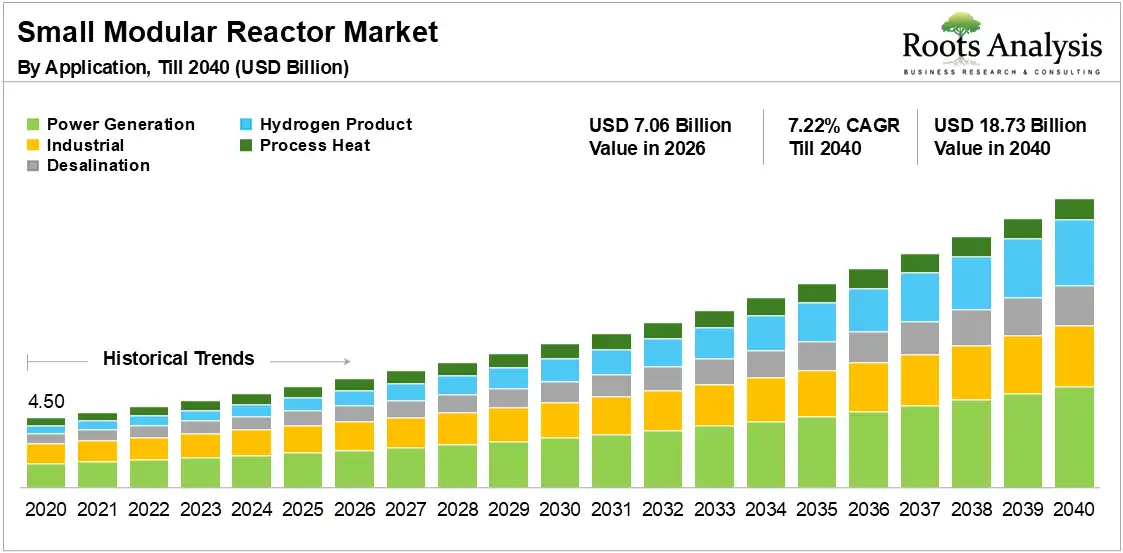
The global small modular reactor market, valued at USD 6.33 billion in 2025, is projected to reach USD 7.06 billion in 2026 and USD 18.73 billion by 2040, with a CAGR of 7.22% during the forecast period 2026 to 2040.
See What’s in the Full Report – Request Your Complimentary Insights!
Market Report: Key Takeaways
- In terms of application, the power generation sub-segment secures 34.20% of the overall revenue share of the global market.
- In terms of types of reactors, the heavy water reactors sub-segment holds the largest share (40.30%) of small modular reactor market.
- In terms of leading region, North America holds the largest share with 35.68% share of the market.
- Key market drivers are the growing demand for low-carbon, reliable energy in grid modernization.
Market Overview
Small modular reactors (SMRs) are a new generation of nuclear reactors characterized by their smaller, modular design, typically generating up to 300 MW of electric power per unit. Unlike conventional large-scale nuclear plants, SMRs integrate key safety components within individual modules, enabling enhanced inherent safety and simpler design.
Their modular nature allows for factory fabrication, scalability via multi-module installations, and reduced construction timelines, which collectively lower capital and operational costs compared to traditional reactors.
SMRs have versatile applications across diverse sectors. Integration of small modular reactors in industrial and desalination applications is suitable for replacing aging fossil fuel plants, supporting industrial processes with combined heat and power, and complementing renewable energy by providing reliable baseload or load-following electricity.
These reactors are especially valuable in regions lacking extensive electrical grids or access to cooling water, as their smaller footprint and flexible deployment allow operation in remote or smaller-scale markets. Additionally, SMRs hold promise for maritime propulsion and off-grid power needs, expanding their utility beyond conventional electricity generation.
The growth of the SMR market is driven by multiple factors. Increasing global electricity demand, the imperative for low-carbon and sustainable energy solutions, and the flexibility SMRs offer in size and application support adoption. Advancements in passive safety features for small modular reactors are reducing barriers to deployment.
Government support, growing industrial interest in decarbonization, and the need for resilient, distributed energy systems further propel the integration of SMRs into future energy infrastructures. Amid global efforts to transition away from carbon-intensive power, SMRs present a strategically significant technology for achieving reliable, cleaner energy generation with economic and safety benefits unmatched by large nuclear plants.
Pay Only for What You Need – The Best Way to Optimize
Recent Developments
- In October 2025, six private companies, including Reliance and Adani Power showed interest in setting up Bharat small modular reactors (BSMRs), across 16 potential sites in six states.
- In October 2025, GE Vernova Hitachi Nuclear Energy and Samsung C&T formed a strategic alliance to advance deployment of the BWRX-300 small modular reactor.
- In August 2025, Vattenfall downselected the BWRX-300 small modular reactor from GE Vernova Hitachi Nuclear Energy to explore building new reactors near its Ringhals plant in Sweden, fueling the modular nuclear reactor market of the region.
- In May 2025, ENEC and GE Vernova Hitachi signed small modular reactor deployment evaluation MoU during World Utilities Congress.
Market Share Insights
Power Generation to Lead the Application Segment of the Industry
According to our small modular reactor market forecast, the power generation sub-segment dominates the market, accounting for 35% of the overall revenue share by 2035. This highest share is driven by an unprecedented surge in always-on energy demand from AI data centers and grid decarbonization mandates. The pipeline of conditional offtake agreements between data center operators and SMR nuclear projects has grown from 25 GW at end of 2024 to 45 GW today, reflecting binding capital commitments from the world's most creditworthy corporations. Further, Microsoft, Google, Amazon, and Meta have collectively signed or committed to over 10 GW of new nuclear capacity, validating long-term contracted revenue through 20 year power purchase agreements that make this the dominant sub-segment of the market.
On the other hand, desalination to is likely to register fastest CAGR of 7.67% during the forecast period 2026-2035. This lucrative growth is underpinned by a structurally irreversible global water crisis. Nearly four billion people face severe water scarcity at least once a year, with demand concentrated in the MENA region where GCC nations alone account for over 45% of global desalination capacity. SMRs offer a uniquely compelling fit here through co-generation simultaneously producing grid electricity and processing heat to power energy-intensive desalination operations, creating dual revenue streams from a single asset. Governments across Jordan, UAE, Egypt, and Saudi Arabia are actively advancing SMR-desalination feasibility programs, providing a sovereign-backed demand floor that de-risks early-stage capital deployment in this high-growth sub-segment.
Heavy Water Reactors Dominate the Growth Trajectory of the SMR Market
According to our projection, the heavy water reactor sub-segment holds the largest share (40.30%) of the market in 2026. This highest share is driven by a combination of proven operational reliability, superior fuel economics, and strategic geopolitical appeal. Heavy water reactors can utilize natural uranium and alternative fuel cycles to reduce dependence on enriched uranium and enhancing fuel supply security, offer a decisive advantage for nations with abundant uranium reserves but limited enrichment infrastructure, including Canada, India, and Argentina. Their superior neutron efficiency enables longer operational cycles and better fuel utilization, directly lowering lifetime operating costs and improving project economics for investors. For capital allocators, HWR-based SMRs represent a lower fuel-cost risk profile with a battle-tested technology base, government-backed programs across multiple jurisdictions, and a growing pipeline of modular deployment opportunities in energy-security-focused markets.
Conversely, light water reactors to likely to register fastest CAGR during the forecast period 2026-2035. The lucrative growth is driven primarily by its unmatched regulatory readiness and near-term deployment velocity. NuScale's design remains the only SMR to have received full NRC design certification, while the BWRX-300 slashes capital costs by up to 60% per megawatt compared to traditional reactors through its streamlined design and reduced material use, making it the most commercially advanced LWR-based SMR globally. In December 2025, the U.S. Department of Energy allocated $800 million in federal funding to support early deployment of advanced light-water SMRs at TVA's Clinch River site and Holtec's Palisades site, directly de-risking private capital entry.
Regional Forecast Suggests North America to Have a Major Share in the Market
According to our market report, North America occupies the largest share (35.68%) of the market in 2026. This lucrative share is due to the most comprehensive convergence of sovereign policy, private capital, and commercial demand of any region globally. A series of US federal executive orders issued in May 2025 streamlined NRC licensing, accelerated environmental reviews, expanded advanced reactor testing pathways, and directed agencies to rebuild the nuclear fuel cycle and expand domestic uranium production. This collectively eliminates the regulatory bottlenecks that historically stalled nuclear investment. On the financing side, Canada's federal government committed $970 million in low-interest financing through the Canada Infrastructure Bank to Ontario Power Generation's Darlington SMR project , the first SMR that will be completed in the G7 while the Province of Ontario directly co-invested an additional $1 billion.
It is worth noting that Asia-Pacific is likely to register higher CAGR of 9.1% through the forecast period 2026-2035. This unprecedented growth is driven by state-directed deployment programs, the world's only commercially operational SMRs, and massive population-driven energy demand that no other technology can address at scale. China planned to begin commercial operations at the world's first SMR to generate nuclear energy as early as the first half of 2026, giving the region a first-mover advantage in operational learning and cost reduction.
Want Information on Specific Region / Segment?
Market Dynamics
Market Drivers
- Demand for Low-carbon, Reliable Energy in Grid Modernization: SMRs provide a flexible and scalable source of baseload power ideal for decarbonizing electricity grids. They support the integration of renewables and this grid flexibility with SMRs can replace aging fossil fuel and large nuclear plants with reliable, emissions-free energy.
- Government Incentives and Policy Support for Nuclear Innovation: Several countries, including the US, UK, Canada, and China offer financial incentives, regulatory framework for SMRs, and R&D funding to accelerate development and deployment. These efforts align with broader net-zero emissions targets, use of small modular reactors for decentralized nuclear energy generation, and energy security priorities.
- Suitability for Remote, Off-grid, and Industrial Applications: SMRs are well-suited to power remote locations such as mines, islands, and military bases, where large reactors are impractical. Their compact footprint and dependable energy output also enable district heating and provide reliable power to critical infrastructure in isolated or industrial areas.
Market Challenges
- Public Perception and Societal Acceptance: Public skepticism around nuclear safety, radioactive waste, and high costs continues to challenge SMR project siting, funding, and policy momentum. Overcoming these barriers requires robust outreach, transparent communication, and education to build trust and social license in affected communities.
- Spent Fuel Management and Long-term Waste Solutions: Although SMRs produce less nuclear waste than large reactors, they still require secure and scalable spent fuel storage and disposal options. Developing and deploying long-term waste management technologies remains a complex technical and political issue across global markets.
- Global Standards and Export Control Complexities: SMR deployment and international collaboration face challenges from fragmented nuclear nonproliferation policies, export controls, and diverse safety regulations. Harmonizing standards and streamlining regulatory processes are essential to accelerate SMR supply chain and manufacturing, along with multinational projects.
Key Market Insights
Competitive Landscape of Small Modular Reactors
The small modular reactor market is increasingly competitive, with key players like NuScale Power, TerraPower, and Rolls-Royce SMR leading SMR design and innovation worldwide. These firms benefit from strong government backing and focus on scalable, safe, and cost-effective small modular reactors that support decarbonization and energy security goals. The market is projected to grow significantly, driven by SMR market growth in clean energy transition strategies, reductions in capital costs, and flexible deployment options.
Traditional nuclear giants, such as Westinghouse and GE Hitachi also remain influential, leveraging their extensive expertise and global presence. Meanwhile, emerging companies and startups contribute to a diverse ecosystem, advancing new designs and accelerating commercialization. Global initiatives and regulatory support are further accelerating international collaborations and the expansion of SMR applications across power generation, industrial uses, and remote locations.
Market Trends in SMR Adoption for Grid Stability and Remote Areas
- Increasing deployment of SMRs in off-grid and remote locations where traditional grid extension is not feasible, such as island communities and isolated industrial sites.
- Growing use of SMRs for grid support and stability by providing reliable baseload power that complements intermittent renewable sources like wind and solar.
- Expanding investments from governments and private sectors in SMRs to enhance energy security and reduce fossil fuel dependence, particularly in climate-vulnerable regions.
- Adoption of modular, scalable SMR designs that enable incremental capacity additions to match grid demand and reduce upfront capital expenditures.
- Rising interest in SMRs for critical infrastructure applications, such as data centers that require uninterrupted power.
Regulatory Frameworks for Safe Deployment of Small Modular Reactors
Regulatory frameworks for the safe deployment of small modular reactors are evolving to address the unique characteristics of these technologies. Regulators globally are adapting licensing processes to streamline approvals without compromising safety, considering SMRs' inherent passive safety features and smaller size.
Countries are experimenting with flexible, risk-informed approaches that support phased construction and operation, as well as modular manufacturing and factory inspections. Financial incentives like government loans, subsidies, and contracts for difference (CfD) models are used to mitigate economic risks associated with advanced nuclear projects. Enhanced international collaboration encourages harmonization of safety standards and mutual recognition of reviews, facilitating broader deployment while maintaining rigorous safety oversight.
Cost Analysis of SMRs V/S Traditional Nuclear Power Plants
In a cost analysis, SMRs present several advantages over traditional large nuclear power plants despite some challenges. The modular construction approach reduces onsite construction time and associated risks, lowering capital expenditure outlays and financing costs. Factory fabrication enables quality control and potential economies of scale as production volume increases.
SMRs’ smaller size requires less upfront investment and can be deployed incrementally, reducing financial exposure and allowing better alignment with demand growth. While unit costs per megawatt may initially be higher due to lower economies of scale compared to large reactors, advancements in standardization and factory manufacturing are expected to improve competitiveness.
Your Business is Unique – Why Shouldn’t Your Report Be?
Market Segmentation
Small Modular Reactor Market: Scope of Report
| Key Report Attributes | Details |
| Historical Trend | 2020-2025 |
| Forecast Period | 2026-2040 |
| Market Size Value 2026 | $ 7.06 Billion |
| Market Size Value 2035 | $ 18.73 Billion |
| CAGR (2026-2040) | 7.22% |
| Segments Covered |
|
| Key Players |
|
| PowerPoint Presentation (Complimentary) | Available |
| Customization Scope | 15% Free Customization |
| Excel Data Packs (Complimentary) |
|
Market Segments
Based on the research, we have segmented the small modular reactor market into type of coolant, connectivity, deployment, location, area of application, reactor, company size, geographical regions, and leading players.
By Coolant
- Gases
- Heavy Liquid Metals
- Molten Salt
- Water
By Connectivity
- Grid-Connected
- Off-Grid
By Deployment
- Multi-Module Power Plant
- Single-Module Power Plant
By Location
- Land
- Marine
By Area of Application
- Desalination
- Hydrogen Production
- Industrial
- Power Generation
- Process Heat
By Reactor
- Fast Neutron Reactor (FNR)
- Heavy Water Reactor (HWR)
- High-Temperature Reactor (HTR)
- Light Water Reactor (LWR)
- Molten Salt Reactor (MSR)
- Thermal Neutron Reactor (TNR)
By Geographical Regions
- North America
- US
- Canada
- Mexico
- Rest of North America
- Europe
- Austria
- Belgium
- Denmark
- France
- Germany
- Ireland
- Italy
- Netherlands
- Norway
- Russia
- Spain
- Sweden
- Switzerland
- UK
- Rest of Europe
- Asia-Pacific
- Australia
- China
- India
- Japan
- New-Zealand
- Singapore
- South Korea
- Rest of Asia-Pacific
- Latin America
- Brazil
- Chile
- Colombia
- Venezuela
- Rest of Latin America
- Middle East and Africa (MEA)
- Egypt
- Iran
- Iraq
- Israel
- Kuwait
- Saudi Arabia
- UAE
- Rest of MEA
Have Questions? Let’s Get Them Answered.


