
Lowest Price Guaranteed
Slides
211
Last Updated
May 2025
View Count
16760
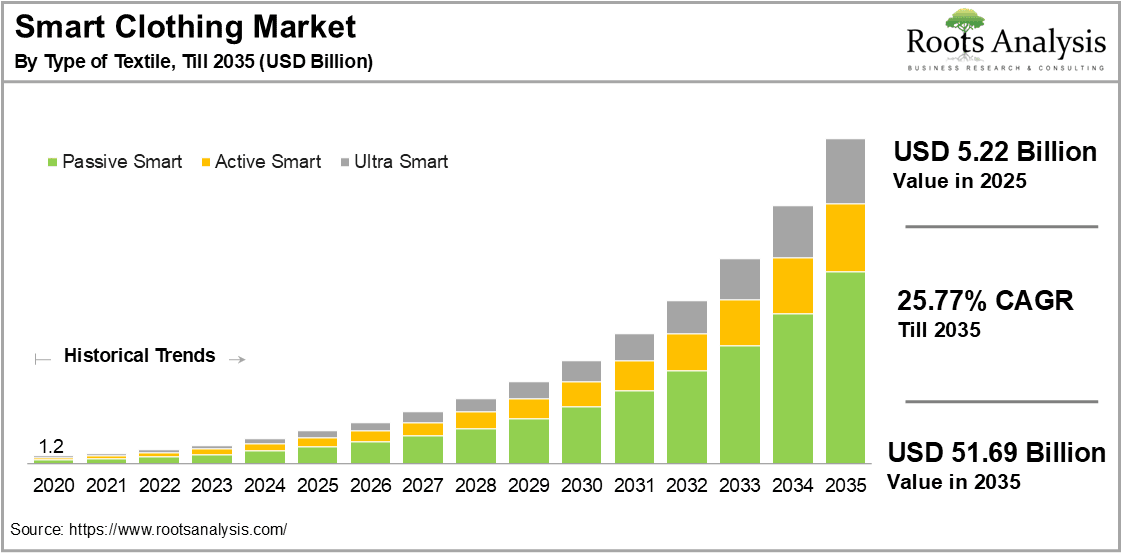
The smart clothing market size is projected to grow from USD 5.22 billion in 2025 to USD 51.69 billion by 2035, representing a CAGR of 25.77% during the forecast period till 2035.
 |
The new research study consists of Smart Clothing Market and trends analysis, detailed market forecast analysis, and provide actionable strategic recommendations.
Just like every other sector, the clothing industry could not be untouched by IoT technology transforming it, making clothing high-tech. Smart clothing also known as high-tech clothing or e-textile refers to garments embedded with advanced technology such as sensors, microchips, and IoT connectivity to enhance functionality beyond traditional clothing.
With soaring demand for data-driven solutions, the smart clothing market is achieving record-breaking growth. This is due to the benefits of smart clothing including biometric tracking, medic monitoring, temperature sensing, motion and activity monitoring, seamless connectivity with smartphones and fitness apps along with fashion & aesthetic enhancements. In addition, ranging from apparel and footwear to wearables patches, smart clothing applications are expanding gradually. Therefore, the healthcare industry is adopting smart wear technology beyond the sports and military sectors.
Owing to this, the market is poised to expand at an extraordinary pace driven by a number of key drivers such as rising awareness of health and fitness, the proliferation of the internet of things, and a surge in demand for remote health monitoring. Apart from this, the emerging smart clothing trend of integration of AI, & machine learning, and fashion-tech collaboration is boosting the market scope significantly. As an effect, industry players and research institutions are actively investing in research and development for smart clothing to enhance the capability of the technology.
For instance, in August 2024, A University of Waterloo research team developed a smart fabric that harvests energy from solar power, and body heat and enables continuous operation without external power. It also can be embedded with sensors to track health, movement, and environmental conditions. Overall considering these factors, the e-textile market is anticipated to rise exceptionally. However, the downsides of the smart clothing for instance high costs, battery power, and privacy concerns remain key challenges which required to be overcome in order to sustain the growth rate of the market throughout this forecast period.
The smart clothing market report presents an in-depth analysis of the various companies that are involved in offering smart clothing, across different segments, as defined in the table below:
| Key Report Attributes | Details | |
| Historical Trend | Since 2020 | |
| Forecast Period | Till 2035 | |
| Current Market Size | $ 5.22 Billion | |
| Market Size Value by 2035 | $ 51.69 Billion | |
| CAGR (Till 2035) | 25.77% | |
| Type of Product |
|
|
| Type of Textile |
|
|
| Type of Distribution Channel |
|
|
| Type of Connectivity |
|
|
| Type of End User |
|
|
| Geographical Regions |
|
|
| Leading Market Players |
|
|
| PowerPoint Presentation (Complimentary) |
Available | |
| Customization Scope | 15% Free Customization | |
| Excel Data Packs (Complimentary) |
|
|
This segmentation of the global smart clothing market underscores a variety of products namely apparel, footwear, wearable patches, and others. According to Roots analysis, apparel is the dominating product and fostering segment growth by acquiring (~43%) of the current market share. The heightening demand for performance tracking, real-time biometric monitoring, and workout optimization are augmenting the market development.
Simultaneously, the wearable patches sub-segment exhibits significant growth and is likely to sprout out at (27.91%) CAGR till the forecast period. The key driving factor behind this growth can be ascribed to the soaring demand for healthcare-focused smart wearable devices which are designed for remote patient monitoring, chronic disease management, and rehabilitation.
On the basis of type of textile, the market is categorized into active smart passive smart, and ultra smart. Active smart textile is leading and is predicted to bolster the segment growth with (~45%) of the market share by 2035. Active smart textiles are fabrics that integrate electronic components and sensors to provide dynamic functionalities, such as monitoring, physiological data, wireless connectivity, and real-time feedback. Also, these textiles can actively interact with users or the environment.
Furthermore, ultra-smart textiles are gaining popularity being the most advanced category. They combine sensing, data processing, and actuation capabilities to give fully autonomous functionality. Resulted in, the ultra-smart textiles segment is expected to expand at a notable CAGR of (26.58%) over this forecast period.
This segmentation of the market explains multiple types of distribution channels including online and offline. As per market research, currently, offline distribution channels are dominating the segment and are projected to hold (~65%) of the market share till 2035. This can be attributed to the credibility and popularity of brand stores such as Adidas, Under Armour, Puma, and others that sell connected apparel and provide service & assistance in stores.
However, the online distribution channels are growing drastically and are likely to grow at the fastest (28.04%) growth rate throughout this projection period owing to convenience wider product availability, and rising digital adoption worldwide.
Based on the connectivity, the market is split into Bluetooth, GPS, RFID, and Wi-Fi. According to this smart clothing market forecast report, Bluetooth connectivity has been dominating the segment by occupying around (~44%) of the current market share. widespread compatibility is the leading factor driving the segment’s dominance. Bluetooth is supported by nearly all modern smartphones, tablets, and wearable devices which make it the most accessible connectivity option for consumers.
Furthermore, Wi-Fi is gaining traction in the industry and is poised to register an outstanding (27.61%) CAGR in the forthcoming years. This trend is mainly driven by the advantages of the wi-fi that offers higher data transfer speed and longer range compared to Bluetooth and is becoming suitable for applications requiring real-time data streaming or cloud connectivity.
The market for smart clothing is distributed to a wide range of end users wherein the healthcare sector dominates the segment with over (~48%) of the current market growth. Smart clothing is widely used for medical monitoring, fitness tracking, and wellness management, therefore, leading the segment’s growth. Besides this, the sports and fitness sector is evolving rapidly and is expected to rise at an exceptional (28.44%) growth rate in the upcoming years. This trend is rising because professional athletes and sports teams use smart clothing for performance analysis, injury prevention, heart rate monitoring, and recovery.
This segment highlights the distribution of the smart clothing market across various geographical regions, such as North America, Europe, Asia, Latin America, the Middle East and North Africa, and the rest of the world. With regard to the tech clothing market, North America is poised to be the leading region in the global marketplace by capturing (~47%) of the current market share.
Furthermore, the demand for smart clothing is exceeding in Asia and is expected to experience a (28.43%) CAGR over this forecast period driven by several key factors such as the growing tech-savvy population and mounting demand in the sports & fitness industry. The largest consumer base with increasing disposable income in China, India, and other Southeast Asian countries is driving the demand for smart wear. China and India are global leaders in textile production which enables cost-effective manufacturing and large-scale production of smart fabrics, boosting the market progress.
Apart from this, the rise in the number of fitness enthusiasts and athletes fueling the demand for apparel and devices to enhance sports performance by body monitoring, thereby, expanding the market outlook in the region.
The “Smart Clothing Market, Till-2035: Industry Trends and Global Forecasts” report features an extensive study of the current market landscape, market size and future opportunities within the smart clothing market, during the given forecast period. The market report highlights the efforts of several stakeholders involved in this rapidly emerging segment of the service providers industry. Key takeaways of the smart clothing market report are briefly discussed below.
The rise in the awareness of health and wellness is one the major key drivers to fuel the demand for smart clothing. The benefits of smart clothing in health monitoring, sleep tracking, and physical activity tracking have raised the adoption of smart clothing. Consumers are embracing preventive healthcare measure that aligns with the capabilities of smart clothing, thus, advancing the market development. Along with this, advancements in wearable technology such as textile sensors, conductive fabrics, and miniaturized electronics are making smart clothing more functional, comfortable, and affordable. Moreover, growth in the adoption of personalized and data-driven solutions coupled with the expansion of military applications is anticipated to continue to propel the smart clothing market growth in the upcoming decade.
Presently, several key players including Adidas, Owlet, Hexoskin, Sensoria Health, WearableX, and others are operating in the industry and shaping the competitive landscape of the market. These companies are driving the market growth driven by advancements in wearable technology, IoT, AI, and sensor integration. These companies are focusing on fitness & sports growth, fashion-tech convergence, and sustainability & material innovation to gain competitive advantages in the market.
Along with key drivers, the market has some substantial challenges such as high cost of production and battery life and power supply issues which can impede the growth of the market. Illustratively, smart clothing encompasses the integration of advanced technology similar to sensors, conductive fibers, and connectivity modules which increase production costs as well as the price of smart clothing. This high cost of products may deter mainstream consumers from purchasing smart & high-tech clothing. Additionally, the need for frequent charging or battery replacement can reduce user convenience and adoption. Impacting the overall growth of the market.
North America is anticipated to capture the largest (~47%) share of the global smart clothing market due to the high adoption of wearable sensor technology in the region. North America is one of the early adopters of wearable technology, including smartwatches, fitness trackers, and other IoT devices. Consumers in the region are tech-savvy and open to integrating innovative technologies into their daily lives which has contributed to the high embrace of smart clothing. Besides this, a strong focus on health and fitness, and the presence of tech giants are substantially fortifying the market growth by introducing innovative product lines through active research and development in smart fabrics and smart textile fields. Moreover, as the smart apparel market continues to evolve, these factors will likely sustain the region’s dominance in the global marketplace.
Examples of key players involved in the market for smart clothing (which have also been captured in this market report, arranged in alphabetical order) include Adidas (Germany), AiQ Smart Clothing (Taiwan), Applycon (Czech Republic), Athos (US), Carre Technologies (Canada), Clothing+ (Finland), DuPont (US), Gentherm Incorporated (US), Hexoskin (Canada), Interactive Wear (Germany), Myontec (Finland), Myzone (US), Owlet UK (UK), Sensoria (US), Siren (US), TORAY INDUSTRIES (Japan), Under Armour (US), Vulpes Electronics (Singapore), and WearableX (US). This market report includes an easily searchable excel database of all the companies who have adopted the smart clothing market.
The market report presents an in-depth analysis, highlighting the capabilities of various companies engaged in this domain, across different segments. Amongst other elements, the market report includes:
At Roots Analysis, we genuinely care about your success and understand that your business requirements are unique. While our market research reports provide valuable insights, we recognize that they might not cover every aspect you need to make well-informed strategic decisions. To account for that, we offer 15% free report customization tailored to your specific needs. Whether you require additional quantitative analysis, qualitative insights, or any other information related to the smart clothing market, reach out us today at: support@rootsanalysis.com