


 Download Free Sample
 Buy Now
Smart Greenhouse Market Size
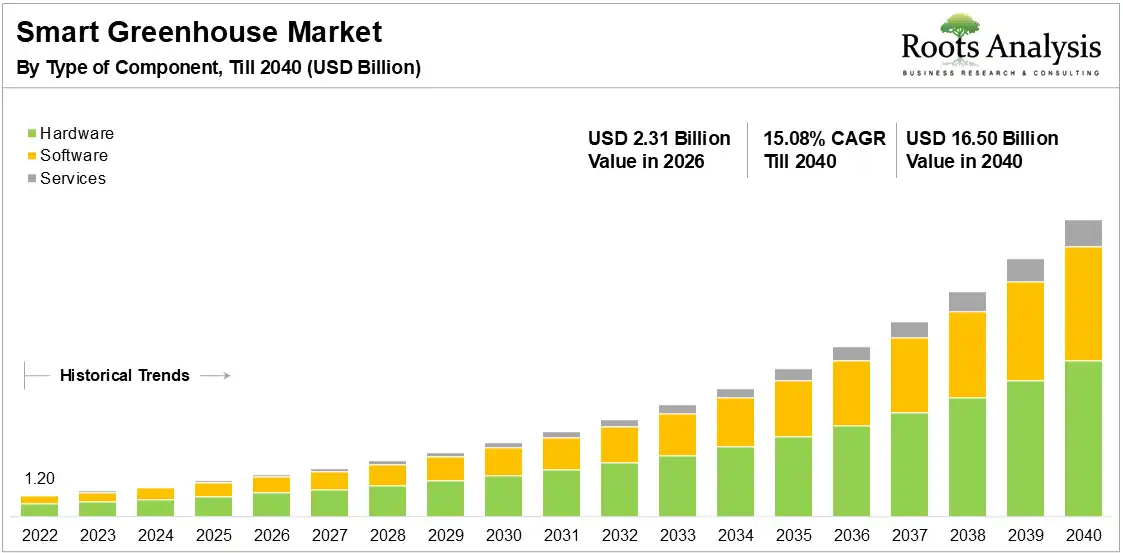
The global smart greenhouse market is projected to reach USD 2.31 billion in 2026 and USD 16.50 billion by 2040, representing a CAGR of 15.08% during the forecast period 2026 to 2040.
See What’s in the Full Report – Request Your Complimentary Insights!
Smart Greenhouse Market Trends and Overview
The smart greenhouse refers to the deployment of automated environmental control and data-driven management within agricultural structures designed for controlled environment agriculture. It spans connected hardware such as IoT sensors, actuators, and advanced lighting, supported by software platforms that apply machine learning and predictive analytics. Smart greenhouse market value is created by improving water, energy, and labor efficiency to enhance crop yield and quality, with use cases ranging from high value produce to specialized medicinal plants.
Moreover, the smart greenhouse market growth is being propelled by the rising global food demand, increasing climate variability affecting conventional farming, and the need to optimize inputs such as water, biofertilizers, and labor requirement. Adoption is strongest in applications involving high-value crops, including leafy greens, tomatoes, and medicinal plants like cannabis, where consistency and yield predictability directly affect profitability. Current momentum reflects growing technological maturity and commercial deployment. In 2025, MAPNA group launched MAPNA MIND, the first indigenous IoT platform for smart greenhouse to facilitate decentralized decision-making and large-scale data processing for agricultural management.
Industry innovation is moving toward deeper artificial intelligence integration for predictive yield modelling and energy optimization; alongside modular and scalable system designs that lower upfront investment. Advances in LED lighting and HVAC technologies are improving energy efficiency and deployment flexibility. The outlook remains favourable as agriculture shifts toward sustainable models. For example, major players are partnering with renewable energy companies to develop hybrid power solutions for facilities, reducing operational expenses.
Smart Greenhouse Market Report: Key Takeaways
- Leading Industry Players: Market players, such as, Aerofarm, DENSO, Priva, Signify, and Confiron are actively undertaking initiatives, such as product development, technological innovations, and partnerships to expand their global reach.
- Startup Ecosystem: Startups are currently focusing on the "last mile" of automation, harvesting and deleafing while larger companies are focusing on data interoperability. Beyond technological innovation, the availability of venture capital funds is attracting startup companies for innovation. In November 2025, SAIA Agrobotics raised €10 million Series A funding round to accelerate the commercial production of its automated greenhouse system, which is designed to boost crop yields and reduce labor requirement across different controlled-environment agriculture.
- Regional Breakthrough: North America is taking the lead with 36.70% of the smart greenhouse market share. The presence of tech giants like Microsoft Azure, Nexus Corporation, Argus Control Systems, and Rough Brothers are highly focused on IoT sensors integration, cloud integration, and AI-driven climate control solutions to enhance crop yield. In addition, government focus on the water conservation mandates in western states are likely to offer compelling opportunities for the industrial players in this region.
- Partnerships and Collaborations: In order to leverage competitive edge, the market players are encouraging partnerships and collaborations. The primary focus of these partnerships will be on commercial-ready automation and climate-resilient pilot projects. Recently, the Ministry of Food, Agriculture, and Light Industry (MOFALI) in Mongolia has signed a partnership agreement with Korea International Cooperation Agency (KOICA), local researchers, and Hankyong National University to establish a USD 3.42 million smart greenhouse complex in Ulaanbaatar. This strategic initiative aims to improve year-round vegetable production even in the harsh climate by using AI controlled systems for humidity and temperature.
- American Farm School Initiative: In 2025, the American Fram School, in Thessaloniki, Greece is spreading a transformative project to boost agricultural education and practices through the implementation of a data-driven, smart greenhouse. This initiative has been undertaken in collaboration with Cisco, Dataways, and Green Project, providing students and local farmers with hands-on experience in smart farming. These initiatives will expand the adoption of smart greenhouses across local farmers.
- Future Market Opportunities: The smart greenhouse technology market opportunities include modular and plug-and-play greenhouse solutions. These solutions expand addressable markets including smaller enterprises, localized food producers, and educational institutions. In addition, the future emphasis will be on predictive analytical services, data monetization, and large-scale food security initiatives.
Smart Greenhouse Market Recent Industry Developments
- In January 2026, Koidra expanded its KoPilot suite with a new Smart Alarm system designed for high-speed response to environmental drifts. This was followed by the full launch of KoPilot Irrigation, an autonomous system that uses physics-informed AI to manage water and nutrient delivery, aiming to reduce water waste by over 20% while increasing cucumber and tomato yields.
- In October 2025, Argus Control System announced the expansion of its Axia platform became fully operational across North American commercial sites. Its primary innovation is on-premises edge analytics, which reduces network latency for climate control.
- In September 2025, Farmonaut launched portable air conditioner that are specifically designed for smart greenhouses to reduce heat stress for plants.
Don't Pay for What You Don't Need. Individual Sections of the Report Are Available for Purchase Now.
Smart Greenhouse Market Share Insights
HVAC Systems Lead the Market
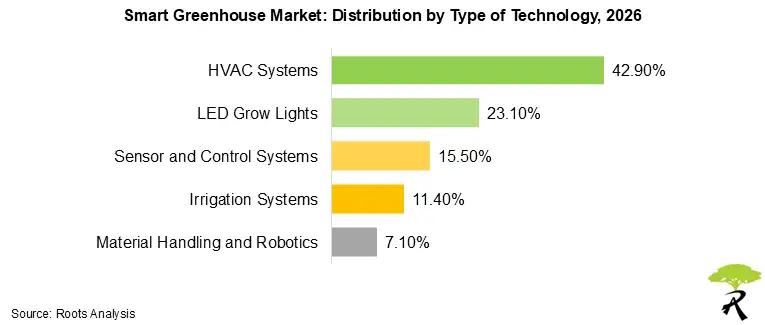
- HVAC systems account for the largest market share at 42.90% in 2026, reflecting their foundational role in enabling precise temperature, humidity, and airflow control across commercial smart greenhouse operations. Their dominance is reinforced by widespread adoption among large-scale growers, particularly in regions with variable climatic conditions, where climate control is mission-critical for year-round production continuity.
- In contrast, LED grow lights are projected to be the fastest-growing component at a CAGR of 13.5% through 2040, supported by declining LED costs, measurable gains in energy efficiency, and the ability to deliver spectrum-optimized lighting for higher yields. Industry evidence showing LEDs already accounting for a significant share of greenhouse lighting revenue, combined with ongoing efficiency-focused product launches. These initiatives underpin their strong growth outlook despite the mature adoption of core HVAC infrastructure.
Regional Analysis: North America Dominates the Market
Based on the smart greenhouse market growth projections and data, North America dominates the market with a share of 36.70% and continues to lead in 2026 due to robust technological infrastructure and challenges from climate fluctuation. Moreover, the region’s mature regulatory environment and investment in controlled-environment agriculture reinforce its leadership position. One of the key trends for 2026 in this region is the focus on retrofits. Now, growers are upgrading aging glasshouses with advanced lighting and automation rather than embarking on new construction, which significantly maintains the robust position of this region.
Smart Greenhouse Adoption Trends in Asia Pacific Region
Asia-Pacific region is projected to grow at a higher CAGR of 16.52% through 2040. This unprecedented growth is driven by rapid urbanization, the loss of arable land in China, India, and Japan, increasing food security initiatives, government support for smart agriculture in major economies, and a surge in regional technology vendors. These factors collectively position Asia-Pacific ahead of more mature markets in terms of growth momentum, despite North Americas larger current base.
Want Information on Specific Region / Segment?
Smart Greenhouse Market Dynamics
Key Market Drivers
- Climate Change Resilience and Production Stability: Rising climate volatility manifested through extreme weather, water stress, and escalating pest pressures is undermining the reliability of open-field agriculture. Smart greenhouses address this structural risk by creating fully controlled growing environments that stabilize output, enable year-round production, and support predictable yields, particularly for high-value crops and food security, focused supply chains.
- Increasing Consumer Demand for Freshness and Local Sourcing: Shifts in consumer behavior, reinforced by urbanization, are prioritizing freshness, traceability, and proximity in food sourcing. Smart greenhouses located near consumption hubs shorten supply chains, reduce spoilage and transit losses, and deliver consistently high-quality produce that aligns with retailer and consumer expectations in developed markets.
- Advancements in IoT and AI Integration: Falling sensor costs, combined with rapid progress in AI and machine learning, are accelerating the commercial viability of smart greenhouse systems. IoT in smart greenhouse systems now enable real-time optimization of water, nutrients, lighting, and climate conditions, improving yield consistency and resource efficiency while reducing labor dependency and overall operating costs.
- Pressure for Resource-Efficient Agricultural Practices: Based on the smart greenhouse industry research and statistics analysis, growing regulatory scrutiny and environmental priorities are reshaping agricultural practices toward efficiency and sustainability. Smart greenhouses directly respond to these pressures through closed-loop irrigation, precise nutrient management, and controlled input usage, positioning them as a practical pathway for producers seeking compliance with evolving sustainability frameworks.
Market Restraints
- High Initial Capital Investment and Financing Hurdles: Smart greenhouse deployments require substantial upfront spending on advanced structures, environmental control systems, automated lighting, and sensor networks. This capital intensity creates a significant entry barrier, particularly for smaller operators, and often results in extended payback periods compared to traditional farming models, leading a significant impact on the precision agriculture technology market.
- Specialized Labor Shortage for Data Management: Effective operation of smart greenhouses depends on skills that span agronomy, data analytics, and systems integration. The limited availability of personnel capable of managing and interpreting complex operational data constrains scalability, reduces system optimization potential, and increases reliance on external technical support, which may limit the precision agriculture technology market growth.
- Significant Energy Consumption and Cost Volatility: Despite improvements in lighting efficiency, smart greenhouses, especially energy-intensive configurations which remain highly dependent on electricity for climate control and artificial illumination. Exposure to volatile energy pricing and limited access to cost-effective renewable power in many regions can materially impact operating margins and long-term viability.
- Lack of Interoperability and Standardization: The fragmented ecosystem of hardware and software providers creates integration challenges across smart greenhouse installations. Proprietary platforms and limited interoperability increase the risk of vendor lock-in, complicate system upgrades, and raise implementation costs, particularly for operators seeking flexible, multi-vendor solutions.
Smart Greenhouse Market Ecosystem Insights
Competitive Landscape of Key Players in Smart Greenhouse Market Report
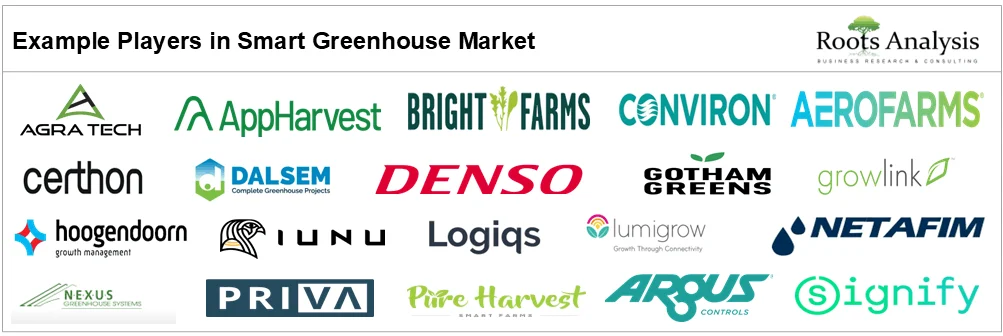
The smart greenhouse market is moderately competitive, featuring a mix of industrial conglomerates and specialized agtech innovators. In order to maintain competitive edge, industrial players are continually focusing on greenhouse automation solutions, intelligent lighting, and high-tech greenhouse projects. Some of the smart greenhouse market key players and strategies are listed below:
- Heliospectra: Focuses on "intelligent lighting" and has a strong presence in high-value crop markets like medicinal plants.
- Argus Control Systems: A dominant player in specialized research and high-performance commercial facilities, recently focusing on cloud integration.
- Netafim: Known for pioneering drip irrigation, it now offers comprehensive automated fertigation systems for large-scale projects globally.
- Priva: One of the most established names, its software platforms are used in over 500 commercial sites to synchronize climate and water cycles.
- Certhon: Offers turnkey high-tech greenhouse projects, often focusing on the full integration of robotics and AI.
- Signify: Leads the market in LED photobiology, providing "light recipes" that are scientifically proven to enhance specific plant characteristics.
Smart Greenhouse Market Investment Potential
The recent funding landscape highlights a shift toward commercial-ready automation and climate-resilient pilot projects. These investments indicate that the smart greenhouse market is highly investible and remain progressive during the forecast period.
- FARMLAB Grant: A consortium led by the University of Groningen secured a €2 million grant to develop autonomous aerial and ground robotics for precision agriculture, which will be integrated into smart greenhouse data analysis.
- USDA Climate-Smart Commodities (Ongoing): The USDA has invested more than USD 3.1 billion across 141 projects to verify greenhouse gas benefits in commodity production. This funding has reached more than 60,000 farms, encouraging the adoption of climate-smart infrastructure.
- Climate Smart Communities Initiative (CSCI) Grants: A total grant budget of USD 1.5-2 million has been allocated for the US based climate resilience projects, with applications due in March 2026.
Smart Greenhouse Market Future Scope and Trends
- High-Value Specialized Crop Production: Smart greenhouses are well positioned to serve premium segments requiring stringent quality control, including pharmaceutical-grade crops, medicinal plants, and differentiated produce varieties. Precise environmental regulation enables consistent control over potency, composition, and nutritional profiles, supporting compliance with high-end industry standards.
- Modular and Plug-and-Play Greenhouse Solutions: Growing demand exists for modular, containerized, and standardized smart greenhouse formats that reduce technical complexity and upfront investment. These scalable solutions expand addressable markets to smaller enterprises, educational institutions, and localized food producers, supporting more distributed and flexible production models.
- Market Penetration in Emerging Economies: Rapid population growth and climate-related agricultural stress in emerging regions are creating demand for resilient food production systems. Smart greenhouses present a viable solution for large-scale food security initiatives, particularly when supported by public-sector programs and collaborative implementation models.
- Data Monetization and Predictive Analytics Services: Beyond physical production, smart greenhouses generate extensive datasets on plant performance, environmental conditions, and resource utilization. This data foundation enables the development of predictive analytics offerings, such as yield forecasting and optimized growth protocols, creating additional revenue streams across the agricultural value chain.
Have Questions? Let's Get Them Answered
Smart Greenhouse Market: Scope of the Report
| Key Report Attributes | Details | |
| Historical Trend | Since 2022 | |
| Forecast Period | Till 2040 | |
| Market Size 2026 | $ 2.31 Billion | |
| Market Size 2040 | $ 16.50 Billion | |
| CAGR (Till 2040) | 15.08% | |
| Segments Covered |
|
|
Smart Greenhouse Market Segmentation
Based on the research, we have segmented the smart greenhouse market into type of greenhouse, type of component, type of technology, type of covering material, deployment mode, application, end user, geographical regions, and key players.
Market Share by Type of Greenhouse
- Hydroponic Greenhouses
- Non-Hydroponic Greenhouses
Market Share by Type of Component
- Hardware
- Software
- Services
Market Share by Type of Technology
- HVAC Systems
- LED Grow Lights
- Sensor and Control Systems
- Irrigation Systems
- Material Handling and Robotics
Market Share by Type of Covering Material
- Polyethylene
- Polycarbonate
- Others
Market Share by Deployment Mode
- Cloud-Based
- On-Premises
Market Share by Application
- Fruits and Vegetables
- Flowers and Ornaments
- Nursery Crops
Market Share by End User
- Commercial Growers
- Home Growers
- Research Institutes
- Urban Verticals
Market Share by Geographical Regions
- North America
- US
- Canada
- Mexico
- Rest of North America
- Europe
- Austria
- Belgium
- Denmark
- France
- Germany
- Ireland
- Italy
- Netherlands
- Norway
- Russia
- Spain
- Sweden
- Switzerland
- UK
- Rest of Europe
- Asia-Pacific
- Australia
- China
- India
- Japan
- New-Zeeland
- Singapore
- South Korea
- Rest of Asia-Pacific
- Latin America
- Brazil
- Chile
- Colombia
- Venezuela
- Rest of Latin America
- Middle East and Africa (MEA)
- Egypt
- Iran
- Iraq
- Israel
- Kuwait
- Saudi Arabia
- UAE
- Rest of MEA


