
Lowest Price Guaranteed
Slides
194
Last Updated
February 2026
View Count
11955
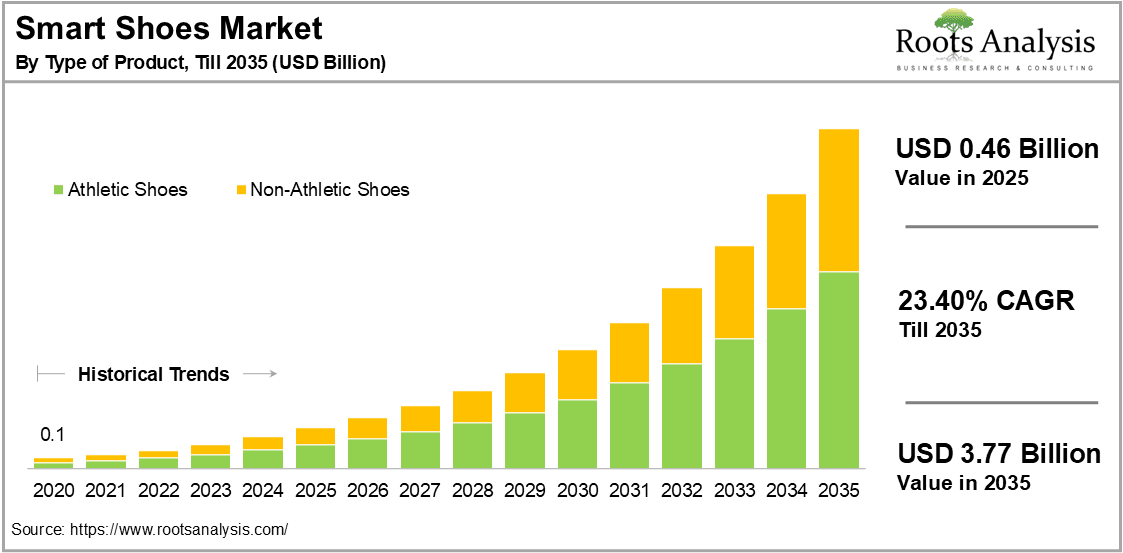
The global smart shoes market, valued at USD 0.35 billion in 2024, is projected to reach USD 0.46 billion in 2025 and USD 3.77 billion by 2035, representing a CAGR of 23.40% during the forecast period.
 |
The new research study consists of smart shoes industry analysis, detailed market forecast analysis, and providing actionable strategic recommendations.
With the emergence of technological advancements coupled with heath awareness has led to the emergence of smart shoes. By integrating accelerometers, gyroscopes and pressure points with traditional shoes to track activities and health metrics have surged smart shoes. These shoes can track calories burned, body temperature and heart rate.
The rising popularity of health monitoring footwear is due to the introduction of advanced features, such as data measures on posture and moving. In addition, these services are used by the healthcare sector for remote patient monitoring. These trends in fitness tracking shoes are majorly driven by the detection and analysis of high blood pressure, diabetes and heart conditions. Further, the integration of machine learning with smart insoles for fall detection and prevention for senior citizens will mark smart shoes to be a crucial innovation. Notably, IoT-enabled shoes for navigation for visually impaired individuals can detect objects and avoid crashes and fall for enhanced safety. The impact of technology on footwear can be defined by 3D printing and AI powered scanning of shoes that ensures mandatory safety features and aesthetic designs.
The global smart shoes market size is expected to grow significantly over the forecast period due to real-time feedback and activity tracking smart shoes for athletic performance enhancement. Further, running shoes with sensors can detect the pronation and ankle positions of athletes for prevention of possible injuries. Consequently, trends in health wearable health tracking devices will drive the market growth for activity tracking footwear.
The global smart shoes market research report presents an in-depth analysis of the various companies that are involved in offering smart shoes, across different segments, as defined in the table below:
| Key Report Attributes | Details | |
| Historical Trend | Since 2020 | |
| Forecast Period | Till 2035 | |
| Current Market Size | $ 0.46 Billion | |
| Market Size Value by 2035 | $ 3.77 Billion | |
| CAGR (Till 2035) | 23.40% | |
| Type of Product |
|
|
| Type of Technology |
|
|
| Type of Distribution Channel |
|
|
| End-User |
|
|
| Geographical Regions |
|
|
| Leading Market Players |
|
|
| PowerPoint Presentation (Complimentary) |
Available | |
| Customization Scope | 15% Free Customization | |
| Excel Data Packs (Complimentary) |
|
|
On the basis of the type of product, the smart shoes market is bifurcated into athletic shoes and non-athletic shoes. The athletic shoes segment is anticipated to dominate the segment with more than 60% of market share in 2025. Prominent reasons for this can be enhanced performance training and tailored suggestions for personal training by feedback. In addition, these shoes can track covered distance, calories burned and speed.
However, the non-athletic shoes segment is expected to grow with a relatively higher CAGR of 24.59%. This can be ascribed to the demand for health-monitoring shoes for early detection and prevention of possible injuries and rehabilitation. In addition, health monitoring approach as they support diagnostic work-up and therapeutic decisions play a pivotal role in market growth.
Based on the type of technology, the global smart shoes market is split into navigation shoes, positioning shoes and step counting shoes. Currently, according to our analysis, the steps counting shoes segment is augmenting the segment's growth with over 50% market share. This can be attributed to progress tracking by recognizing patterns and areas of improvement. In addition, smart running shoes are considered effective in encouraging physical activities.
On the other hand, the navigation shoes segment is expected to grow with a relatively higher (25.45%) CAGR in the near future. This can be ascribed to the introduction of a highly reliable navigation system for visually impaired individuals. These shoes can identify objects and alerts individual to prevent injuries forwardly boosting smart shoes industry insights.
On the basis of the type of distribution channel, the smart shoes market is bifurcated into E-commerce and offline stores. According to our global smart shoes market analysis, the E-commerce segment is anticipated to dominate the segment with more than 40% of the market share in 2025. Further, this segment is anticipated to grow with a relatively higher CAGR of 24.67%. The prominent reason for this dominance can be high internet penetration and smart usage. In addition, rising trust in cross-border B2C E-commerce platforms such as Amazon and Walmart have played a major role in the growth of the market.
Based on end-user, the global smart shoes market report is segmented into female and male. According to our analysis, male is leading the segment with the major market share (55%). This can be attributed to high focus on health and wellbeing in males. In addition, males have also been biggest consumers of traditional shoes. Notably, innovations in smart shoe features such as health tracking, navigation and assistive technology have contributed to the expansion.
However, female is expected to grow with the relatively faster (24.61%) CAGR in the forecasted period. This can be ascribed to rising awareness for health and wellbeing. In addition, these shows are favored for their comfort and aesthetic designs.
This segment highlights the distribution of the smart shoes market across various geographical regions such as North America, Europe, Asia, Latin America, Middle East, North Africa, and the rest of the world. According to our smart shoes market analysis, North America exhibits dominance in the market with over 40% of the smart shoes market share in the global marketplace. This can be attributed to high disposable income and the fast adoption of technology. Notably, high availability of products due to presence of leading companies and major market of E-commerce have played a pivotal role in the growth.
However, Asia is projected to grow with a relatively higher CAGR (24.76%) in the forecast period. Primary reasons for this growth include the rising research and development in advancements, specifically, China is continuously investing and launching new models in the market.
The “Smart Shoes Market, Till-2035: Industry Trends and Global Forecasts” report features an extensive study of the current market landscape, market size and future opportunity within smart shoes market, during the given forecast period. The market report highlights the efforts of several stakeholders involved in this rapidly emerging segment of the service providers industry. Key takeaways of the global smart shoes market report are briefly discussed below.
An increasing awareness for health and wellbeing is majorly driving the smart shoes industry. Further, the rising demand for wearable technology in footwear for activity and progress tracking has contributed to the expansion of the demand for connected smart shoes. Moreover, development of dedicated augmented reality (AR) experience for visualization of virtual shoes on customers’ feet has spurred growth in the domain. In addition, benefits of smart footwear such as navigation, step-counting and positioning technologies will continue to aid the growth in the forecasted period. It is worth highlighting that smart shoes can be connected with smartphones to access the information gathered by connected shoes.
With the presence of several small and large smart shoes companies, the competitive landscape of the smart shoes industry is experiencing intense competition and changing market dynamics. From large multinational companies to local smart shoes players, companies are striving to enhance their competitive edge. In terms of market share, large enterprises and multinational companies are dominating the market. While small smart shoes players are continuously improving their products to cater to niche markets, or they are offering specialized services. These industry players are focusing on adopting competitive strategies, such as developing innovative solution techniques, forming strategic alliances and partnerships to expand their portfolios and global footprint, investing in recent developments and new feature launches to enhance their smart shoes offerings.
Despite the strong market growth projection, the smart shoes market faces numerous challenges. The most common challenge is that they are highly costly in comparison with the traditional shoes. In addition, these shoes have low durability that can forwardly limit the daily usage. Further limited battery life hampers market growth, while low awareness and affordability add further complexities.
North America currently holds a substantial share of approximately 40% in the smart shoes market opportunities. This dominance can be attributed to several factors, including rising awareness of health and wellbeing. In addition, boosting demand for wearables for activity and progress tracking has played a pivotal role in the growth of smart shoes market. This region is home to prominent players such as Nike and Under Armour that are driving the market through innovation and competition. Further, North Americans are considered tech-savvy, the primary reason for this is rapid adoption of technological advancements.
It is worth highlighting that enhanced features such as navigation, step-counting and positioning are continuously contributing to the expansion of the domain. Consequently, rising collaboration and partnerships among organization will drive the market growth in the forecasted period.
Examples of key player involved in the smart shoes market (which have also been captured in this market report, arranged in alphabetical order) include 361 Degrees, Adidas, ASICS, Bata, Digitsole Pro, Honeywell, Li-Ning, Nike, Puma, Salted Venture, Sole Power, Sunflower, Under Armour, Wolverine and Xiaomi. This market report includes an easily searchable excel database of all the companies who have adopted the smart shoes market.
The market report presents an in-depth analysis, highlighting the capabilities of various companies engaged in this domain, across different segments. Amongst other elements, the market report includes:
At Roots Analysis, we genuinely care about your success and understand that your business requirements are unique. While our market research reports provide valuable insights, we recognize that they might not cover every aspect you need to make well-informed strategic decisions. To account for that, we offer 15% free report customization tailored to your specific needs. Whether you require additional quantitative analysis, qualitative insights, or any other information related to the smart shoes market, reach out us today at: support@rootsanalysis.com