


 Download Free Sample
 Buy Now
Market Size
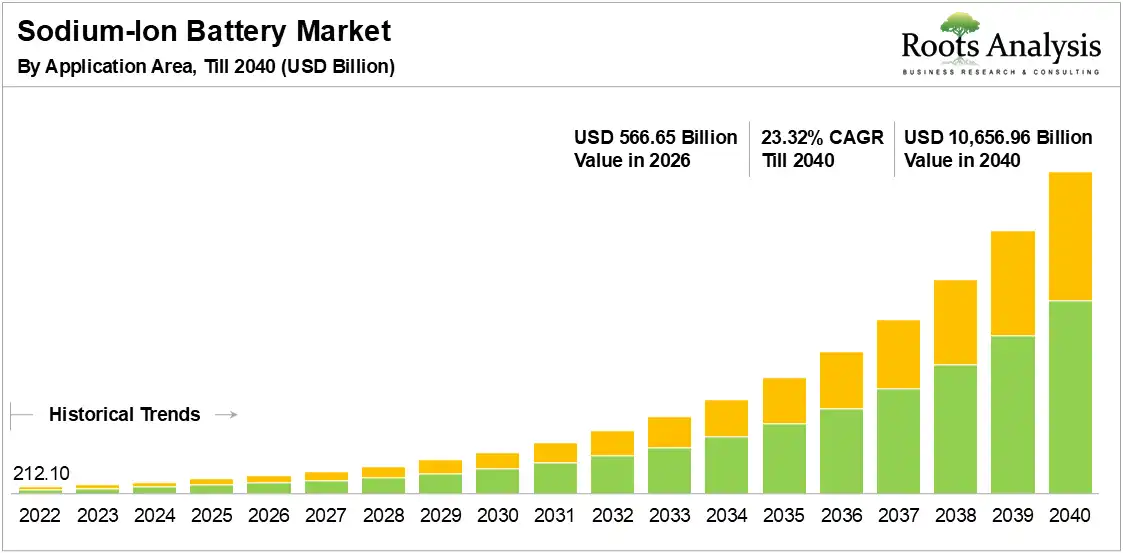
The global sodium-ion battery market, valued at USD 566.65 billion in 2026, is projected to reach USD 3,736.98 billion in 2035 and USD 10,656.96 billion by 2040, representing a CAGR of 23.32% during the forecast period 2026 to 2040.
See What’s in the Full Report - Request Your Complimentary Insights!
Market Report: Key Takeaways
- In terms of battery, sodium sulfur battery holds the largest share (48.32%) of the overall revenue share. The sodium sulfur battery will remain dominant in the future.
- Based on the type of technology, aqueous dominates the market by securing maximum sodium-ion battery technology market size.
- On the basis of application area, stationary energy storage lead the market with a share of 61.30%.
- With respect to end use industry, energy storage holds maximum sodium-ion battery market size (with over 50% share).
- According to regional analysis, Europe holds the largest sodium battery market size (with a share of 41.13%).
Market Overview
The Na-ion battery market is experiencing a transformative evolution, driven by the growing demand for electric vehicles and energy storage systems. Notably, sodium-ion battery refers to the rechargeable battery that uses sodium ion to release and store energy. Unlike, automotive lithium-ion battery that are expensive and have short lifecycle, sodium-ion batteries are sustainable, have longer lifecycle and charge faster.
Moreover, sodium-ion batteries are also widely used in electric vehicles and electronics due to improved safety and better performance in cold weather. Beyond electronic vehicles, sodium-ion batteries are widely used for energy storage systems and alternative to lithium-ion batteries.
Owing to the increasing acceptance as an alternative to lithium-ion batteries, several market players and research organizations are undertaking strategies and innovations. For instance, in November 2025, US researchers recently developed a sodium-ion pouch cell that can operate at temperature as low as -100ºC. This newly launched battery has been tested with renewable energy sources, including solar and wind, and maintained stable performance in field and laboratory conditions. These initiatives along with increasing demand is likely to raise the sodium-ion battery market at an unprecedented rate.
Recent Industry Developments
- In November 2025, Sinopec and LG Chem announced partnership plans to develop key materials for sodium-ion batteries.
- In November 2025, Bihar Batteries launched sodium-ion battery and aiming to commercialize it in 2026.
- In November 2025, Pret plans to invest CNY 800 million (USD 112.3 billion) to build a new 6 GWh sodium-ion battery plant. This investment will also be used to promote large-scale application of sodium-ion batteries.
- In October 2025, Alsym Energy announced its new NA-Series line, a sodium-ion battery aiming to enter stationary energy storage market.
Pay Only for What You Need – The Best Way to Optimize
Market Share Insights
Sodium Sulfur Battery Holds Highest Share of the Market
Based on our analysis, sodium-sulfur captures 48.32% of revenue share in 2026. It is the dominant choice for grid-scale ESS due to superior stability and a projected 25.8% CAGR through 2040. This highest share is due to the sodium-salt is merging as the primary low-cost alternative for urban / micro-EVs and industrial storage as production shifts toward 24GW+ gigafactory scales. Moreover, market players are capitalizing on Na-S for mature utility-grade projects while targeting Na-Salt for high-volume automotive "A-segment" applications seeking 30% lower costs than LFP.
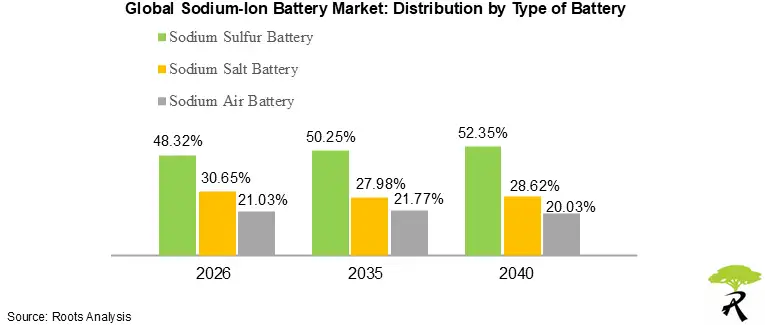
On the other hand, sodium-air battery represents the "high-alpha" R&D play with a steady 6.9% CAGR during the forecast period. Its superior theoretical energy density makes it the long-term strategic candidate for long-range mobility and high-performance portables.
Stationary Energy Storage Dominates the Market
Currently, stationary energy storage holds 61.30% market share in 2026. This highest share is driven by large-scale grid stabilization and renewable integration. Its dominance is underpinned by the cost-effectiveness and safety profiles of sodium-ion technology, making it the preferred choice for utility-scale solar and wind projects facing Li-ion supply constraints. With the highest projected volume through 2030, stationary storage offers a “low-risk, high-scale” entry point. Investors should focus on projects leveraging Sodium-Sulfur (Na-S) chemistries, which are currently optimized for the long-duration discharge cycles required by critical energy infrastructure.
While stationary storage holds the current share, the automotive segment is emerging as the high-growing region, projected to grow at a CAGR of 23.3% through 2035. This rapid growth is fueled by the aggressive shift toward mass-market “A-segment” electric vehicles (micro-EVs) where low-cost sodium-ion packs (targeting $40-$50 /kWh) provide a decisive competitive edge over LFP. Furthermore, recent advancements in Prussian Blue and layered oxide cathodes have narrowed the performance gap, enabling 15-minute fast-charging and superior cold-weather resilience. These technical milestones are positioning sodium-ion as the "safety-first" alternative for next-generation urban mobility and light-duty commercial fleets.
Market Share by Geographical Regions: Europe Holds the Largest Share
Currently, Europe holds the largest market share at 41.13% in 2026. Europe’s dominance is largely driven by strict regulatory frameworks like the 2026 Circular Economy Act and strict carbon reduction mandates that has successfully industrialized Na-ion solutions for grid-scale storage and a robust EV manufacturing ecosystem, positioning it as the primary hub for sustainable, long-duration energy infrastructure.
Moreover, the rapid integration of renewable energy across EU member states has created a mature demand for temperature-stable, cost-effective alternatives to lithium, ensuring Europe remains the revenue anchor for the foreseeable future.
Meanwhile, North America is the fastest growing region with a projected CAGR of 24.22% during the forecast period 2026-2040. This surge is fueled by a strategic pivot to reduce reliance on imported lithium and massive capital inflows into domestic large-scale energy storage projects and solar / wind firming initiatives. Notably, the North American market represents a high-alpha opportunity, particularly in the utility and automotive sectors. Stringent guidelines for EV adoption and federal incentives for domestic battery supply chains are creating a fertile environment for Na-ion technology to capture significant market share as it moves from pilot deployments to gigafactory scale production.
Want Information on Specific Region / Segment?
Market Dynamics
Key Market Drivers
- Demand for Cost-effective and Scalable Energy Storage: Sodium is highly abundant in nature which makes it less expensive than lithium. Moreover, it is environment friendly that lithium-ion counterparts which further propelled the adoption of sodium-ion battery for grid storage and renewable energy storage.
- Supply Chain and Resource Security Concerns with Lithium and Cobalt: The geopolitical risk, global shortage of lithium and cobalt have accelerated the demand for sodium-ion alternatives for energy storage, mobility, and consumer electronics.
- Government Support and Clean Energy Policies: The sodium-ion battery market growth is further backed by the increasing regional energy strategies to adopt clean and green energy. Moreover, the robust supply chain and raw material availability for sodium-ion batteries has further diversified the use of these batteries for energy storage solutions.
Key Challenges
- Achieving Performance Parity with Lithium-ion for Key Applications: Sodium-ion batteries might be energy dense, still lithium-ion based batteries are mostly preferred for electric vehicles and energy storage solutions due to its optimal performance and energy efficiency. Therefore, sodium-ion batteries are requirement to improve energy density, cycle life, and reliability to penetrate markets dominated by lithium-ion.
- Ensuring Manufacturing Scale-up and Cost Reduction: The process of transitioning from pilot projects to mass projections requires massive capital investment. Moreover, the scaling processing also require process optimization and standardized design to reduce cost. Ensuring manufacturing scale up and cost reduction can be challenging for the market players due to the requirement of massive investment.
- Managing Intellectual Property and Standardization Issues: It is worth noting that technical standardization, intellectual property and patent landscape is crucial for the sodium-ion batteries market entry. However, stringent protocols of intellectual property protection and complexity of the standardization process delay the establishment of universally accepted rules needed for sodium-ion batteries to scale efficiently and securely.
Key Market Insights
Competitive Landscape of Key Players in Sodium-Ion Battery Market
The market for sodium-ion battery is fragmented and is experiencing intense competition due to the presence of well-established tech-giants and small industrial players. In order to leverage the competitive edge, the market players are encouraging investments, partnerships, collaborations, and technological innovations.
For instance, in March 2025, Altris announced a strategic investment deal and collaboration with Volvo Cars to develop new sodium-ion batteries for battery energy storage systems. Likewise, several sodium-ion battery manufacturers are scaling sodium-ion battery production to meet the growing demand across diverse industries.
Latest Technological Advancements and Trends in Sodium-Ion Batteries
- Improved Performance in Modern Sodium-ion Battery Designs: The market players are aiming for the advancements in new materials, and cell architectures to boost energy density, operating temperature range, and cycle life. These material innovations, such as solid electrolytes, advanced cathodes, and carbon anodes are required for regulatory compliance for sodium-ion battery manufacturing.
- Renewable Integration, Scale-Up For Grid Storage, and Backup Power: The future roadmap for sodium-ion batteries will be on scaling up for large-scale gid storage, solar / wind buffering, and stationary backup applications. This innovation is crucial for stationary applications, specifically where energy density is less critical, but scalability and economies are essential.
- Expansion into Two / Three-Wheelers and Low Cost Mobility Solutions: With growing adoption of electric two / three-wheelers, and lightweight vehicles, the market players are emphasizing the integration of low-cost battery chemistries into micro-mobility solutions. The expansion intro two / three wheelers is due to the cost advantage, and modest energy density requirements.
Get an Instant Quote in 10 Minutes. Lowest Price Guaranteed
Strategic Partnerships and Local Manufacturing Ventures
In order to foster large scale commercialization of the sodium-ion batteries, market players are undertaking strategic partnership agreements. These partnerships are majority in between battery developers, utilities, automakers, and governments. The aim of these strategic partnerships is to build a robust supply chain and raw material availability for sodium-ion batteries, and bring rechargeable sodium-ion battery innovations.
For instance, in April 2025, Inlyte Energy and HOREIN entered into a strategic partnership to scale the manufacturing of iron-sodium battery in the US. Similarly, the market players are also emphasizing sustainability and recycling strategies for sodium-ion battery waste for the widescale adoption of these next generation batteries across different industrial sectors.
Market Segmentation
Sodium-Ion Battery Market: Scope of the Report
| Key Report Attributes | Details | |
| Historical Trend | Since 2022 | |
| Forecast Period | Till 2040 | |
| Market Size 2026 | $ 566.65 Billion | |
| Market Size 2040 | $ 10,656.96 Billion | |
| CAGR (Till 2040) | 23.32% | |
| Segments Covered |
|
|
| Key Players Profiled |
|
|
| PowerPoint Presentation (Complimentary) | Available | |
| Customization Scope | 15% Free Customization | |
| Excel Data Packs (Complimentary) |
|
|
Market Segments
Based on research, we have segmented the sodium-ion battery market into type of battery, type of technology, application area, end use industry, geographical regions, and key players.
By Type of Battery
- Sodium Sulfur Battery
- Sodium Salt Battery
- Sodium Air Battery
By Type of Technology
- Aqueous
- Non-Aqueous
By Application Area
- Stationary Energy Storage
- Transportation
By End Use Industry
- Automotive
- Consumer
- Energy Storage
- Industrial
- Others
By Geographical Regions
- North America
- US
- Canada
- Mexico
- Rest of North America
- Europe
- Austria
- Belgium
- Denmark
- France
- Germany
- Ireland
- Italy
- Netherlands
- Norway
- Russia
- Spain
- Sweden
- Switzerland
- UK
- Rest of Europe
- Asia-Pacific
- Australia
- China
- India
- Japan
- New-Zealand
- Singapore
- South Korea
- Rest of Asia-Pacific
- Latin America
- Brazil
- Chile
- Colombia
- Venezuela
- Rest of Latin America
- Middle East and Africa (MEA)
- Egypt
- Iran
- Iraq
- Israel
- Kuwait
- Saudi Arabia
- UAE
- Rest of MEA
Unlock Deeper Insights – Schedule Your Personalized Workshop Today!


