


 Download Free Sample
 Buy Now
Market Size
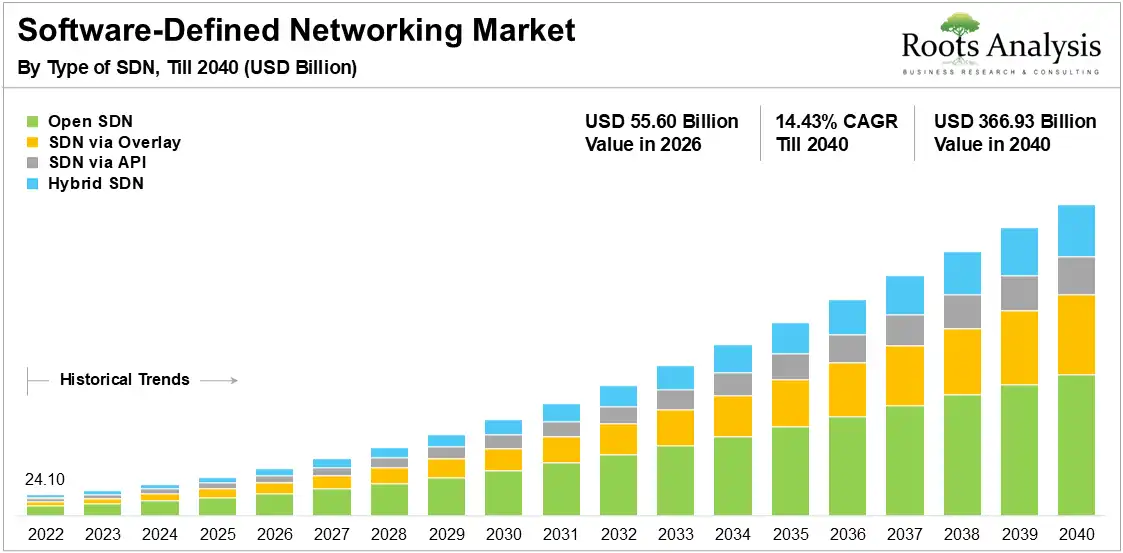
Software-defined networking (SDN) market size market size is forecasted to reach USD 366.93 billion by 2035, growing at a 14.43% CAGR from USD 55.6 billion in 2026.
See What’s in the Full Report – Request Your Complimentary Insights!
Market Report: Key Takeaways
- In terms of component, SDN infrastructure holds the highest share (42.4%) of the market in 2026, while services represent the fastest-growing segment with an anticipated CAGR of 16.6% through 2040.
- With respect to the type of SDN, open SDN dominates (48.0%) the 2026 landscape, whereas SDN via overlay is projected to expand at the highest CAGR of 16.0% during the forecast period.
- Based on applications, SD-WAN captures the largest share (55.6%) of the current market and simultaneously exhibits the most rapid growth trajectory, accelerating at a 15.2% CAGR till 2040.
- Amongst end users, telecom service providers capture the maximum market share (42.0%) in 2026; however, cloud service providers showcase the steepest growth curve at a 17.0% CAGR till 2040.
- By organization size, large enterprises account for the majority (57.3%) of current deployments, though SMEs are adopting solutions rapidly with an expected CAGR of 14.8%.
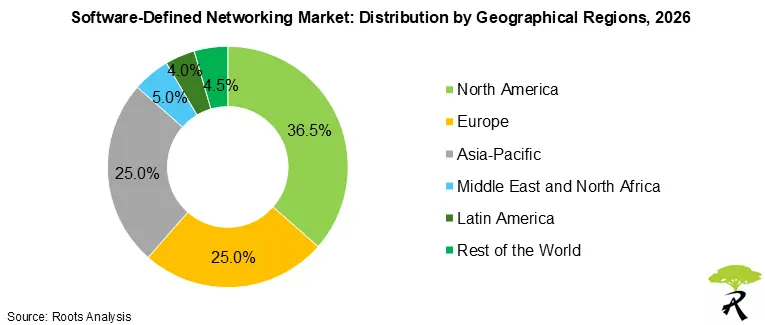
- In terms of geographical regions, North America currently maintains the highest market share (36.5%), while Asia-Pacific presents the fastest growth opportunity, scaling at a 16.2% CAGR till 2040.
- Focusing on verticals, the telecom & IT sector holds the leading baseline share (20.0%), whereas retail & e-commerce emerge as the fastest-expanding segment, accelerating at a 19.5% CAGR.
Software-Defined Networking Market Outlook
Enterprise digital infrastructure is fundamentally restructuring, aggressively abandoning legacy hardware constraints for highly programmable, disaggregated architectures. Software-defined networking centralizes control planes, allowing organizations to dynamically orchestrate virtualized network functions across distributed hybrid environments. This strategic decoupling enables intent-based management, effectively mitigating the operational friction associated with escalating multi-cloud complexity and unprecedented global data traffic surges.
Accelerating 5G rollouts and intensive artificial intelligence workloads serve as primary deployment catalysts, necessitating elastic bandwidth and ultra-low latency capabilities. Public sector modernization mandates and enterprise sustainability goals further support this commercial momentum. Recent 2026 initiatives, including Arista Networks’ advancements in AI-driven Ethernet scaling, demonstrate how integrated controllers drastically optimize hyperscale data center operational performance.
The future trajectory relies on executing autonomous networking, where predictive algorithms proactively configure infrastructure to eliminate costly outages. As 6G planning pushes intelligence toward the network edge, uncompromising security becomes mandatory. Aligning with robust 2026 federal cybersecurity directives, identity-verified, zero-trust SDN frameworks are now the definitive standard for protecting mission-critical global enterprise digital connectivity architectures.
Software-Defined Networking Market Growth Drivers, Restraints, Challenges and Opportunities
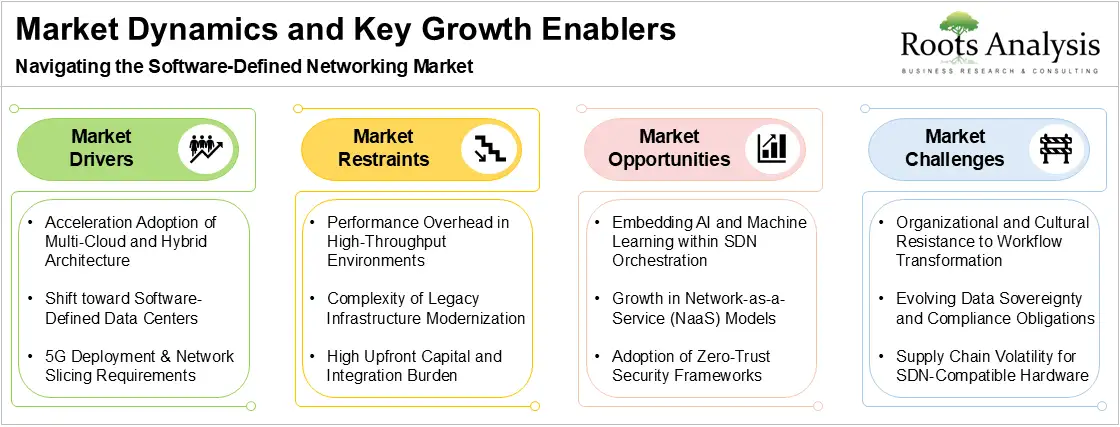
Accelerating multi-cloud adoption and critical 5G network slicing requirements are aggressively pushing global enterprises toward software-defined data centers. However, executing this transition faces severe friction from legacy infrastructure modernization complexities and high upfront and integration capital burdens.
Navigating these structural bottlenecks requires organizations to adopt flexible network service models and embed artificial intelligence within orchestration layers. Furthermore, scaling these zero-trust architectures demands overcoming entrenched organizational workflow resistance while managing strict data sovereignty obligations.
Pay Only for What You Need – The Best Way to Optimize
Software-Defined Networking Market Size Estimation Methodology
- As a starting point, we established the market scope by categorizing the Software-Defined Networking (SDN) ecosystem into core functional layers, including infrastructure, software controllers, and managed services. We differentiated between open SDN and SDN via overlay using industry-standard definitions to prevent double-counting, while setting geographic and vertical segmentations based on regional data sovereignty laws and specific networking requirements for critical sectors like BFSI and telecom.
- Then we examined demand-side adoption rates using S-curve diffusion logic, evaluating the transition phase from early-adopting hyperscalers to the early majority of global enterprises, as well as the 5-to-7-year replacement cycles for legacy hardware, to understand technology maturity, shifts in IT budget elasticity toward cloud spending, and macroeconomic impacts such as hardware inflation.
- Thereafter, we collected segment-wise product shipment volumes, prevailing average selling prices (ASPs) across hardware and software tiers, and vendor market shares through primary research with industry stakeholders, cross-validating these findings using secondary sources like vendor financial filings, product whitepapers, and technographic data from cloud service providers.
- Using these data and insights, we calculated the global software-defined networking market size and projected the future market opportunity. This was achieved through a comprehensive approach that reconciled a bottom-up aggregation of company-level hardware and software sales with a top-down assessment of total addressable IT infrastructure spend, factoring in historical technology shifts, accelerated 5G rollouts, and edge computing demands.
- The overall opportunity associated with the global market was further distributed across distinct market segments, allocating revenue by functional layer, organization size, vertical industry, and key geographical regions weighted by GDP growth, the density of hyperscale data centers, and localized digital transformation maturity.
- Finally, in order to assess the sensitivity of our assumptions, we conducted a multivariate sensitivity and scenario analysis (base, optimistic, and conservative) on some of the most important parameters of our forecast methodology, evaluating the potential impact of white-box switch adoption rates, open-source controller pricing dynamics, semiconductor supply chain constraints, and potential IT budget freezes.
Software-Defined Networking Market Share Insights
Which SDN Component Dominates Market in 2026?
- SDN infrastructure sub-segment secures the largest revenue share (42.4%) within the software-defined networking industry, functioning as the capital-intensive foundation for legacy hardware virtualization.
- This structural dominance stems from supply chain maturity in programmable application-specific integrated circuits (ASICs) and switches, coupled with established ecosystem readiness in data centers and telecom backbones, providing scalability advantages as enterprises prioritize hardware upgrades for cloud-hybrid environments. For instance, in February 2025, Cisco Systems launched its Agile Services Networking suite, emphasizing SDN infrastructure for high-speed routing and programmable control in service provider networks.
- The Services segment represents the fastest-growing market vector, accelerating at a robust 16.6% CAGR. This expansion is strictly propelled by surging corporate demand for expert integration and lifecycle orchestration as organizations navigate highly complex, AI-driven multicloud infrastructure migrations.
- Validating this demand trajectory, NTT DATA’s April 2026 expansion of AI-powered software-defined infrastructure services directly addresses market friction, equipping enterprises with the strategic integration frameworks required to scale hybrid ecosystems while successfully stabilizing long-term operational expenditures.
Software-Defined Networking (SDN) Market Size by End User
- Telecom service providers maintain dominance (42.0% market share) by leveraging massive physical infrastructure control and stringent regulatory mandates. Government modernization initiatives compel carriers to aggressively adopt software-defined core networks for national-scale 5G slicing rollouts.
- Validating this scale, Tata Communications launched its AI-ready IZO Multi-Cloud Network suite in January 2026. This software-defined platform explicitly enables deterministic routing and dynamic bandwidth orchestration, allowing carriers to cost-effectively virtualize legacy assets.
- On the other hand, cloud service providers represent the fastest-growing segment, accelerating at a robust 17.0% CAGR. This trajectory is strictly propelled by surging hyperscale demands for elastic multi-region orchestration and sub-millisecond network convergence supporting massive artificial intelligence workloads.
- Reflecting this momentum, Google Cloud deployed GKE Inference Gateway routing in February 2026, while AWS advanced disaggregated network infrastructure. These structural upgrades allow hyperscalers to dynamically allocate exabyte-level resources across global hybrid environments.
Want Information on Specific Region / Segment?
Software-Defined Networking Industry Forecast by Geographical Regions
North America Region to Capture Largest Share in 2026
- North America software-defined networking industry analysis suggests that the region dominates the market, capturing 36.5% share. Established cloud computing ecosystems and strict federal cybersecurity mandates provide unmatched regional infrastructure readiness. Consequently, organizations actively execute large-scale, highly cost-efficient software-defined network integrations across highly complex telecommunications and advanced corporate IT sectors.
- Validating this strict regulatory environment, the US Federal Communications Commission issued January 2025 mandates requiring telecom operators to strengthen network cybersecurity. Concurrently, Cisco accelerated regional infrastructure readiness by deploying Hypershield architectures, enabling North American enterprises to program secure networks for production-scale workloads.
Software-Defined Networking Market Growth Rate in Asia Pacific
- The Asia-Pacific region projects the highest market growth at a 16.2% CAGR. Explosive urbanization and government-led initiatives, such as Digital India, actively compel massive regional data center expansions. Consequently, telecom operators aggressively scale software-defined architectures supporting massive hyperscale cloud services.
- Validating this regional momentum, Japan's KDDI rapidly expanded disaggregated software-defined core deployments across its entire national network in January 2026. Simultaneously, Singtel partnered with Ericsson in March 2026, aggressively deploying AI-native programmable infrastructures targeting Level 4 autonomy to securely automate highly complex, massive telecommunications environments.
Market Ecosystem Analysis
Software-Defined Networking Market Competitive Landscape
The software-defined networking competitive landscape is rapidly consolidating as enterprise requirements shift toward autonomous, AI-driven orchestration. Established infrastructure giants and agile software startups fiercely compete to deliver zero-trust security, programmable edge connectivity, and scalable multi-cloud provisioning to successfully capture highly lucrative corporate digital transformation investments.
Established Top-Tier Companies: Scaling Hyperscale SDN Connectivity
Market consolidation is accelerating among Tier-1 infrastructure providers actively scaling AI-native architectures. These strategic infrastructure deployments confirm that global enterprise giants are prioritizing autonomous network optimization to aggressively secure dominant market share across highly complex hybrid environments.
- Validating this momentum, Cisco introduced the Silicon One G300 in February 2026. This 102.4 Tbps programmable networking chip explicitly targets massive artificial intelligence cluster buildouts, supporting highly automated AgenticOps frameworks for global hyperscale data centers.
- Broadcom unveiled VMware Telco Cloud Platform 9 in March 2026, delivering zero-trust security and advanced micro-segmentation specifically designed to help telecommunications operators seamlessly manage complex, in-border sovereign cloud workloads.
- Hewlett Packard Enterprise significantly expanded its corporate networking ecosystem by successfully completing the strategic acquisition of Juniper Networks in July 2025. This critical integration bundles high-performance AI visibility with robust multi-cloud management capabilities, allowing enterprise clients to permanently bypass legacy hardware constraints.
Startups Accelerating Software-Defined Network Automation
Software startups are aggressively disrupting established market hierarchies by delivering cloud-native orchestration and specialized automation frameworks. These emerging innovators consistently outmaneuver legacy incumbents by completely eliminating hardware dependencies, offering global enterprise buyers highly elastic, subscription-based scalability that immediately stabilizes volatile capital expenditure models and drastically accelerates the execution of mission-critical digital transformation initiatives.
- Demonstrating this commercial velocity, Arrcus launched the industry’s first AI Inference Network Fabric in February 2026. This intent-driven architectural solution specifically accelerates the delivery of real-time physical and agentic artificial intelligence applications while drastically improving power efficiency for distributed computing environments.
- Alkira strategically expanded its multi-cloud dominance by introducing the Connect Partner Program in early 2026, enabling system integrators to instantly provision high-value network infrastructure-as-a-service capabilities.
- Nile launched the Nile 2.0 strategy in March 2026, introducing the “Segment-of-1” architecture. This framework embeds identity-based microsegmentation directly into a zero-trust fabric, strictly isolating individual devices to decisively prevent lateral malware propagation.
- DriveNets deployed an ethernet-based AI networking fabric in May 2025. This scalable, disaggregated routing infrastructure efficiently interconnects massive, advanced GPU-as-a-Service data centers, actively supporting intense computational workloads for modern cloud-native enterprises.
Key Software-Defined Networking Market Trends
Impact of 5G and IoT on the Software-Defined Networking Market
The exponential proliferation of internet of things (IoT) endpoints alongside the transition to 5G standalone architecture strictly dictates the deployment of software-defined frameworks. Organizations cannot physically route millions of deterministic, ultra-low-latency connections using rigid legacy hardware. Consequently, SDN enables dynamic network slicing, allowing telecom operators to provision dedicated bandwidth pipelines for mission-critical edge workloads, such as industrial predictive maintenance and autonomous telematics. This architectural evolution actively transforms cellular connectivity into a highly monetizable, scalable enterprise service.
Intent-Based Orchestration: The Agentic AI Commercial Opportunity
Representing the most critical emerging commercial frontier, intent-based networking (IBN) powered by agentic AI fundamentally redefines infrastructure management. As architectural complexity completely outpaces human administrative bandwidth, enterprises actively deploy AI-native orchestration platforms that autonomously translate natural-language business directives into functional network configurations. By utilizing predictive intelligence to execute zero-touch provisioning and real-time anomaly remediation, organizations immediately neutralize severe industry talent shortages while drastically reducing long-term operational expenditures across massive multi-cloud environments.
Your Business is Unique – Why Shouldn’t Your Report Be?
Market Access Considerations
Open-Source Interoperability & Vendor Ecosystems
Market access fundamentally requires strict adherence to open-source protocols like OpenFlow to prevent severe enterprise vendor lock-in. Modern corporate buyers demand seamless multi-vendor integration, forcing providers to compete purely on software agility. Consequently, successful commercialization heavily depends on active consortium participation, substantially lowering entry barriers for pure-play agile software challengers.
Agentic Intelligence & Autonomous Talent Gap Mitigation
Overcoming severe global IT talent shortages dictates that autonomous artificial intelligence / AI agents integration is now a mandatory commercial prerequisite. Validating this, Cisco launched AgenticOps in February 2026, empowering non-expert technicians to instantly troubleshoot industrial networks. Vendors failing to embed natural-language predictive automation cannot successfully access highly complex, modern enterprise infrastructure markets.
Zero-Trust Mandates & Control Plane Resilience
Centralized orchestration creates highly attractive targets for distributed cyber threats, making strict regulatory compliance a mandatory market gateway. Adoption across heavily regulated sectors requires proving absolute control plane resilience. Consequently, commercial scaling demands continuous investments in zero-trust architectures, erecting substantial structural barriers that consolidate power among resource-rich cybersecurity industry leaders.
CapEx to OpEx Transition & ROI Viability
Transitioning toward disaggregated architecture fundamentally shifts procurement from massive upfront capital expenditures to subscription-based operational models. While reducing initial financial friction, scaling market penetration requires vendors to explicitly quantify rapid returns on investment through automated provisioning. Therefore, competitive viability strictly prioritizes vendors offering compelling financial modeling alongside high-performance network efficiency.
How Stakeholders Benefit from the Key Focus Areas of Our Software-Defined Networking Market Report
The global software-defined networking ecosystem rapidly accelerates as enterprise infrastructure pivots toward programmable, disaggregated architectures. This comprehensive report equips executives and strategic planners with authoritative market drivers, granular forecasts, and actionable trend evaluations, enabling decision-makers to aggressively execute scalable digital transformation across highly complex, multi-cloud hybrid environments.
- Software-Defined Networking Market Landscape and Competitive Dynamics: The report maps established infrastructure giants, pure-play software challengers, and evolving ecosystem consolidation strategies. Stakeholders utilize these precise competitive benchmarks to identify critical whitespace opportunities, optimize market entry frameworks, and proactively navigate structural telecommunications shifts.
- Unmet Needs and Market Gaps in Software-Defined Networking: This analysis identifies critical inefficiencies within legacy hardware architectures, multicloud integration friction, and severe automation talent shortages. Strategy leaders leverage these verified gaps to align product development with urgent demand, targeting underserved segments possessing massive commercial upside.
- Technology Innovation and Adoption Trends: Detailed coverage of agentic AI orchestration, zero-trust security frameworks, and 5G network slicing clarifies exact innovation trajectories. Decision-makers evaluate proven commercial traction, ensuring enterprise digital transformation initiatives strictly align with validated adoption patterns to maximize network investment returns.
- Funding and Investment Landscape in Software-Defined Networking Industry: Comprehensive analysis highlights capital flow trends, venture hotspots, and high-growth segments within programmable infrastructure. Stakeholders gain absolute clarity regarding private equity concentration, empowering investors to strategically allocate capital toward scalable automation platforms and rapidly identify lucrative consolidation opportunities.
- Partnership and Collaboration Trends in Software-Defined Networking: The study examines high-impact strategic alliances, open-source consortiums, and telecom-hyperscaler frameworks accelerating network modernization. Corporate development teams utilize this analytical perspective to pinpoint synergistic partners, rapidly facilitating go-to-market execution and unlocking alternative revenue streams through shared technological architectures.
- Software-Defined Networking Market Segmentation and Geographic Coverage: Granular segmentation across components, type of SDN, applications, deployment models, end users, vertical, organization size, and regional maturity provides absolute clarity regarding structural demand patterns. This exhaustive, data-driven foundation strictly guides tactical resource prioritization, ensuring targeted regional market entries and highly localized scaling operations execute flawlessly globally.
Have Questions? Let’s Get Them Answered.
Software-Defined Networking Market: Scope of the Report
| Key Report Attributes | Details | |
| Forecast Period | Till 2040 | |
| Market Size 2026 | USD 55.60 Billion | |
| Market Size 2040 | USD 366.93 Billion | |
| CAGR (Till 2040) | 14.43% | |
| Segments Covered |
|
|
| Geographical Regions Covered |
|
|
| Key Sections Covered |
|
|
Market Segmentation
The software-defined networking market report presents an in-depth analysis, highlighting the capabilities of various stakeholders, based on different segments such as component, type of SDN, application, end user, organization size, vertical, geographical regions, and key players.
Market Share by Component
- SDN Infrastructure
- Applications
- Controllers
- Networking Devices
- Software
- Services
- Professional
- Managed
Market Share by Type of SDN
- Open SDN
- SDN via Overlay
- SDN via API
- Hybrid SDN
Market Share by Application
- SD-WAN
- SD-LAN
- Security
- Others
Market Share by End User
- Telecom Service Providers
- Cloud Service Providers
- Enterprises
Market Share by Organization Size
- Large Enterprises
- Small and Medium Enterprises (SMEs)
Market Share by Vertical
- BFSI
- Education
- Government & Defense
- Healthcare
- Manufacturing
- Retail & E-commerce
- Telecom & IT
- Others
Market Share by Geographical Regions
- North America
- US
- Canada
- Mexico
- Rest of North America
- Europe
- Austria
- Belgium
- Denmark
- France
- Germany
- Ireland
- Italy
- Netherlands
- Norway
- Russia
- Spain
- Sweden
- Switzerland
- UK
- Rest of Europe
- Asia-Pacific
- Australia
- China
- India
- Japan
- New-Zealand
- Singapore
- South Korea
- Rest of Asia-Pacific
- Latin America
- Argentina
- Brazil
- Chile
- Colombia
- Venezuela
- Rest of Latin America
- Middle East and North Africa (MENA)
- Egypt
- Iran
- Iraq
- Israel
- Kuwait
- Saudi Arabia
- UAE
- Rest of MENA
- Rest of the World


