


 Download Free Sample
 Buy Now
Sovereign AI Infrastructure Market Size
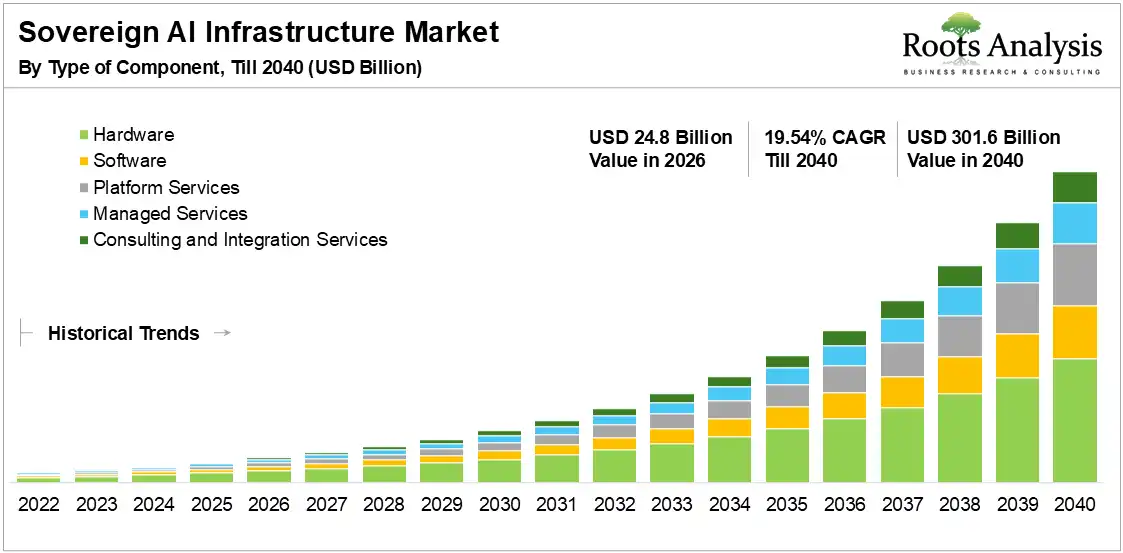
The global Sovereign AI Infrastructure market reached USD 24.8 billion in 2026 and will grow to USD 301.6 billion by 2040, registering a CAGR of 19.54% over the forecast period 2026 to 2040, driven by national AI sovereignty initiatives and localized AI compute investments.
See What’s in the Full Report – Request Your Complimentary Insights!
Market Report: Key Takeaways
- Based on infrastructure type, Compute Infrastructure captures 34.0% market share in 2026, whereas Security Infrastructure registers a 24.5% CAGR through 2040, supported by sovereign cybersecurity mandates.
- Based on deployment model, Private Cloud captures 39.0% market share in 2026, whereas Sovereign Public Cloud registers a 24.2% CAGR through 2040, driven by regulated AI workloads.
- Based on component, Hardware captures 46.0% market share in 2026, whereas Platform Services registers a 23.6% CAGR through 2040, fueled by sovereign AI orchestration demand.
- Based on technology, GPU Accelerated Computing captures 29.0% market share in 2026, whereas Large Language Model Infrastructure registers a 25.0% CAGR through 2040, driven by national foundation model programs.
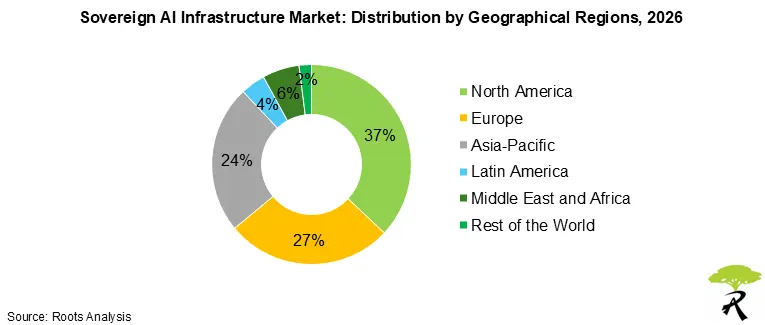
- Based on geography, North America captures 37.0% market share in 2026, whereas Asia-Pacific registers a 23.1% CAGR through 2040, supported by regional AI sovereignty investments.
Sovereign AI Infrastructure Market Outlook
The sovereign AI infrastructure market has shifted from isolated pilot builds to national-scale capacity planning. Governments now buy compute, storage, networking, power, cooling, and security as one stack. Demand has moved toward regionally controlled AI clouds, domestic GPU access, and compliant data residency. Supply constraints now center on chip allocation, energy availability, and trusted infrastructure partners, not on proof of demand.
Growth is being pulled by sovereign data policies, public-sector AI programs, and regulated workload requirements. Canada launched the AI Sovereign Compute Infrastructure Program in April 2026 to expand national compute access for domestic users. Maharashtra also approved an AI policy targeting INR 10,000 crore in investments, 2,000 GPUs, and compute infrastructure development, which shows how regional governments now treat AI capacity as industrial infrastructure.
The market remains high-growth and still early in its structural buildout, with long-term demand tied to federated compute, sovereign public cloud, and national foundation model programs. NVIDIA’s DGX Cloud Lepton expansion in January 2026 strengthened region-specific GPU access for localization compliance. Through 2040, the market should keep scaling as governments localize AI infrastructure, harden security controls, and fund regional resilience. The outlook stays expansionary, but access will remain shaped by capital intensity and policy control.
Sovereign AI Infrastructure Market Size Estimation Methodology
- As a starting point, we anchored the 2026 market base on verified sovereign cloud announcements, national compute programs, and hyperscaler capex disclosures tied to AI infrastructure. We cross-checked those signals against server shipment data and GPU allocation announcements to avoid double counting capacity that was only planned, not deployed. That gave us the initial market floor for sovereign AI infrastructure spending.
- Moving forward, we mapped demand by infrastructure type using observed procurement patterns for compute, storage, networking, power, cooling, and security layers. We compared those patterns with colocation leasing rates and utility billing data in major AI hubs, because energy and facility costs directly shape deployment economics. This step helped us separate headline AI intent from actual spending that reaches operating sites.
- Building on this, we sized deployment models using sovereign cloud launches, private cloud contracts, and hybrid AI program disclosures from governments and regulated enterprises. We used regulatory submission counts and policy release volumes as a proxy for how many jurisdictions were formalizing sovereign AI requirements. That approach captured the difference between experimental interest and programs that require commercial infrastructure.
- Drawing upon these inputs, we calibrated regional shares with construction cost indices, regional power constraints, and announced data center build pipelines. We also used trade flow data and semiconductor fab output indicators to estimate how quickly hardware supply can support local buildouts. The result was a region-by-region view that reflected both demand pull and supply-side bottlenecks.
- The projected value was then forecast by applying segment-level growth rates to the validated 2026 base and testing them against infrastructure adoption curves. We checked whether the implied expansion matched known milestones such as government AI compute programs, sovereign public cloud rollouts, and AI factory investments. Any segment that produced an unrealistic capital intensity profile was adjusted downward.
- Finally, we normalized the full forecast against long-run market maturation, procurement latency, and the slower ramp typical of regulated infrastructure markets. We stress-tested the model against downside cases where power access, export controls, or public procurement delays slowed deployment. This produced a 2026 to 2040 trajectory that stayed consistently aligned with real-world infrastructure build constraints.
Sovereign AI Infrastructure Market Share Insights
Market Share by Type of Component
Presently, hardware leads the market with 46% of the overall revenue share in 2026. Hardware dominates because sovereign AI deployments require massive investments in GPUs, networking chips, optical connectivity, and specialized servers. Infrastructure localization strategies continue increasing domestic procurement spending. In May 2026, NVIDIA invested USD 300 million with Corning to expand optical connectivity manufacturing for AI infrastructure systems.
Meanwhile, platform services will show robust growth at a CAGR of 23.6% through 2040. Platform services will expand rapidly because sovereign AI deployments increasingly require orchestration layers, governance frameworks, and AI lifecycle management tools. Enterprises also need integrated sovereign AI operations across distributed environments.In December 2025, McKinsey estimated sovereign AI could become a USD 600 billion opportunity by 2030.
Market Share by Type of Technology
GPU accelerated computing segment holds 27% of the overall revenue share in 2026. GPU accelerated computing dominates because sovereign AI infrastructure still depends heavily on high-density GPU clusters for model training and inference. National AI initiatives continue prioritizing compute-intensive deployment architectures.In May 2026, Anthropic expanded AI infrastructure through SpaceX data center partnerships supporting more than 220,000 NVIDIA GPUs.
On the other hand, large language model Infrastructure is likely to grow at a CAGR of 25% during the forecast period. Large language model infrastructure will expand rapidly because governments increasingly fund domestic foundation models and sovereign inference capabilities. Countries aim to localize linguistic intelligence and reduce dependence on foreign AI providers.In December 2025, Taiwan launched a sovereign AI cloud center powered by NVIDIA H200 and Blackwell systems.
Want Information on Specific Region / Segment?
Regional Analysis: North America Leads the Market and Asia-Pacific Growth at Higher CAGR
Dominant Region: North America
Presently, North America leads the market with 37% of the global market share in 2026. North America leads because the region maintains the deepest AI infrastructure ecosystem, largest hyperscale investments, and strongest semiconductor supply networks. The United States and Canada continue funding sovereign AI compute and national AI resilience programs. In May 2026, NVIDIA announced multibillion-dollar infrastructure partnerships supporting AI data center capacity expansion across North America.
Fastest-growing Region: Asia-Pacific
Asia-Pacific region is likely to grow at a CAGR of 23.1% during the forecast period 2026-2040. Asia-Pacific will expand rapidly because governments increasingly prioritize localized AI ecosystems, domestic cloud infrastructure, and sovereign semiconductor supply chains. Regional AI adoption also benefits from large-scale public and private infrastructure investments. In March 2026, Adani Group announced plans to invest USD 100 billion into AI-ready data centers across India.
Market Ecosystem Analysis
Sovereign AI Infrastructure Market Competitive Landscape
The Sovereign AI Infrastructure Market is consolidating around vertically integrated ecosystems combining GPUs, sovereign cloud environments, networking, power infrastructure, and jurisdiction-specific data governance capabilities. NVIDIA, hyperscalers, and national infrastructure operators increasingly bundle compute, cloud sovereignty controls, AI software stacks, and localized deployment architectures into unified offerings.
The primary competitive force reshaping this market is the rapid nationalization of AI compute capacity, particularly across Europe, the Middle East, and Asia-Pacific. Governments and regulated enterprises now prioritize sovereign compute ownership, domestic inference capability, and jurisdiction-controlled AI operations over generalized public cloud adoption.
Top Companies and Their Key Initiatives
Tier 1 AI Infrastructure Vendors Embedding Sovereign Compute Into National AI StrategiesLarge infrastructure vendors are aligning closely with governments and national digital sovereignty initiatives to secure long-term AI infrastructure contracts.
- NVIDIA Corporation expanded sovereign AI positioning in Europe during June 2025 through multiple national AI infrastructure collaborations announced at VivaTech. The initiative strengthened NVIDIA’s role beyond GPU supply into sovereign AI platform enablement, particularly for industrial and public-sector deployments. The strategy increased dependence on NVIDIA networking, software, and AI orchestration layers across sovereign deployments.
- Microsoft Corporation and Amazon Web Services accelerated sovereign cloud positioning across government and regulated sectors during 2025 through dedicated sovereign cloud frameworks and jurisdiction-controlled AI environments. Their approach shifted competition from commodity cloud infrastructure toward policy-compliant AI environments with localized governance controls.
Startup And Emerging Company Highlights
The sovereign AI infrastructure space is seeing some of the most aggressive capital deployment in tech right now. Several startups often called “neocloud providers” are building the physical compute backbone that governments and enterprises need to run AI workloads without routing sensitive data through American hyperscalers. Major players in this emerging category include Nscale, CoreWeave, and Carbon3ai, each focused on providing sovereign infrastructure for high-performance computing and AI workloads. Nscale raised $2 billion in its Series C in March 2026 at a $14.6 billion valuation, the largest such round in European technology history for an AI infrastructure company.
The company is co-developing Stargate UK with OpenAI and NVIDIA, partnering with Microsoft to build the UK's most powerful supercomputer in Loughton featuring over 24,000 NVIDIA Grace Blackwell Ultra GPUs, and separately launching Stargate Norway through a joint venture with Aker ASA targeting 100,000 NVIDIA GPUs by end of 2026. CoreWeave, now public, is also deep in this buildout, committing a $2 billion investment as part of a larger $3.4 billion UK infrastructure play, including a new data center in Scotland in partnership with DataVita.
On the compute and inference side, several startups are carving out positions that go beyond the GPU-rental model. Lambda is in talks to raise around $1 billion at a $7.5 billion valuation as of March 2026, with annualized revenue approaching $1 billion, positioning itself as a CoreWeave alternative for GPU infrastructure. Meanwhile, Forrester predicts 2026 is the year governments formally shift toward “tech nationalism” in AI supplier selection, which positions these purpose-built sovereign infrastructure providers to capture an outsized share of public-sector AI spending globally.
Sovereign AI Infrastructure Market Trends
National Sovereign AI Compute Buildouts Are Repricing Infrastructure Deals: National AI programs are turning compute capacity into a policy asset, not a generic cloud service. Canada’s AI Sovereign Compute Infrastructure Program and Maharashtra’s 2,000-GPU plan both show governments buying localized capacity as strategic infrastructure that pushes suppliers toward framework agreements, public funding alignment, and longer sales cycles.
Sovereign Compute Programs are also Changing Who Captures Value in the Stack: NVIDIA’s January 2026 DGX Cloud Lepton expansion strengthened region-specific GPU access for localization compliance, which makes geography part of product design. The competitive implication is clear, vendors that can localize access will win more contracts than vendors that only sell raw capacity.
Sovereign AI Infrastructure Market Security Layers Are Becoming a Standalone Revenue Pool: Security requirements now shape architecture decisions as much as performance targets. Governments and regulated buyers want encryption, auditability, and trusted execution inside sovereign environments, which expands demand for security infrastructure and policy-controlled orchestration. BT’s November 2025 sovereign platform for UK enterprises and government organizations shows security-led positioning moving into commercial offers
Your Business is Unique – Why Shouldn’t Your Report Be?
Market Access Considerations
Data Residency and Jurisdictional Control
Data residency rules define whether a provider can host, process, and move workloads across borders. In sovereign AI infrastructure, that constraint determines who can bid at all, because buyers often require in-country processing for regulated or strategic workloads. Canada’s sovereign compute program and the UK sovereign cloud moves both show that national control is now a commercial gate, not a technical preference. Vendors that cannot prove jurisdictional separation lose access before price negotiations begin.
GPU Supply and Regional Compute Availability
Accelerator access remains the most direct scaling constraint because sovereign AI demand is tied to dense GPU clusters and local inference capacity. NITI Aayog’s federated compute roadmap for over 38,000 GPUs shows how access now depends on national compute planning, not only cloud subscription models. Companies with reserved supply, regional allocation, or direct hardware partnerships can commercialize faster and win larger public programs.
Public Procurement and Policy Qualification
Public procurement rules shape how quickly sovereign AI deals convert from policy intent into revenue. Governments often require competitive tendering, domestic hosting, security audits, and local partner participation before deployment begins. Maharashtra’s first AI policy, with Compute-as-a-Service incentives and sovereign AI support, shows that policy design can accelerate entry for compliant suppliers while excluding vendors that lack local delivery capacity. That favors firms with legal, technical, and commercial localization already in place.
Trusted Security Architecture and Compliance Assurance
Security assurance decides whether sovereign AI systems move from pilots to production. Buyers need encryption, audit logging, isolated execution, and clear operational control because they are protecting government, defense, or regulated enterprise data. BT’s sovereign platform launch in November 2025 shows that security-led positioning can become a market-entry advantage. Providers that can document controls and pass audits scale faster and command better margins.
How Stakeholders Benefit from the Key Focus Areas of Our Sovereign AI Infrastructure Market Report
Sovereign AI infrastructure now sits at the intersection of national security, data policy, and capital-intensive AI buildout. Canada, Maharashtra, and other governments are pushing compute programs and sovereign cloud incentives, which makes the commercial case immediate rather than theoretical. This report helps teams decide where demand is real, where capital will flow, and which infrastructure layers can still win share.
- Unmet Needs and Market Gaps in Sovereign AI Infrastructure Market: This report identifies where domestic compute, local hosting, security, and orchestration remain underbuilt across regions and sectors. It shows which gaps are structural, such as GPU access and power capacity, and which gaps are commercial, such as compliance-ready managed services. That supports decisions on which markets still need entry and where a provider can differentiate fastest.
- Funding and Venture Investment Opportunities in Sovereign AI Infrastructure Market: This report isolates the segments attracting policy-backed capital, partner-led investment, and infrastructure spending from public and private buyers. It highlights where sovereign AI cloud, GPU infrastructure, and platform services are gaining budget priority, which helps investors and corporate development teams screen deal themes. The output supports allocation decisions across equipment, software, and localized hosting plays.
- Technology Innovation and Adoption Trends: This report tracks which technologies are moving from pilot to deployment, including GPU accelerated computing, sovereign public cloud, AI supercomputing, and federated compute models. It shows how adoption differs across government, healthcare, telecom, and industrial buyers, which helps technology leaders decide what to build next. The insight is practical for product roadmap, deployment architecture, and partner selection.
- Sovereign AI Infrastructure Market Competitive Landscape and Industry Analysis: This report maps the current provider base, from Tier 1 platform owners to specialist infrastructure vendors and emerging GPU cloud players. It shows who is positioned around compute, security, networking, and managed services, which helps commercial teams judge where competition is already crowded. The analysis supports account targeting, competitor benchmarking, and partnership screening.
- Mapping Strategic Partnerships and Ecosystem Synergies: This report highlights where partnerships are reshaping market access, especially between cloud operators, GPU vendors, data center firms, and regional hosts. It examines structures like local inference clouds and sovereign AI factory models, which helps business leaders decide which allies shorten go-to-market. The result supports channel strategy and ecosystem design.
- Sovereign AI Infrastructure Market CAGR and Growth Trends: This report quantifies growth by geography, deployment model, component, and use case, so planning teams can see where expansion stays strongest through 2040. It separates large but mature segments from faster-growing areas such as sovereign public cloud and large language model infrastructure. That supports investment timing, capacity planning, and long-range revenue targeting.
Sovereign AI Infrastructure Market: Scope of the Report
| Key Report Attributes | Details | |
| Forecast Period | Till 2040 | |
| Market Size 2026 | USD 24.8 Billion | |
| Market Size 2040 | USD 301.6 Billion | |
| CAGR (Till 2040) | 19.54% | |
| Segments Covered |
|
|
| Geographical Regions Covered |
|
|
| Key Sections Covered |
|
|
Source: Roots Analysis
Market Segmentation
The sovereign AI infrastructure market report presents an in-depth analysis, highlighting the capabilities of various stakeholders, based on different segments such as component, deployment model, business model, enterprise size, application, end-user, geographical regions, and leading players.
By Type of Component
- Hardware
- Software
- Platform Services
- Managed Services
- Consulting and Integration Services
By Type of Deployment Model
- On-Premise
- Private Cloud
- Hybrid Cloud
- Sovereign Public Cloud
By Infrastructure Type
- Compute Infrastructure
- Storage Infrastructure
- Networking Infrastructure
- Power Infrastructure
- Cooling Infrastructure
- Security Infrastructure
By Technology
- GPU Accelerated Computing
- AI Supercomputing
- Edge AI Infrastructure
- High-Performance Computing (HPC)
- AI Cloud Platforms
- Large Language Model Infrastructure
- AI Networking and Interconnects
By Application
- Generative AI
- National Security and Defense AI
- Smart Governance
- Healthcare AI
- Industrial AI
- Financial Analytics
- Research and Simulation
- Autonomous Systems
End User
- Government and Defense
- BFSI
- Healthcare and Life Sciences
- Telecommunications
- Manufacturing
- Energy and Utilities
- Research and Academia
- Others
By Geographical Regions
- North America
- US
- Canada
- Mexico
- Rest of North America
- Europe
- Austria
- Belgium
- Denmark
- France
- Germany
- Ireland
- Italy
- Netherlands
- Norway
- Russia
- Spain
- Sweden
- Switzerland
- UK
- Rest of Europe
- Asia-Pacific
- Australia
- China
- India
- Japan
- New-Zealand
- Singapore
- South Korea
- Rest of Asia-Pacific
- Latin America
- Argentina
- Brazil
- Chile
- Colombia
- Venezuela
- Rest of Latin America
- Middle East and North Africa (MENA)
- Egypt
- Iran
- Iraq
- Israel
- Kuwait
- Saudi Arabia
- UAE
- Rest of MENA
- Rest of the World


