


 Download Free Sample
 Buy Now
Market Size
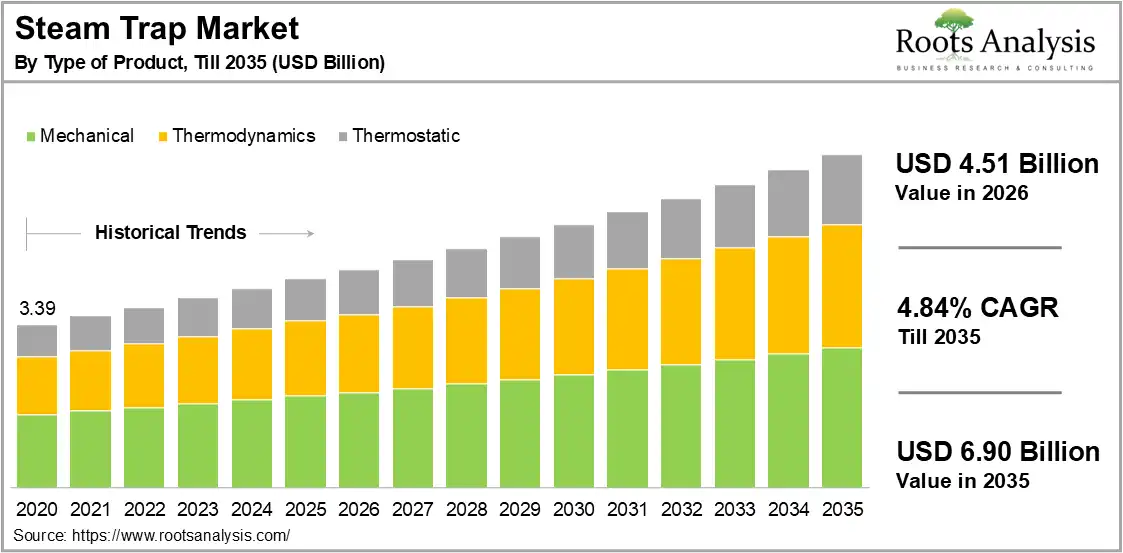
The global steam trap market, valued at USD 4.51 billion in 2026, is projected to reach USD 5.71 billion in 2030 and USD 6.90 billion by 2035, representing a CAGR of 4.84% during the forecast period.
See What’s in the Full Report - Request Your Complimentary Insights!
Market Overview
Industries are a major source of condensate. These condensates forwardly cause water pollution and soil contamination. To minimize such impact, steam traps are on a surge.
What’s driving the growth of the steam trap market is the advancements in valve technology. For instance, double-isolation-and-bleed trap valve stations for improved energy efficiency and reduced operational costs.
It is worth highlighting that the demand for carbon footprint reduction strategies for lower emission rates and fuel consumption is also accelerating adoption rates. Besides this, the introduction of predictive maintenance for steam traps for reduced downtime, lower maintenance and extended equipment lifespan is also a major factor of industrial steam systems market growth.
In reference to this, the regulatory compliance in energy uses that limit greenhouse gas emissions is also urging industries to install steam traps.
Consequently, the rising focus on space research programs in China, India and Japan are continuously aided by steam trap in Asia-Pacific space industry growth.
Recent Industry Developments
- In October 2024, Yokogawa, a Japanese industrial automation company, launched a wireless steam trap monitoring device for status monitoring in steam piping equipment.
Pay Only for What You Need – The Best Way to Optimize
Market Share Insights
Which Type of Product Will Dominate the Steam Trap Market?
When it comes to the global steam trap market, the mechanical segment is set to take the lead, holding a significant market share of over 38.47% of the market. Also, this segment is expected to grow with a relatively higher CAGR of 5.66%. This market growth is largely a result of their simple design and operation that makes them easy to use and maintain.
In addition, they have efficient condensate management that makes them suitable for various industrial applications. Besides this they are also reliable and cost-effective.
Which Type of Material Will Witness the Fastest Growth Rate?
When it comes to the steam trap industry analysis, the steel segment acquires 66.14% of the steam trap market share. Further, this segment is also expected to grow the fastest with a projected CAGR of 5.35% during the forecast period. Here’s why: steel offers high durability and strength, excellent in corrosion and impact resistance.
Steel steam traps are designed to efficiently remove condensate and non-condensate gases offering energy conservation in steam systems. Adding to the benefits, these also offer easy maintenance and repair due to their simple designs.
Which End-User is Most Popular in Steam Trap?
When we look at the end-user of the steam trap market, the oil & gas segment really stands out as the dominant end-user with 22.61% market share. In fact, it’s expected to grow with a steam trap market growth rate of 5.84% during the forecast period.
Here’s how; steam traps are used in heating the underground oil reservoirs for smooth flow of oil when extraction. This saves costs and energy as the extraction process takes shorter time in comparison with traditional extraction.
What is the Impact of Asia-Pacific’s Industrialization on Steam Trap Market Trends?
According to our steam trap market by region analysis, the Asia Pacific steam trap market currently exhibits dominance with 45.55% of the overall market share.in fact, this region is also forecasted to grow with a relatively higher CAGR of 6.33% in the coming decade.
As industrialization speeds up, the need for enhanced systems that can effectively separate condensate rises. Particularly, India and China are raising the demand for steam trap significantly. The prominent reason is expanded manufacturing, pharmaceutical and energy sectors.
Another reason is the localization of industrialization. For reference, India’s Make In India and China’s China Manufacturing 2025 programs are rapidly boosting domestic industrial automation solutions.
Have Questions? Let’s Get Them Answered.
Key Market Insights
Key Market Drivers
The rising demand for sustainable manufacturing practices for lower energy consumption and minimizing environmental impact is growing the market demand.
Various countries around the world are mandating steam trap due to the development of IoT in steam trap monitoring that allows early detection of possible failure. This early detection also secures the system from downgraded performance and notifies when need of repairs.
Furthermore, the development of advanced pharmaceutical manufacturing processes for efficient heating, sanitation and improved product quality is also a major factor of domain growth.
What Strategies are Companies Using to Gain Steam Trap Market Share?
Steam trap suppliers are using smart strategies to stay ahead. Big players are focusing on partnerships, acquisitions, joint ventures, and innovations to strengthen their position while also investing in R&D to bring innovative and novel products to the market. Launching new technologies and expanding into regions where industry automation is growing are key moves helping them capture more market share.
What are the Challenges in Steam Trap Market?
The major challenges in steam trap market are high steam trap installation costs followed by high maintenance costs. These make steam trap a high investment deal, limiting its adoption to big industries only.
The other major challenge is that despite being an efficient system, it is often resisted to be adopted. The major reason for that is lack of awareness about the benefits of greenhouse gas reduction technologies.
Another major challenge is possible steam trap failures like blockage, water hammer and air binding. In addition, the requirement of skilled labor adds further complexities.
What are the 3 Types of Steam Traps?
Steam traps have types that use different operating principles to separate condensates. These are as follows:
- Mechanical Traps
- Thermostatic Traps
- Thermodynamic Traps
Where are the Steam Traps Needed?
Though steam traps have various applications, they are mainly used in removing condensable gases and ensuring proper operations.
What are the Benefits of Steam Trap?
This process industries equipment is highly favored in separating condensate, while its enhanced thermal efficiency limits the steam loss. In addition, the development of steam leakage prevention systems maintains regular inspection and proper maintenance.
Your Business is Unique – Why Shouldn’t Your Report Be?
Steam Trap Market: Scope of the Report
| Key Report Attributes | Details | |
| Historical Trend | Since 2020 | |
| Forecast Period | Till 2035 | |
| Market Size 2026 | $ 4.51 Billion | |
| Market Size 2035 | $ 6.90 Billion | |
| CAGR till 2035 | 4.84% | |
| Type of Product |
|
|
| Type of Material |
|
|
| End-User |
|
|
| Type of Enterprise |
|
|
| Geographical Regions |
|
|
| Key Players Profiled |
|
|
| PowerPoint Presentation (Complimentary) | Available | |
| Customization Scope | 15% Free Customization | |
| Excel Data Packs (Complimentary) |
|
|


