


 Download Free Sample
 Buy Now
Market Size
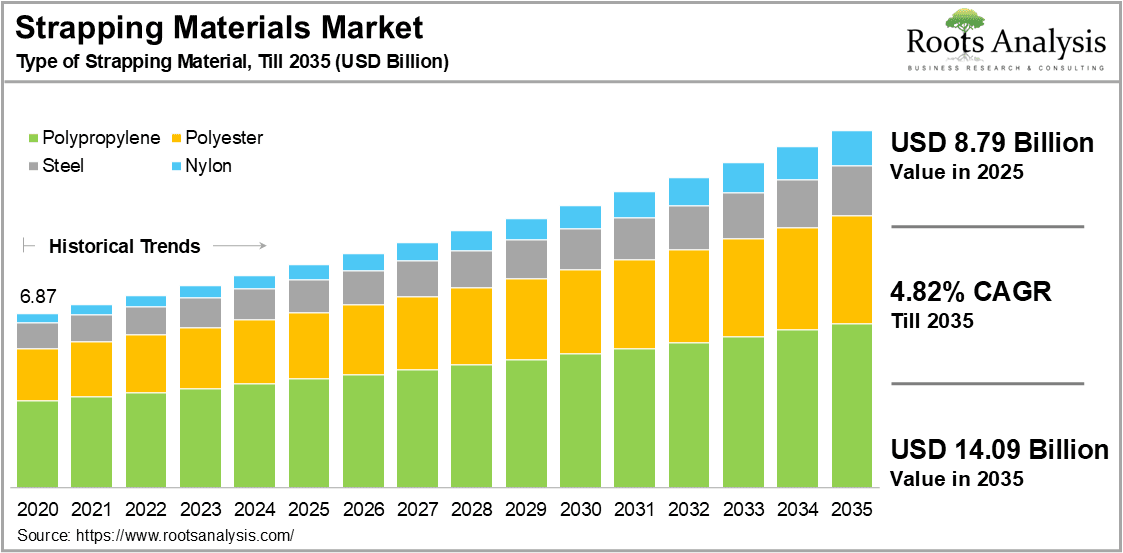
The global strapping materials market size, valued at USD 8.79 billion in 2025, is projected to reach USD 11.67 billion by 2030 and USD 14.09 billion by 2035, with a CAGR of 4.82% during the forecast period 2025-2035.
See What’s in the Full Report – Request Your Complimentary Insights!
Strapping materials are flat, flexible bands, most commonly made from steel, polypropylene, or polyester, used to bundle, stabilize, hold, and secure loads during storage, handling, and transportation across industries. This practical trade method, also called bundling or banding, is fundamental in packaging, logistics, construction, and other sectors for ensuring cargo integrity and safe delivery to end destinations.
Presently, the demand for sustainable packaging materials shapes the future of the strapping materials market. Strapping material manufacturers increasingly choose polypropylene and polyester straps for their lightweight strength, recyclability, and cost savings. This shift toward sustainability brings new industry standards for strength, durability, and ease of use.
Composite strapping, engineered from modern polymers, continues to gain market share for its robust performance and safe handling, securely managing a wide range of cargo types. In the words of Alex Frueh, "Cordstrap's composite polyester strap, together with a high-quality galvanized steel buckle, provides optimal strength in all cargo securing applications and offers excellent performance even under extreme temperatures and conditions."
Beyond basic functionality, the strapping materials market is a vibrant intersection of traditional industrial needs and innovative packaging trends. Its evolution is driven by advanced strapping technologies and a commitment to eco-conscious solutions. Businesses benefit from stronger, safer, and sustainable strapping products along with growing supply chain packaging innovations and an intensified demand for product safety.
Recent Developments in the Strapping Materials Market
- In May 2025, Mosca showcased three new strapping solutions at Ligna 2025 in Hanover, Germany. These include the KOV-111 with an advanced angular edge protector feeder, designed to address the strapping needs of sensitive and bulky building materials.
Market Dynamics
Key Market Drivers
- Expansion of E-Commerce and Logistics Sectors: The rapid growth of global e-commerce and logistics is a primary driver for strapping materials, as secure packaging is essential for safe transportation and delivery.
- Shift Toward Sustainable and Recyclable Materials: There is a marked trend toward eco-friendly strapping materials, such as recycled polypropylene and polyester strapping solutions, driven by regulatory pressures and consumer demand for sustainable packaging.
- Automation and Technological Advancements in Packaging: The adoption of automated and semi-automated strapping systems is increasing, especially in developed markets, to streamline packaging processes and enhance operational efficiency. IoT-enabled smart packaging and digital tension controllers are further modernizing the industry and reducing labor costs.
- Growth in Food, Beverage, and Pharmaceutical Industries: Rising demand for secure packaging solutions in the food, beverage, and pharmaceutical sectors is fueling market expansion. These industries require reliable strapping to ensure product safety during transit and storage, supporting steady consumption of strapping materials.
Key Market Challenges
- Volatility in Raw Material Prices: Fluctuations in the prices of key raw materials like steel, polyester, and polypropylene can impact production costs and profit margins for manufacturers, creating uncertainty and complicating long-term planning.
- High Initial Investment in Automation: The capital expenditure required for advanced automated strapping equipment can be prohibitive for small and medium-sized enterprises. High upfront costs and ongoing maintenance expenses limit adoption, especially in price-sensitive markets.
- Environmental Concerns Over Plastic Waste: Despite efforts to increase recycling, the widespread growth of plastic strapping materials market raises environmental concerns and regulatory scrutiny. Stricter regulations on single use plastics and waste management could restrict market growth or necessitate costly shifts to alternative materials.
- Competition from Alternative Packaging Solutions: The availability of alternative packaging and securing methods, such as stretch wrapping, shrink wrapping, and adhesive tapes, poses competitive challenges. Customers may opt for these solutions based on cost, convenience, or specific application needs.
Impact of E-Commerce Expansion on Strapping Materials Demand
- Rising online retail activities are driving demand for durable, versatile strapping materials, particularly polypropylene (PP) and polyester (PET) strapping, which offer high tensile strength, cost-effectiveness, and lightweight properties suitable for varying package sizes and rapid logistics.
- The growing e-commerce sector is fostering innovation in high-performance, customizable, and machine-compatible strapping solutions aimed at improving packaging security, efficiency, and reducing material waste in automated warehouses and distribution centers.
- Sustainability trends are shaping the market with increased development and adoption of recyclable, biodegradable, and bio-based strapping materials to meet environmental regulations and the circular economy goals within e-commerce packaging and logistics.
Get an Instant Quote in 10 Minutes. Lowest Price Guaranteed
Market Share Insights
Polypropylene Strapping Material Dominates the Industry
In 2025, the polypropylene material sub-segment holds the largest market share of 47.30%, driven by its exceptional strength, flexibility, and durability that are key characteristics for securing heavy and diverse loads during transportation and storage.
The polypropylene strapping market is experiencing rapid growth due to its cost-effectiveness, compared to other materials, attracting companies looking for affordable yet reliable strapping solutions. Moreover, polypropylene's lightweight nature contributes to lower shipping costs and improved handling efficiency, enhancing overall logistics performance. On the contrary, the polyester material sub-segment is expected to witness the fastest CAGR during the forecasted period.
Industrial Logistics & Warehouse Application to Hold the Largest Market Share
Among the various applications, the industrial logistics & warehouse sub-segment is set to take the lead, holding a significant share of 28.10% in 2025. This growth stems from the increasing complexity of supply chains and the critical need for load stability in transportation and storage.
Additionally, adoption of technologically advanced, high-strength, and automated strapping solutions is enhancing operational efficiency, minimizing product damage, and meeting stringent logistics demands, positioning strapping materials as vital in modern industrial packaging.
Asia-Pacific to Drive Strapping Materials Industry Growth
Asia-Pacific's strapping material sector holds substantial 40.70% market share globally. This robust growth is fueled by rapid industrialization across key sectors, including food & beverage, construction, and logistics. The region also benefits from massive government infrastructure investments; for instance, India allocated over USD 130.5 billion in the 2022-23 budget to boost infrastructure, accelerating demand for steel strapping in construction projects.
Additionally, strict environmental policies in countries like India are encouraging a shift toward sustainable alternatives, such as paper strapping in retail and e-commerce packaging centers. Leading companies like Krishca Strapping Solutions Ltd. have achieved notable revenue milestones, exemplifying the region's commercial momentum.
North America Set for Fastest Market Growth Driven by E-Commerce and Manufacturing
While the Asia-Pacific leads in market size, North America is projected to experience the fastest CAGR during the period 2025 to 2035. This growth is driven by innovation in automation and smart packaging technologies, including fully automatic strapping machines, that are widely adopted to meet growing demand for secure and sustainable packaging solutions.
The emergence of bio-based polypropylene straps and integration of RFID technologies in packaging further contributes to market differentiation. Industry leaders are investing heavily in R&D and innovation to capitalize on increasing demand for efficient logistics and eco-friendly packaging materials in North America.
Market Key Takeaways
Competitive Landscape of Leading Players in Strapping Materials Industry
The strapping materials market is highly competitive, led by a mix of global and regional players focused on innovation, efficiency, and sustainability. Notable companies dominating the field include Signode, StraPack, Mosca, Polychem, Cyklop, FROMM, which stand out for their robust R&D investments, adoption of advanced automation, and expansion into eco-friendly materials.
The market also sees participation from major firms like 3M, Samuel, Son & Co., UNIPACK, and TITAN Umreifungstechnik, many of which are rolling out new biodegradable, recyclable, and high-performance plastic and polyester strapping products to address the rising demand for sustainable packaging solutions.
Adoption of Recycled Polyester Strapping in Packaging Industry
There is rapid growth in the use of recycled PET (rPET) strapping due to sustainability mandates and the push for greener packaging. Adoption is particularly strong among logistics, FMCG, and food sectors, with over 33% of packaging companies globally using recyclable PET. Major brands are also launching closed-loop recycling programs to minimize waste and reduce costs.
Technological Advancements in Automated Strapping Solutions
Automated strapping systems now feature robotics, advanced controls, sensors, and artificial intelligence for fast and precise strapping. These technologies reduce labor, boost throughput, enable real-time monitoring, and enable predictive maintenance. Such innovations are also improving safety and allowing customization for different package types, driving adoption in modern warehouses and distribution centers.
Cost Comparison of Plastic v/s Steel Strapping Materials for Logistics
Plastic strapping is generally more cost-effective upfront, offering lower material and equipment costs than steel. While steel is preferred for heavy-duty loads due to superior strength and durability, it carries higher initial and tool costs. Plastic strapping may require more frequent replacement but provides long-term savings for lighter loads, whereas steel offers fewer replacements but greater expense overall.
Strapping Materials Market Outlook for Food and Beverage Packaging
The food and beverage packaging sector is set to be the fastest-growing application for strapping materials. Trends favor food-safe and sustainable strapping to ensure secure, tamper-evident transport and comply with consumer/environmental demands. The increasing shift toward eco-friendly and recyclable strapping materials is projected to further boost segmentation growth in this sector through 2035.
Investment Opportunities in Eco-Friendly Strapping Materials Sector
There is rising investor interest in bio-based, biodegradable, and recycled strapping materials thanks to regulatory support and corporate sustainability goals. Opportunities lie in R&D for new materials, circular economy programs, and advanced automation aligned with green standards. The sector is expected to experience above-average growth as companies and governments prioritize sustainable packaging materials.
Pay Only for What You Need – The Best Way to Optimize
Strapping Materials Market: Scope of the Report
| Key Report Attributes | Details | |
| Historical Trend | Since 2020 | |
| Forecast Period | Till 2035 | |
| Market Size 2025 | USD 8.79 Billion | |
| Market Size 2035 | USD 14.09 Billion | |
| CAGR (Till 2035) | 4.82% | |
| Strapping Material |
|
|
| Application |
|
|
| Geographical Regions |
|
|
| Key Players Profiled |
|
|
| PowerPoint Presentation (Complimentary) | Available | |
| Customization Scope | 15% Free Customization | |
| Excel Data Packs (Complimentary) |
|
|


