


 Download Free Sample
 Buy Now
Market Size
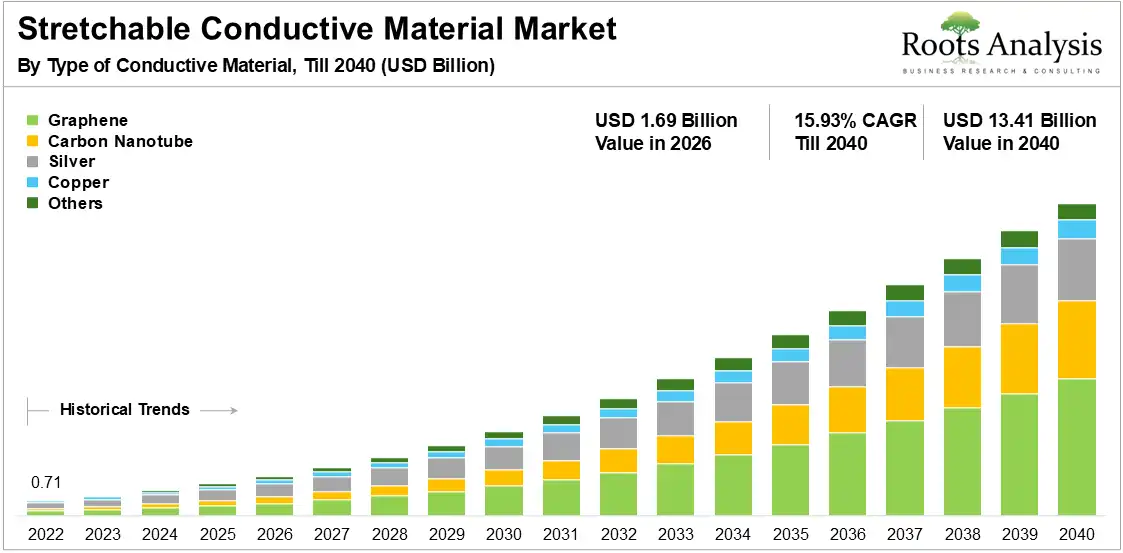
The global size is projected to grow from USD 1.69 billion in 2026 to USD 13.41 billion by 2040, representing a CAGR of 15.93% during the forecast period 2026 to 2040.
See What’s in the Full Report – Request Your Complimentary Insights!
Market Report: Key Takeaways
- In terms of type of conductive material, graphene accounts for the dominant 35% share, while carbon nanotube is projected to experience the highest CAGR (19.20%) through 2040.
- In terms of product form, conductive inks dominate the industry with a 45% market share in 2026, driven by the rapid adoption of additive manufacturing and screen-printing techniques, which allow for cost-effective, high-volume production of complex flexible electronics.
- Stretchable conductive material market forecast estimates suggest that wearable electronics maintain the largest application share at 30.5% in 2026, while the application across soft robotics & actuators will exhibit the fastest growth at a 21.5% CAGR.
- Original equipment manufacturers (OEMs) represent the dominant end users, commanding a 40% market share in 2026.
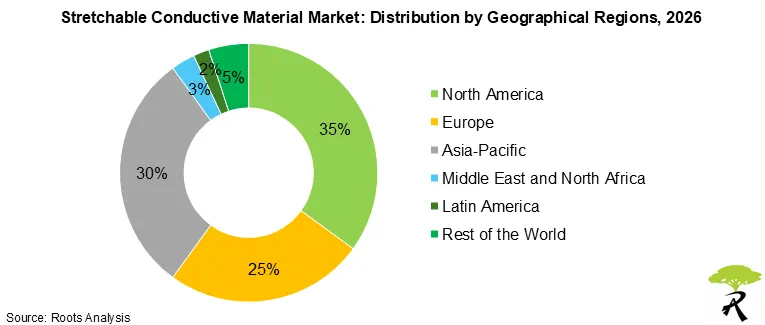
- In 2026, North America captures the largest global industry share at 35.0%, anchored by a mature R&D ecosystem. However, Asia-Pacific is projected to be the fastest-growing region with a 20.5% CAGR, powered by extensive manufacturing hubs and the rapid scale-up of graphene / polymer composite production.
- Healthcare digitization, AI-integrated wearables, and decentralized patient monitoring act as primary mega-trends driving the long-term acceleration of the stretchable conductive material market.
- Global market penetration is rapidly widening as adoption structurally shifts from specialized lab-scale prototyping into mass-volume industrial IoT architectures and high-growth commercial electronics.
Market Overview
A paradigm shift is actively reshaping the advanced electronics supply chain as industrial stakeholders increasingly prioritize high-performance elasticity. Current market dynamics reflect a strategic shift toward high-durability, cost-efficient substrates engineered for seamless integration into consumer electronics and clinical healthcare. Manufacturers are now prioritizing the mechanical-electrical equilibrium (the ability to maintain superior conductivity under extreme elongation) to meet rigorous industrial reliability standards. This evolution from artisanal fabrication to automated, high-yield manufacturing platforms marks a significant maturation of the global supply chain.
This strategic growth is propelled by the rapid convergence of smart textiles and decentralized medical infrastructure. As global healthcare providers rapidly scale remote patient monitoring networks, the necessity for conformal, biocompatible sensors has surged exponentially. Institutional momentum further accelerates this adoption curve, heavily reinforced by the 2025 National Science Foundation (NSF) funding initiative, which specifically targets scalable manufacturing for wearable diagnostics. This backing reduces R&D risk and clears commercialization pathways for advanced sensors used in real-time biometric tracking across athletic and rehabilitative sectors.
The long-term trajectory centers on the industrialization of soft robotics and the expansion of the Internet of Things (IoT) ecosystem. Future innovation is pivoting toward high-volume roll-to-roll (R2R) processing to optimize unit costs and enable mass-market penetration. As soft robotic actuators and flexible sensor networks become critical to automation, the demand for resilient, conductive interfaces will surge. This ongoing synergy between advanced material science and digital healthcare transformation ensures a robust growth outlook, positioning stretchable electronics as a primary pillar of next-generation hardware architecture.
Pay Only for What You Need – The Best Way to Optimize
Stretchable Conductive Material Market Size Estimation Methodology
- As a starting point, we established the market scope by identifying core stretchable conductive materials, such as specialized inks, polymers, and nanocomposites, that maintain electrical conductivity under significant physical strain. This included mapping key material configurations, like silver nanowires and carbon nanotubes, across major end-use sectors such as smart textiles, medical patches, and flexible displays.
- Then we examined the technology readiness levels and adoption S-curves of these advanced materials, comparing their performance metrics against established alternatives like flexible printed circuit boards. We evaluated historical commercialization data, early-stage purchase orders, and the integration phases for next-generation applications in medical devices and high-end wearables to understand technology maturity, cost structures, and product replacement cycles.
- Thereafter, we collected segment-wise shipment volumes, application-specific material volume requirements, and prevailing average selling price (ASP) trends through primary research with key stakeholders across the value chain, including material manufacturers, end-product integrators, and academic institutions. We cross-validated these inputs using secondary research, analyzing cost reduction curves, R&D investment levels, and expected price erosion as production scales.
- Using these data and insights, we calculated the global stretchable conductive material market size and projected the future market opportunity. This was achieved through a hybrid forecasting methodology that multiplied the required volume of stretchable materials per end-product unit by specific component ASPs, cross-referencing bottom-up demand projections with top-down macroeconomic indicators such as healthcare technology expenditure and consumer electronics market growth.
- The overall opportunity associated with the global market was further distributed across distinct market segments, allocating revenue by material type, end-use application, and key geographical regions. This regional distribution was driven by localized factors, including end-product manufacturing hubs, advanced healthcare regulatory frameworks, and regional investments in flexible electronics R&D.
- Finally, in order to assess the sensitivity of our assumptions, we conducted a multivariate sensitivity and scenario analysis (base, optimistic, and conservative) on some of the most important parameters of our forecast methodology, evaluating the potential impact of fluctuating raw material costs, shifting adoption rates, and market disruptions.
Stretchable Conductive Material Market Share Insights
Wearable Electronics Dominate the Market by Application while Soft Robotics & Actuators Grow at a Higher CAGR Through 2040
- Growth patterns across the stretchable conductive material market highlight wearable electronics as the primary application segment, capturing 30.5% share in 2026. This strong dominance reflects widespread early adoption across smart garments and fitness trackers, propelled by the scalable integration of graphene-based conductive elastane yarns. These advanced composites guarantee uninterrupted biometric signal transmission during continuous physiological deformation, driving high-volume OEM procurement.
- Concurrently, soft robotics & actuators are emerging as the fastest-growing application, accelerating at a market-leading 21.5% CAGR. This trajectory is fundamentally propelled by the shift toward tactile intelligence, where stretchable conductive networks provide the electronic skin necessary for safe, high-precision human-robot collaboration. As global manufacturing pivots to adaptive cobots, stretchable conductive materials capable of maintaining absolute signal integrity under more than 300% mechanical strain are becoming mission-critical for real-time sensory feedback and haptic actuation.
- Validating this shift toward adaptive industrial infrastructure, strategic capital is increasingly concentrated on high-fidelity soft-robotic interfaces. The 2026 AI, Data, and Robotics Association (ADRA) funding cycles, under the European Horizon framework, have earmarked substantial grants specifically for bio-inspired tactile sensing and autonomous soft systems. This institutional backing directly accelerates the transition from rigid automation to fluid, compliant robotics, securing long-term competitive advantages for early adopters in high-speed logistics and specialized surgical assistance.
Want Information on Specific Region / Segment?
Market Share Analysis by Geographical Regions: North America Region Dominates the Stretchable Conductive Material Industry in 2026
- North America region dominates the market, commanding a definitive 35.0% market share in 2026. This leadership is firmly anchored by a highly mature technological ecosystem and aggressive commercialization pipelines established by advanced material leaders like DuPont, specifically targeting high-yield domestic production of advanced flexible hybrid electronics networks.
- Moreover, the 2025 federal investments through the CHIPS Act’s National Advanced Packaging Manufacturing Program (NAPMP) are directly accelerating flexible substrate innovation in the region. By funding R&D for advanced polymeric materials and conformal packaging, these strategic government deployments enable high-volume commercial scaling of stretchable sensor networks across defense and MedTech sectors.
Market Share in Europe Driven by MedTech and Automotive
- Our stretchable conductive material market forecast estimates indicate that Europe captures a substantial 25.0% market share in 2026. This strong strategic positioning is primarily driven by rigorous adoption rates across Germany’s advanced automotive sector. Here, Tier-1 manufacturers increasingly mandate high-durability, stretchable sensor networks to ensure critical operational reliability within next-generation electric vehicle platforms.
- European market share is robustly fortified by the multibillion-euro IPCEI on Microelectronics and Communication Technologies. This active 2025-2026 state-aid framework specifically subsidizes the commercialization of flexible smart sensors and advanced conductive substrates. This ensures localized, enterprise-grade material innovation while strategically insulating the regional automotive supply chain from global market volatilities.
- Moreover, the strategic institutional investments are actively strengthening advanced commercialization pathways. For instance, January 2026 EU Horizon funding expansion, dedicating nearly USD 1.2 billion toward flexible biomedical monitoring technologies, provides critical momentum. This targeted capital directly addresses complex regulatory requirements and secure long-term growth for healthcare-focused stretchable electronics across global diagnostic networks in the region.
Asia-Pacific is Projected to be the Fastest-Growing Regional Hub Propelled by Manufacturing Scale
- Emerging as the fastest-growing global hub, the Asia-Pacific region is accelerating at an aggressive 20.5% CAGR, projecting long-term dominance. This exponential growth is fundamentally propelled by the unmatched scalability of mature manufacturing ecosystems across China and Japan. These localized hubs rapidly optimize production cost curves for advanced graphene and specialized polymer composites.
- The region’s aggressive growth trajectory is heavily validated by surging consumer electronics demand and massive capital deployment into flexible device infrastructure. By minimizing barriers to adoption across well-established regional value chains, Asia-Pacific enables high-volume, cost-efficient deployment of stretchable conductive materials, securing its transition toward absolute long-term market dominance.
Latin America and MENA: Emerging Growth Markets and Infrastructure Expansion
- The Middle East and North Africa (MENA) region is generating vital strategic growth momentum, leveraging substantial sovereign capital investments into advanced technology projects. This acceleration is distinctly driven by the UAE’s aggressive smart city initiatives and expanding healthcare infrastructure, creating highly favorable deployment conditions for scalable stretchable conductive material networks.
- Concurrently, Latin America demonstrates steady sector momentum fueled by targeted foreign direct investments across industrial hubs in Brazil and Mexico. The region’s growth is heavily propelled by the rising integration of localized digital health technologies and commercial wearables, establishing critical secondary markets for flexible component integration despite broader infrastructure limitations.
Market Ecosystem Analysis
Stretchable Conductive Material Market Competitive Landscape
The global stretchable conductive material ecosystem features massive material science conglomerates like DuPont, Henkel, 3M Company, Covestro, and Volex, alongside specialized innovators such as BotFactory, FlexiSens, Nanocyl, Nanoleq, StretchSense and Voltera. While established giants leverage massive production scale to dominate high-volume industrial sectors, agile startups aggressively disrupt the market by pioneering niche, highly conformable architectures.
Enterprise Giants Drive Market Expansion Through Strategic Production Scaling
Large material science corporations are aggressively scaling their functional portfolios and embedding advanced stretchable capabilities into high-growth sectors, creating formidable structural barriers to entry for competitors. By leveraging massive production infrastructure, these leaders secure dominance across global supply chains and define the benchmarks for commercial material reliability.
- Henkel: Accelerating its position in printed electronics market segment, Henkel launched advanced silver-plated copper (SPC) and self-regulating PTC conductive inks at LOPEC 2026. These cost-efficient material formulations are specifically engineered for scalable integration into continuous wearable electronics and smart healthcare components, directly addressing the 2025 surge in global silver pricing.
- Covestro: Showcased at Techtextil 2026, Covestro’s Platilon® TPU specialty films are engineered to maintain optimal structural integrity throughout extensive stretch-flex cycling. These advanced thermoplastic polyurethane substrates serve as the foundational layer for flexible printed electronics in protective apparel and medical-grade skin patches, ensuring consistent performance under physical deformation.
- 3M Company: Driving innovation in conformable shielding, 3M expanded its Electrically Conductive Tape (ECT) portfolio in 2025 to include high-flexibility polyolefin pressure-sensitive adhesives. These specialized tapes provide critical XYZ-axis conductivity and EMI management for flexible circuit grounding, specifically optimized for high-volume manufacturing in the automotive and mobile sensor sectors.
Emerging Startups Expand Market Boundaries Through Next-Generation Architectures
Specialized innovators and venture-backed startups are aggressively disrupting traditional flexible circuitry boundaries. By pioneering novel additive manufacturing processes and stretchable interconnects, these emerging players commercialize highly specialized conformal techniques that legacy giants are actively seeking to acquire or strategically integrate into broader systems.
- Voltera: Disrupting traditional circuitry limits, Voltera showcased its NOVA direct-ink writing (DIW) platform in early 2026 for high-viscosity conductive pastes. This additive technology allows researchers to bypass traditional masks, enabling rapid prototyping of multi-layer stretchable electronics on TPU and textile substrates with manufacturing-ready data for mass production.
- Nanoleq: Driving the democratization of smart textiles, Nanoleq launched its bodyGuard component suite in 2025, featuring the ElectroSkin and PhantomLink stretchable interconnects. These high-performance connectors are engineered for long-term integration into smart garments, providing medical-grade ECG and respiratory monitoring through materials that withstand over 100 industrial wash cycles.
- FlexiSens: Emerging as an elite spin-off, FlexiSens secured significant commercialization funding in 2025 to scale its highly sensitive, nanomaterial-based stretchable sensors. These advanced components ensure seamless, high-fidelity integration into soft robotic actuation systems and continuous wearable biomonitoring devices, offering a breakthrough in pressure sensitivity and mechanical resilience.
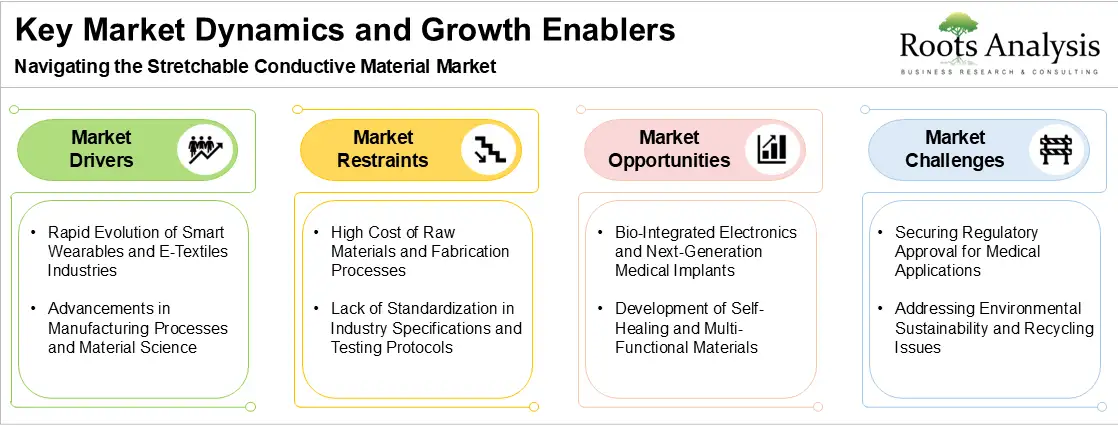
Stretchable Conductive Material Market Growth Drivers, Restraints, Challenges and Opportunities
Market Access Considerations
Regulatory Landscape: Standardization Hurdles in MedTech and Automotive
Market entry into high-value stretchable conductive material applications, particularly MedTech wearables and automotive sensors, faces significant friction due to fragmented regulatory oversight. The absence of universal testing protocols, such as standardized IEC 63203 metrics for stretch cycle durability and e-textile biocompatibility, creates steep validation hurdles. This complex compliance landscape substantially elevates R&D burn rates, restricting entry to heavily capitalized leaders. Consequently, OEMs experience delayed procurement cycles, demanding extensive clinical certifications like FDA Class II approvals for e-skin patches before authorizing full-scale commercial deployment.
Pricing Dynamics: Navigating Cost-Performance Trade-offs in Consumer Electronics
Mass commercialization of stretchable conductive materials across consumer electronics and smart e-textiles is bottlenecked by unfavorable cost-performance ratios compared to conventional rigid circuitry. While stretchable substrates deliver superior ergonomic form factors, their elevated production premiums and lower absolute conductivity restrict viability within cost-sensitive segments. To secure competitive positioning, strategic suppliers are aggressively optimizing material compositions. By transitioning from expensive silver nanowire networks to cost-efficient carbon nanotube (CNT) composites, manufacturers effectively close this pricing gap, establishing distinct application tiers critically necessary for scalable OEM adoption.
Ecosystem Maturity: Integration Readiness and Technical Partnerships
Scalable commercialization of stretchable materials strictly depends on integration readiness within existing manufacturing ecosystems, particularly roll-to-roll printed electronics. A major bottleneck is that end-product manufacturers currently lack the specialized engineering expertise required to transition these novel materials from prototype to mass production. Consequently, successful market entry demands extensive, hands-on partnerships. Material suppliers must provide comprehensive technical support alongside product innovation, creating a competitive dynamic that heavily favors firms offering end-to-end integration solutions rather than standalone raw materials.
Supply Chain Resilience: Securing Critical Raw Material Sourcing
Commercialization is highly sensitive to supply chain resilience for critical raw materials, such as silver nanowires, carbon nanotubes, or specific conducting polymers. Price volatility of precious metals or reliance on single-source suppliers for advanced chemical inputs introduces significant risk for large-scale production in high-volume applications like consumer electronics. This vulnerability dictates competitive advantages, favoring firms that have secured stable supply agreements or invested in backward integration through proprietary synthesis processes, thus ensuring predictable costs and consistent quality for end-product manufacturers.
Your Business is Unique – Why Shouldn’t Your Report Be?
How Stakeholders Benefit from the Key Focus Areas of Our Stretchable Conductive Material Market Report
The stretchable conductive material market has moved definitively beyond theoretical R&D, entering a critical phase of enterprise-scale commercialization across MedTech, smart textiles, and advanced mobility platforms. Rapid material innovation and cross-industry integration are actively rewriting competitive dynamics. The market report on global stretchable conductive material industry analysis and trends equip decision-makers with the verified intelligence necessary to optimize capital allocation, de-risk commercialization roadmaps, and execute high-yield global expansion strategies.
- Unmet Needs and Market Gaps in Stretchable Conductive Material Market: The report identifies critical performance, durability, scalability, and cost-efficiency gaps limiting broader adoption across wearable electronics, healthcare devices, automotive electronics, and aerospace systems. It highlights underserved applications and material limitations that create commercialization opportunities. These insights help strategy leaders prioritize high-impact innovation areas, while product teams refine value propositions aligned with real-world adoption drivers. Investors gain visibility into white-space opportunities with strong growth outlook and defensible differentiation.
- Funding / Capital Flow and Investment Landscape: This section analyzes venture concentration, strategic OEM investments, and institutional capital backing scalable production frameworks. By benchmarking funding momentum across emerging nanocomposites and manufacturing models, corporate development teams and private equity investors can accurately gauge market capital intensity and align M&A strategies with validated growth trajectories.
- Stretchable Conductive Material Market Landscape and Competitive Dynamics: The study maps the complete vendor ecosystem, profiling legacy material giants alongside emerging, vertically integrated innovators. By evaluating IP moats, commercialization progress, and localized market dominance, executive teams can anticipate industry consolidation, refine competitive positioning, and accelerate high-value partnership or acquisition screening.
- Technology Innovations and Adoption Insights: The report evaluates advancements in conductive polymers, nanomaterials, hybrid composites, and printing technologies driving performance improvements. It assesses adoption trends across high-growth applications and identifies barriers to large-scale deployment. Technology and product leaders can use this analysis to align R&D investments with evolving market trends and customer requirements. The insights also inform commercialization roadmaps and timing of market entry.
- Partnership and Collaboration Trends: The analysis highlights strategic alliances between material synthesizers, device OEMs, and research institutions, detailing the collaborative models required to overcome manufacturing friction. Business development teams gain a clear framework for co-innovation, accelerating product validation, navigating complex regulatory compliance, and ensuring long-term supply chain resilience.
- Stretchable Conductive Material Market Segmentation and Geographic Coverage: The report delivers detailed segmentation by application and region, supported by growth outlook, adoption drivers, and demand patterns. It compares regional competitiveness, regulatory environments, and manufacturing ecosystems influencing expansion decisions. Strategy leaders can prioritize high-growth markets, while investors identify scalable geographies with favorable risk-return profiles. The segmentation framework enables precise targeting and data-driven market entry planning.
Stretchable Conductive Material Market: Scope of the Report
| Key Report Attributes | Details | |
| Forecast Period | Till 2040 | |
| Market Size 2026 | USD 1.69 Billion | |
| Market Size 2040 | USD 13.41 Billion | |
| CAGR (Till 2040) | 15.93% | |
| Segments Covered |
|
|
| Geographical Regions Covered |
|
|
| Key Sections Covered |
|
|
Market Segmentation
The global stretchable conductive material market report presents an in-depth analysis, highlighting the capabilities of various stakeholders, based on different segments such as type of conductive material, product form, application, end user, geographical regions, and key players.
Market Share by Type of Conductive Material
- Carbon Nanotube
- Copper
- Graphene
- Silver
- Others
Market Share by Product Form
- Coatings
- Films
- Inks
- Others
Market Share by Application
- Automotive & Aerospace Systems
- Biomedical & Healthcare Devices
- Consumer Electronics
- Photovoltaics
- Soft Robotics & Actuators
- Wearable Electronics
- Others
Market Share by End User
- Original Equipment Manufacturers
- Component Manufacturers
- Research Institutions
- Others
Market Share by Geographical Regions
- North America
- US
- Canada
- Mexico
- Rest of North America
- Europe
- Austria
- Belgium
- Denmark
- France
- Germany
- Ireland
- Italy
- Netherlands
- Norway
- Russia
- Spain
- Sweden
- Switzerland
- UK
- Rest of Europe
- Asia-Pacific
- Australia
- China
- India
- Japan
- New-Zealand
- Singapore
- South Korea
- Rest of Asia-Pacific
- Middle East and North Africa (MENA)
- Egypt
- Iran
- Iraq
- Israel
- Kuwait
- Saudi Arabia
- UAE
- Rest of MENA
- Latin America
- Brazil
- Chile
- Colombia
- Venezuela
- Rest of Latin America
- Rest of the World


