
Lowest Price Guaranteed
Slides
186
Last Updated
February 2025
View Count
15292
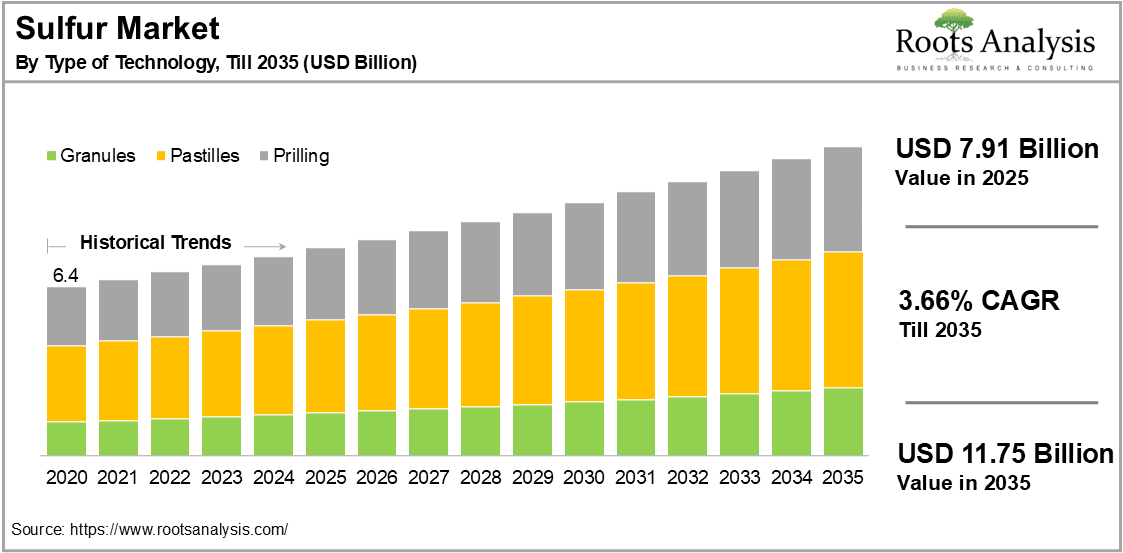
The sulfur market size is projected to grow from USD 7.91 billion in 2025 to USD 11.75 billion by 2035, representing a CAGR of 3.66%, during the forecast period till 2035.
 |
To learn more about this report, request a free sample copy
The new research study consists of sulfur industry analysis, detailed market forecast analysis and providing actionable strategic recommendations.
Sulfur is a vital chemical element, represented by the symbol S, that plays a crucial role in various industrial applications, particularly in agriculture, chemical manufacturing, and metallurgy. It is worth highlighting that the functioning of the sulfur market is characterized by its integration within supply chains that include extraction from oil refineries and mining operations. Notably, advantages of sulfur include its cost-effectiveness and essential role in improving crop yields and soil health.
The global sulfur market is expected to grow significantly over the forecast period due to the rapid industrialization in emerging economies like China and India. Additionally, some of the sulfur product innovations and advancements in manufacturing include advancing battery technology, particularly in the development of lithium-sulfur batteries. Notably, innovations, such as the incorporation of sulfur iodide crystals have drastically improved the conductivity of these batteries, addressed internal resistance issues and enhanced longevity through self-healing properties during charge cycles. Additionally, key players are investing in research and development to explore innovative uses, unlocking new opportunities for growth in this dynamic sector.
Recently, in October 2024, Lyten secured a $650 million letter of intent from the Export-Import Bank of the United States to support the expansion of lithium-sulfur battery manufacturing in the US. While informing about the funding Dan Cook, Co-Founder and CEO of Lyten mentioned– We are excited to collaborate with EXIM as a financial partner to enhance U.S. lithium-sulfur manufacturing and address the rapidly increasing global customer demand.
The sulfur market research report presents an in-depth analysis of the various companies that are involved in offering sulfur , across different segments, as defined in the table below:
| Key Report Attributes | Details | |
| Historical Trend | Since 2020 | |
| Forecast Period | Till 2035 | |
| Current Market Size | $ 7.91 Billion | |
| Market Size Value by 2035 | $ 11.75 Billion | |
| CAGR (Till 2035) | 3.66% | |
| Type of Form |
|
|
| Type of Technology |
|
|
| End-User |
|
|
| Type of Distribution Channel |
|
|
| Geographical Regions |
|
|
| Leading Market Players |
|
|
| PowerPoint Presentation (Complimentary) |
Available | |
| Customization Scope | 15% Free Customization | |
| Excel Data Packs (Complimentary) |
|
|
Based on the type of form, the global sulfur market is split into solid and liquid. According to our analysis the solid segment will augment the segment's growth with over 60% of sulfur market share during this sulfur market forecast period. Further, this segment is expected to grow with a relatively higher (4.34%) CAGR in the near future. This can be ascribed to its versatility and critical role in key industries, particularly agriculture and chemical manufacturing.
On the basis of the type of application, the sulfur market is bifurcated into granules, pastilles and prilling. The pastilles segment is anticipated to dominate the segment with more than 45% of sulfur market size in 2025. This can be ascribed to their superior application efficiency and growing demand in agriculture, where they serve as an effective slow-release fertilizer that enhances soil fertility and crop yields. However, the granules segment is expected to witness a relatively faster sulfur market growth rate of (4.87%) until 2035. This can be attributed to the crucial role in agriculture, where it enhances soil fertility and addresses sulfur deficiencies in crops.
On the basis of the type of end user, the sulfur market is bifurcated into chemical processing, fertilizer, metal manufacturing, rubber processing and others. The applications of sulfur in chemical processing segment is anticipated to dominate the segment with more than 35% of sulfur market size in 2025. This can be ascribed to its extensive use of sulfur in various applications, particularly in the sulfuric acid production, which is a fundamental chemical used across multiple sectors, including fertilizers, petrochemicals, and pharmaceuticals. However, the fertilizer segment is expected to witness a relatively faster sulfur market growth rate of (5.87%) until 2035. This can be attributed to its critical role in enhancing soil fertility and increasing agricultural productivity. Global food demand rises, particularly in densely populated regions like Asia-Pacific.
On the basis of the type of distribution channel, the sulfur market is bifurcated into direct sales, distributors and retailers. The distributors segment is anticipated to dominate the segment with more than 60% of market share in 2025. Additionally, this segment is expected to witness a relatively faster sulfur market growth rate until 2035. This can be ascribed to their ability to handle large volumes of sulfur and provide extensive reach across various markets and increasing industrial global sulfur demand for efficient supply chain solutions.
This segment highlights the distribution of the sulfur market across various geographical regions such as North America, Europe, Asia, Latin America, Middle East, North Africa, and the rest of the world. According to our sulfur market analysis, Asia exhibits dominance in the market with over 40% of the sulfur market share in the global marketplace. Further, Asia is also projected to grow with a relatively higher CAGR in the forecasted period. Primary reasons for this dominance include the combination of rapid industrialization, urbanization, rising focus on sustainable and bio-based materials, aligning with global environmental trends. Notably, presence of major sulfur producers in countries such as China, Japan, and South Korea and a robust supply chain further strengthen the region's market position
The “Sulfur Market, Till-2035: Industry Trends and Global Forecasts” report features an extensive study of the current market landscape, market size and future opportunity within sulfur market, during the given forecast period. The market report highlights the efforts of several stakeholders involved in this rapidly emerging segment of the service providers industry. Key takeaways of the global sulfur market report are briefly discussed below.
An increasing emphasis on environmental sustainability and regulatory compliance is majorly driving the sulfur industry. The rise in consumer preferences for environmentally friendly options is influencing manufacturers to innovate and expand their offerings. Further, increasing agricultural demand for sulfur in fertilizers, essential for enhancing crop yields amid rising food needs and soil deficiencies. Moreover, industrial applications, particularly in chemical manufacturing and the rubber industry, also significantly contribute to demand, further bolstering the market. Additionally, advancements in sulfur production technology and rising disposable incomes in developing economies, such as India, China and Japan have further propelled market growth.
With the presence of several small and large sulfur manufacturers companies, the market is experiencing intense competition and changing dynamics. From large multinational companies to sulfur manufacturers players, companies are striving to enhance their competitive edge. In terms of market share, large enterprises and multinational companies are dominating the market. While small sulfur manufacturers players are continuously improving their products to cater to niche markets, or they are offering specialized services. These industry players are focusing on adopting competitive strategies, such as developing innovative solution techniques, forming strategic alliances and partnerships to expand their portfolios and global footprint, investing in recent developments and new feature launches to enhance their sulfur offerings.
Despite strong market growth projection, the sulfur market faces numerous challenges. The most common challenges include strict environmental regulations affecting sulfur production, price volatility linked to raw material costs, and challenges in the sulfur supply chain disruptions exacerbated by global events like the COVID-19 pandemic. Additionally, competition from environmentally friendly alternatives threatens traditional sulfur products, while changing customer preferences for customized offerings add complexity for producer.
Asia currently holds a substantial share of approximately 35% in the sulfur market opportunities. This dominance can be attributed to the strong agricultural demand for sulfur-containing fertilizers, rapid industrial growth in the chemical and petrochemical sectors, and stringent environmental regulations that encourage cleaner technologies. Further, Countries like China and India are leading this trend, driven by their expanding agrochemical industries and urbanization, further enhances the region's market position. Notably, substantial investments in research and development, leading to the creation of superior sulfur, is one of the major governing reasons for growth in this region.
Examples of key player involved in the sulfur market (which have also been captured in this market report, arranged in alphabetical order) include Abu Dhabi National Oil, Aramco Trading, Chemtrade Logistics, China Petroleum & Chemical, Exxon Mobil, Gazprom, Georgia Gulf, Kuwait Petroleum, Marathon Petroleum, Merafe Resources, Ohio Sulfur Mining, Shell, Suncor Energy, Texas Gulf Sulfur and The Saudi Arabian Oil. This market report includes an easily searchable excel database of all the companies who have adopted the sulfur market.
The market report presents an in-depth analysis, highlighting the capabilities of various companies engaged in this domain, across different segments. Amongst other elements, the market report includes:
At Roots Analysis, we genuinely care about your success and understand that your business requirements are unique. While our market research reports provide valuable insights, we recognize that they might not cover every aspect you need to make well-informed strategic decisions. To account for that, we offer 15% free report customization tailored to your specific needs. Whether you require additional quantitative analysis, qualitative insights, or any other information related to the sulfur market, reach out us today at: support@rootsanalysis.com