Surface Radars Market
Surface Radars Market, Till 2035: Distribution by Type of Platform (Land-based, Shipborne, and Unmanned Surface Vehicles), Type of Frequency (L-Band, S-Band, and X-Band), Type of Range (Short Range, Medium Range, and Long Range), Type of Dimension (2D and 3D), Type of Component (Antenna, Receiver, Signal Processor, and Transmitter), Type of Waveform (Frequency Modulated Continuous Waveform and Pulsed Waveform), Type of Application (Commercial and Military & Government), and Geographical Regions (North America, Europe, Asia, Latin America, and Middle East and North Africa and Rest of the World): Industry Trends and Global Forecast
-
Lowest Price Guaranteed
-
Slides
214 -
Last Updated
April 2025 -
View Count
10173 -
Surface Radars Market Overview
The surface radars market size is projected to grow from USD 16.56 billion in 2025 to USD 29.43 billion by 2035, representing a CAGR of 5.92% during the forecast period till 2035.
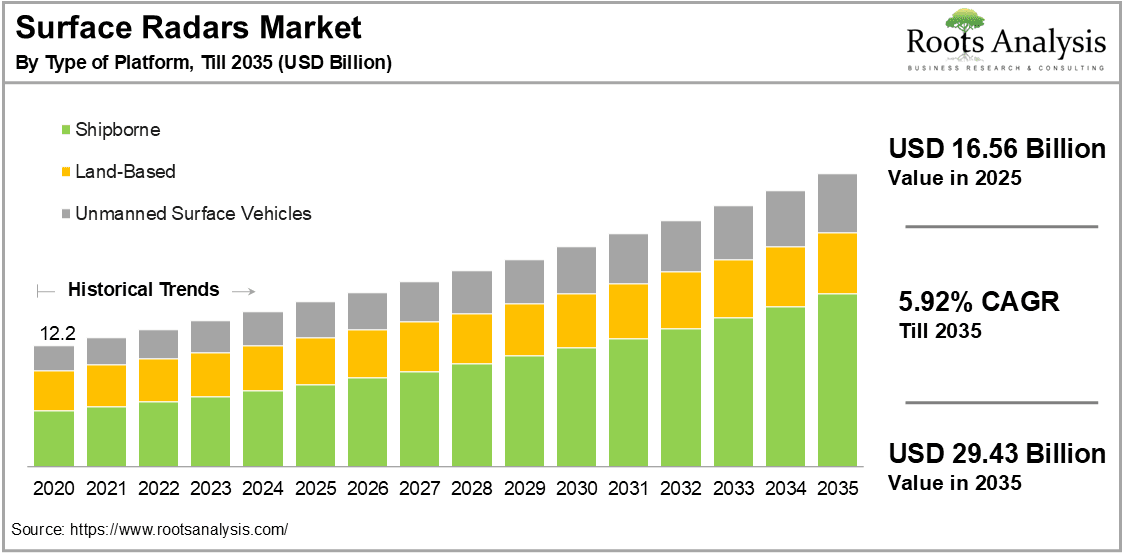 |
The new research study consists of surface radars market and trends analysis, detailed market forecast analysis, and provide actionable strategic recommendations.
Today, radar sensors have gone beyond their military origin to become an essential tool across myriad fields and applications. Surface radar is one of the categories of radar system that is designed to detect and track objects on Earth’s surface such as vehicles, ships, aircraft, and other targets. These radars operate by using radio waves to detect the location, speed, and movements of objects. The surface radar market incorporates different types of surface radars ranging from land-based to shipborne radars, which are implemented in military and commercial applications for various purposes.
Primarily, these radar systems are highly utilized for air surveillance to reinforce countries’ defense sector with improved detection and tracking of aircraft in airspace. Also, these radars are employed for maritime and naval surveillance to monitor ships, submarines, and other vessels at sea. Apart from surveillance, these systems are advancing weather monitoring and traffic control in the air and sea.
The benefits of surface radar systems have driven the growth of the surface radar market as they help enhance the detection of threats, better surveillance capabilities, and increase operation efficiency in both military and commercial applications. Owing to this, developing nations are particularly emphasizing indigenous radar development to manufacture their own radar systems in order to enhance national security and reduce reliance on foreign technology, becoming a regional trend in surface radar industry. As an effect, stakeholders are striving to capitalize on these lucrative opportunities to innovate advanced technology and development of multi-function radars.
For instance, in December 2024, Saab secured a $48 million contract from BAE Systems to supply multiple Giraffe 4A radar systems for US Air Forces in Europe, enhancing long-range surveillance and air base defense. These deliveries are set to begin in 2027. Resulted in, the market is experiencing extraordinary growth, however, the radar jamming and cybersecurity challenges can impact the overall market growth during this forecast period.
Surface Radars Market Share Insights
The surface radars market report presents an in-depth analysis of the various companies that are involved in offering surface radars, across different segments, as defined in the table below:
Surface Radars Market: Report Attributes / Market Segmentations
| Key Report Attributes | Details | |
| Historical Trend | Since 2020 | |
| Forecast Period | Till 2035 | |
| Current Market Size | $ 16.56 Billion | |
| Market Size Value by 2035 | $ 29.43 Billion | |
| CAGR (Till 2035) | 5.92% | |
| Type of Platform |
|
|
| Type of Frequency |
|
|
| Type of Range |
|
|
| Type of Dimension |
|
|
| Type of Component |
|
|
| Type of Waveform |
|
|
| Type of Application |
|
|
| Geographical Regions |
|
|
| Leading Market Players |
|
|
| PowerPoint Presentation (Complimentary) |
Available | |
| Customization Scope | 15% Free Customization | |
| Excel Data Packs (Complimentary) |
|
|
Surface Radars Market Segmentation
Market Share by Type of Platform
The global surface radars market features a wide range of platforms wherein the shipborne segment holds a leading position by capturing (~48%) of the current market share. This dominance is mainly due to the increasing need for naval defense, maritime surveillance, and protection of territorial waters. Shipborne radar systems are crucial for monitoring air and sea traffic, detecting threats, and supporting various naval operations which remarkably elevates the market progress.
However, presently, the land-based platform is accelerating the market growth excellently at (6.48%) CAGR due to its widespread use for border security, air defense surveillance, and disaster management. Their versatility and ability to cover large areas make them a key component in both military and commercial applications, bolstering the market prospects.
Market Share by Type of Frequency
This segment of the surface radar market describes multiple frequencies including L-Band, S-Band, and X-Band. According to our analysis, the L Band segment is poised to dominate the market with the majority (~46%) of the market share by 2035. L-band radars are commonly used in applications requiring long-range detection similar to air surveillance, weather monitoring, and maritime navigation. Their ability to operate effectively in various environmental conditions for instance rain or fog, makes them particularly suited for long-range, wide-area surveillance, thereby, fortifying the market expansion.
In addition, X Band frequency offers excellent performance in detecting smaller and faster targets which signifies their importance for more precise, short- to medium-range radar applications. As a result, the X Band segment is projected to grow at a higher (7.06%) CAGR during this forecast period.
Market Share by Type of Range
Based on the type of range, the market for surface radar is divided into short, medium, and long range. Among these ranges, the short range is anticipated to hold (~44%) of the market share and will lead the segment by 2035. These radars are commonly used for applications that require the detection of targets within a limited range, such as close-range air defense, vehicle tracking, and collision avoidance systems. Their cost-effectiveness, ease of integration, and ability to operate in dense environments make them widely adopted in both commercial and military sectors.
Furthermore, the medium range is driving the market at a notable (7.63%) growth rate and is expected to continue to rise in the upcoming years. This can be accredited to the significance of medium-range in applications such as maritime surveillance, air traffic control, and border security, where a balance between coverage area and target detection accuracy is required. These radars offer enhanced capabilities over short-range systems while being more cost-effective than long-range alternatives.
Market Share by Type of Dimension
The global market for surface radar based on the type of dimension is fragmented into 2D and 3D. As per market research, the 2D dimension has been holding a leading position with a maximum (~63%) of the current market share. This is primarily due to its widespread use in applications such as air defense, maritime surveillance, and navigation, where the primary focus is on detecting and tracking targets in a specific plane (elevation and azimuth). 2D radar systems are simpler, cost-effective, and efficient for many commercial and defense applications, therefore, contributing to their leading market position.
Moreover, the 3D dimension is gaining traction in the market and is expected to grow at a substantial (6.11%) CAGR over this projection period. 3D radar systems provide more comprehensive tracking capabilities by adding the vertical dimension (elevation) to the horizontal tracking, enabling more accurate detection of targets in both azimuth and elevation. This makes 3D radar systems significant in missile defense, air surveillance, and naval operations, where precise and reliable tracking is important.
Market Share by Type of Component
Based on the type of component, the market is bifurcated into antenna, receiver, signal processor, and transmitter. According to our projection, the antenna segment is expected to dominate the market with (~42%) of the market share by 2035. Antennas are critical components in radar systems, responsible for transmitting and receiving radio waves to detect and track targets. The demand for advanced, high-performance antennas, such as phased array and Active Electronically Scanned Array (AESA) antennas, drives this segment's growth. These antennas enhance radar range, resolution, and accuracy, making them indispensable for modern radar applications.
Additionally, the transmitter segment is witnessing a substantial (8.81%) CAGR during this projection timeframe. Transmitters play a vital role in generating and amplifying radio frequency signals sent by the radar system. The increasing demand for high-power and efficient transmitters, especially with the adoption of advanced radar technologies contributes to the growth and importance of this segment.
Market Share by Type of Waveform
This segment of the surface radar market is characterized by frequency-modulated continuous waveform and pulsed waveform. The frequency-modulated continuous waveform has been a leading segment and is expected to hold the largest (~61%) of the market share till 2035. Due to several core advantages such as improved range resolution, lower power consumption, and the ability to detect small and fast-moving targets, the segment dominates the market.
Additionally, the pulse waveform segment is showcasing a noticeable (7.12%) growth rate during this forecast. This growth is attributed to the ability of pulse waveforms to detect and track moving targets while filtering out stationary objects which makes them crucial for air defense, maritime surveillance, and battlefield. Their versatility and effectiveness in differentiating between threats and background clutter contribute to their high demand, supporting the market growth.
Market Share by Type of Application
The market for surface radar is distributed into a variety of applications ranging from commercial and military & government. military & government are dominating the segment by capturing (~65%) of the current market share. This is driven by the increasing demand for advanced radar systems to enhance national security surveillance and detect and track threats.
Additionally, the commercial application is likely to experience a faster (6.02%) CAGR during this forecast period. The key factor of this segment’s growth can be ascribed to the high demand for air traffic control, weather monitoring, and maritime navigation. As global air travel, weather forecasting, and maritime safety become more crucial, radar systems play a key role in improving efficiency, safety, and automation across these sectors.
Market Share by Geographical Regions
This segment highlights the distribution of the surface radars market across various geographical regions, such as North America, Europe, Asia, Latin America, the Middle East and North Africa, and the rest of the world. Among the categories, Asia is the dominating market for surface radar and is predicted to capture the (~43%) of the market share till 2035.
Additionally, North America is growing at a rapid pace and is likely to experience (8.82%) growth rate throughout this forecast period. Key contributors that are accelerating the growth of the market are high defense spending and technological innovation from leading companies. In North America, the US and Canada allocate substantial budgets to defense which enable investment in advanced radar technologies for air defense, missile tracking, and surveillance.
Also, the region is home to leading radar tech developers including Lockheed Martin, Northrop Grumman, and Raytheon Technologies which significantly invest in advanced radar technology development and collaborate with governments, thus, solidifying the region’s leadership. For instance, in January 2025, RTX Raytheon secures a $333.3 million contract to produce radar-guided air-defense missiles for surface warships.
Surface Radars Market Key Insights
The “Surface Radars Market, Till-2035: Industry Trends and Global Forecasts” report features an extensive study of the current market landscape, market size and future opportunities within the surface radars market, during the given forecast period. The market report highlights the efforts of several stakeholders involved in this rapidly emerging segment of the service providers industry. Key takeaways of the surface radars market report are briefly discussed below.
Key Drivers of the Surface Radars Market
Multiple critical drivers are propelling the surface radars industry growth however, rising geopolitical tension and the need for air traffic control are the leading contributors. Territorial disputes around the world such as the South China Sea, East China Sea, and along contested borders, have created a pressing need for enhanced surveillance and defense capabilities. Similarly, radar systems serve a vital function in ensuring the safety and efficiency of air traffic by providing precise data on aircraft positions, speeds, and trajectories, therefore, civil applications of surface radars are predominantly drivers the market development.
Furthermore, the growing demand for maritime surveillance radars is attributed to the market's expansion. Increasing threats to maritime borders and exclusive economic zones have led to heightened investment in coastal and shipborne radar systems. Lastly, the ongoing advancements in the surface radars technology for anti-jamming features is likely to intensify the market progress. Overall, these growth factors for surface radars are projected to maintain the growth rate of the market in the forthcoming years.
Surface Radars Market Competitive Landscape
The market for surface radars is dynamic and undergoing intense competition with operating global and regional companies. Major players including Raytheon Technologies, Northrop Grumman, Thales, and others are dominating the market by holding substantial market share in the global marketplace. These industry leaders are stimulating market growth through their wide range of product portfolios and technological expertise. They are focusing on advanced radar technologies, and multifunctional radar systems for naval vessels, submarines, and land-based defense systems. Besides, to retain their market positions, companies are forming partnerships with technology tech giants and investing in R&D to develop radar systems with high sensitivity and improved range.
Market Challenges in Surface Radars Market
As radar systems become more connected and integrated into broader defense networks, the threat of cyberattacks on these critical systems grows which can be a notable challenge in the surface radars market. In addition, radar jamming is one of the common challenges in surface radar technology. Radar jamming is the interference of radar signals to disrupt detection and tracking which typically use noise, deception, or barrage jamming. It poses a threat to military and civilian applications, including defense systems and air traffic control. Resulted in, this raises the need for countermeasures such as anti-jamming technology and adaptive radar systems which help mitigate the effects, but overcoming radar jamming remains a complex and ongoing challenge, and may potentially halt the market growth.
Regional Analysis: Asia is Anticipated to Dominates the Market with the Largest Surface Radars Market Share
Asia is the leading market for surface radars due to the high rise in defense budgets driven by geopolitical tensions and territorial disputes. Renowned countries China, India, and South Korea are progressively investing in advanced radar systems to bolster their air and missile defense capabilities. The region is experiencing comprehensive military modernization where the growing integration of radar with defense systems is a cornerstone in airspace monitoring, border protection, and maritime surveillance. Apart from military needs, the demand for surveillance radar systems in civil applications such as air traffic control weather monitoring, and smart city infrastructure are bolstering the market demand to a greater extent in the region.
Leading Surface Radars Manufacturing Companies
Examples of key players involved in the market for surface radars (which have also been captured in this market report, arranged in alphabetical order) include Aptiv (Ireland), BAE Systems (UK), Elbit Systems (Israel), General Dynamics (US), Here Technologies (Netherlands), Hensoldt (Germany), Israel Aerospace Industries (Israel), Indira (Spain), L3Harris Technologies (US), Lockheed Martin (US), Moog (US), Northrop Grumman (US), Nuro (US, Raytheon Technologies (US), Saab (Sweeden), Safran (France), and Thales (France). This market report includes an easily searchable excel database of all the companies who have adopted the surface radars market.
Recent Developments in Surface Radars Market
- In November 2024, Hensoldt South Africa’s GEW Business Unit introduced the RES9000 radar electronic surveillance solution at the African Aerospace and Defence (AAD 2022) exhibition, showcasing its capabilities for detecting, locating, and analyzing adversarial radar emitters.
- In November 2024, Saab introduced the Autonomous Ocean Core, an advanced control system designed to enable autonomous operations for naval surface and underwater platforms, supporting both military and civilian missions.
- In March 2024, Lockheed Martin and Navantia extended their partnership for three more years to collaborate on surface ship and submarine projects, continuing their 27-year successful alliance in naval combat systems. The two companies also work together on integrating the combat management and sonar systems for the Spanish Navy's S-80 submarines.
Surface Radars Market Report Coverage
The market report presents an in-depth analysis, highlighting the capabilities of various companies engaged in this domain, across different segments. Amongst other elements, the market report includes:
- A preface providing an introduction to the full report surface radars market, 2020-2024 (Historical Trends) and till-2035 (Forecasted Estimates).
- An outline of the systematic research methodology adopted to conduct the study on the surface radars market providing insights on the various assumptions, methodologies, and quality control measures employed to ensure the accuracy and reliability of our findings.
- An overview of economic factors that impact the overall surface radars market including historical trends, currency fluctuation, foreign exchange impact, recession, and inflation measurement.
- An executive summary of the insights captured during our research. It offers a high-level view on the current state of the surface radars market their likely evolution in the mid-long term.
- A detailed assessment of the surface radars market landscape, based on several relevant parameters, including year of experience, company size, location of headquarters, and ownership structure.
- Elaborate profiles of prominent players engaged in the surface radars market, featuring information on their year of establishment, location of headquarters, company size, company mission, company footprint, management team, contact details, financial information, operating business segments, surface radars market portfolio, moat analysis, recent developments, and an informed future outlook.
- A qualitative assessment of the various megatrends ongoing in the surface radars industry, including integration of AI and machine learning as well as growing development of multi-functional radars.
- An analysis highlighting the key unmet needs across the surface radars market, featuring insights generated from real-time data on unmet needs as identified from social media posts, recent publications, industry blogs and the views of key opinion leaders expressed on online platforms.
- An in-depth analysis of various patents that have been filed / granted related to the surface radars market and its components, based on various parameters, such as type of patent, patent publication year, patent age and leading players.
- A detailed analysis of recent developments in the surface radars market domain, based on relevant parameters such as year of initiative, type of initiative (partnerships and collaborations, expansions, funding and product launches), geographical distribution and most active players (in terms of number of recent developments).
- Key winning strategies framework that helps in analyzing the level of competition within an industry, by tracing the key market activities including partnership, funding, expansion of leading players
- A qualitative analysis, highlighting the five competitive forces prevalent in surface radars market, including threats for new entrants, bargaining power of suppliers, bargaining power of customers, threats of substitution and rivalry among existing competitors.
- A discussion on affiliated global surface radars market trends, key drivers and challenges, under a SWOT framework, which are likely to impact the industry’s evolution, along with a Harvey ball analysis, highlighting the relative effect of each SWOT parameter on the overall surface radars market.
- A value chain analysis featuring a discussion on various stakeholders involved in the development of the surface radars market, from suppliers to end-users.
- A detailed estimate of the current market size and the future growth potential of the surface radars market over the next decade. Based on multiple parameters we have provided an informed estimate on the market evolution during the forecast period 2025-2035. The report also features the likely distribution of the current and forecasted opportunity within the surface radars market. Further, in order to account for future uncertainties and to add robustness to our model, we have provided three forecast scenarios, namely conservative, base, and optimistic scenarios, representing different tracks of the industry’s growth.
- Detailed projections of the current and future market across various types of platforms such as land-based, shipborne, and unmanned surface vehicles.
- Detailed projections of the current and future market across various types of frequent such as L-Band, S-Band, and X-Band.
- Detailed projections of the current and future market across various types of range such as short range, medium range, and long range.
- Detailed projections of the current and future market across various types of dimensions such as 2D and 3D.
- Detailed projections of the current and future market across various types of components such as antenna, receiver, signal processor, and transmitter.
- Detailed projections of the current and future market across various types of waveforms such as frequency modulated continuous wave and pulsed waveform.
- Detailed projections of the current and future market across various types of applications such as commercial military, and government.
- Detailed projections of the current and future surface radars market across various geographical regions, such as North America (US, Canada, Mexico and other North American countries), Europe (Austria, Belgium, Denmark, France, Germany, Ireland, Italy, Netherlands, Norway, Russia, Spain, Sweden, Switzerland, UK and other European countries), Asia (China, India, Japan, Singapore, South Korea and other Asian countries), Middle East and North Africa (Egypt, Iran, Iraq, Israel, Kuwait, Saudi Arabia, UAE and other MENA countries), Latin America (Brazil, Chile, Colombia, Venezuela and other Latin American countries) and rest of the world (Australia, New Zealand and other countries).
Author: Ronit Sharma and Neha Kashyap
Customization Opportunities
At Roots Analysis, we genuinely care about your success and understand that your business requirements are unique. While our market research reports provide valuable insights, we recognize that they might not cover every aspect you need to make well-informed strategic decisions. To account for that, we offer 15% free report customization tailored to your specific needs. Whether you require additional quantitative analysis, qualitative insights, or any other information related to the surface radars market, reach out us today at: support@rootsanalysis.com