
Lowest Price Guaranteed
Slides
211
Last Updated
August 2026
View Count
14455
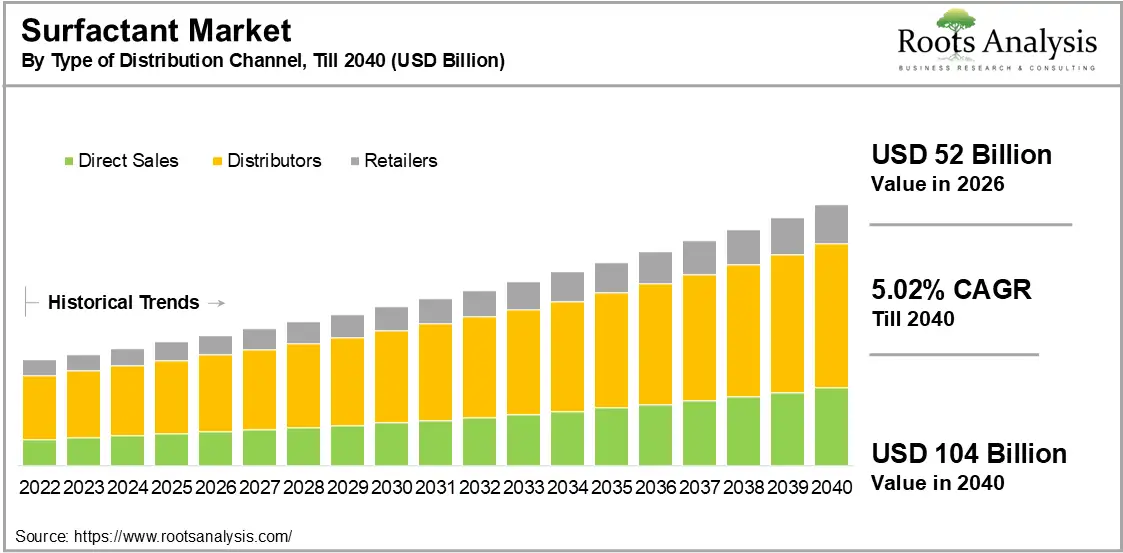
The surfactant market size is projected to grow from USD 52 Billion in 2026 to USD 104 Billion by 2040, representing a CAGR of 5.02%, during the forecast period till 2040.
To learn more about this report, request a free sample copy
The new research study consists of surfactant industry analysis, detailed market forecast analysis and providing actionable strategic recommendations.
More than 15 million tons of surfactant are used annually and notably 60% of surfactants ending up in aquatic environment. Surfactants are synthesized through both chemical processes and biological means, leading to two main categories: synthetic surfactants and biosurfactants. It is worth highlighting that synthetic surfactants are favored for their capacity to form micelles, which facilitates the mixing of immiscible substances, enhances solubility, and stabilizes emulsions. Surfactants are used across various industries including detergents, lubricants, pharmaceuticals, and cosmetics. Within the broader surfactant category, amphoteric surfactants offer unique pH-responsiveness and mildness, making them ideal for personal care formulations.
Lately, Hideya Ito, Vice President of TAI Group mentioned recently - as we strive for carbon neutrality by 2050, we are committed to investing in innovations that will foster a brighter future for everyone.
The global surfactant market is expected to grow significantly over the forecast period due to the rapid industrialization in emerging economies like China and India, further fueling global surfactant sales. Additionally, some of the surfactant product innovation and advancements in manufacturing include refining technologies, bio-based surfactants demand and integration of automation and artificial intelligence in manufacturing. Notably, growing environmental concerns regarding wastewater hazards particularly in sectors like pharmaceuticals and personal care have motivated authorities and regulatory bodies across various nations to mandate bio-based surfactants. Additionally, innovations in enhanced oil recovery (EOR) have introduced new classes of surfactants that operate effectively under challenging reservoir conditions, achieving ultra-low interfacial tension and enhancing oil mobilization
The surfactant market research report presents an in-depth analysis of the various companies that are involved in offering surfactant, across different segments, as defined in the table below:
| Key Report Attributes | Details | |
| Historical Trend | Since 2022 | |
| Forecast Period | Till 2040 | |
| Market Size Value in 2026 | $ 52 Billion | |
| Market Size Value by 2040 | $ 104 Billion | |
| CAGR (Till 2040) | 5.02% | |
| Type of Source |
|
|
| Type of Surfactants |
|
|
| Type of Application |
|
|
| Type of Distribution Channel |
|
|
| Geographical Regions |
|
|
| Leading Market Players | ||
| PowerPoint Presentation (Complimentary) |
Available | |
| Customization Scope | 15% Free Customization | |
| Excel Data Packs (Complimentary) |
|
|
Based on the type of source, the global surfactant market is split into biobased and synthetic. According to our analysis the biobased segment will augment the segment's growth with over 60% market share during this surfactant market forecast period. Further, this segment is expected to grow with a relatively higher CAGR in the near future. This can be attributed to several interrelated factors, primarily driven by increasing consumer awareness and preference for sustainable products.
On the basis of the type of surfactant, the surfactant market is segmented into amphoteric, anionic, cationic and nonionic. The anionic segment is anticipated to dominate the segment with more than 35% of market share in 2026. Further, this segment is expected to witness a relatively faster surfactant market growth rate of 6.87% until 2040. This can be ascribed to their superior cleaning and foaming properties, which make them highly effective in a wide range of applications, particularly in household and industrial cleaning products.
On the basis of the type of application, the surfactant market is bifurcated into food & beverages, home care, industrial & institutional cleaning, personal care, plastics, textile and others. The industrial & institutional cleaning segment is anticipated to dominate the segment with more than 30% of market share in 2026. This can be attributed to increasing workplace hygiene, particularly following the COVID-19 pandemic.
Industries, such as manufacturing, healthcare, and food processing require strict cleanliness standards to ensure safety and product quality, which enhances productivity and operational efficiency. However, the surfactants application in personal care segment is expected to witness a relatively faster (6.34%) surfactant market growth rate until 2040. This can be ascribed to heightened consumer awareness of hygiene and cleanliness, leading to increased demand for products like shampoos and body washes that utilize surfactants for their cleansing properties.
On the basis of the type of distribution channel, the surfactant market is bifurcated into direct sales, distributors and retailers. The distributors segment is anticipated to dominate the segment with more than 60% of market share in 2026. Additionally, this segment is expected to witness a relatively faster surfactant market growth rate until 2040. This can be ascribed to their ability to handle large volumes of surfactants and provide extensive reach across various markets and increasing industrial global surfactant demand for efficient supply chain solutions.
This segment highlights the distribution of the surfactant market across various geographical regions such as North America, Europe, Asia, Latin America, Middle East, North Africa, and the rest of the world. According to our surfactant market analysis, Asia exhibits dominance with over 40% of the market share in the global marketplace. Further, Asia is also projected to grow with a relatively higher CAGR in the forecasted period. Primary reasons for this dominance include the combination of rapid industrialization, urbanization, and a burgeoning population that drives demand across multiple sectors, including personal care, household cleaning, and industrial applications.
The “Surfactant Market, Till-2040: Industry Trends and Global Forecasts" report features an extensive study of the current market landscape, market size and future opportunity within surfactant market, during the given forecast period. The market report highlights the efforts of several stakeholders involved in this rapidly emerging segment of the service providers industry. Key takeaways of the global surfactant market report are briefly discussed below.
An increasing emphasis on environmental sustainability and regulatory compliance is majorly driving the surfactant industry. The rise in consumer preferences for environmentally friendly options are influencing manufacturers to innovate and expand their offerings. Further, increasing demand from personal care, surfactants in household cleaning products, and industrial applications are likely to drive surfactant market. Moreover, the Asia-Pacific region leads the market due to industrial growth and availability of raw materials. Additionally, technological advancements and rising disposable incomes in developing economies, such as India, China and Japan have further propelled market growth.
With the presence of several small and large surfactant manufacturers companies, the market is experiencing intense competition and changing surfactant dynamics. From large multinational companies to local surfactant manufacturers players, companies are striving to enhance their competitive edge. In terms of market share, large enterprises and multinational companies are dominating the market. While small surfactant manufacturers players are continuously improving their products to cater to niche markets, or they are offering specialized services. These industry players are focusing on adopting competitive strategies, such as developing innovative solution techniques, forming strategic alliances and partnerships to expand their portfolios and global footprint, investing in recent developments and new feature launches to enhance their surfactant offerings.
Despite strong market growth projection, the surfactant market faces numerous challenges. The most common challenge is high raw material costs for bio-based surfactants and economic pressure are affecting production costs. Environmental and regulatory concerns regarding toxicity further complicate production processes, necessitating investments in sustainable practices, such as eco-friendly alternatives, impacting research and development initiatives. Further, surfactant supply chain dynamics disruptions, exacerbated by geopolitical events and the COVID-19 pandemic, have led to inconsistent product availability.
Asia currently holds a substantial share of approximately 40% in the surfactant market opportunities. This dominance can be attributed to several factors, including supportive government regulations, rapid industrialization and urbanization in countries such as India and China. Further, the ongoing growth of end-use industries, coupled with a focus on innovation and sustainability, further enhances the region's market position. Notably, substantial investments in research and development, leading to the creation of superior surfactant materials, is one of the major governing reasons for growth in this region.
Examples of key player involved in the surfactant market (which have also been captured in this market report, arranged in alphabetical order) include AkzoNobel, BASF, Bayer, Clariant, Croda International, Dow, El Dupont De Nemours, Evonik Industries, Huntsman International, Kao Corporation, Koppert, Nouryon, Nufarm, Solvay, Som Phytopharma, Stepan Company, UPL and Valent Biosciences. This market report includes an easily searchable excel database of all the companies who have adopted the surfactant market.