
Lowest Price Guaranteed
Slides
179
Last Updated
September 2025
View Count
13257
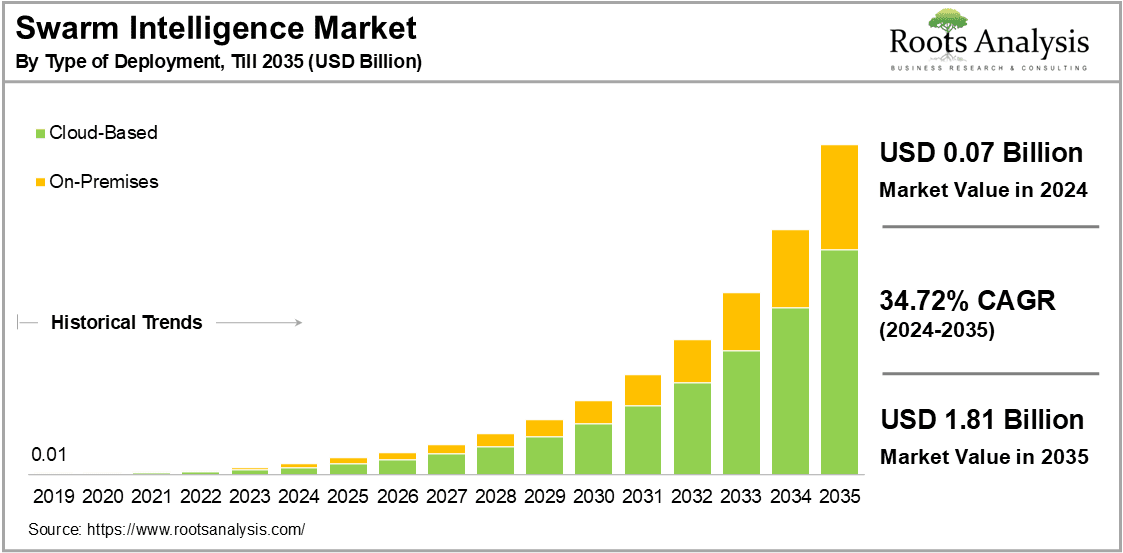
The swarm intelligence market size is projected to grow from USD 0.07 billion in 2024 to USD 1.81 billion by 2035, representing a CAGR of 34.72%, during the swarm intelligence market forecast period 2024-2035.
To learn more about this report, request a free sample copy
The new research study consists of swarm intelligence market trends analysis, detailed industry forecast analysis, and providing actionable strategic recommendations.
Swarm intelligence is the study of self-organized, decentralized control systems which comes under the umbrella term of artificial intelligence. It is a technology inspired by the collective behavior systems of insects like bees, wasps and ants working together and trying to accomplish a common objective on a big scale. As a result, it enhances human group decisions and helps predict occurrences. The swarm intelligence technology is widely used in robotics and drones utilizing agents like sonar, radar, and cameras that collect large amounts of data and information. This enables them to assign tasks to numerous virtual or actual agents, further allowing them to evaluate enormous datasets in a fraction of the time usually needed by traditional approaches.
The global swarm intelligence market is witnessing a significant growth, fueled by several key drivers. The increasing swarm intelligence opportunities in transportation and logistics for addressing location challenges is one prominent market growth factor. Along with that the demand of swarm intelligence in defense and military sector is also culminating in a massive market demand globally. Furthermore, in the healthcare system swarm intelligence optimizes patient care by leveraging diverse data sources for disease diagnosis, treatment planning, and hospital operations improvement. Additionally, with the emergence of smart cities, swarm intelligence is optimizing urban systems with innovative solutions including urban mobility which optimizes traffic management and reducing congestion.
The swarm intelligence market report presents an in-depth analysis of the various service providers that are involved in swarm intelligence market, across different segments, as defined in the table below:
| Key Report Attributes | Details | |
| Historical Trend | Since 2019 | |
| Forecast Period | 2024-2035 | |
| Market Size Value in 2024 | $ 0.07 Billion | |
| Market Size Value by 2035 | $ 1.81 Billion | |
| CAGR (Till 2035) | 34.72% | |
| Type of Swarm Intelligence |
|
|
| Type of Capability |
|
|
| Areas of Application |
|
|
| Type of End-Users |
|
|
| Types of Deployment |
|
|
| Company Size |
|
|
| Type of Business Model |
|
|
| Geographical Regions |
|
|
| Leading Market Players | ||
| PowerPoint Presentation (Complimentary) |
Available | |
| Customization Scope | 15% Free Customization | |
| Excel Data Packs (Complimentary) |
|
|
The global swarm intelligence market is segmented into various types of swarm intelligence, such as ant colony optimization, particle swarm optimization and swarm-based network. According to our swarm intelligence market analysis, the ant colony optimization segment will dominate with the largest market share of over 25% during this forecast period. This segment is witnessing rapid growth as it is the easiest type to implement and understand as compared to others. This factor makes the ant colony optimization techniques more accessible to a wider range of developers and businesses, increasing the market growth and adoption. This type is used to solve a wide variety of optimization issues like routing, scheduling, and resource allocation. However, it is worth mentioning that the particle swarm optimization method will be experiencing the fastest CAGR of 36.25% in the forecasted period. This can be owed to the growing need for energy efficient solutions as this model is the most eco-friendly.
The global swarm intelligence market is split into different types of capabilities, such as clustering, data analysis, optimization, routing and scheduling. Among the categories, the optimization segment is expected to gain the maximum market share of around 30%. This can be attributed to the flexibility of swarm intelligence in solving real-time data processing problems. Its capacity to react swiftly and collaboratively to changing circumstances is highly beneficial for industries with dynamic and time-sensitive optimization requirements; these include industries like banking and emergency response systems. On the other hand, the routing segment is expected to witness the fastest CAGR of 35.9% due to the increased integration of swarm intelligence in routing solutions for providing the transportation industry with intelligent and autonomous systems.
The market is fragmented into multiple swarm intelligence applications namely, drones, environmental monitoring, human swarming, robotics, and search & rescue operations. The robotics segment is anticipated to dominate with the highest market share of around 27% during the forecast period. This can be attributed to the increasing adoption of swarm robotics in industries like logistics where they are needed to work on complex tasks seamlessly. The ability of swarm intelligence to efficiently distribute tasks among robotic entities ensuring a synchronized and optimized workflow is also a prominent factor for this segment’s growth. This ability benefits systems, such as autonomous drone swarms for package delivery or collaborative robot teams managing complex assembly lines. On the other hand, the human-swarming in the swarm intelligence market applications segment is expected to witness the fastest CAGR of 37.1% in the forecasted period. This can be owed to this segment’s capability of decentralized decision-making which is highly crucial in sectors such as disaster response, where rapid and adaptive decision making among group of responders is critical.
The global swarm intelligence market is fragmented into multiple types of end-users namely healthcare, retail & e-commerce, robotics & automation, transportation & logistics, and others. The transportation & logistics segment is anticipated to dominate with the highest market share of over 25% during this forecast period. Swarm intelligence is majorly being used in the transportation and logistics industry due to its capability to solve complex optimization challenges, such as route planning, delivery scheduling, warehouse operations and rising costs. All these challenges have a major effect on probability. Swarm intelligence can drastically reduce these challenges by changing delivery schedules in response to unanticipated situations, assuring timely deliveries. Further its adaptive nature can fulfill automated operations like product retrieval and warehouse order fulfillment, enhancing efficiency and production rate.
The global swarm intelligence market is fragmented into two types of deployment namely cloud-based solutions and on-premises solutions. The cloud-based solutions segment is anticipated to dominate with the highest market share of 70% by 2035. This can be attributed to their scalability, ease of access, and lower upfront costs, making them more appealing for businesses looking to adapt this technology in their domains. However, it is worth highlighting that the on-premises solutions will have the fastest CAGR of 38% as it on-premises swarm intelligent solutions can meet the need for customized solutions tailored to specific organizational needs along with mitigating data security risks.
The global swarm intelligence market is fragmented into multiple types of enterprise namely large and small and medium enterprise. The large enterprise segment is anticipated to dominate the segment with the highest market share over this forecast period. However, small and medium enterprise segments are expected to witness the fastest growth rate until 2035. This is ascribable to their agility, innovation, focus on niche markets, and ability to adapt to changing customer preferences and market conditions.
This segment highlights the swarm intelligence market segmentation across various geographical regions such as North America, Europe, Asia, Latin America, Middle East, North Africa, and the rest of the world. According to our analysis, North America is expected to dominate the market in the forecasted period. This growth can be attributed to the increasing complexity of cyber security threats as the region faces a substantial amount of sophisticated and evolving cyber threats. Swarm intelligence systems’ collective intelligence and adaptability actively offers to detect and mitigate these threats.
The “Swarm Intelligence Market, Till-2035: Industry Trends and Global Forecasts” report features an extensive study of the current market landscape, market size and future opportunity during the given forecast period. The market report highlights the efforts of several stakeholders involved in this rapidly emerging segment of the service providers industry. Key takeaways of the swarm intelligence market report are briefly discussed below.
The expansion of the swarm intelligence market trends is being fueled by several factors, including advancements in AI, particularly the deep learning and machine learning in swarm intelligence which in return are enabling the creation of increasingly powerful swarm intelligence programs. Additionally, sensor technology advancements are also resulting in the swarm intelligence market growth with increasingly advanced sensors for robots and drones which are further utilized in swarm intelligence systems. The detailed environmental data provided by these sensors allows the systems to make more educated judgements and decreases the problem response time. For instance, in February 2024, GreyOrange launched a next-generation warehouse robotics system driven by the advanced swarm intelligence which incorporated cutting edge technology in enhancing warehouse operations, improving efficiency and streamlining processes.
With the presence of several small and large companies, the market is experiencing intense competition and changing market dynamics. From large multinational companies to local players, companies are striving to enhance their competitive edge. In terms of market share, large enterprises and multinational companies are dominating the market. The key players are using strategies such as partnerships, acquisitions, ventures, swarm intelligence innovations, novel product launches, R&D and geographical expansions in an attempt to solidify their position in the industry. For instance, in January 2023, AGILOX launched the new Omnidirectional Dolly Mover AGILOX ODM, expanding its autonomous mobile robots’ range to the electronics and pharmaceuticals industries.
Despite the exceptional growth, the swarm intelligence market is facing a few challenges. The most prominent one includes security and privacy concerns associated with swarm-based systems. These systems are highly vulnerable to cyber-attacks and security breaches; hence the collected data should always be ensured to prevent any potential harm to businesses and individuals. Another restraint is the lack of skilled professionals to develop and implement swarm-based systems.
North America currently holds over 40% market share in the swarm intelligence industry opportunity. This dominance can be attributed to the concentration of technology companies, technological advancements, increasing demand of automation and route analytics in retail and e-commerce sector, and the increasing adoption of swarm-based drones in military and defense sector by the region.
Examples of key service providers involved in the swarm intelligence market (which have also been captured in this market report, arranged in alphabetical order) include Abundant, AGILOX, Apium Swarm, Axon, Brainalyzed, Boston Dynamics, Continental, ConvergentAI, Cubbit, Dobot, Enswarm, Hydromea, iRobot, Kim, Mobileye, NVIDIA, Power-Blox, Reach Labs, Robert Bosch, Sentien, SSI Schäfer - Fritz Schäfer, Swarm Systems, Swarm Technology, SwarmFarm, Unanimous AI, Valutico. This market report includes an easily searchable Excel database of all the companies with swarm intelligence market products.
The market report presents an in-depth analysis, highlighting the capabilities of various companies engaged in this domain, across different segments. Amongst other elements, the market report includes:
At Roots Analysis, we genuinely care about your success and understand that your business requirements are unique. While our market research reports provide valuable insights, we recognize that they might not cover every aspect you need to make well-informed strategic decisions. To account for that, we offer 15% free report customization tailored to your specific needs. Whether you require additional quantitative analysis, qualitative insights, or any other information related to the swarm intelligence market, reach out us today at: support@rootsanalysis.com