


 Download Free Sample
 Buy Now
Market Outlook
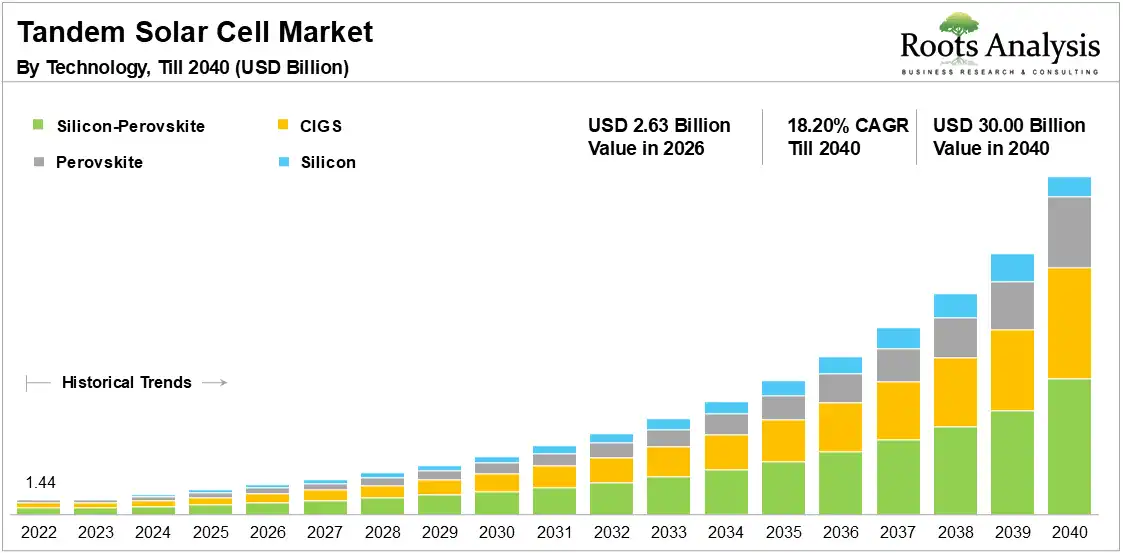
The Tandem Solar Cell Market is projected to reach USD 2.63 billion in 2026 and USD 30 billion by 2040, representing a compounded annual growth rate (CAGR) of 18.20% during the forecast period 2026 to 2040.
See What’s in the Full Report - Request Your Complimentary Insights!
The tandem solar cell market encompasses advanced photovoltaic devices that stack two different types of solar cells, typically perovskite on top of a conventional silicon base. This configuration enables the capture of a broader light spectrum, significantly enhancing overall energy conversion efficiency beyond single-junction theoretical limits. The value proposition lies in delivering higher power output from a reduced physical footprint, applicable in both utility-scale arrays and space-constrained residential or commercial installations where maximizing energy yield per area is critical.
Market expansion is primarily driven by the imperative to reduce the levelized cost of energy (LCOE) through increased efficiency, addressing the performance plateau faced by single-junction silicon technologies. Utility-scale solar power market adoption is accelerating as demand drivers increasingly emphasize high-density power supply for large utility-scale projects as well as premium rooftop installations. End-use industries are prioritizing superior module performance to maximize energy yields per square meter, a critical requirement in land-constrained regions where space optimization directly impacts project economics.
Advances in high-efficiency technologies and improved balance-of-system integration are further supporting adoption, enabling developers and utilities to achieve higher output, better returns on investment, and long-term reliability across diverse geographic and regulatory environments. Furthermore, innovation is focused on enhancing device stability and enabling large-scale manufacturing to overcome perovskite durability challenges.
The industry is moving from lab-scale success to commercial readiness, with partnerships between established silicon manufacturers and perovskite innovators accelerating adoption. Companies such as Longi Green Energy Technology and Oxford PV have announced tandem integration roadmaps, targeting large-scale deployment within two years, supporting a positive market outlook driven by continued investment and rising performance standards.
Market Report: Key Takeaways
- Leading Players Competitive Footprint: Key players in the tandem solar cell industry include Canadian Solar, Cubic PV, Enel Green Power, First Solar, GCL, Hanwha Solutions, Hevel, Huasun, JA Solar, JinkoSolar, LG Energy Solution, LONGi, Meyer Burger, Panasonic Energy, Qcells, Renshine Solar, Saule Technologies, Sharp, Solar Frontier, and Solaronix. These companies hold strong market positions with extensive geographic presence in various regions.
- Startup Ecosystem and Innovation Hotspots: Early-stage companies are emphasizing scaling from prototypes to manufacturing amid robust venture funding exceeding $80 million for leaders like Tandem PV. Companies are making advancements such as prioritizing stability, cost reduction, and domestic production to compete with traditional silicon panels.
- Industry Scale-up and Adoption Trend: Perovskite tandem solar cell market share by manufacturers is expanding as rapid industrialization and a growing number of pilot production facilities gain momentum, supported by strong government initiatives. Adoption is accelerating in utility-scale projects, where perovskite silicon tandem architectures deliver higher energy yields. Manufacturing scale-up is being enabled through automated production lines and artificial intelligence optimized layer stacking, improving stability and supporting the development of international electrotechnical commission/ underwriters laboratories (IEC/UL-certified modules).
- Silicon Perovskite holds Highest Market Segment: In terms of distribution by technology, silicon perovskite holds the maximum market share of 38.50% in 2026. The growth is derived from rapid lab to pilot scaling, with efficiencies hitting via interface engineering and stability enhancements.
- Opportunities in Tandem Solar Cell Market emerge from targeted deployment in niche applications that demand high power density, particularly in space and land constrained environments. Strategic licensing models and technology partnerships are enabling faster commercialization while reducing development risks for manufacturers. At the same time, diversification of material architectures is expanding performance and reliability options across use cases.
- Funding and Investment Momentum: The tandem solar cell industry attracts steady investment from government grants, venture capital, and strategic corporate partnerships, primarily directed toward materials innovation, stability improvements, and manufacturing scale-up for sustainable high-efficiency modules.
Recent Industry Developments
- January 2026: TCL announced the strategic acquisition of DA Solar to accelerate N type PV vertical integration, boosting tandem development.
- May 2025: Hanwha Q cells reached a stability milestone for tandem modules under IEC and UL standards validating commercial readiness.
- April 2025: Trina solar signed an exclusive patent licensing deal with Oxford PV for perovskite products in China. This facilitates the transition of the solar industry to a high efficiency multi-junction technology platform.
- March 2025: Trina solar launched the world's first industrial-standard perovskite/silicon tandem module exceeding 800W output, with lab efficiencies hitting 30.6%. Taiwan perovskite solar showcased vertically integrated high-efficiency modules at Energy Taiwan 2025.
- March 2025: Tandem PV raised $50 million in series A funding to scale US perovskite manufacturing, targeting over 30% efficiency.
Pay Only for What You Need – The Best Way to Optimize
Market Dynamics
Key Market Drivers
- Efficiency Breakthroughs Beyond Silicon Limits: Multi-junction solar cell market research highlights that tandem cells surpass the theoretical efficiency limits of single junction silicon by stacking multiple absorber layers. This approach enables substantially higher power output per module area, leading to lower levelized cost of energy (LCOE), particularly for high insolation and land constrained projects, making it a key adoption driver for utility scale developers.
- Growing Demand for High-Density Power Generation: As renewable energy penetration increases, the need for maximizing energy yield per available land area intensifies, particularly in densely populated regions and urban environments. Tandem cells provide a competitive advantage by enabling higher power density for utility-scale solar farms and high-value niche applications reducing balance of system (BOS) costs related to land use, mounting structures, and cabling.
- Policy Incentives for Domestic Manufacturing and High Efficiency: Government policies, such as the inflation reduction act (IRA) in the US and similar initiatives in Europe, incentivize domestic manufacturing and investment in next-generation solar technologies. These policies provide critical financial support and tax credits for high-efficiency modules, effectively subsidizing the initial higher production costs associated with integrating tandem architectures.
- Sustained Pressure for System Cost Reduction: PV module cost reduction strategies emphasize that although tandem modules may have higher upfront costs than conventional silicon panels, their higher efficiency significantly lowers balance-of-system (BOS) expenses, including installation labor, mounting structures, cabling, and inverter requirements. These system-level savings improve overall project economics especially in large-scale deployments where efficiency gains accumulate over the project’s operational lifetime.
Market Restraints
- Long-Term Reliability and Bankability Concerns: Tandem solar cell commercialization challenges center on the still unproven long-term reliability of perovskite layers under real world stressors such as heat, humidity, and UV exposure. The absence of long-term field data and standardized durability benchmarks limits lender confidence restricts access to project financing and prevents manufacturers from offering conventional 25-year warranties, resulting in a persistent bankability gap.
- High Manufacturing Complexity and Integration Costs: Integrating perovskite layers onto silicon wafers requires new manufacturing equipment and processes, such as (vacuum deposition or solution processing) which differ significantly from standard silicon cell production lines. This adds substantial capital expenditure and operational complexity for existing silicon manufacturers, creating a steep entry barrier and increasing initial production costs.
- Supply Chain Vulnerabilities and Material Scarcity: The supply chain for specific precursors required in perovskite manufacturing (such as lead iodide) is currently nascent and lacks the established scale and geographic diversity of the silicon supply chain. This presents potential supply bottlenecks and price volatility, complicating large-scale commercialization plans for new entrants.
- Environmental Regulations Regarding Lead Content: Tandem solar cell stability and durability issues are compounded by the widespread use of lead-based perovskite formulations, which raise environmental, health, and safety concerns under regulations such as restriction of hazardous substances and waste electrical and electronic equipment (RoHS and WEEE) in Europe. Uncertainty around hazardous material compliance and end-of-life recycling requirements poses a barrier to market entry, pushing manufacturers to either develop lead-free perovskite alternatives or invest substantially in advanced recycling and containment solutions.
Market Share Insights
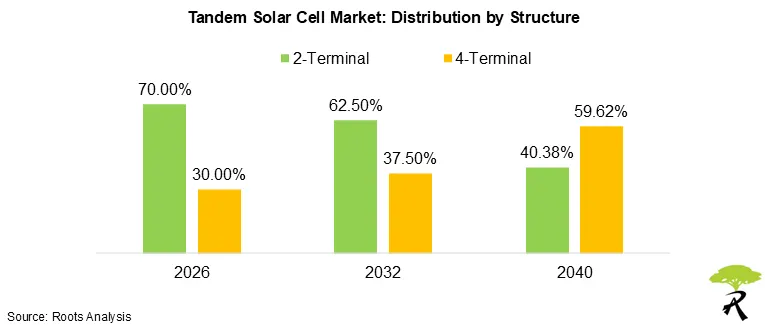
Market Share by Structure: 2-Terminal Hold the Largest Market Share
- According to our tandem solar cell market analysis, 2-Terminal holds the largest market share of 70.00%. The growth is driven by simpler series integration into current manufacturing, cost-effectiveness, and scalability versus multi-terminal complexity.
- There is a growing industrial demand for 2-Terminal through their compatibility with existing silicon manufacturing lines and cost-effective scalability. For instance, Oxford PV and Jinko Solar prioritize 2T for commercial rollout, aligning with Asia-Pacific capacity expansions and policies like India's renewable targets.
- The tandem solar cell market forecast indicate that 2-terminal (2T) adoption significantly boosts deployment through high efficiency gains, simpler manufacturing, and scalability for utility-scale products. R&D efforts on current matching minimize losses, positioning 2T ahead in early market phases despite 4-terminal (4T) designs offering a theoretical efficiency edge. For instance, investments from Trina Solar and LONGi emphasize 2T dominance, fueled by declining costs and EU carbon goals that favor rapid deployment.
Market Share by Geographical Regions: Asia-Pacific to Dominate Market Growth Through 2040
- The regional analysis suggests that Asia Pacific is expected to capture largest tandem solar cell market share of 40.00%, and is also anticipated to witness the fastest CAGR 37.50%.
- The Asia Pacific dominance is due to supply chain control and investments fueled by renewable targets and infrastructure. Additionally, China, Japan, India, and South Korea control over 80% of global solar production capacity, enabling rapid scaling of tandem cells via existing silicon lines used by firms like LONGi, JinkoSolar, and Trina Solar.
- In the Asia-Pacific region, the tandem solar cell is experiencing the fastest growth, with a CAGR of 37.50%, driven by rising energy demand across industrialization and urbanization boost utility-scale deployments, where tandem efficiencies (>30%) outperform traditional panels amid declining costs.
Want Information on Specific Region / Segment?
Market Ecosystem Insights
Leading Players Competitive Footprint
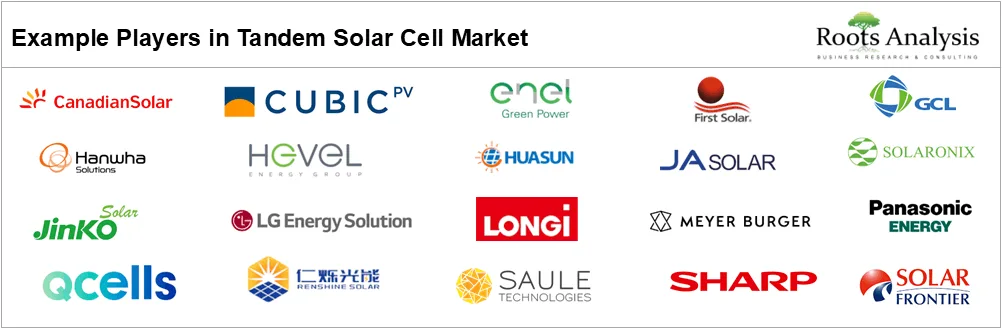
Leading players in the tandem solar cell market domain include industry giants such as Canadian Solar, Cubic PV , Enel Green Power, First Solar, GCL, Hanwha Solutions, Hevel, Huasun, JA Solar, JinkoSolar, LG Energy Solution, LONGi, Meyer Burger, Panasonic Energy, Qcells, Renshine Solar, Saule Technologies, Sharp, Solar Frontier, Solaronix which hold strong market positions through their extensive product portfolios and global reach.
Collaborations and expansions remain key growth strategies, with players accelerating innovation, market penetration, and scalability. For instance, Solar Frontier partnered with researchers at King Abdullah University of science and technology (KAUST) to develop high-efficiency CIGS-perovskite tandem solar cells.
Similarly, Sun Drive secured AU$21 million in funding from the Australian renewable energy agency (ARENA) and announced a collaboration with the commonwealth scientific and industrial research organization (CSIRO) to advance its tandem solar cell technology.
Startup Activity and Innovation Hotspots
Tandem solar cell market competitive strategy analysis report suggests reflects rapid technological evolution, with early-stage companies playing a critical role in advancing high-efficiency and sustainable tandem architectures. These innovators are focusing on performance-enhancing material designs, lightweight and flexible modules, and application-specific solutions for next-generation energy systems. Their developments complement utility-scale, building-integrated, and specialty power applications, strengthening competitive dynamics and accelerating the transition from laboratory innovation to commercial deployment.
Recent launches include investments focused on commercialization, production scaling, and R&D for higher efficiency. For instance, Tandem PV announced a significant milestone in scaling its proprietary manufacturing process for perovskite-silicon tandem solar cells, transitioning from lab-scale to pilot production.
Additionally, there are other startups such as those providing technological advancements, expansions and innovations such as Cubic PV secured investment and formed strategic partnerships to focus on developing cost-effective manufacturing techniques for its "tandem on a wafer" approach, combining high-efficiency perovskite cells with silicon.
Funding and Investment Momentum
There is a strong funding and investment momentum across the tandem solar cell industry. Fundings inflow for manufacturing facilities, perovskite-silicon integration, and stability enhancements. These funds support the accelerated development and deployment by providing critical capital for pilot lines, interface engineering to minimize losses, and compatibility upgrades with existing silicon infrastructure, aligning with Asia-Pacific’s dominance and utility-scale deployments.
Key investments include Swift Solar’s completion of seed funding round led by an institutional investor to accelerate R&D and pilot manufacturing for its flexible tandem cells. Similarly, Oxford PV announced a new funding round totaling £20 million from existing investors and new institutional funds to support the commercialization and scale-up of its perovskite-on-silicon tandem technology. Meanwhile, Cubic PV announced a new funding round and significant investment for the development and commercialization of its tandem cell technology.
Your Business is Unique – Why Shouldn’t Your Report Be?
Tandem Solar Cell Market: Scope of the Report
| Key Report Attributes | Details | |
| Historical Trend | Since 2022 | |
| Forecast Period | Till 2040 | |
| Market Size 2026 | $ 2.63 Billion | |
| Market Size 2040 | $ 30.00 Billion | |
| CAGR (Till 2040) | 18.20% | |
| Segments Covered |
|
|
Market Segmentation
Based on research, we have segmented the tandem solar cell market into technology, structure, application, geographical regions, and key players.
Market Share by Technology
- CIGS
- Perovskite
- Silicon
- Silicon Perovskite
Market Share by Structure
- 2-Terminal
- 4-Terminal
Market Share by Application
- Building Integrated Photovoltaics (BIPV)
- Commercial
- Residential
- Utility-scale
Market Share by Geographical Regions
- North America
- US
- Canada
- Mexico
- Rest of North America
- Europe
- Austria
- Belgium
- Denmark
- France
- Germany
- Ireland
- Italy
- Netherlands
- Norway
- Russia
- Spain
- Sweden
- Switzerland
- UK
- Rest of Europe
- Asia-Pacific
- Australia
- China
- India
- Japan
- New-Zealand
- Singapore
- South Korea
- Rest of Asia-Pacific
- Latin America
- Brazil
- Chile
- Colombia
- Venezuela
- Rest of Latin America
- Middle East and Africa (MEA)
- Egypt
- Iran
- Iraq
- Israel
- Kuwait
- Saudi Arabia
- UAE
- Rest of MEA


