


 Download Free Sample
 Buy Now
Market Size
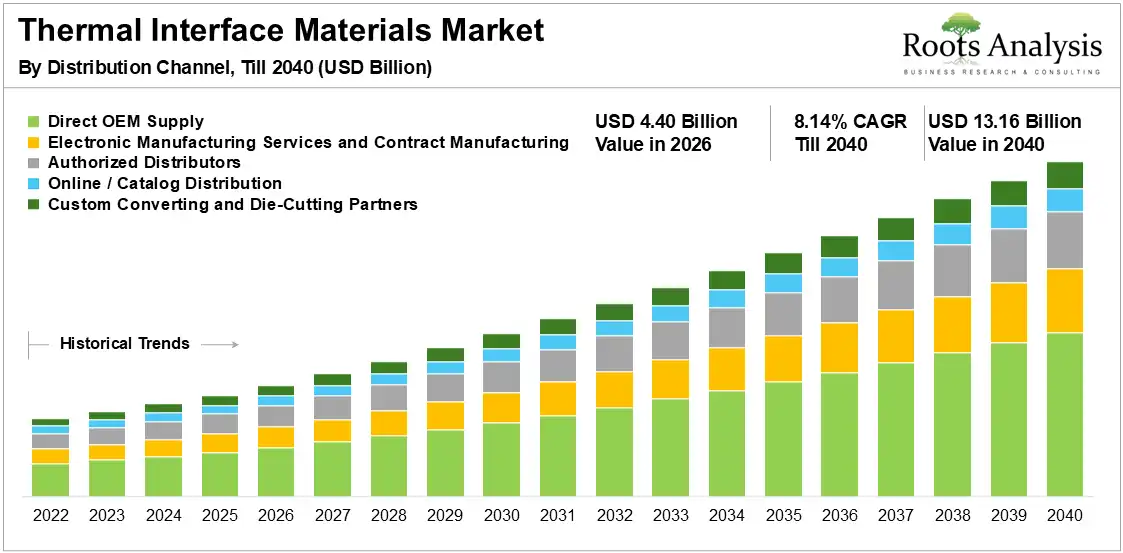
The global thermal interface materials market size is projected to grow from USD 4.40 billion in 2026 to USD 13.16 billion by 2040, representing a CAGR of 8.14% during the forecast period 2026 to 2040.
See What’s in the Full Report – Request Your Complimentary Insights!
Market Report: Key Takeaways
- Based on product type, thermal greases and pastes capture 25.0% market share in 2026, whereas Gap filler gels and liquid gap fillers register a 11.3% CAGR through 2040, driven by automated EV battery and power module dispensing.
- On the basis of material chemistry, silicone-based TIMs capture 34.0% market share in 2026, whereas Graphite / carbon-based TIMs register a 10.1% CAGR through 2040, driven by low-profile heat spreading in compact electronics.
- With respect to application, computers and servers are both the dominant and fastest-growing category, holding 24.0% share in 2026 and expanding at 10.4% CAGR through 2040, driven by AI accelerator heat density.
- In terms of interface / use case, TIM2: lid or heat source to heat sink captures 30.0% market share in 2026, whereas TIM1.5: advanced package / lid-adjacent interface registers a 13.6% CAGR through 2040, driven by chiplet and HBM package thermal constraints.
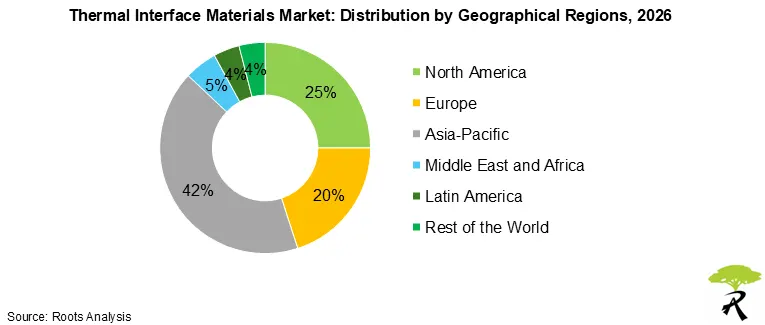
- Based on Geography, Asia-Pacific is both the dominant and fastest-growing category, holding 42% share in 2026 and expanding at 9.0% CAGR through 2040, driven by electronics, EV, and semiconductor manufacturing concentration.
Thermal Interface Materials Market Outlook
The thermal interface materials market is shifting from commodity TIM2 pastes toward engineered heat paths for AI servers, EV batteries, and advanced packages. Thermal greases and pastes still hold 25.0% share in 2026, but gap filler gels, liquid fillers, metal TIMs, and graphite materials are gaining share. Buyers now prioritize conductivity, dispensability, reliability, and platform qualification over simple interface coverage.
Growth comes from AI accelerator heat flux, EV battery safety, power module density, and semiconductor packaging complexity. Sustainability and supply-chain localization also shape sourcing, especially as India’s September 2025 semiconductor mission update highlighted support for fabrication, display manufacturing, and chip design. Henkel launched silicone-free gap filler and thermally conductive adhesive products for EV battery thermal management in May 2026.
The market will rise from USD 4.40 billion in 2026 to USD 13.16 billion by 2040, at 8.1% CAGR. Growth will remain high as TIM1.5 interfaces, above 10 W/m·K materials, and direct OEM qualification gain importance. WACKER expanded specialty silicone capacity in Japan in January 2025, including silicone-based thermal interface materials for automotive customers. The outlook remains positive, with growth shifting toward application-specific solutions.
Pay Only for What You Need – The Best Way to Optimize
Thermal Interface Materials Market Size Estimation Methodology
- As a starting point, the forecast anchored the thermal interface materials market at USD 4.40 billion in 2026. The anchor used reviewed estimates clustered around USD 3.7 billion to USD 5.2 billion for 2025 to 2026. Narrow-scope and aggressive-growth outliers were excluded to avoid distorting the 2040 baseline.
- Moving forward, annual growth was cross-checked against application demand signals from AI servers, EV batteries, power electronics, and semiconductor packaging. The model used server shipment data, hyperscaler capex disclosures, semiconductor fab output, and EV platform qualification behavior. These inputs aligned with the 8.1% CAGR path from 2026 to 2040.
- Building on this, segment shares were assigned using recurring publisher segment structures and supplier product taxonomies. Henkel, WACKER, Indium Corporation, Fujipoly, Shin-Etsu, 3M, Honeywell, Boyd, and MG Chemicals validated product forms. These forms included gap fillers, greases, pads, phase-change materials, adhesives, graphite sheets, and metal-based TIMs.
- Drawing upon these, regional shares were tied to electronics assembly, semiconductor packaging, EV battery manufacturing, and thermal material conversion capacity. Asia-Pacific received the largest 2026 share at 42.0% and the fastest CAGR at 9.0%. Trade flow data, materials production volumes, and semiconductor fab output supported this regional concentration.
- The projected value was then calculated through a year-by-year compound growth curve from 2026 to 2040. The CAGR formula checked USD 4.40 billion growing to USD 13.16 billion over 14 years. The calculation produced 8.1% CAGR, which matched the consensus forecast narrative.
- Finally, every segment forecast was checked against product-level logic and dated development evidence from 2025 onward. Gap filler gels, liquid fillers, TIM1.5 interfaces, above 10 W/m·K materials, and direct OEM supply gained share. Thermal greases, lower-conductivity materials, and catalog-led channels lost share as platform qualification became more important.
Thermal Interface Materials Market Share Insights
Market Share by Type of Product: Thermal Greases and Pastes Hold Highest Share
Thermal greases and pastes hold the largest share (25%) of the TIM market in 2026, and the reason is structural rather than performative. This segment lead because thermal greases and pastes remain the default specification in TIM2 assemblies as they are low-cost, reworkable, and carry decades of qualification history across processors, graphics units, motors, and LEDs. MG Chemicals positions its thermal paste range squarely on those properties: air pocket displacement, corrosion resistance, and easy removal for component rework. That reworkability is the defining commercial advantage keeping greases and pastes dominant in electronics maintenance, legacy server refresh cycles, and discrete component assembly where manual application is still standard.
On the other hand, gap filler gels and liquid gap fillers will show robust growth, anticipated to grow at a higher CAGR of 11.3% through 2040. Gap filler gels and liquid gap fillers will expand fastest as EV batteries and power modules need automated dispensing. They dispense at high rates, conform to complex geometries without compression risk, and can be formulated without silicone for chemically sensitive battery applications. In May 2026 Henkel launched Bergquist TGF 2030APS, a silicone-free gap filler dispensable at over 40cc per second, and Loctite TLB 9270APS, a polyurethane-based thermally conductive adhesive for cell-to-pack architectures, are direct expressions of that demand.
Which Application Drives Demand in Thermal Interface Materials Market?
According to our analysis, computers and servers occupy the largest share (24%) of the market in 2026 and will remain so through the forecast period. AI accelerators, high-core-count CPUs, and GPUs now routinely operate at heat flux levels that commodity TIM2 paste was not designed to sustain. The thermal dissipation requirement is not marginal; it is a hard constraint on how fast AI inference clusters can be clocked and how densely racks can be configured. Indium Corporation's presentation at Productronica 2025 addressed this directly, examining metal-based compressible TIMs as the category capable of matching the lifecycle and thermal performance demands of processor-heavy AI computing environments. That focus on metal TIMs, rather than organic-based alternatives, is the signal: the AI compute segment is already moving beyond what conventional thermal greases and polymer-based pads can deliver.
The same segment will also grow at the fastest CAGR of 10.4% through 2040, because AI infrastructure is still in its first major build cycle and the thermal specifications are tightening with each GPU generation. Liquid-cooled rack architectures and advanced packaging formats, including 2.5D and chiplet-based designs, are introducing new TIM interface positions that did not exist in previous server generations.
Want Information on Specific Region / Segment?
Thermal Interface Materials Regional Market Outlook
Asia-Pacific leads the thermal interface materials market in 2026 by holding 42% of the overall revenue share. The region combines electronics assembly scale, semiconductor packaging density, EV battery production volume, and contract manufacturing depth in a single geography. TIM buyers in Asia-Pacific benefit from supplier proximity, shorter qualification loops, and co-located material conversion and end-assembly operations that are difficult to replicate in other regions.
WACKER's January 2025 expansion at its Tsukuba facility added a dedicated silicone-based TIM production line for automotive and power electronics customers. This illustrates exactly this logic: the investment was placed in Japan because that is where the qualification relationships, the automotive supply base, and the downstream demand are concentrated.
Asia-Pacific will also show the fastest regional growth through 2040, at a 9.0% CAGR. The reason is not simply that the region is large. This unprecedented growth is due to the fact that Asia-Pacific is simultaneously the incumbent consumption center and the active construction zone for the next demand cycle.
Semiconductor localization is building new fab and packaging capacity that did not previously exist in the region. India's SEMICON India 2025 backgrounder, published by the Press Information Bureau in September 2025, confirmed that the India Semiconductor Mission extends financial support to fabrication, display manufacturing, and chip design, with ten approved semiconductor projects across six states representing combined investment of over INR 1.60 lakh crore.
EV battery gigafactory capacity is also concentrated in China, South Korea, and emerging Southeast Asian hubs. AI server manufacturing is following the same geographic pull. Each of these demand drivers generates new TIM qualification events at the OEM level, compounding regional volume rather than simply expanding it.
Market Ecosystem Analysis
Thermal Interface Materials Market Competitive Landscape
The thermal interface materials market remains supplier-fragmented, but competitive behavior now centers on platform convergence around chip-to-system thermal stacks. AI data centers, EV power electronics, and high-density optical modules are pushing suppliers beyond standalone pads or pastes into validated, application-specific cooling architectures.
Acquisition-driven consolidation is now the dominant structural dynamic. Eaton’s November 2025 agreement to buy Boyd’s Thermal business for USD 9.5 billion signals that thermal materials, liquid cooling, and power infrastructure are converging commercially.
.
Tier 1 Chemical Suppliers Engineering High-Conductivity TIMs for AI Optics and EV Power Electronics
Large chemical suppliers are tuning silicone and non-silicone TIM platforms for higher heat flux and automated assembly.
- Henkel commercialized Loctite TCF 14001 in October 2025 for 800G and 1.6T optical transceivers. The 14.5 W/m-K liquid silicone TIM targets AI data center optical modules, where low outgassing and automated dispensing reduce reliability risk.
- Dow opened its first Cooling Science Studio in Shanghai in November 2025. The facility supports testing, application demonstrations, and customer collaboration for TIMs, immersion fluids, and heat-transfer fluids.
Startup Innovation and Investments Accelerating Thermal Interface Materials Market
The thermal interface materials market is attracting a new wave of investment, and the reason is straightforward. As AI chips run hotter and denser with every generation, the materials sitting between those chips and their cooling systems have become a critical bottleneck. Investors and established chemical companies alike have taken notice.
The clearest sign of startup momentum is NovoLINC, spun out of Carnegie Mellon University, which is building nanostructured TIMs for the heat flux levels that conventional materials simply cannot sustain. The company raised seed funding in January 2025 from M Ventures, TDK Ventures, and Foothill Ventures, and returned to close an oversubscribed follow-on round in December 2025, bringing in Fathom Fund and Hitachi Ventures alongside its existing backers. The US government has also backed the underlying technology through ARPA-E's COOLERCHIPS program and the NSF Partnerships for Innovation initiative, giving the company credibility on both the commercial and scientific fronts.
Thermal Interface Materials Market Trends
AI Package Heat Density Reshaping the Thermal Interface Materials Market Competitive Mix
AI accelerator heat flux is moving demand toward high-conductance TIM1, TIM1.5, and TIM2 solutions. Indium Corporation announced high-reliability liquid metal TIM products for TIM0 and TIM1 applications at SEMI-THERM 2026. This shift favors suppliers with metal TIM, solder TIM, and package-level reliability expertise.
Optical transceiver heat also creates new TIM demand inside AI data center networks. Henkel commercialized Loctite TCF 14001, a 14.5 W/m·K silicone liquid thermal interface material, in October 2025. High-conductivity liquids now compete directly for 800G and 1.6T thermal sockets.
EV Battery Thermal Management Turning Gap Fillers into Strategic OEM Materials
EV battery designs are shifting demand toward dispensed gap fillers and thermally conductive adhesives. Henkel’s May 2026 launch targeted battery thermal management with silicone-free gap filler and adhesive. This trend strengthens suppliers that can qualify materials with OEMs and battery manufacturers.
Power electronics inside EV platforms increase demand for silicone gap fillers with stable thermal and mechanical performance. WACKER introduced SEMICOSIL 9649 TC for EV power electronics at Battery Show Europe 2025. The launch reinforces silicone-based TIMs despite rising interest in non-silicone options.
Your Business is Unique – Why Shouldn’t Your Report Be?
Market Access Considerations
OEM Qualification and Locked Material Specifications
Market access depends on approved material lists because EV, server, telecom, and semiconductor customers qualify TIMs around full platform reliability. Direct OEM supply leads with 43.0% share in 2026 and will reach 49.0% by 2040. This behavior constrains late entrants because switching creates revalidation costs, production risk, and assembly yield exposure. Suppliers with co-design teams gain stronger competitive positioning than catalog-only providers.
Thermal Conductivity and Reliability Validation
High-growth segments require proof of stable conductivity, compression behavior, dielectric performance, and thermal cycling endurance. Above 10 W/m·K materials will grow at 10.9% CAGR, but metal TIMs and carbon-based TIMs require tighter process controls. Electronics Cooling’s January 2026 spacecraft thermal control discussion shows how extreme cycling environments raise validation complexity. Reliability evidence directly affects qualification speed.
Supply-Chain Localization and Critical Materials Availability
Critical inputs shape access where gallium-containing liquid metal TIMs and advanced fillers enter high-performance applications. Indium Corporation’s April 2026 USD 3.2 million DOE grant supported domestic gallium supply chain development. This program shows how material security affects commercialization speed. Suppliers with secured input streams can scale faster in AI, semiconductor, and power electronics accounts.
Regional Manufacturing Proximity and Conversion Capacity
Asia-Pacific access depends on proximity to electronics assembly, EV battery production, semiconductor packaging, and converting networks. The region holds 42% share in 2026 and will reach 47% by 2040. WACKER’s January 2025 Tsukuba expansion added silicone-based TIM production capacity for automotive customers in Japan. Local production improves responsiveness, qualification speed, and account retention.
How Stakeholders Benefit from the Key Focus Areas of Our Thermal Interface Materials Industry Report
AI servers, EV batteries, and advanced semiconductor packages now make thermal interface materials a strategic design input. The report links market sizing, segment priorities, supplier positioning, and technology adoption to decisions on growth, investment, sourcing, and product roadmaps.
- Unmet Needs and Market Gaps in Thermal Interface Materials Market: The report identifies gaps where current TIM solutions struggle with heat flux, automation, compression, and long-term reliability. Product planners can use the analysis to prioritize gap filler gels, liquid fillers, TIM1.5 interfaces, and above 10 W/m·K materials. This supports decisions on new product development, acquisition targets, and platform-specific material roadmaps.
- Funding and Venture Investment Opportunities in Thermal Interface Materials Market: The report highlights investable spaces including liquid metal TIMs, carbon nanotube pads, boron nitride fillers, and EV battery thermal materials. Investment teams can compare growth rates, qualification barriers, and recent funding signals such as Indium’s DOE grant. This supports screening decisions across startups, specialty chemical suppliers, and advanced materials developers.
- Technology Innovation and Adoption Trends: The report explains which technologies are gaining share as AI servers, optical transceivers, EV packs, and power electronics raise thermal loads. Engineering teams can compare silicone-based TIMs, non-silicone polymers, metal TIMs, graphite materials, and ceramic-filled composites. This supports material selection, supplier qualification, and next-generation package design.
- Thermal Interface Materials Market Competitive Landscape and Industry Analysis: The report maps Tier 1 leaders, Tier 2 specialists, and emerging suppliers by role, product focus, and market relevance. Commercial teams can benchmark Henkel, 3M, Dow, Parker Hannifin, Honeywell, WACKER, Shin-Etsu, Indium, and Momentive. This supports account targeting, partnership evaluation, and competitive positioning.
- Mapping Strategic Partnerships and Ecosystem Synergies: The report shows where OEMs, material suppliers, distributors, converters, and technology specialists influence adoption. Business development teams can identify co-design opportunities in EV batteries, AI data centers, semiconductor packaging, and thermal material conversion. This supports partnership prioritization and channel strategy.
- Thermal Interface Materials Market CAGR and Growth Trends: The report quantifies growth from USD 4.40 billion in 2026 to USD 13.16 billion in 2040, at 8.1% CAGR. Strategy teams can compare segment momentum across geography, product type, chemistry, application, use case, conductivity, and channel. This supports capital allocation, regional expansion, and segment prioritization through 2040.
Have Questions? Let’s Get Them Answered.
Thermal Interface Materials Market: Scope of the Report
| Key Report Attributes | Details | |
| Forecast Period | Till 2040 | |
| Market Size 2026 | USD 4.40 Billion | |
| Market Size 2040 | USD 13.16 Billion | |
| CAGR (Till 2040) | 8.14% | |
| Segments Covered |
|
|
| Geographical Regions Covered |
|
|
| Key Sections Covered |
|
|
Source: Roots Analysis
Thermal Interface Materials Market Segmentation
The global Thermal Interface Materials industry report presents an in-depth analysis, highlighting the capabilities of various stakeholders, based on different segments, such as, product, material chemistry, application, interface / use case, thermal conductivity range, distribution channel, geographical regions, and key players.
By Product Type
- Thermal Greases and Pastes
- Gap Filler Pads
- Gap Filler Gels and Liquid Gap Fillers
- Phase Change Materials
- Thermally Conductive Tapes and Films
- Thermally Conductive Adhesives
- Metal-Based TIMs
- Graphite and Carbon-Based TIMs
By Material Chemistry
- Silicone-Based TIMs
- Non-Silicone Polymer TIMs
- Epoxy-Based TIMs
- Acrylic-Based TIMs
- Polyurethane-Based TIMs
- Metal / Alloy-Based TIMs
- Graphite / Carbon-Based TIMs
- Ceramic-Filled Composites
By Application
- Computers and Servers
- Consumer Electronics
- Telecom and 5G Infrastructure
- Automotive and Electric Vehicles
- Power Electronics
- Medical Devices
- Aerospace and Defense
- Industrial Electronics
By Interface / Use Case
- TIM1: Die-to-Lid / Chip-Level Interface
- TIM1.5: Advanced Package / Lid-Adjacent Interface
- TIM2: Lid or Heat Source to Heat Sink
- Battery Module-to-Cooling Plate Interface
- Power Module-to-Cooling Plate Interface
- Heat Spreader and Enclosure Interface
Thermal Conductivity Range
- Below 1 W/m·K
- 1–3 W/m·K
- 3–6 W/m·K
- 6–10 W/m·K
- Above 10 W/m·K
Distribution / Customer Channel
- Direct OEM supply
- Electronics Manufacturing Services and Contract Manufacturing
- Authorized Distributors
- Online / Catalog Distribution
- Custom Converting and Die-Cutting Partners
Market Share by Geographical Regions
- North America
- US
- Canada
- Mexico
- Rest of North America
- Europe
- Austria
- Belgium
- Denmark
- France
- Germany
- Ireland
- Italy
- Netherlands
- Norway
- Russia
- Spain
- Sweden
- Switzerland
- UK
- Rest of Europe
- Asia-Pacific
- Australia
- China
- India
- Japan
- New Zealand
- Singapore
- South Korea
- Rest of Asia-Pacific
- Latin America
- Argentina
- Brazil
- Chile
- Colombia
- Venezuela
- Rest of Latin America
- Middle East and Africa (MEA)
- Egypt
- Iran
- Iraq
- Israel
- Kuwait
- Saudi Arabia
- UAE
- Rest of MEA
- Rest of the World


