


 Download Free Sample
 Buy Now
Track Geometry Measurement System Market Size
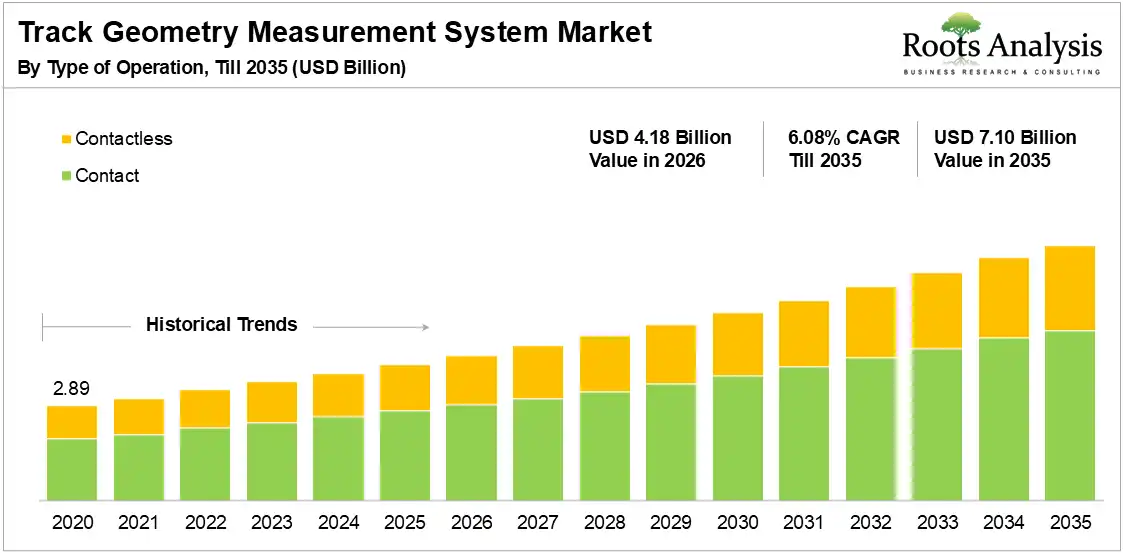
The global track geometry measurement system market, valued at USD 4.18 billion in 2026, is projected to reach USD 5.29 billion in 2030 and USD 7.10 billion by 2035, representing a CAGR of 6.08% during the forecast period 2026 to 2035.
See What’s in the Full Report–Request Your Complimentary Insights!
Track Geometry Measurement System Market Report: Key Takeaways
- In terms of component, hardware dominates the market by holding 51% of the overall revenue share.
- Based on the type of railway, high speed railways lead the market, accounting for 40.47% of the track geometry measurement system market share.
- With respect to type of operation, contact holds the largest share (57.20%) of the overall market share, while contactless is likely to grow at a CAGR of 6.97% during the forecast period.
- On the basis of type of technology, laser based systems dominate the market by securing 36.30% of the market share.
- With regards to end use industry, metro holds the maximum share (51.28%) of the global market share.
- Based on geographical regions, Asia-Pacific lead the market, accounting for nearly 40% share of the track geometry measurement system market.
Track Geometry Measurement System Market Overview
Track geometry measurement system (TGMS) is a form of technology broadly used in the railway industry to measure track condition for maintenance planning. These systems combines inertial sensors and optical sensors that are mounted on rail-bound vehicle to measure several parameters, such as twist, crosslevel, gauge, alignment and profile. Unlike traditional methods that are prone to human errors, these systems provide real-time feedback for track assessment to prevent track-associated derailment.
With increasing shift towards digital infrastructure and stringent safety regulatory guidelines from government, there is a surge in the demand for track irregularity detection systems. In addition, the growing focus on automation in predictive analytics, maintenance, government-led railway modernization, and high-speed measurement vehicles are encouraging the use of advanced track irregularity measurements systems.
Given the growing emphasis on modern railways infrastructure, several market players are focusing on the development of advanced track geometry measurement systems for predictive maintenance, safety enhancement and improving railway efficiency with real-time railways track analysis. Several partnerships have been made between industrial players and government organizations for driving innovation and expanding adoption of track geometry measurement systems.
For instance, in November 2025, ACRE entered into a strategic partnership with Rail Technology to strengthen railway infrastructure modernization in Latin America and North America. This partnership will also offer local access to advanced technologies for diagnosing wear and profiling rails and measuring track geometry with innovative technical support. As market players continue to innovate technological solutions, it is expected that track geometry measurement market will grow at an unprecedented rate.
Track Geometry Measurement System Market Recent Developments
- In September 2025, the UK’s department of transport announced GBP 5 million funding for 25 rail innovation projects. These projects have been designed to enhance patient safety and reduce disruption for overall travel experience. This funding will be delivered through First-of-a-kind competition to support new technologies trials, such as IntelliPan Network, SafeRide 5G, and portable track geometry measurement system and improve its adoption abross freight companies, train operators and Network Rail.
- In September 2025, MEMSYS successfully raised USD 390K in a seed funding round. This fund will be utilized to develop sensor-based inspection solutions for the railway infrastructure.
- In April 2025, Indian Railways signed a Memorandum of Understanding (MoU) with the Delhi Metro Rail Corporation (DMRC) to install and procure automatic wheel profile measuring system.
- In March 2025, L&T Technology Servicces launched TrackEi, an AI-powered automated rail track assessment solution.
Have Questions? Let’s Get Them Answered.
Track Geometry Measurement System Market Dynamics
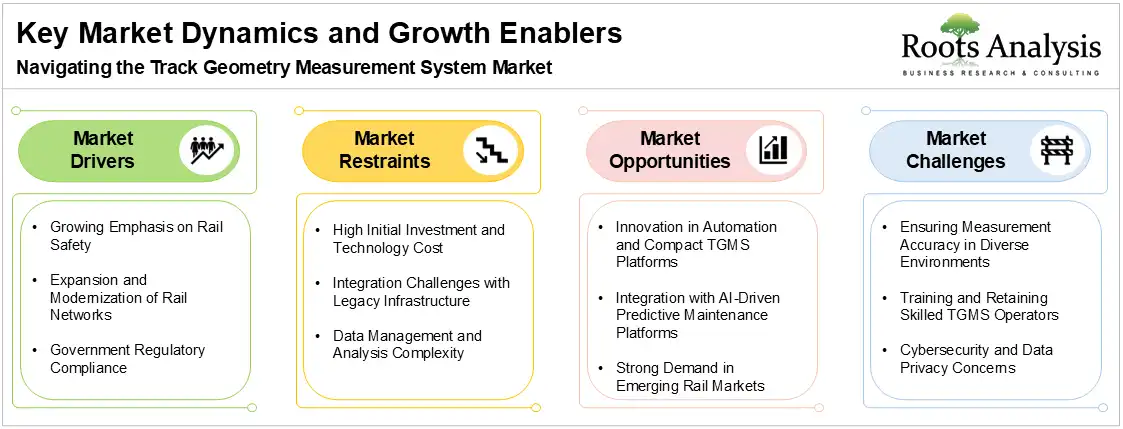
The track geometry measurement system industry is set to witness a dynamic growth, driven by the several drivers, restraints, opportunities, and challenges that will influence its trajectory in the coming years.
Key Market Drivers
- Growing Emphasis on Rail Safety: One of the significant driver of track geometry measurement system market is growing focus on railway safety and predictive maintenance of aging rail infrastructure. The high-speed railway track monitoring systems helps to get accurate and frequent measurement of track geometry parameters, such as alignment, gauge, twist, and cross-level to prevent catastrophic accidents and derailment chances. As rail traffic continue to increase, government and rail operators have mandated the stringent regulator guidelines for regular inspection of rail tracks.
- Expansion and Modernization of Rail Networks: It is important to note here that government organizations for the expansion of high-speed rail networks, freight corridors, and metros, specifically in the Middle East, Asia-Pacific, and North America. This constant focus on modernization of rail network are driving the demand for advanced track geometry measurement systems for railway infrastructure monitoring to enhance safety.
- Government Regulatory Compliance: Regulatory guidelines from government organizations, such as Indian Railways and International Union of Railways for regular track geometry parameter measurement and predictive maintenance has further fueled the adoption of track geometry measurement systems in high-speed rail projects.
Key Market Challenges
- Ensuring Measurement Accuracy in Diverse Environments: The diverse environmental conditions, such as weather, debris, and vibrations may impact the data accuracy of the track geometry measurement systems. Moreover, the track types, such as bridges, cures, and tunnels, can also impact the accuracy of TGMS. Therefore, ensuring measurement accuracy in diverse environment conditions create a significant challenge for the market players.
- Training and Retaining Skilled TGMS Operators: The effective data interpretation from track geometry measurement systems required specialized trainers and quality TGMS operators. The scarcity of skilled operators for the performance optimization in maintenance planning with track geometry systems can limit the adoption of these technologies.
- Cybersecurity and Data Privacy Concerns: The increasing integration of data-based systems and technologies have heightened the risk of cyber security. Therefore, the market players are required to compliance with data security and privacy regulation to ensure safe data transmission.
Pay Only for What You Need – The Best Way to Optimize
Track Geometry Measurement System Market Segmentation
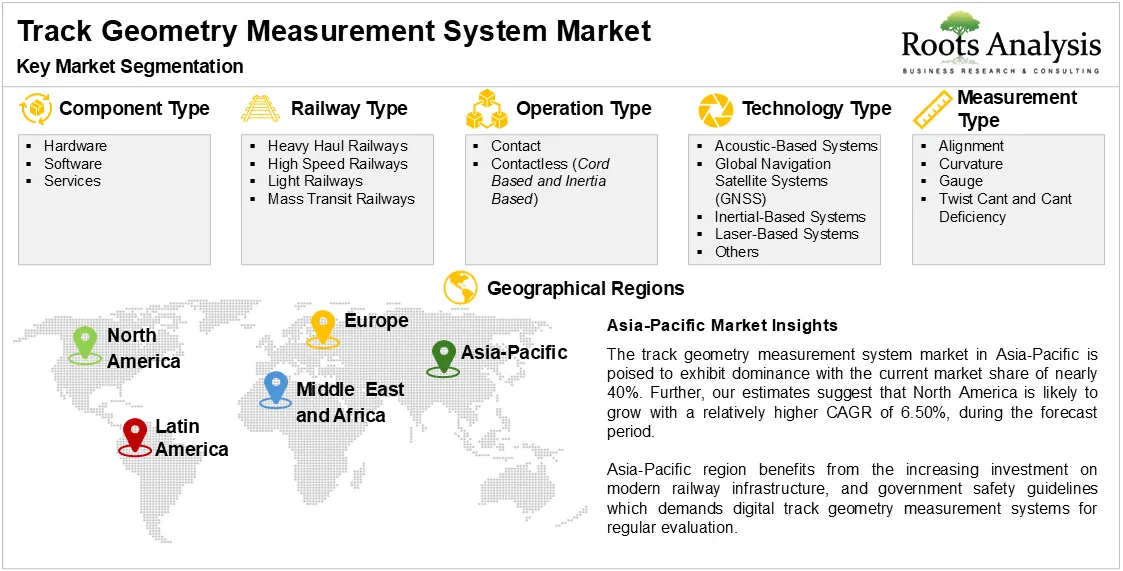
The track geometry measurement system market report presents an in-depth analysis of the various companies that are involved in offering track geometry measurement solutions, across different segments, as in the figure below:
Track Geometry Measurement System Market Share Insights
High Speed Railway Dominate the Industry
According to the track geometry measurement system market forecast, high speed railways dominate the market with a share of 40.47%. This can be ascribed to the increasing investment by government organizations in high speed rail networks specifically in Asian countries. It is important to note here that these networks requires advanced digital track geometry measurement systems to maintain safety standards.
It is worth highlighting here that high speed railways will continue to expand at a substantial CAGR during the forecast period. This dynamic growth is due to the fact that the high speed rails require advanced maintenance infrastructure as small deviation within track geometry can increase the risk of derailment and accident. Therefore, as high speed rail network continue to expand globally, there will be a surge in the demand for track geometry measurement systems.
Contactless Register a Higher CAGR During the Forecast Period
Based on the track geometry measurement industry analysis, contact holds the largest share (57.20%) of the market. This is generally driven by the preferences of conventional track geometry inspection vehicles for the inspection of track geometry. Notably, the mechanical track geometry assessment vehicles offer accurate data analysis of track alignment, surface irregularities and curvatures which increases the reliability of mechanical systems for predictive maintenance. Contrastingly, these systems are cost-effective, durable and reliable which further continue to drive its demand across railway organizations for predictive maintenance and inspection.
While contract based systems dominate the market, contactless is likely to grow at a higher CAGR of 6.97% during the forecast period. This can be ascribed to the increasing shift towards digital infrastructure and innovations in real-time track geometry data acquisition. In addition, the focus on optical 3D scanning technology and laser based LiDAR measurement solutions to achieve high accuracy in data collection is driving its demand for high speed rails.
Regional Forecast Estimates: Asia-Pacific Dominate the Market
The market for track geometry measurement system is distributed across North America, Europe, Asia-Pacific, Latin America, and Middle East & Africa. With a share of nearly 40%, Asia-Pacific lead the market and is likely to remain dominant in the future. Factors, such as increasing advancements in railway infrastructure and rapid shift towards high speed rails in Asia countries, such as China, India and Japan are driving the demand for track geometry measurement systems.
In addition, the growing expansion of metro and freight corridor projects in Asian countries has further fueled the demand for automated rail track assessment solutions. Government organizations, such as Indian Railway corporation is investing in railway modernization, which is another robust reason for the market expansion in this region.
It is worth noting that the automated track geometry measurement market in North America is likely to register a higher CAGR of over 6.50% during the forecast period. The mandatory safety regulatory guidelines across railway infrastructure and rapid development of modern railway networks are underscoring the demand for advanced rail infrastructure measurement systems in this region.
Want Information on Specific Region / Segment?
Track Geometry Measurement System Market Trends and Key Insights
Leading Players in Track Geometry Measurement System Industry
Examples of leading track geometry measurement systems developers (which have also been captured in this market report, arranged in alphabetical order) include Amberg Technologies, Balfour Beatty, Bentley Systems, DMA, Deutzer Technische Kohle, Egis, ENSCO, ESIM, Fugro, Goldschmidt Thermit, Harsco, Hitachi, KZV, MERMEC, Plasser & Theurer, R. Bance, Siemens, Trimble, Vista Instrumentation, and ZG Optique.

Increasing Competitiveness in the Track Geometry Measurement System Market
The global track geometry measurement system industry is witnessing a steer competition from the well-established and new entrants. Driven by the emerging demand for innovative predictive maintenance tools to inspect high-speed rail networks, these market players are leveraging partnerships and collaborations. Moreover, government organizations are also releasing tenders to replace aging infrastructure with modern equipment.
For instance, in August 2025, Network Rail launched a tender that worth GBP 1.5 billion to replace its aging infrastructure monitoring fleet. The tender winner will get the charge of entire Britain’s track-inspection capabilities for up to 16 years in one of the UK rail industry’s technology procurement. These initiatives are driving competitiveness in the market for a long term.
Market Trends in Automated Track Geometry Inspection Technologies
- Innovation in Autonomous and Compact TGMS Platforms: The market players are continuously emphasizing the development of compact or lightweight TGMS solutions, such as autonomous vehicles, drones, and trolleys. These innovations are greatly focused to expand the reach of track geometry measurement systems across industrial sidings, smaller rail lines, branch routes, and instant spot inspection areas.
- Integration with AI Driven Predictive Maintenance Platforms: The future aim of the market players will be automation and data-oriented analysis. Considering the future need, the rail track geometry measurement market players are integrating TGMS with AI / ML-driven predictive tools that will improve maintenance scheduling and resource allocation. Moreover, the data collected through automated rail track assessment solutions deliver deep insight to rail operations to make an informed decisions.

Track Geometry Measurement System Market: Scope of the Report
| Key Report Attributes | Details | |
| Historical Trend | Since 2020 | |
| Forecast Period | Till 2035 | |
| Market Size in 2026 | $ 4.18 Billion | |
| Market Size in 2035 | $ 7.10 Billion | |
| CAGR (Till 2035) | 6.08% | |
| Segments Covered |
|
|
Unlock Deeper Insights – Schedule Your Personalized Workshop Today!
Market Segmentation
The market report on track geometry measurement system presents an in-depth analysis of the various companies that are involved in offering track profile measurement solutions, across different segments, as mentioned below:
By Type of Component
- Hardware
- Software
- Services
By Type of Railway
- Heavy Haul Railway
- High Speed Railways
- Light Railways
- Mass Transit Railways
By Type of Operation
- Contact
- Contactless
- Cord Based
- Inertial Based
Type of Technology
- Acoustic-based Systems
- Global Navigation Satellite Systems (GNSS)
- Inertial-based Systems
- Laser-based Systems
- Others
By Type of Measurement
- Alignment
- Curvature
- Guage
- Twist Cant and Cant Deficiency
End Use Industry
- Metro
- Rail Transportation
- Subway Systems
- Others
By Geographical Regions
- North America
- US
- Canada
- Mexico
- Rest of North America
- Europe
- Austria
- Belgium
- Denmark
- France
- Germany
- Ireland
- Italy
- Netherlands
- Norway
- Russia
- Spain
- Sweden
- Switzerland
- UK
- Rest of Europe
- Asia-Pacific
- Australia
- China
- India
- Japan
- New-Zealand
- Singapore
- South Korea
- Rest of Asia-Pacific
- Latin America
- Brazil
- Chile
- Colombia
- Venezuela
- Rest of Latin America
- Middle East and Africa (MEA)
- Egypt
- Iran
- Iraq
- Israel
- Kuwait
- Saudi Arabia
- UAE
- Rest of MEA
- Rest of the World
- Austria
- New Zealand
- Other Countries
Your Business is Unique – Why Shouldn’t Your Report Be?


