


 Download Free Sample
 Buy Now
Market Size
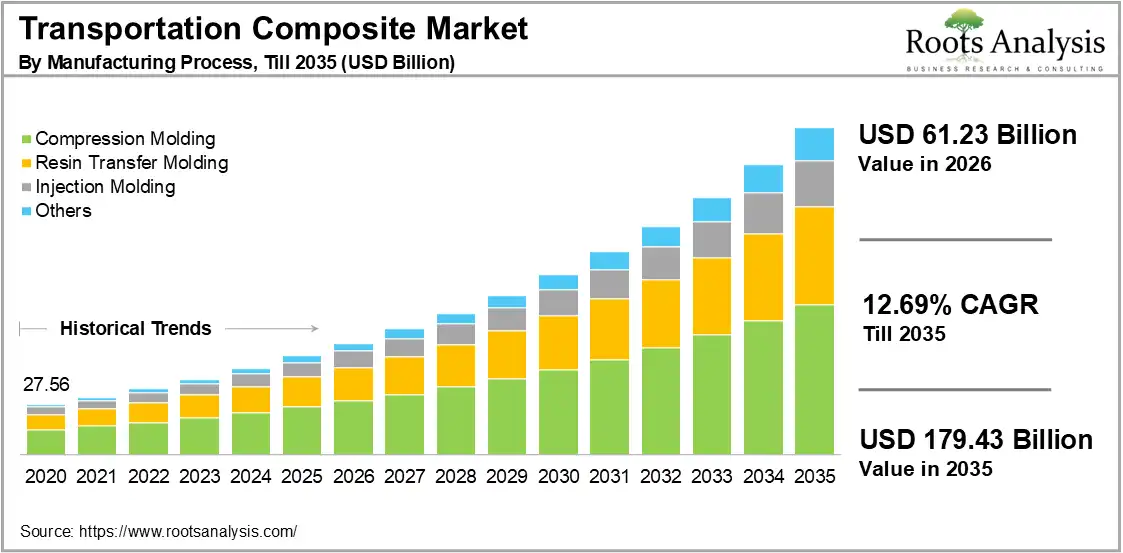
The global transportation composites market size is valued at USD 54.33 billion in 2025, is projected to reach USD 61.23 billion in 2026, and USD 179.43 billion by 2035, with a 12.69% CAGR during the forecast period 2026 to 2035.
See What’s in the Full Report - Request Your Complimentary Insights!
Market Report: Key Takeaways
- In terms of manufacturing process, compression molding secured 48.30% of the overall revenue share of the global market.
- In terms of type of fiber, carbon fiber composite holds the largest share of transportation composite market.
- In terms of leading region, Asia-Pacific holds the largest share with 46% share of the market.
- Key market drivers are the rising need for vehicle weight reduction and fuel efficiency, along with the growth of electric vehicles and urban mobility.
Market Overview
Transportation composites are engineered materials formed by combining fibers (such as glass, carbon, or natural fibers) with a resin matrix, resulting in a product exhibiting superior mechanical properties, durability, and corrosion resistance compared to conventional materials. These composites address the unique structural requirements and efficiency challenges in transportation, supporting vehicle weight reduction in transport sector, enhanced fuel economy, and longer durability and lifecycle of transportation composite parts.
Versatility of these composites makes them an integral part of automotive, aerospace, marine, rail, and trucking sectors. Here they are used in components, such as transportation composites for electric vehicle battery enclosures, wing assemblies, bumpers, doors, propellers, braking systems, exhausts, interiors, and frame structures. The ability to tailor mechanical, thermal, and impact properties allows manufacturers to meet diverse performance standards while optimizing maintenance and cost.
Growth in the transportation composites market is driven by regulations favoring lightweight and energy-efficient solutions, environmental pressures for sustainable transport composites, and advancements in material science enabling multifunctional and recyclable composite designs.
Increasing adoption is further propelled by automation, design flexibility, and innovations in both thermoset and thermoplastic technologies, a trend supported by the push towards electrification in automotive and smart infrastructure in mobility.
Your Business is Unique – Why Shouldn’t Your Report Be?
Recent Developments
- In July 2025, Toray Advanced Composites signed an LTA with Airborne Aerospace to provide advanced composite materials for the production of solar array substrates for mega-constellation satellites.
- In May 2025, Toray Advanced acquired Gordon Plastics’ assets to expand its continuous fiber-reinforced thermoplastic composite materials portfolio.
- In May 2025, Teijin Carbon launched a new brand, Tenax Next, to represent its next-generation carbon fiber products.
- In May 2025, TataAutoComp partnered with Katcon Global in Mexico, to manufacture advanced composites, with a focus to serve the North American Market.
- In March 2025, The Mercedes-AMG Petronas F1 Team took its first steps toward the qualification and application of sustainable carbon fiber composites in their 2025 Formula 1 season W16 race car.
Market Share Insights
Transportation Composites Market Forecast Estimates Suggest the Dominance of Carbon Fiber Composite Sub-Segment
The carbon fiber composite sub-segment is set to have the highest market share in the current global market. The growth of carbon fiber transportation composites is driven by the rising demand for lightweight vehicles across the globe. Another factor driving the growth is the increasing use of carbon fiber as a prominent raw material for advanced composite material fabrication.
The glass fiber sub-segment is expected to witness significant growth in terms of CAGR. This growth is majorly driven by the increasing demand for glass fiber reinforced composites vehicles where its used for manufacturing automotive interior and exterior parts. Along with this, the use of glass fiber in marine vessel composites for the production of hulls, liners, decks, and some other parts is also driving the market growth.
Which Manufacturing Process Will Have the Fastest Pace of Growth in Transportation Composites Market?
According to transportation composites industry analysis, the resin transfer molding sub-segment will have the fastest growth during the forecast period.
This growth can be attributed to the rising demand for lightweight composites for automotive fuel efficiency and the need to produce intricate parts for automotive and aerospace applications. It is also experiencing significant growth, particularly for mass-producing components due to its cost-effectiveness and ability to handle complex designs and high-quality finishes.
On the other hand, the compression molding sub-segment is expected to have the highest market share of around 48.30% in the current market. This large revenue share is driven by its versatility and ability to optimize manufacturability.
Which Type of Transportation Will Have the Fastest Pace of Growth in Transportation Composites Market?
The roadways sub-segment will have the fastest growth during the forecast period driven by global infrastructure development and maintenance projects for roads and bridges.
Another factor significantly enhancing the growth of this sub-segment is the increasing use of composites in automotive applications including body panels, structural components, under-body shields, and composites in electric vehicles (EVs) to reduce vehicle weight, improve fuel efficiency, and increase battery range and performance.
On the other hand, the airways sub-segment is expected to have the highest market share. This large revenue share of the aerospace composites market is driven by the significant demand from commercial and defense sectors which use advanced composites in aerospace for their high tensile strength and low weight to improve fuel economy and reduce maintenance costs.
Asia-Pacific to Lead the Transportation Composites Market with the Highest Market Share
The regional growth of transportation composites in Asia-Pacific is likely to contribute the largest market share of 46% during the current market year.
The region is mainly benefiting from rising government initiatives in countries such as India, China, South Korea, Japan and others to strengthen the chemical sector. Additionally, the rising developments in the rail transportation composites market, along with the presence of well-established waterways in India and China are also strengthening the regional market.
Regulatory standards for composites in transportation industry, and the presence of major automakers and raw material suppliers are further fueling the market growth.
On the contrary, the North American market is set to witness the fastest CAGR during the forecast period. This growth is being attributed to the increasing demand from the automotive composites market as well as aircraft replacement.
Want Information on Specific Region / Segment?
Key Market Insights
Market Landscape of Transportation Composites
The competitive landscape of the transportation composites market in the current year features global leaders who drive innovation and set industry standards. These companies compete by expanding capacities, developing advanced carbon fiber composites in commercial aircraft structures and thermoplastic composites for automotive, enhancing sustainability, and investing in R&D for lightweight multifunctional solutions.
The market is moderately consolidated, with a focus on strategic partnerships, technological advancements, and catering to growing demand from automotive, aerospace, and rail sectors, especially in Asia Pacific, North America, and Europe.
Market Dynamics
Key Market Drivers
- Need for Vehicle Weight Reduction and Fuel Efficiency: Transportation composites are critical for reducing vehicle weight, improving fuel economy, and lowering emissions in automotive, aerospace, and rail sectors. Increasing pressure to meet stricter fuel efficiency / emission standards (EURO 7, CAFE, ICAO) accelerates the adoption of sustainable bio-based composites in public transport to replace steel and aluminum components.
- Growth of Electric Vehicles and Urban Mobility: EV manufacturers favor composites for battery enclosures, structural parts, and exterior panels due to lightweight, corrosion resistance, and design flexibility. The rise of micro-mobility, e-bikes, e-buses, and next-gen rail transit systems further boosts demand for durable, efficient, and low-maintenance material solutions, such as composite materials in high-speed rail manufacturing.
- Expanding Aerospace and Defense Applications: Commercial aircraft (Boeing 787, Airbus A350) and military programs increasingly integrate carbon composites in fuselages, wings, and interiors, enabling weight reduction, higher payloads, and better fatigue performance.
Market Challenges
- High Material and Manufacturing Costs: Composites remain more expensive on a per-kg basis than metals. Cost and complexity of custom tooling, skilled labor, inspection, and limited economies of scale (especially for carbon fiber) restrain adoption in price-sensitive markets and entry-level vehicles.
- Repair, Recyclability, and End-of-Life Issues: Composites, especially thermosets, pose challenges in inspection, field repair, and recycling compared to metals, complicating aftermarket service and life-cycle management.
- Integration and Design Complexity: Designing for composites requires specialized simulation, joining, and assembly approaches. Limitations in joining, machining, and quality assurance processes can slow adoption and increase engineering requirements.
Crashworthiness of Composites in Vehicle Safety Applications
The crashworthiness of composites in vehicle safety applications is notable due to their high strength-to-weight ratio and energy absorption capabilities. Composites help reduce vehicle weight while enhancing occupant protection by absorbing energy impact efficiently, which improves crash performance and safety in accidents.
Composites Market Growth in Marine and Shipbuilding Sectors
The transportation composite growth in marine and shipbuilding is exponential. This growth is driven by demand for corrosion-resistant, high-strength, and lightweight materials in shipbuilding, powerboats, and cruise ships, which enhance fuel efficiency and durability in marine vessels.
Market Segmentation
Transportation Composites Market: Scope of the Report
| Key Report Attributes | Details | |
| Historical Trend | Since 2020 | |
| Forecast Period | Till 2035 | |
| Market Size 2026 | $ 61.23 Billion | |
| Market Size 2035 | $ 179.43 Billion | |
| CAGR (Till 2035) | 12.69% | |
| Segments Covered |
|
|
| Key Players |
|
|
| PowerPoint Presentation (Complimentary) | Available | |
| Customization Scope | 15% Free Customization | |
| Excel Data Packs (Complimentary) |
|
|
Pay Only for What You Need – The Best Way to Optimize
Market Segmentation
Based on the research, we have segmented the transportation composites market into fiber, resin, manufacturing process, type of transportation, application, geographical regions, and key players.
By Fiber
- Aramid Fiber
- Carbon Fiber Composite
- Glass Fiber
- Natural Fiber
- Others
By Resin
- Thermoplastic
- Polyphenylene Sulphide
- Polyamide
- Polypropylene
- Others
- Thermoset
- Epoxy
- Polyester
- Vinyl Ester
- Others
By Manufacturing Process
- Compression Molding
- Injection Molding
- Resin Transfer Molding
- Others
By Type of Transportation
- Airways
- Railways
- Roadways
- Waterways
By Application
- Exteriors
- Interiors
- Others
By Geographical Regions
- North America
- US
- Canada
- Mexico
- Rest of North America
- Europe
- Austria
- Belgium
- Denmark
- France
- Germany
- Ireland
- Italy
- Netherlands
- Norway
- Russia
- Spain
- Sweden
- Switzerland
- UK
- Rest of Europe
- Asia-Pacific
- Australia
- China
- India
- Japan
- New-Zealand
- Singapore
- South Korea
- Rest of Asia-Pacific
- Latin America
- Brazil
- Chile
- Colombia
- Venezuela
- Rest of Latin America
- Middle East and Africa (MEA)
- Egypt
- Iran
- Iraq
- Israel
- Kuwait
- Saudi Arabia
- UAE
- Rest of MEA


