


 Download Free Sample
 Buy Now
Market Size
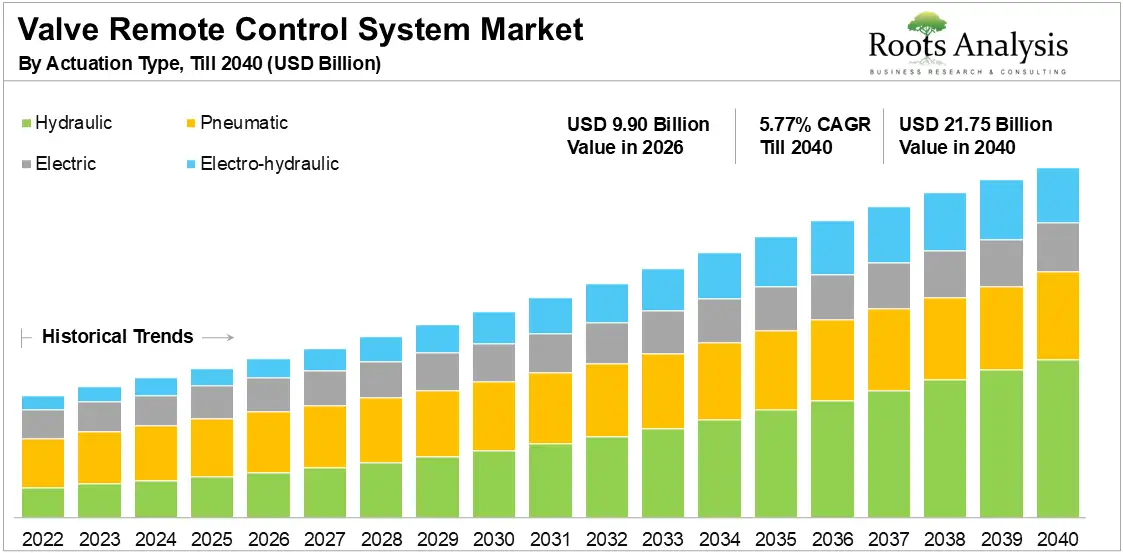
The valve remote control system market, valued at USD 9.90 billion in 2026, is expected to reach USD 21.75 billion by 2040, growing at a CAGR of 5.77%, during the forecast period 2026-2040.
See What’s in the Full Report – Request Your Complimentary Insights!
Market Report: Key Takeaways
- Electric actuation holds 21.4% market share in 2026 and is expected to grow a steady pace, driven by digitalization and energy efficiency advantages.
- Hydraulic actuation holds 28.5% share in 2026 and is expected to decline due to high maintenance and replacement by hybrid / electric systems.
- Actuators account for 35.0% share in 2026 and are expected to grow further as core automation components.
- Sensors account for 10.0% share in 2026 and are expected to grow rapidly, due to IoT and predictive maintenance adoption.
Valve Remote Control System Market Outlook
The valve remote control system (VRCS) includes industrial automation focused on the centralized management and monitoring of fluid flow components within maritime and offshore environments. These solutions integrate hydraulic, electric, and pneumatic actuators with sophisticated control units to oversee critical operations on commercial vessels and complex platforms. These systems streamline the management of ballast water, cargo, and process controls through precise remote monitoring. By doing so, they significantly improve operational safety and efficiency across a wide range of maritime vessels.
Stricter global regulations on environmental protection and maritime safety are the primary drivers of current market growth. As specialized vessels like liquified natural gas (LNG) carriers and floating production storage and offloading (FPSO) become more complex, the industry is increasingly turning to advanced automation to prevent human error during critical fluid transfers. This shift has triggered a surge in demand for both new ship construction and the upgrading of existing fleets. Recent projects in South Korea successfully implemented electro-hydraulic systems to satisfy rigorous safety standards and enhance cargo operations.
The future of the market is being shaped by the integration of digital tools and IoT into core machinery. Innovation is currently focused on electric and electro-hydraulic systems that provide detailed data for predicting maintenance needs and monitoring equipment health. A key example of this shift is the use of digital twin models to analyze system data, which helps lower long-term operating costs. As companies update their fleets, the demand for these transparent and mature technologies remains strong, ensuring a positive outlook for the industry.
Valve Remote Control System Market Segmentation Analysis
Market Segment by Type of Valve
Ball valves lead the market with a 28.0% share in 2026, driven by strong adoption trends due to their operationally robust design, rapid quarter-turn operation, and seamless compatibility with automated control systems. Their market leadership is sustained by strict safety regulations that mandate dependable remote shutoff capabilities in high-risk offshore environments. This dominance is further supported by an established global supply network that ensures both cost-effectiveness and the ability to scale operations easily.
By meeting rigorous compliance standards while leveraging a proven logistics infrastructure, these systems remain the preferred choice for demanding maritime applications. Meanwhile, diaphragm valves represent the fastest-growing segment, fuelled by rising demand in biotech, pharmaceutical, and chemical industries. Their ability to handle corrosive and high-purity fluids without contamination aligns with strict regulatory standards and expanding life sciences investments. Advances in hydraulic actuation and increasing commercialization in sanitary processing further strengthen their growth outlook, positioning them as a key driver of evolving competitive dynamics in valve remote control systems.
Market Segment by Type of Actuation
Pneumatic actuation leads the valve remote control system market with a 38.2% market share in 2026, driven by its proven reliability and safety in hazardous environments. Its dominance is supported by strong adoption trends in oil and gas, and marine sectors, where compressed air systems eliminate spark risks and ensure operational continuity. Mature supply chains, standardized components, and cost-effective scalability further strengthen its competitive position, especially in applications like cranes and hoists. Meanwhile, electric actuation is currently the fastest-growing market segment, fueled by rapid digitalization and its clear energy-saving advantages. The outlook is exceptionally positive as the integration of AI and IoT allows for more precise control and the ability to predict maintenance needs before failures occur. As industries invest more heavily in smart manufacturing and move away from traditional fluid-based systems, electric technology is set to gain significant market share by 2040.
Market Segment by Component
Actuators lead the valve remote control system market with a 35.0% share in 2026, supported by their essential role in enabling precise valve operation across safety-critical industries. Their dominance reflects strong automation adoption trends, regulatory requirements for reliable control systems, and well-established supply chains for electro-hydraulic and electric variants, which ensure scalability and cost efficiency. Mature infrastructure and widespread deployment in oil & gas, marine, and power sectors further reinforce their market leadership. Meanwhile, sensors represent the fastest-growing segment, expanding at a CAGR of 7.5% through 2040, driven by rising demand for predictive maintenance and real-time monitoring. Growth outlook is fueled by Industry 4.0 integration, increasing investments in IoT-enabled systems, and the commercialization of AI-driven analytics, which are reshaping competitive dynamics and accelerating adoption trends toward smarter, data-driven valve management.
Market Segment by End Use Industry
The marine segment leads the valve remote control system market with a 42.0% market share in 2026, driven by strong adoption in global shipbuilding and offshore operations where centralized fluid control is critical for safety, efficiency, and regulatory compliance. Established infrastructure in Asia-Pacific shipyards, combined with stringent maritime standards such as international maritime organization (IMO) regulations, supports sustained demand and scalable deployment, reinforcing its dominant position and favourable growth outlook. Meanwhile, water treatment is the fastest-growing segment, due to rising regulatory pressure on leak detection, wastewater management, and resource efficiency. Increasing investments in smart water infrastructure and IoT-enabled monitoring systems are accelerating adoption trends. These competitive dynamics highlight how regulatory support and digital innovation are reshaping growth trajectories across end-use industries.
Valve Remote Control System Dynamics
Market Drivers:
- Acceleration of Autonomous and Highly Automated Vessel Architecture: The key driver for the adoption of advanced persistent threat (APT) protection solutions is the increasing frequency and sophistication of attacks conducted by well-funded, state-backed cyber threat groups and advanced cybercriminal organizations.
- Stringent Compliance Frameworks for Safety and Environmental Protection: Governments worldwide are implementing stricter mandates requiring higher cybersecurity standards for critical infrastructure sectors like energy, finance, and healthcare.
- Increased Vessel Size and System Complexity: Modern container ships, LNG carriers, and specialized offshore vessels feature thousands of valves and intricate piping networks for fuel, cargo, and ballast. Manual operation is impractical and poses significant safety risks, making valve remote control system (VRCS) a mandatory component for efficient and safe management of large-scale maritime operations.
Market Opportunities:
- Expanding Retrofit Market: International mandates requiring the installation of ballast water treatment systems (BWTS) on existing vessels constitute a substantial growth opportunity for valve remote control system (VRCS) providers. These retrofitting projects necessitate the integration of high-precision valve controls to interface seamlessly with modern treatment hardware, thereby stimulating a robust demand for modernized remote oversight solutions across the global fleet.
- Technological Transition Toward Electric and Electro-Hydraulic Actuation: There is a distinct market opportunity in the shift away from centralized hydraulic power units toward electro-hydraulic (EHA) or fully electric actuators. These technologies offer a compelling value proposition for next generation vessel construction by reducing piping requirements, lowering maintenance friction, and providing superior energy efficiency and digital compatibility compared to legacy systems.
Market Challenges
- Lack of Cross-Platform Standardization and Interoperability: The maritime industry’s fragmented regulatory and supplier landscape creates significant hurdles for system integration. A lack of universal standards across classification societies and manufacturers lead to high levels of customization, driving up engineering costs and complicating the synchronization of valve remote control system (VRCS) hardware with broader vessel management ecosystems.
- Supply Chain Volatility and Extended Procurement Lead Times: The production of high-performance actuators and hydraulic components is susceptible to global supply chain disruptions and geopolitical instability. Extended lead times resulting from these bottlenecks frequently compromise delivery schedules for both new construction programs and essential fleet modernizations. Such disruptions introduce significant financial instability, impacting the fiscal predictability of shipyards and shipowners alike. Consequently, the inability to secure critical components within established timelines remains a primary risk to project viability.
Regional Analysis
North America maintains its market leadership with a 30.5% share in 2026, sustained by an established oil and gas infrastructure and rigorous regulatory standards that mandate advanced automation. The region's dominance is further reinforced by strategic investments in unconventional resource plays and offshore projects that leverage sophisticated safety systems to achieve economies of scale. Concurrently, the Asia-Pacific region is projected to be the primary growth driver through 2040, propelled by accelerating industrialization and an expanding shipbuilding sector. Increased government support for digital infrastructure and IoT integration is fueling adoption across water management and energy systems, while rising demand for specialized valve controls in LNG and industrial applications confirms the region's long-term commercial momentum.
Your Business is Unique – Why Shouldn’t Your Report Be?
Leading Players Competitive Footprint
- Emerson Electric: Emerson launched the new ASCO Series 580 valve remote control system, designed for critical applications in marine, oil and gas, and process industries.
- Rotork: Rotork introduced the new IQ Pro electric actuator range, featuring advanced data logging and predictive maintenance capabilities for improved remote monitoring. The company expanded its manufacturing capacity in Germany to increase production of electric actuators and control solutions for European industrial markets.
- Wartsila: Wartsila signed a contract to provide its integrated automation system, which includes valve remote control system market solutions, for six newbuild very large crude carriers (VLCCs). The company completed the installation of a new VRCS system and integrated controls for a large chemical tanker fleet modernization project.
- Parker Hannifin: Parker Hannifin launched a new series of IoT-enabled hydraulic remote-control solutions to facilitate predictive maintenance and system diagnostics for heavy machinery applications. The company expanded its manufacturing footprint in Mexico in October 2023 to support rising demand for automation and fluid control components in North American markets.
- Kongsberg Maritime: Kongsberg Maritime secured a major contract to supply its integrated vessel automation system, including advanced valve remote control systems, for a new series of liquefied gas carriers. The company implemented upgrades to its K-Control VRCS software in early 2024, enhancing digital twin functionality and remote diagnostic tools for fleet operators.
- ACES (Advanced Control & Electrical Systems): ACES announced a series of contracts to supply valve remote control system solutions for multiple newbuild vessels at shipyards in South Korea and China. The company recently secured an order to provide its VRCS and tank gauging systems for a new generation of ammonia carriers being built in Asia.
Valve Remote Control System Market: Scope of the Report
| Key Report Attributes | Details | |
| Historical Trend | Since 2022 | |
| Forecast Period | Till 2040 | |
| Market size 2026 | USD 9.90 Billion | |
| Market size 2040 | USD 21.75 Billion | |
| CAGR (Till 2040) | 5.77% | |
| Report coverage |
|
|
| Key companies profiled | ||
| Segments covered |
|
|
| Countries covered |
|
|


