


 Download Free Sample
 Buy Now
Vector Database Market Size
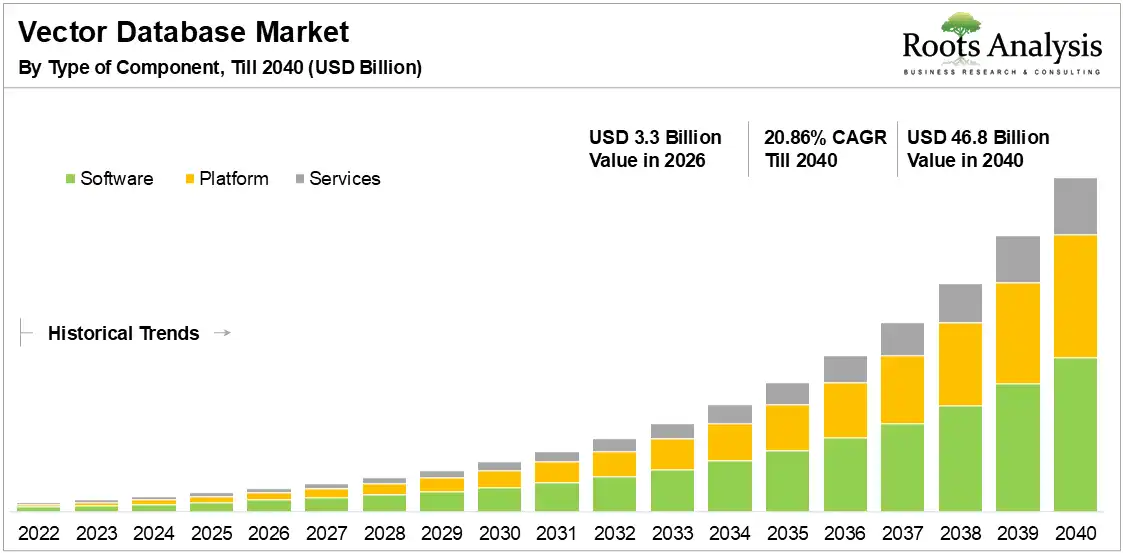
The global vector database market reached USD 3.3 billion in 2026 and will grow to USD 46.8 billion by 2040, registering a CAGR of 20.86% over the forecast period 2026 to 2040, driven by enterprise-scale deployment of generative AI, retrieval-augmented generation, and AI agent architectures.
See What’s in the Full Report – Request Your Complimentary Insights!
Market Report: Key Takeaways
- Based on deployment mode, cloud captures 68.0% market share in 2026, whereas hybrid registers a 24.5% CAGR through 2040, driven by enterprise governance requirements.
- On the basis of database type, pure vector databases capture 39.0% market share in 2026, whereas hybrid search databases register a 24.8% CAGR through 2040, driven by multimodal retrieval demand.
- Based on application, retrieval-augmented generation (RAG) is both the dominant and fastest-growing category, holding 28.0% share in 2026 and expanding at 26.2% CAGR through 2040, driven by enterprise generative AI adoption.
- With respect to end user industry, IT and Telecommunications captures 26.0% market share in 2026, whereas healthcare and life sciences registers a 24.0% CAGR through 2040, driven by precision AI workflows.
- Based on geographical regions, North America captures 42.0% market share in 2026, whereas Asia-Pacific registers a 24.1% CAGR through 2040, driven by sovereign AI infrastructure investments.
Vector Database Market Outlook
The vector database market has moved from niche infrastructure to a core AI retrieval layer. Early deployments focused on standalone similarity search, but buyers now want hybrid search, embedding orchestration, and RAG readiness in one stack. That shift has pushed Pinecone, Weaviate, Qdrant, pgvector, and MongoDB Atlas vector search into broader enterprise architecture reviews, where latency, governance, and integration depth matter as much as raw ANN performance.
Enterprise demand is rising because RAG, copilots, and AI agents all need fast access to proprietary text, image, and operational data. Cloud deployment also keeps expanding because it shortens rollout time and reduces infrastructure burden, while hybrid architectures gain traction in regulated sectors that need tighter data control. Qdrant expanded edge vector search and lightweight deployment optimization in May 2026, which shows how vendors now sell around deployment flexibility rather than storage alone.
Through 2040, the market will stay high-growth but gradually normalize as vector search becomes embedded inside broader data platforms. Pure-play vendors will keep winning performance-sensitive RAG workloads, yet database incumbents and hyperscalers will absorb more demand through bundled AI services, vector extensions, and managed search engines. MongoDB's Voyage AI acquisition in November 2025 reinforced that convergence. The outlook stays positive because enterprise AI roadmaps now need retrieval, memory, and semantic ranking.
Vector Database Market Size Estimation Methodology
- As a starting point, we anchored the baseline to hyperscaler capex disclosures from Microsoft, Amazon, Google, and Oracle, because vector database demand rises with cloud AI buildouts. We then matched those signals with vendor-reported adoption of RAG, semantic search, and AI agent memory use cases. That produced the initial 2022 to 2026 adoption curve for the Vector Database market across every major buying cycle.
- Moving forward, we adjusted growth using enterprise software release cadence, funding disclosures, and production deployment signals from vendors such as Pinecone, Weaviate, Qdrant, MongoDB, and Databricks. We treated March 2026 and April 2026 launch activity as evidence that buyers now expect production-grade RAG support, not experimental pilots. That reduced the risk of overstating demand from one-time hype.
- Building on this, we used open-source repository activity, extension adoption, and integration counts for pgvector, Chroma, Milvus, and OpenSearch to gauge lower-cost market expansion. We also tracked how often vector search appeared inside relational and NoSQL platforms, because that shows convergence pressure on standalone providers. Those signals informed the mix shift toward platform and hybrid search models.
- Drawing upon these, we cross-checked sector concentration against enterprise AI workload patterns in IT and telecommunications, healthcare and life sciences, and BFSI, because those buyers handle large unstructured data sets. We weighted regulated-industry deployment more heavily in hybrid and on-premises scenarios, since sovereignty and auditability slow pure cloud uptake. That approach shaped the regional and vertical splits.
- The projected value was then calibrated against long-range benchmark disclosures from other secondary sources and information shared by stakeholders during primary research. We rejected outlier estimates that implied either very low long-term adoption or unsustainably fast saturation. The final curve reflects convergence from standalone vector databases toward vector-native data infrastructure and long-term buyer willingness to pay.
- Finally, we stress-tested the forecast against the cadence of enterprise AI commercialization, including RAG, AI agent memory, and multimodal retrieval use cases. We also checked whether hyperscaler vector offerings and incumbent database bundles would compress standalone pricing over time. That step supported the 2040 market value and the slower CAGR profile after the early buildout phase in production budgets.
Vector Database Market Share Insights
Market Share by Type of Component
Based on our market analysis, the software segment holds 51% of the global market share in 2026. Software solutions dominate because enterprises initially prioritize vector indexing, embedding orchestration, and semantic retrieval capabilities. Most early deployments still begin with standalone vector database engines. In April 2025, Elastic expanded semantic search optimization inside Elasticsearch AI infrastructure services.
On the other hand, platform segment is likely to grow at a CAGR of 23.4% during the forecast period 2026-2040. Platform offerings will expand faster because enterprises increasingly demand integrated orchestration, observability, governance, and AI lifecycle management. Vendors now bundle vector search with inference orchestration and AI agents framework. In May 2025, Databricks introduced enhanced Mosaic AI capabilities supporting enterprise vector retrieval pipelines.
Market Share by Application
According to our market analysis, retrieval-augmented generation (RAG) dominates by holding 28% of the overall revenue share in 2026. Moreover, this segment will continue to grow at a higher CAGR of 26.2% through 2040. RAG dominates because enterprises require grounded AI outputs connected to internal knowledge repositories. Vector retrieval dramatically improves response accuracy and reduces hallucination risks. In July 2025, Gartner identified enterprise RAG optimization as a strategic AI infrastructure priority.
Notably, RAG will maintain the fastest growth because enterprises increasingly operationalize generative AI assistants across customer service, software development, and internal knowledge management. AI copilots require scalable semantic retrieval infrastructure. In June 2025, Microsoft expanded enterprise Copilot retrieval orchestration capabilities supporting grounded AI responses.
Want Information on Specific Region / Segment?
Regional Analysis: North America Leads the Market
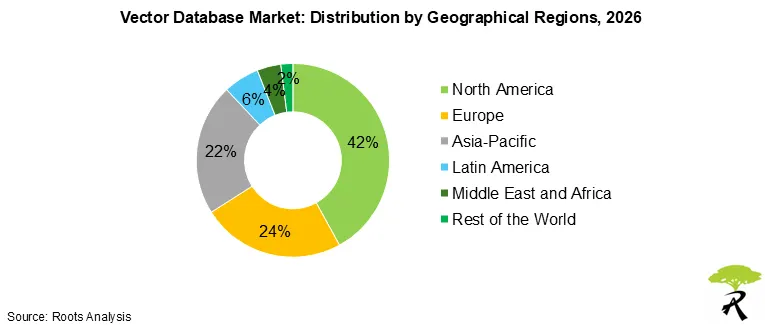
Based on our regional analysis, North America accounted for 42% market share in 2026.The region leads because hyperscale cloud infrastructure, enterprise AI spending, and advanced semiconductor ecosystems remain heavily concentrated in the United States. Large technology vendors also accelerate vector retrieval adoption through integrated generative AI platforms.In February 2025, OpenAI expanded enterprise infrastructure partnerships supporting large-scale AI retrieval workloads.
Meanwhile, Asia-Pacific will register a 24.1% CAGR through 2040. The region benefits from aggressive sovereign AI programs, expanding cloud infrastructure investments, and rapidly digitizing enterprise ecosystems. China, India, Singapore, Japan, and South Korea continue scaling multilingual AI deployment capabilities. In March 2025, Alibaba Cloud expanded AI infrastructure and vector retrieval capabilities for enterprise customers across Asia.
Market Ecosystem Analysis
Vector Database Market Competitive Landscape
The Vector Database Market has shifted from a niche infrastructure segment into a core AI application layer, driven by retrieval-augmented generation, agentic AI, and enterprise semantic search deployments. The competitive structure increasingly reflects platform convergence, where hyperscalers, database incumbents, and specialized vector-native vendors compete through integrated AI infrastructure stacks instead of standalone similarity search engines.
The primary commercial force reshaping competition is enterprise demand for scalable, low-latency AI retrieval systems that integrate directly with foundation model ecosystems and cloud-native developer workflows. This dynamic accelerated consolidation between vector search, analytics, storage, and orchestration capabilities across cloud and database platforms during 2025 and 2026.
Top Companies and Their Key Initiatives
Large cloud vendors increasingly position vector databases as embedded infrastructure inside broader AI application ecosystems rather than standalone products.
- Amazon Web Services expanded enterprise AI retrieval capabilities in March 2025 by integrating Amazon OpenSearch managed clusters into Amazon Bedrock Knowledge Bases for vector storage. The move strengthened AWS’s vertically integrated RAG stack and reduced enterprise dependence on third-party vector database providers.
- Microsoft Azure AI Search and Google Vertex AI Vector Search continued embedding vector indexing directly into enterprise AI development platforms during 2025 and 2026. This convergence increased customer preference for unified AI orchestration environments instead of standalone vector tooling.
Vector-Native Specialists Scaling Enterprise Retrieval Infrastructure for Agentic AI
Dedicated vector database vendors increasingly differentiate through retrieval performance, scalability, and AI agent optimization.
- Pinecone Systems introduced its next-generation serverless vector database architecture in February 2025 to support broader AI application workloads, including recommendation engines and autonomous agents. The upgrade improved operational flexibility while reinforcing Pinecone’s positioning as enterprise-grade retrieval infrastructure. In May 2026, Pinecone Systems launched “Nexus,” a knowledge engine targeting AI agents and large-scale retrieval orchestration. The company emphasized growing enterprise demand for persistent AI memory systems supporting millions of isolated contexts and production-grade semantic retrieval.
- Qdrant Solutions, Weaviate B.V., and Zilliz continued competing through open-source ecosystems, hybrid search performance, and cloud-native deployment models during 2025 and 2026. Their strategies increasingly targeted developers building retrieval-heavy generative AI applications requiring lower infrastructure complexity.
Startup and Emerging Company Highlights
The vector database market is rapidly maturing, with startups moving beyond basic vector storage to build full AI retrieval stacks. Pinecone and Zilliz lead in enterprise adoption, collectively serving thousands of production AI deployments, while Weaviate and Qdrant are gaining ground among developers building RAG-based applications. Chroma has become the go-to choice for early-stage LLM prototyping due to its lightweight, open-source design. The critical competitive shift in 2025 is that standalone vector databases are no longer sufficient, startups integrating hybrid search, knowledge graphs (GraphRAG), and real-time filtering are attracting the most investment and enterprise interest.
Vector Database Market Trends
- RAG Workloads are Pulling Vector Databases into Core AI Platform Spend: RAG has become the commercial anchor because enterprises need grounded answers from private content, not generic model output. Gartner highlighted RAG optimization as a strategic AI infrastructure priority in July 2025, and Microsoft expanded Copilot tuning in June 2025 to support grounded responses. The implication is simple, vendors that optimize retrieval quality will win more budget than vendors that only sell storage.
- Hybrid Search Convergence is Raising Switching Costs and Shifting Deals Toward Broader Data Platforms: Hybrid search has moved from a feature request to a buying requirement because keyword and vector retrieval solve different parts of the same query. Enterprise buyers increasingly evaluated hybrid architectures in September 2025, and that preference lifts hybrid search databases to the fastest-growing type through 2040. The implication is that pure vector vendors must add structured filtering or lose deal share.
- Platform Bundling by Incumbents is Compressing Pure-Play Margins: Platform economics now matter more than database micro-optimizations because buyers want one contract for data, retrieval, orchestration, and governance. Databricks expanded Mosaic AI capabilities in May 2025, and Elastic expanded semantic search optimization in April 2025. The implication is that vendors without platform breadth must defend on performance, open-source gravity, or developer experience.
Your Business is Unique – Why Shouldn’t Your Report Be?
Market Access Considerations
Cloud Marketplace Reach and Hyperscaler Certification
Cloud access determines whether a vector database can land inside enterprise AI budgets quickly. AWS, Azure, and Google Cloud already package vector search inside broader AI services, so vendors that integrate cleanly into those procurement paths shorten sales cycles. Qdrant, Pinecone, and Weaviate benefit when buyers can test them inside existing cloud accounts, while vendors outside those ecosystems face slower commercialization and weaker competitive positioning. That favors vendors that pass security and vendor-review gates quickly.
Data Residency and Hybrid Control Requirements
Data residency shapes access because many embeddings contain regulated or proprietary content that buyers refuse to move into public cloud-only environments. That is why hybrid and on-premises deployments still matter in healthcare, BFSI, and defense. Singapore's sovereign AI infrastructure push in 2025 shows the market behavior clearly, vendors that support local control, auditability, and split-plane architectures win more regulated deployments and scale faster. That also raises implementation cost and slows initial rollout.
Integration with Existing Databases and Extensions
Compatibility with PostgreSQL, MongoDB, and elastic search stacks lowers entry barriers because most buyers will not rebuild their data estate for vector search. Atlas Vector Search and Elastic Search Labs win attention because they attach to familiar operational workflows. Vendors that force a rip-and-replace motion slow adoption, while extension-friendly products enter the market faster and displace fewer incumbent systems at launch. That also protects incumbent share in the short term.
Enterprise Governance, Security Review, and Procurement Friction
Security review is a real access barrier because vector platforms touch private documents, code, and customer records. Large enterprises demand access controls, logging, and retrieval guardrails before production rollout, which favors vendors with strong compliance posture and reference deployments. That is why platform vendors and incumbents often win against smaller specialists when the buying committee values procurement certainty over raw retrieval performance and lower implementation risk. That matters most in regulated procurement cycles.
How Stakeholders Benefit from the Key Focus Areas of Our Vector Database Market Report
The Vector Database market matters now because enterprise AI programs have moved from pilots to production retrieval layers. RAG, copilots, and AI agents all need governed access to private content, which makes vector infrastructure a budget item for strategy, capital allocation, and platform architecture.
- Unmet Needs and Market Gaps in Vector Database Market: The report pinpoints where product gaps still block adoption, especially around hybrid retrieval, edge deployment, and enterprise governance. Commercial teams can use that to identify which unmet needs still justify switching from incumbent databases or cloud search services. It also helps solution owners decide whether to compete on latency, integration depth, or deployment flexibility. That makes it useful for prioritizing roadmap work before competitors close the same gap.
- Funding and Venture Investment Opportunities in Vector Database Market: The report maps funding and venture activity around specialist vector platforms, which matters to capital allocators tracking whether pure-play vendors can keep financing product expansion. It helps them separate durable infrastructure bets from crowded feature layers. That supports decisions on where to back category leaders, which adjacencies deserve follow-on capital, and when consolidation risk changes valuation. It also shows when acquisition becomes more likely than independent scale-up.
- Technology Innovation and Adoption Trends: The report tracks technology innovation and adoption trends across RAG, AI memory, hybrid search, and ANN indexing. Platform architects can use that view to decide whether to build pure vector databases, vector-enabled relational systems, or bundled AI platforms. It also clarifies which technical features buyers now expect in production, not just in demos. That reduces the risk of overbuilding features the market has already commoditized.
- Vector Database Market Competitive Landscape and Industry Analysis: The report breaks down the competitive landscape and industry analysis by vendor tier, deployment model, and database type. Strategy teams can use that to see which incumbents are absorbing share and which specialists still own differentiated workloads. That directly supports partner selection, channel prioritization, and competitive response planning. It also helps identify where pricing pressure will hit first.
- Mapping Strategic Partnerships and Ecosystem Synergies: The report maps strategic partnerships and ecosystem synergies across cloud providers, database incumbents, and AI application layers. Business development teams can use that to identify where distribution, co-selling, or integration partnerships create faster access to enterprise accounts. It also shows which alliances strengthen buyer trust and which merely add to noise. That matters when the shortest path to revenue depends on someone else’s installed base.
- Vector Database Market CAGR and Growth Trends: The report quantifies CAGR and growth trends through 2040, with segment-level differences that matter for investment and operating plans. Commercial leaders can use those growth curves to choose between cloud, hybrid, platform, and pure-play positions. It also helps assess where to commit resources now and where price pressure will likely erode returns. That makes the forecast directly actionable for budget and hiring decisions.
Vector Database Market: Scope of the Report
| Key Report Attributes | Details | |
| Forecast Period | Till 2040 | |
| Market Size 2026 | USD 3.3 Billion | |
| Market Size 2040 | USD 46.8 Billion | |
| CAGR (Till 2040) | 20.86% | |
| Segments Covered |
|
|
| Geographical Regions Covered |
|
|
| Key Sections Covered |
|
|
Source: Roots Analysis
Market Segmentation
The vector database market report presents an in-depth analysis, highlighting the capabilities of various stakeholders, based on different segments such, component, deployment model, database, application, enterprise size, end user industry, geographical regions, and leading players.
Component
- Software
- Platform
- Services
Deployment Mode
- Cloud
- On-Premises
- Hybrid
Database Type
- Pure Vector Databases
- Vector-Enabled Relational Databases
- Vector-Enabled NoSQL Databases
- Graph Databases with Vector Search
- Hybrid Search Databases
Application
- Semantic Search
- Recommendation Engines
- Retrieval-Augmented Generation (RAG)
- Fraud Detection
- Image and Video Search
- Conversational AI
- Personalization Systems
- AI Agent Memory
Enterprise Size
- Large Enterprises
- Small and Medium-Sized Enterprises (SMEs)
End User Industry
- BFSI
- Healthcare and Life Sciences
- Retail and E-commerce
- IT and Telecommunications
- Media and Entertainment
- Manufacturing
- Automotive
- Government and Defense
- Others
By Geographical Regions
- North America
- US
- Canada
- Mexico
- Rest of North America
- Europe
- Austria
- Belgium
- Denmark
- France
- Germany
- Ireland
- Italy
- Netherlands
- Norway
- Russia
- Spain
- Sweden
- Switzerland
- UK
- Rest of Europe
- Asia-Pacific
- Australia
- China
- India
- Japan
- New-Zealand
- Singapore
- South Korea
- Rest of Asia-Pacific
- Latin America
- Argentina
- Brazil
- Chile
- Colombia
- Venezuela
- Rest of Latin America
- Middle East and North Africa (MENA)
- Egypt
- Iran
- Iraq
- Israel
- Kuwait
- Saudi Arabia
- UAE
- Rest of MENA
- Rest of the World


