


 Download Free Sample
 Buy Now
Vehicle to Grid Market Overview
The global vehicle to grid market size is expected to rise from USD 4.28 billion in 2025 to USD 15.06 billion by 2030, and USD 34.84 billion by 2035, representing an overall CAGR of 23.32% till 2035.
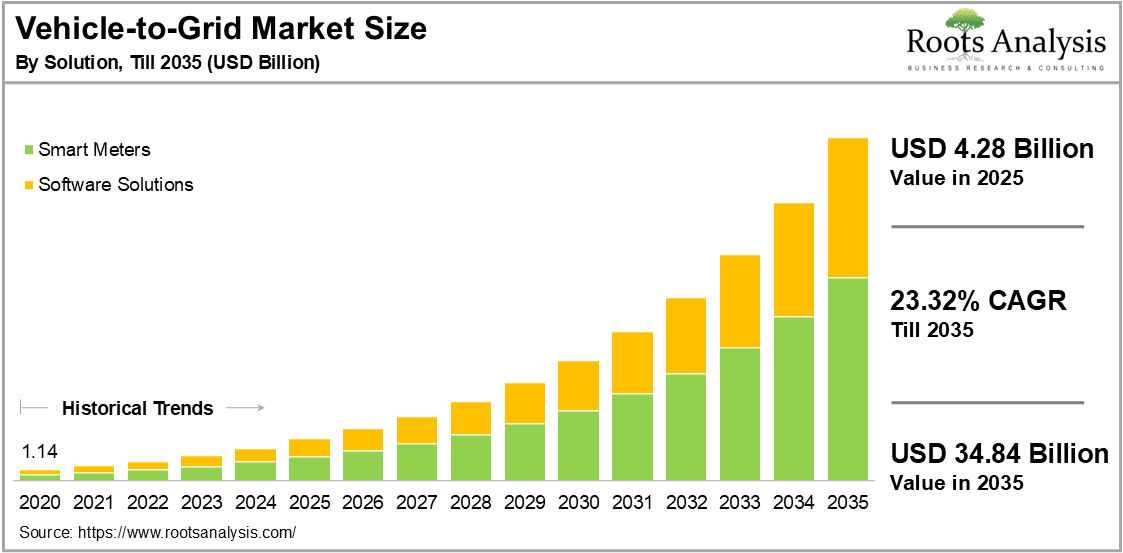 |
See What’s in the Full Report - Request Your Complimentary Insights!
Vehicle-to-grid (V2G) technology is an innovative system that enables electric vehicles (EVs) to not only draw power from the grid for charging but also send unused electricity stored in their batteries back to the grid when needed.
This bidirectional flow transforms electric vehicles into mobile energy storage units, helping to balance grid supply and demand, especially during peak hours or fluctuations in renewable energy generation.
As the world accelerates toward electric mobility, V2G is emerging as a crucial bridge between transportation and energy sectors. Unlike traditional energy storage, V2G leverages the vast, distributed network of parked EVs, vehicles that are idle most of the time, to provide grid services, such as frequency regulation and emergency backup.
Industry stakeholders are increasingly recognizing the potential of V2G to support renewable energy integration and grid resilience. For instance, Thomas Raffeiner, CEO of The Mobility House, states that the intelligent integration of electric vehicles into the energy system is key to a sustainable and economical mobility future. Together with Mercedes-Benz, they are bringing Vehicle-to-Grid technology from vision to reality, a way to realize emission-free and cost-efficient electromobility.
Recent Developments in the Vehicle-to-Grid Market
- In June 2025, Nissan launched next generation Leaf- the third generation of their EVs, with more range (up to 600kms on some models), a new plug, and V2L. Its vehicle-to-home compatible in Japan and vehicle to grid compatible, initially only in Europe.
- In May 2025, Mercedes and The Mobility House partnered to launch V2G charging at home.
- In April 2025, Essential Energy launched market-ready V2G charging technology in Australia, unlocking the potential for customers to get more value out of their renewable energy investments.
- In April 2025, China announced its plant to launch grid-connected car projects to balance power supply.
- In April 2025, Energy Island Power, a German startup, launched bidirectional charging kit for EVs.
- In March 2025, Nuvve, a global leader in grid modernization and V2G technology, announced the launch of its new company in Japan, NUVVE Japan.
Vehicle-to-Grid Market Segmentation Insights
The vehicle-to-grid market report 2025 presents an in-depth analysis of the various companies that are involved in offering vehicle-to-grid solutions, across different segments, as defined in the table below:
Vehicle-to-Grid Market: Report Attributes / Market Segmentations
| Key Report Attributes | Details | |
| Historical Trend | Since 2020 | |
| Forecast Period | Till 2035 | |
| Market Size in 2025 | $ 4.28 Billion | |
| Market Size in 2035 | $ 34.8 Billion | |
| CAGR (Till 2035) | 23.32% | |
| Component |
|
|
| Solution |
|
|
| Service |
|
|
| Charger |
|
|
| Vehicle Type |
|
|
| Technology |
|
|
| Area of Application |
|
|
| Geographical Regions |
|
|
| Leading Market Players |
|
|
| PowerPoint Presentation (Complimentary) | Available | |
| Customization Scope | 15% Free Customization | |
| Excel Data Packs (Complimentary) |
|
|
Text: Want Information on Specific Region / Segment?
Vehicle-to-Grid Market Share Insights
Which Component Will Dominate the Vehicle-to-Grid Market?
Among the components, the hardware sub-segment is set to take the lead, holding a significant share of 67.78%. This dominance is driven by the essential role hardware plays in physically enabling the two-way flow of electricity between electric vehicles and the grid, as well as the significant investments required for large-scale deployment of charging infrastructure.
As V2G adoption accelerates, the need for robust, reliable, and widely available hardware solutions will keep this segment at the forefront of market share. However, the software sub-segment will witness the fastest vehicle-to-grid market CAGR (24.78%) during the forecast period.
How is the Smart Meters Sub-Segment Dominating the Market?
According to our vehicle-to-grid market analysis, the smart meters sub-segment stands out as the leading one, holding a market share of 67%. This dominance is primarily due to their widespread deployment and essential role in enabling real-time energy monitoring, accurate billing, and seamless integration between EVs and the grid.
Meanwhile, the V2G software solutions sub-segment is expected to witness the fastest CAGR (24.45%) during the forecast period.
Which Service Will have the Fastest CAGR?
Among the vehicle-to-grid applications, the arbitrage sub-segment is set to witness the fastest CAGR (25.89%). This rapid growth is driven by the increasing sophistication of energy trading platforms and dynamic electricity pricing models, which create lucrative opportunities for EV owners and aggregators to maximize revenue by leveraging price fluctuations in real time.
The frequency response & reserve subsegment, on the other hand, will hold the largest market share of 40% during the forecast period.
Which Charger Will Dominate the Vehicle to Grid Technology Market?
Among the charger type, the AC chargers’ sub-segment is set to hold the largest revenue share of 69% within the current vehicle-to-grid market size.
Their growth is largely due to their widespread deployment in both residential and public charging infrastructure. AC chargers hold the largest share of the global EV charging infrastructure, reflecting their established presence and compatibility with most electric vehicles and existing grid systems.
Which Vehicle Type Will Dominate the Vehicle-to-Grid Market?
The battery electric vehicles (BEV) sub-segment is set to hold the largest revenue share of 36% within the current vehicle-to-grid market size.
Their dominance is attributed to their larger battery capacities, which provide substantial energy storage for EVs and enable efficient two-way energy exchange with the grid. The rapid adoption of BEVs, supported by advancements in battery technology, government incentives, and growing environmental awareness, further cements their leadership in the V2G sector.
Which Technology Will Dominate the Vehicle-to-Grid Market?
Based on the technology type, the bidirectional charging is set to hold the largest revenue share of 78% as well as the fastest CAGR (24.78%) during the forecast period.
This technology enables electric vehicles not only to draw power from the grid but also to return stored energy back to the grid, supporting grid stability, load balancing, and the integration of renewable energy sources. As the need for flexible, resilient grid services grows and the adoption of electric vehicles accelerates, bidirectional charging market is expected to remain at the forefront of V2G applications.
Which Area of Application Will Dominate the Vehicle-to-Grid Market?
Among V2G applications, currently the commercial sub-segment is set to hold the maximum revenue share of 56%. This dominance is driven by large-scale fleet operators, public transportation systems, and commercial property owners who leverage V2G technology to optimize energy costs, generate additional revenue streams, and enhance grid stability.
Commercial applications benefit from the aggregation of multiple vehicles, which provides significant energy storage capacity and makes participation in grid services more attractive and economically viable.
Which Regions are Expected to See the Highest Vehicle-to-Grid Market Demand?
The Asian vehicle-to-grid market exhibits dominance by capturing 39.86% of the overall current market share along with having the fastest CAGR (24.87%). This growth is primarily fueled by the rapid adoption of electric vehicles in countries, like China, Japan, and South Korea, which collectively account for a significant share of global EV sales.
Governments in these countries have implemented strong policy support, including subsidies, infrastructure investments, and mandates for clean transportation, all of which have accelerated the deployment of V2G technologies.
Additionally, the region boasts robust investments in smart grid technology and renewable energy integration, making V2G solutions highly attractive for grid stability and energy management.
Have Questions? Let’s Get Them Answered.
Vehicle-to-Grid Market Key Takeaways
The “Vehicle-to-Grid Market: Industry Trends and Global Forecasts, Till 2035” report features an extensive study of the current market landscape, market size, and future opportunity within the global vehicle-to-grid market forecast period. Key takeaways of the market report are briefly discussed below.
Vehicle-to-Grid Market Drivers and Challenges
What are the Key Drivers for Growth in the Vehicle-to-Grid Market?
The vehicle-to-grid market is experiencing robust growth due to several key drivers. Here are some significant factors contributing to this expansion:
- Rapid Expansion of Electric Vehicle Fleets: The global surge in electric vehicle (EV) adoption, especially battery electric vehicles (BEVs), is a primary driver for the V2G market. As EVs become more prevalent, their large battery storage capacity offers significant potential to stabilize and support the grid, making V2G technology increasingly relevant and valuable for energy management.
- Government Policies and Incentives: Strong government support, including subsidies, regulatory mandates, and public-private partnerships, is accelerating V2G deployment. Countries, like the U.S., China, and Australia are investing in V2G infrastructure market and V2G pilot programs, to promote energy sustainability and grid resilience.
- Integration with Smart Grids and Renewable Energy: V2G for renewable energy enables seamless integration of renewable energy sources by providing grid flexibility and energy storage. This helps manage intermittent generation from solar and wind, supporting the transition to a cleaner, more sustainable energy system.
What Challenges Affect Vehicle-to-Grid Production and Supply?
The vehicle-to-grid market challenges are as follows:
- High Implementation and Infrastructure Costs: Developing and deploying V2G infrastructure, including advanced charging stations and electric vehicle grid integration solutions, requires significant capital investment. This can hinder adoption, especially for smaller utilities and consumers.
- Lack of Standardization and Regulatory Uncertainty: The absence of universally accepted standards for V2G communication, safety, and interoperability creates challenges for seamless integration and widespread deployment. V2G regulatory frameworks are still evolving, leading to uncertainty for market participants.
- Limited Public Awareness and Consumer Acceptance: Many consumers and businesses are unfamiliar with V2G technology and its benefits, which can slow adoption. Concerns about battery degradation and the complexity of V2G systems may also deter potential users.
What is the Impact of Electric Vehicle Adoption on V2G Market?
The rapid increase in electric vehicle (EV) adoption is a primary driver for the V2G market, as more EVs provide a larger pool of mobile energy storage that can interact with the grid, helping balance supply and demand, lower vehicle ownership costs, and support grid stability. This symbiotic relationship also encourages further investments in charging infrastructure and smart grid solutions.
What are the Advancements in Bidirectional Charging Technology?
Recent progress in bidirectional charging enables EVs to both draw power from and supply power back to the grid, making vehicles active participants in energy management and grid services. These advancements enhance grid flexibility, allow for better V2G for renewable energy integration, and open up new revenue streams for EV owners through energy trading and grid support.
What are the Challenges in V2G Infrastructure and Standardization?
V2G adoption faces hurdles, such as the need for widespread, reliable bidirectional charging infrastructure, concerns about battery degradation, and a lack of uniform technical standards across regions and manufacturers. These challenges can slow market growth and complicate large-scale integration with existing grid systems.
How is the Vehicle-to-Grid Market Growth Driven by Smart Grid Initiatives?
Smart grid initiatives are fueling V2G market expansion by enabling real-time communication, demand response, and efficient energy distribution, making it easier to integrate EVs as distributed energy resources. These initiatives also support the deployment of advanced charging infrastructure and energy management systems that are crucial for V2G success.
What are the Government Incentives for Vehicle-to-Grid Deployment?
Government incentives, such as subsidies, tax rebates, and supportive regulations, play a vital role in accelerating V2G adoption by reducing costs and encouraging investment in infrastructure and technology. These policies also promote the integration of renewable energy and smart grid solutions, further driving market growth.
Your Business is Unique – Why Shouldn’t Your Report Be?
Vehicle-to-Grid Market Report Coverage
The market report presents a guide to understanding different types of vehicle-to-grid and their applications, highlighting the capabilities of various companies engaged in this domain, across different segments. Amongst other elements, the market report includes:
- An Infographic Executive Summary
- Market Landscape of Leading Players
- Company Competitiveness Analysis
- Startup Ecosystem Analysis
- Value Chain Analysis
- Company Profiles
- Key Winning Strategies
- In-depth View of Recent Developments
- Mega Trends
- Unmet Needs Analysis
- Patent Analysis
- Market Forecast and Opportunity Analysis
- Porter’s Five Forces Analysis
- SWOT Analysis


