Video Surveillance Market by Component (Cameras, Hardware, Software), Services (VSaaS, Installation, Maintenance, Consulting, Managed Services), Type of Government and Public Sector (Public Transportation, Law Enforcement, Municipal Surveillance), Pricing Model (Per Camera, Per System, Subscription-Based, Pay-Per-Use), Type of Data Storage, Type of User Interface, Company Size, End User, Business Model, Key Geographical Regions, and Key Players – Trends and Forecast 2026-2040
Market Size
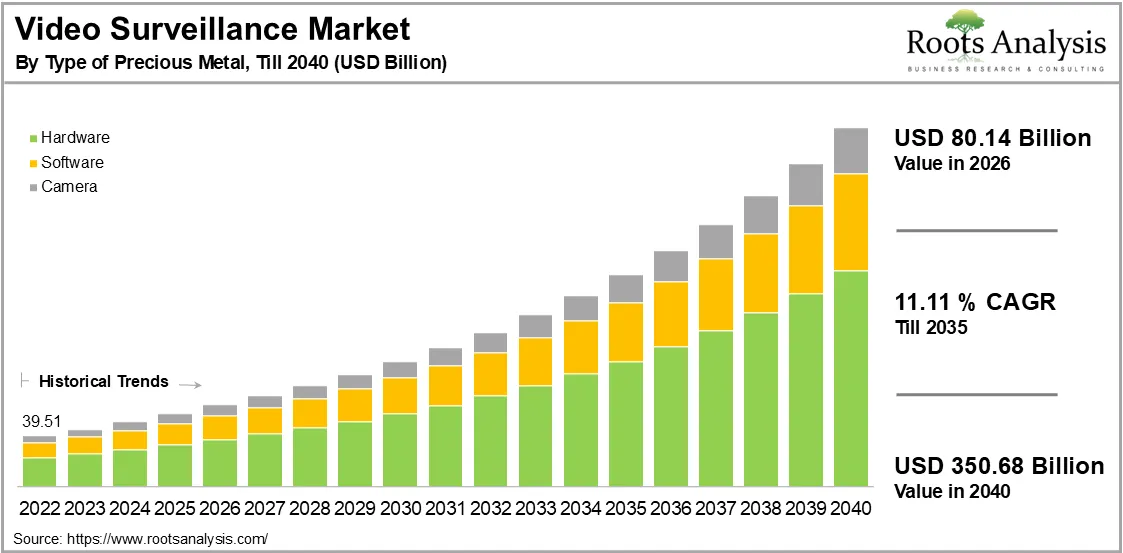
The global video surveillance market[, valued at USD 71.23 billion in 2025, is projected to reach USD 80.14 billion in 2026 and USD 350.68 billion by 2040, with a CAGR of 11.11% during the forecast period
See What’s in the Full Report - Request Your Complimentary Insights!
Market Report: Key Takeaways
- In terms of component, hardware holds largest share of revenue (58.76%) in the global market.
- In terms of leading region, Asia-Pacific dominates the global market (37% market share), while North America is poised to grow at a faster pace during the forecast period.
- Commercial sector currently dominates by capturing 41.24% share, while the infrastructure sector is growing at a relatively higher CAGR (12.67%) through 2040.
- Increasing advancements in AI-based analytics, cloud, and edge computing are propelling the market growth.
Market Overview
Video surveillance has changed the dynamics of the vigilance industry and has now become an integral part. It has been majorly helping to provide advanced security but at improved prices owing to the introduction of more advanced technology and artificial intelligence. The global video surveillance market is undergoing a transformative phase, driven by advancements in IP-based digital technologies aimed at detecting and preventing various undesirable behaviors such as shoplifting, theft, vandalism, and even terror attacks.
These technologies have been constantly gaining among industries including manufacturing, banking, financial services, transportation, and retail, fueling a huge demand and market growth of video surveillance systems for public safety and crime prevention. This widespread adoption is particularly evident in major economies like the United States, the United Kingdom, India, China, and Brazil, due to the presence of abundant large-scale industries and rising awareness.
The increased development and integration of video analytics and facial recognition in surveillance platforms have led to a pivotal contribution to CCTV market growth. The installation of security cameras has led to identification and deterrence of potential offenders, thereby contributing to a reduction in crime rates globally. The industry has been witnessing a surge in demand for integrated surveillance systems, further propelled by advancements in video surveillance as a service (VSaaS). Furthermore, the increasing demand for wireless and IP-based video surveillance cameras as well as the adoption of centralized data management solutions has paved the way for lucrative opportunities, fueling the surveillance camera market.
Looking ahead in the video surveillance market report, the industry is poised for substantial growth, with projections indicating significant market expansion. This growth trajectory reflects ongoing technological innovations and increasing adoption across sectors globally. Advanced surveillance systems, characterized by ease of installation, maintenance, and superior video quality, are expected to drive further market penetration, supported by the exponential growth of digital data and the need for efficient data management solutions.
Recent Developments
- In September 2025, Nikon released the ZR, a full-frame sensor camera from the “Z CINEMA” series born from synergy with RED.
- In August 2025, RVNL bagged a contract of INR 91 crore from southern railway to install video surveillance systems at 441 D and E category stations, and upgrade systems at 43 A1 to C category stations, making it a total of 484 stations.
- In August 2025, Transline Technologies, a video surveillance and biometric solutions provider, filed for an IPO to raise funds via initial public offering.
- In April 2025, Fez launched an ambitious $14 million video surveillance expansion project to level up urban security infrastructure, ahead of upcoming AFCON and the 2030 FIFA World Cup.
Pay Only for What You Need – The Best Way to Optimize
Market Share Insights
Market Share by Type of Component
The hardware segment is dominating the video surveillance industry with a market share of 58.76% within the current global year. The growth is due to the requirement of physical equipment, such as cameras, storage (NVR / DVR), and monitors, for every deployment. This together accounts for the largest share of system spending worldwide.
Demand is especially strong in the IP video surveillance market, AI enabled edge devices, and large capacity storage, driven by smart city programs, infrastructure expansion, and stricter security requirements across commercial, residential, and public sector.
Market Share by End User
The commercial sector dominates the video surveillance market, generating the largest revenue share of 41.24%. This dominance is due to widespread adoption in retail stores, corporate offices, banking, hospitality, and warehouses. These commercial spaces use video surveillance systems for theft deterrence, fraud prevention, customer behaviour analysis, and improving staff and visitor safety.
The infrastructure sector is experiencing the fastest CAGR (12.67%) during the forecasted period. This rapid growth is driven by substantial adoption of video surveillance in smart city infrastructure, transportation networks, and investments. Expanding urbanization and public safety initiatives further fuel demand in infrastructure applications.
Video Surveillance Market Forecast: Asia-Pacific to Lead the Regional Segment
The Asia-Pacific region currently dominates the video surveillance market, accounting for the largest revenue share of 37% within the current global year. This dominance is fueled by strong demand in major countries like China, Japan, and India, driven by rapid urbanization, infrastructure development, and government initiatives promoting public safety and security. The region's focus on smart city projects and expanding retail and business sectors contributes heavily to market growth.
Meanwhile, North America, led by the United States, is a key market characterized by early adoption of advanced technologies such as AI-powered analytics and cloud-based surveillance, supported by strong government investments and regulatory support.
Want Information on Specific Region / Segment?
Market Dynamics
Market Key Drivers
- Rising Need for Security Across Public, Commercial, and Industrial Sectors: Growing concerns about theft, vandalism, terrorism, and workplace safety are prompting increased adoption of video surveillance systems.
- Advancements in AI-based Analytics, Cloud, and Edge Computing: Modern video surveillance leverages artificial intelligence for real-time threat detection, facial recognition surveillance, anomaly detection, and automated alerts. The integration of cloud and edge computing enables scalable remote access and powerful analytics capabilities, improving efficiency and responsiveness, further fueling the cloud video surveillance market.
- Government Initiatives and Regulatory Mandates: Governments worldwide are enforcing mandatory surveillance requirements and investing in smart city projects, public safety, and traffic management. These initiatives accelerate the adoption of video monitoring technologies, ensuring broader deployment and enhanced security and safety video solutions globally.
Market Challenges
- Managing Large Volumes of Video Data: Handling massive video streams demands robust infrastructure capable of efficient storage, fast retrieval, and thorough analysis. This includes advanced compression techniques and sound data governance strategies to ensure video data is stored securely and accessible when needed.
- Adapting to Evolving Legal, Ethical, and Regulatory Demands: With constant changes in regulations, surveillance systems must be designed to be flexible and comply with diverse legal requirements. This is particularly important for multinational deployments, which must consider varying privacy laws and ethical standards.
- Ensuring Interoperability Across Vendors and Technologies: The video surveillance market features a fragmented ecosystem with many proprietary systems, which can obstruct integration, scalability, and future upgrades. Achieving interoperability is essential to create seamless, scalable surveillance solutions that can evolve as technology advances.
Key Market Insights
Competitive Landscape of Service Providers
The video surveillance market is intensely competitive and rapidly evolving, led by major players such as Hangzhou Hikvision, Dahua Technology, and Honeywell International, who hold strong market positions backed by extensive portfolios and global reach. These established players benefit from broad customer bases across diverse sectors including commercial, industrial, and public safety.
The market is also characterized by continuous innovation, driven by advancements in AI, cloud, and edge computing, enabling smarter and more integrated surveillance solutions, such as remote video monitoring systems. Despite consolidation among top firms, ample opportunities remain for niche players and startups, thanks to increasing security demands and evolving technology needs worldwide. This dynamic competition fosters ongoing product development and market expansion, especially in emerging regions where security infrastructure is rapidly growing.
Market Trends in Cloud-Based and AI-Powered Video Surveillance Solutions
- Cloud-based video surveillance is becoming the standard architecture for enterprises with multiple sites, offering scalability, remote accessibility, and centralized management.
- AI adoption in video surveillance is accelerating, with advanced analytics like real-time threat detection, facial recognition solutions, and automated alerts becoming common.
- Hybrid models combining edge storage and cloud analytics optimize bandwidth and retention costs while enabling always-on AI capabilities.
- Regulatory compliance pressures, such as NDAA/FCC mandates, drive demand for secure, camera-agnostic, and auditable surveillance platforms.
Regulatory Compliance for Video Surveillance Data Privacy and Storage
Regulatory demands are evolving rapidly, requiring surveillance systems to adhere to stringent data privacy and video storage rules globally. Privacy regulations in video surveillance often involve integration with access control systems, maintaining audit trails, and ensuring secure data governance policies to prevent misuse of video footage. Organizations deploying surveillance must design flexible and compliant architectures that can adapt to regional legal variations, especially in multinational contexts.
This is critical to balance public safety benefits with individual privacy rights, so systems incorporate role-based AI controls and transparency mechanisms to meet legal standards. Government mandates also emphasize data retention limits and secure deletion practices, necessitating integrated compliance workflows within surveillance solutions.
Innovations in 4K and High-Resolution Video Surveillance Technologies
The video surveillance industry is witnessing significant advancements in 4K and ultra-high-resolution camera technologies, offering enhanced image clarity and detail compared to legacy systems. These improved resolutions enable more accurate facial recognition, license plate reading, and object detection, especially in challenging lighting conditions. Innovations also focus on integrating smart compression algorithms to manage video storage and archiving, along with bandwidth requirements despite higher data volumes.
Furthermore, these technologies support better zoom capabilities without sacrificing image quality, making them highly effective for critical infrastructure and public safety use cases. Manufacturers continue to push the limits with HDR imaging, wider dynamic ranges, and multi-sensor fusion to deliver superior situational awareness.
Market Segmentation
Video Surveillance Market: Scope of Report
| Key Report Attributes | Details | |
| Historical Trend | 2022-2025 | |
| Forecast Period | 2026-2040 | |
| Market Size Value 2026 | $ 80.14 Billion | |
| Market Size Value 2040 | $ 350.68 Billion | |
| CAGR (Till 2040) | 11.11% | |
| Segments Covered |
|
|
| Leading Market Players |
|
|
| PowerPoint Presentation (Complimentary) | Available | |
| Customization Scope | 15% Free Customization | |
| Excel Data Packs (Complimentary) |
|
|
Market Segments
Based on the research, we have segmented the video surveillance market into components, services, type of government and public sector, pricing model, type of data storage, type of user interface, company size, end user, business model, geographical regions, and leading players.
By Component
- Cameras
- Analog
- IP
- Thermal
- PTZ (Pan-Tilt-Zoom)
- Hardware
- Recorders
- Encoders
- Storage Devices
- Monitors
- Software
- Video Management Software (VMS)
- Video Analytics
By Services
- VSaaS
- Installation
- Maintenance
- Consulting
- Management Services
By Type of Government and Public Sector
- Public Transportation
- Law Enforcement
- Municipal Surveillance
By Pricing Model
- Per Camera
- Per System
- Subscription-Based
- Pay-Per-Use
By Type of Data Storage
- Local Storage
- Cloud Storage
- Hybrid Storage
By Type of User Interface
- Web-Based Interface
- Mobile App
- Desktop Application
By Company Size
- Small and Medium-sized Enterprises (SMEs)
- Large Enterprises
By End User
- Commercial
- Retail
- Banking and Finance
- Hospitality
- Corporate Offices
- Residential
- Homes
- Apartments
- Gated Communities
- Industrial
- Manufacturing Facilities
- Warehouses
- Construction Sites
By Business Model
- B2B
- B2C
- B2B2C
By Geographical Regions
- North America
- US
- Canada
- Mexico
- Rest of North America
- Europe
- Austria
- Belgium
- Denmark
- France
- Germany
- Ireland
- Italy
- Netherlands
- Norway
- Russia
- Spain
- Sweden
- Switzerland
- UK
- Rest of Europe
- Asia-Pacific
- Australia
- China
- India
- Japan
- New-Zealand
- Singapore
- South Korea
- Rest of Asia-Pacific
- Latin America
- Brazil
- Chile
- Colombia
- Venezuela
- Rest of Latin America
- Middle East and Africa (MEA)
- Egypt
- Iran
- Iraq
- Israel
- Kuwait
- Saudi Arabia
- UAE
- Rest of MEA
Have Questions? Let’s Get Them Answered.


