Voice Assistant Application Market
Voice Assistant Application Market, Till 2035: Distribution by Type of Component (Solutions and Services), Type of Deployment (Cloud and On-premises), End-User (BFSI, Healthcare, Manufacturing, Media and Entertainment, Retail, Telecom and IT and Others), Type of Enterprise (Large and Small and Medium Enterprise) and Geographical Regions (North America, Europe, Asia, Latin America, and Middle East and North Africa and Rest of the World): Industry Trends and Global Forecasts
-
Lowest Price Guaranteed
-
Slides
188 -
Last Updated
October 2026 -
View Count
13388 -
Voice Assistant Application Market Overview
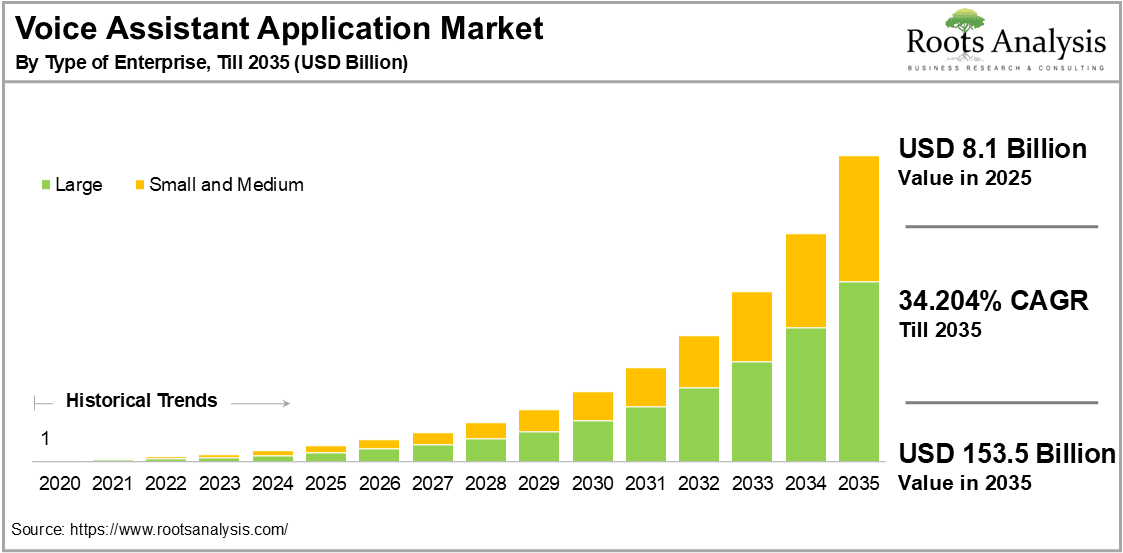
The voice assistant application market size is projected to grow from USD 8.1 billion in 2025 to USD 153.5 billion by 2035, representing a CAGR of 34.2%, during the forecast period till 2035.
To learn more about this report, request a free sample copy
The new research study consists of industry analysis, detailed voice assistant application market analysis, mega trends, patent analysis, porter five forces, SWOT analysis, value chain analysis and other strategic frameworks.
Globally, more than 20% of the population use voice search to find information on the internet. This signifies the groundbreaking fusion of voice assistant application and advanced technologies such as artificial intelligence. It is worth highlighting that voice assistant application poised to leverage advanced technologies, such as speech recognition and natural language processing, enabling users to setting reminders, and controlling smart home devices. Few of the major advantages of voice assistant application include the hands-free operation, and improved accessibility, benefiting various industries, such as healthcare, retail, banking, and telecommunications. Furthermore, as the demand for seamless integration with smart devices continues to rise, the market is poised for significant voice assistant technology advancements and innovations in the coming years. It is worth noting that utilization of technological tools in major industries is on surge due to rapid penetration of internet and rising awareness among masses.
The voice assistant application market is emerging as a critical component in the global shift towards innovation and digital transformation in internet search to reach higher operational efficiency and customer experience. Natural language processing (NLP) technologies have played a pivotal role in unlocking full voice assistant application market potential, which includes improved the accuracy and responsiveness of voice assistants. Additionally, the integration of voice assistants into a wide range of devices from smartphones to demand for voice assistants in smart homes has further fueled their popularity, allowing for seamless, hands-free interactions in daily tasks. Consequently, with continuous technological advancements and rising investors, the voice assistant application market is anticipated to witness noteworthy growth during this forecast period.
For instance, in October 2024, Google and Qualcomm announced a partnership to enhance in-car voice assistants and digital experiences using generative AI technologies. While, discussing about the partnerhsip Nakul Duggal, General Manager at Qualcomm mentioned it marks a crucial milestone in opening up new opportunities for automakers and tier-1 suppliers, enabling the industry to develop safe and digitally advanced experiences.
Voice Assistant Application Market Share Insights
The voice assistant application market research report presents an in-depth analysis of the various service providers that are involved in offering voice assistant application market, across different segments, as defined in the table below:
Voice Assistant Application Market: Report Attributes / Market Segmentations
| Key Report Attributes | Details | |
| Historical Trend | Since 2020 | |
| Forecast Period | Till 2035 | |
| Market Size Value in 2025 | $ 8.1 Billion | |
| Market Size Value by 2035 | $ 153.59 Billion | |
| CAGR (Till 2035) | 34.2% | |
| Type of Component |
|
|
| Type of Deployment |
|
|
| End-User |
|
|
| Type of Enterprise |
|
|
| Geographical Regions |
|
|
| Leading Market Players | ||
| PowerPoint Presentation (Complimentary) |
Available | |
| Customization Scope | 15% Free Customization | |
| Excel Data Packs (Complimentary) |
|
|
Voice Assistant Application Market Segmentation
Market Share by Type of Component
Based on the type of component, the global voice assistant application market is split into solutions and services. Among the categories, the solutions segment is expected to gain nearly 65% of the current market share. Further, this segment is expected to expand with a relatively higher (36.35%) CAGR till 2035. This can be attributed to several key factors, including the advancements in AI-driven customer interaction solutions and Natural Language Processing (NLP), which enhance interaction accuracy and user satisfaction.
Market Share by Type of Deployment
The global voice assistant application market is segmented into various types of deployment, such as cloud and on-premises. According to our analysis, the cloud-based voice assistant services segment will augment the segment's growth with the largest voice assistant application market share of around 60% by 2035. Further, this segment is expected to grow with the highest CAGR of 35.56% till 2035. This can be attributed to its scalability, cost-effectiveness, and efficiency in managing large data volumes. As businesses increasingly prefer flexible solutions that can grow with their needs, cloud systems offer easy updates and maintenance without the burden of extensive on-premises infrastructure.
Market Share by End-User
On the basis of the end-user, the voice assistant application market is bifurcated into BFSI, healthcare, media and entertainment, retail, telecom and IT and others. As per our research, the BFSI segment is projected to hold the majority of the market shares, nearly 40%, and will drive the segment growth until 2035. This can be attributed to its its focus on enhancing customer service, streamlining operations, and improving user engagement through personalized interactions. However, the healthcare segment is expected to grow with the highest CAGR of 37.7% in the forecasted period. This can be ascribed to their increasing reliance on technology to enhance customer engagement and operational efficiency.
Market Share by Type of Enterprise
Based on the types of enterprise, the global voice assistant application market is segmented into large and small and medium enterprise. According to our analysis, the large-scale voice assistant applications are leading the segment with the 65% market share and are expected to growth with the fastest CAGR in the forecasted period. This can be attributed to its capacity to invest in advanced voice assistant application technologies, benefit from substantial resources, increase economies of scale, and drive business growth.
Market Share by Geographical Regions
This segment highlights the distribution of voice assistant application across various geographical regions, such as North America, Europe, Asia, Latin America, Middle East and North Africa, and the rest of the world. According to our analysis, North America exhibits dominance in the market with the majority of the voice assistant application market share, nearly 35% in the global marketplace. However, Asia is expected to grow with the fastest CAGR. This can be attributed to a large, tech-savvy population that increasingly demands digital solutions, coupled with rapid smartphone adoption and increasing internet penetration, which create favorable conditions for voice assistant technology integration.
Voice Assistant Application Market Key Insights
The “Voice Assistant Application Market, Till-2035: Industry Trends and Global Forecasts” report features an extensive study of the current market landscape, market size and future opportunity within their voice assistant application market dynamics, during the given forecast period. The market report highlights the efforts of several stakeholders involved in this rapidly emerging segment of the service providers industry. Key takeaways of the voice assistant application report are briefly discussed below.
Key Drivers of Voice Assistant Application Market
The demand for AI in every industry is increasing, which will mark voice assistant application market to be a crucial innovation in technological advancement and digitalization. Key driving factors include technological advancements like AI and big data analytics, which enhance user experiences, and the integration of these assistants with IoT devices, promoting seamless automation. Additionally, Increased adoption of smart devices and a shift towards automation accelerated by the COVID-19 pandemic have further fueled demand. Recently, in October 2024, AI-powered voice assistant company Suki raised $70 million in funding to enhance product development and expand its offerings.
Voice Assistant Application Competitive Landscape
With the presence of several small and large voice assistant application companies, the market is experiencing intense competition and changing market dynamics. From large multinational companies to local voice assistant application players, companies are striving to enhance their competitive edge. In terms of market share, large enterprises and multinational companies are dominating the market. While small voice assistant application players are continuously improving their products to cater to niche markets, or they are offering specialized services. These industry players are focusing on adopting competitive strategies, such as developing innovative voice assistant application techniques, forming strategic alliances and partnerships to expand their portfolios and global footprint, investing in recent developments and new feature launches to enhance their voice assistant application offerings.
Market Challenges in Voice Assistant Application Market
Despite strong market growth projection, voice assistant application market faces numerous challenges in voice recognition technology, including difficulties in accurately recognizing customer intent and understanding diverse languages and dialects. Notably, lack awareness of the benefits of voice technology, particularly in developing regions, while concerns over data privacy and security further impact trust and adoption. Additionally, fluctuating policies and regulations can create an unpredictable environment for investors in voice assistant application, lack of education and high costs of setup can reduce voice assistant application adoption across regions. Addressing these mentioned challenges is essential for the expansion of market in the near future.
Regional Analysis: North America is Expected to Dominate the Market with the Largest Voice Assistant Application Market Share
With respect to regional voice assistant application market insights, North America is likely to dominate the market for voice assistant application with a 40% market share. Primarily, due to high digital literacy among its population, significant technological advancements, and a vibrant investment landscape. The region's voice assistant application growth is driven by the adoption of artificial intelligence, machine learning, and big data analytics, which enhance underwriting accuracy and personalized voice assistant offerings. Further, the presence of major tech companies like Amazon, Google, Microsoft, and Apple, further encourages innovation, fostering a culture that enables startups and established firms to thrive in this rapidly evolving sector.
Leading Companies in Voice Assistant Applications
Examples of key players involved in the voice assistant application market (which have also been captured in this market report, arranged in alphabetical order) include Apple, Avaya, AWS, Baidu, Cisco, Creative Virtual, Google, IBM, Microsoft, Nuance Communications, Oracle, Salesforce, Samsung, SAP, Verbio Technologies, and Verint. This market report includes an easily searchable excel database of all the companies who are in voice assistant application market.
Voice Assistant Application Market Report Coverage
The market report presents an in-depth analysis, highlighting the capabilities of various companies engaged in this domain, across different segments. Amongst other elements, the market report includes:
- A preface providing an introduction to the full report, voice assistant application market, since 2020-2024 (Historical Trends) and 2025-2035 (Forecasted Estimates).
- An outline of the systematic research methodology adopted to conduct the study on the voice assistant application market, providing insights on the various assumptions, methodologies, and quality control measures employed to ensure the accuracy and reliability of our findings.
- An overview of economic factors that impact the overall voice assistant application market, including historical voice assistant application market trends, currency fluctuation, foreign exchange impact, recession, and inflation measurement.
- An executive summary of the insights captured during our research. It offers a high-level view on the current state of the voice assistant application market and its likely evolution in the mid-long term.
- A detailed assessment of the voice assistant application market landscape, based on several relevant parameters, including year of experience, company size, location of headquarters, and ownership structure.
- Elaborate profiles of prominent players engaged in the voice assistant application market, featuring information on their year of establishment, location of headquarters, company size, company mission, company footprint, management team, contact details, financial information, operating business segments, voice assistant application portfolio, moat analysis, recent developments, and an informed future voice assistant application market outlook.
- A qualitative assessment of the various megatrends ongoing in the global voice assistant application industry, including integration of voice assistant with AI, rapid growth in machine learning applications and the emergence of natural language processing.
- An analysis highlighting the key unmet needs across global voice assistant application industry trends, featuring insights generated from real-time data on unmet needs as identified from social media posts, recent publications, industry blogs and the views of key opinion leaders expressed on online platforms.
- An in-depth analysis of various patents that have been filed / granted related to voice assistant application and its components, based on various parameters, such as type of patent, patent publication year, patent age and leading players
- A detailed analysis of recent developments in the voice assistant application domain, based on relevant parameters such as year of initiative, type of initiative (partnerships and collaborations, expansions, funding and product launches), geographical distribution and most active players (in terms of number of recent developments).
- Key winning strategies framework that helps in analyzing the level of voice assistant application market competition within an industry, by tracing the key market activities including partnership, funding, expansion of leading players
- A qualitative analysis, highlighting the five competitive forces prevalent in voice assistant application industry, including threats for new entrants, bargaining power of suppliers, bargaining power of customers, threats of substitution and rivalry among existing competitors.
- A discussion on affiliated global voice assistant application trends, key drivers and challenges, under a SWOT framework, which are likely to impact the industry’s evolution, along with a Harvey ball analysis, highlighting the relative effect of each SWOT parameter on the overall voice assistant application market.
- A value chain analysis featuring a discussion on various stakeholders involved in the development of the voice assistant application market, from suppliers to end-users.
- A detailed estimate of the current market size and the future growth potential of the voice assistant application market over the next decade. Based on multiple parameters we have provided an informed estimate on the market evolution during the forecast period 2025-2035. The report also features the likely distribution of the current and forecasted opportunity within the voice assistant application market. Further, in order to account for future uncertainties and to add robustness to our model, we have provided three forecast scenarios, namely conservative, base, and optimistic scenarios, representing different tracks of the industry’s growth.
- Detailed projections of the current and future market across various types of voice assistant application such as auto, business, health, home, specialty, travel and others .
- Detailed projections of the current and future market across various type of service such as consulting, support & maintenance and managed services.
- Detailed projections of the current and future market across various types of technology such as blockchain in voice assistant application, cloud computing, IoT, machine learning, robo advisory and others.
- Detailed projections of the current and future market across various end-user such as automotive, BFSI, government, healthcare, manufacturing, retail, transportation and others.
- Detailed projections of the current and future market across various types of enterprise such as large and small and medium enterprise.
- Detailed projections of the current and future voice assistant application market across various geographical regions, such as North America (US, Canada, Mexico and other North American countries), Europe (Austria, Belgium, Denmark, France, Germany, Ireland, Italy, Netherlands, Norway, Russia, Spain, Sweden, Switzerland, UK and other European countries), Asia (China, India, Japan, Singapore, South Korea and other Asian countries), Middle East and North Africa (Egypt, Iran, Iraq, Israel, Kuwait, Saudi Arabia, UAE and other MENA countries), Latin America (Brazil, Chile, Colombia, Venezuela and other Latin American countries) and rest of the world (Australia, New Zealand and other countries).
Recent Development Voice Assistant Application Market
- In September 2024, PolyAI announced a partnership with OpenTable to enhance reservation support for enterprise restaurants using voice AI technology. This collaboration aimed to help restaurants manage reservations over the phone, improve customer experience, and alleviate staffing challenges.
- In May 2024, Apple announced a partnership with OpenAI to enhance Siri's capabilities, marking a shift from its previous collaboration with Google. This collaboration aimed to leverage OpenAI's advanced AI algorithms, potentially allowing Siri to provide more natural and contextual responses.
- In May 2024, SoundHound announced a partnership with Perplexity to enhance its voice assistant, SoundHound Chat AI, by integrating advanced online large language model (LLM) capabilities.
Author: Ronit Sharma and Rishav Thakur
Customization Opportunities
At Roots Analysis, we genuinely care about your success and understand that your business requirements are unique. While our market research reports provide valuable insights, we recognize that they might not cover every aspect you need to make well-informed strategic decisions. To account for that, we offer 15% free report customization tailored to your specific needs. Whether you require additional quantitative analysis, qualitative insights, or any other information related to the voice assistant application market, reach out us today at: support@rootsanalysis.com