


 Download Free Sample
 Buy Now
Market Size
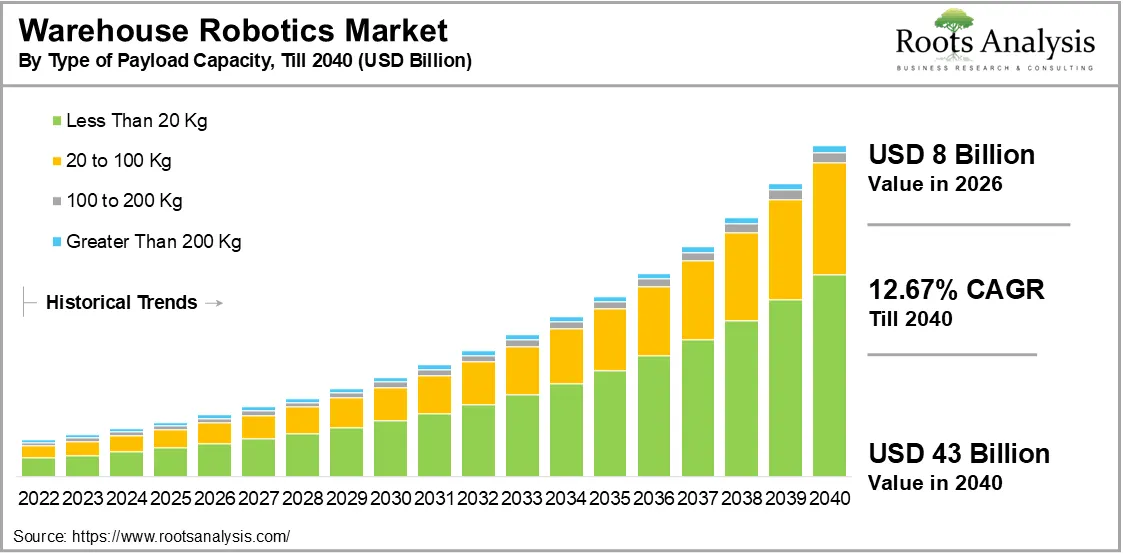
The global warehouse robotics market, valued at USD 8 billion in 2026, is projected to reach USD 26 billion in 2035 and USD 43 billion by 2040, representing a CAGR of 12.67% during the forecast period 2026 to 2040.
See What’s in the Full Report - Request Your Complimentary Insights!
Market Report: Key Takeaways
- In terms of component, hardware dominates the market by holding more than 70.62% of overall revenue share.
- Based on the type of robot, autonomous mobile robots account for the largest share (nearly 25%) of the market.
- On the basis of type of function, pick & place leads the market with a share of 45%.
- With respect to type of payload capacity, less than 20 kg takes the lead in the market by occupying 54% of the market share.
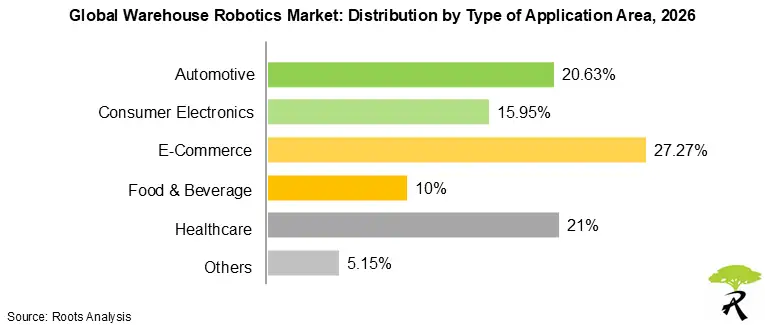
- Based on application area, e-commerce dominates the market by securing 27.27% of the revenue share.
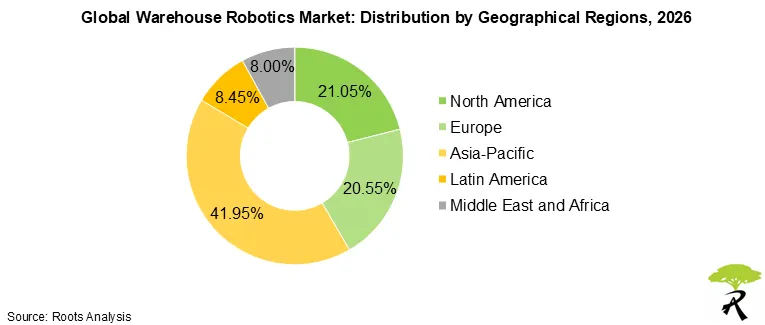
- According to regional insights, Asia-Pacific leads the market, anticipating holding 41.95% of the market share.
Market Overview
The warehouse robotics industry is growing exponentially, driven by the rising e-commerce services and shortage of skilled forces, and demand for operational efficiency. Notably, the e-commerce platforms are increasingly focused on better space utilization in warehouses, order fulfillment, and inventory management. The traditional approach requires intense labor and is prone to human error, which has necessitated demand for warehouse robots in order fulfillment.
Beyond e-commerce, the robotics are widely used in logistics, automotive, and warehousing. These robots are designed to automate wide range of tasks, such as packing, palletizing, storage, and transportation. Moreover, the integration of collaborative robots in warehouses improve accuracy, operational flexibility, precision, and scalability in supply chain.
Notably, e-Commerce giants, such as Amazon, Alibaba, Walmart, and Mercado Libre are increasing usage of warehouse robots. In November 2025, Amazon introduced Blue Jay (new warehouse robotic system) that has the capability to perform multiple tasks, such as picking & packing, and consolidating packages in a single assembly line. Likewise, in January 2025, Deus Robotics successfully raised USD 3 million in a seed funding round for warehouse automation solutions. Driven by the increasing investment and adoption of warehouse robotics solutions for e-commerce fulfillment and same-day delivery operations, it is expected that warehouse robotics market will grow tremendously in the future.
Unlock Deeper Insights – Schedule Your Personalized Workshop Today!
Recent Developments in Warehouse Robotics Market
- June 2026: Amazon unveiled a next-generation AI-powered warehouse robot capable of responding to conversational prompts, prioritizing tasks, and autonomously planning routes within fulfillment centers. The company also introduced the STARK robotic tote-handling system for warehouse operations.
- June 2026: Richtech Robotics completed the acquisition of a 79,325-square-foot warehouse facility in Las Vegas to support its robotics and AI-powered growth objectives. The acquisition was completed on May 29, 2026, and announced in June 2026.
- May 2026: Locus Robotics announced the acquisition of Nexera Robotics to expand its mobile manipulation capabilities and strengthen AI-powered warehouse automation solutions.
- March 2026: ITG deployed AI-driven warehouse automation solutions from Locus Robotics to improve high-density warehouse performance and fulfillment operations.
- March 2026: FANUC America announced that it would demonstrate five robotic and autonomous mobile robot (AMR) systems designed for warehousing, logistics, and supply-chain applications at MODEX 2026.
- January 2026: NEOintralogistics secured €3 million in funding to expand its robotics-as-a-service (RaaS) offering for warehouse picking automation and warehouse automation deployments.
- January 2025: LG announced the acquisition of a controlling 51% stake in Bear Robotics after exercising its call option to acquire an additional 30% stake, strengthening its robotics capabilities and warehouse-service robotics portfolio.
Market Share Insights
Autonomous Mobile Robots Holds the Largest Share
Based on the warehouse robotics market report, autonomous mobile robots holds the largest share (nearly 25%) of the market and likely to remain dominant in the future. Autonomous mobile robots in warehouses use mapping technology that helps to navigate in real-time and adjust themselves according to the space changes within the warehouse layout. These capabilities make these robots ideal for e-Commerce order fulfillment centers and logistics operations.
On the other hand, automated guided vehicles will show a robust growth, anticipated to grow at a higher CAGR during the forecast period. The automated guided vehicles for warehouses designed to move heavy items by using magnetic guidance or LiDAR along set routes to assist in automated steering. Owing to its ability to move heavy items, these robots are widely being adopted in manufacturing facilities and large scale warehouses for material movements.
Pick & Place Secures Highest Share of the Warehouse Robotics Industry
On the basis of our warehouse robotics market forecast, pick & place dominates the market by holding 45% of the overall revenue share. This dominance stems from the rising demand for autonomous inventory management robots to pick items from one place to place to another. The capability of recognizing objects position, and selection has facilitated the adoption of these robots for pick & place tasks within warehouses.
It is worth noting that palletizing & de-palletizing will grow at the fastest CAGR during the forecast period. Palletizing and de-palletizing is a repetitive task in warehouses. It require massive labor as it is highly physically demanding task. However, the palletizing and de-palletizing of heavy boxes may cause workforces injuries, inconsistency, and may require more working hours. These challenges underscore the demand for palletizing and depalletizing robots.
Pay Only for What You Need – The Best Way to Optimize
Regional Market Growth Analysis: Asia-Pacific Lead the Warehouse Automation Robots Market
According to our analysis, Asia-Pacific leads the market with a share of 41.95%. The rapidly expanding e-Commerce economies and diverse industrialization in Asian countries, such as electronics, information technology, and manufacturing is driving the demand for autonomous robots.
In addition, the robust presence of technology giants, such as Samsung, FANUC, Mitsubishi Electric and Tata Group are aiming for technological innovations to provide autonomous mobile robots (AMRs) and AGVs for inventory transport and order picking in logistics warehouses. In addition, Asian government are widely emphasizing on infrastructure development which further create a competitive environment for the market players in this region.
It is worth noting that North America is likely to grow at a higher CAGR during the forecast period. This increasing e-Commerce and expanding network of third-party logistics (3PL) along with rapid adoption of autonomous technologies are the key driving factors of the warehouse robotics market growth.
Additionally, the market players, such as Amazon and Walmart and accelerating the adoption of high-throughput warehouse automation and mobile robots, which further support the market expansion in this region.
Market Dynamics
Key Market Drivers
- E-Commerce Growth and Demand for Fast Order Fulfillment: The explosive growth of e-commerce and online shopping is driving the demand for warehouse robots for order fulfillment. The adoption of autonomous robots in warehouses helps in palletizing, picking, packing, and sortation on time to meet the expectations for same-day / next-day delivery with higher accuracy.
- Labor Shortage Solutions with Warehouse Robotics: With rising shortage of labor for warehouse, e-commerce and logistics giants are shifting to autonomous mobile robots and collaborative robots for inventory management. Additionally, the rising cost of warehouse laborers and difficulty in hiring and retaining warehouse workers has further accelerated the adoption of robotic picking systems.
- Pressure to Optimize Space, Throughput, and Operating Costs: Warehouse robotics adoption in e-commerce and 3PL support high storage density, ensure continuous operations, lower damage rates, and fewer errors. Moreover, the integration of warehouse robotics improves throughput and ensures space optimization.
Key Challenges
- Interoperability and Vendor Lock-In Concerns: The fragmented vendor ecosystem and complications associated with integrating existing fleet systems and proprietary software may raise the risk of long-term dependence on single suppliers.
- Safety, Cybersecurity, and Reliability Requirements: The increasing connectivity between multiple robots and rising robots density heightened the requirement for robust safety, cybersecurity and reliability systems. These security measures are essential to avoid operational downtime and data breach accidents.
- Macroeconomic Uncertainty and Warehouse Capacity Cycles: Notably, the growing shift in consumer demand, new warehouse construction, and evolving inventory strategies can significantly impact automation budgets. This macroeconomic uncertainty may delay the projects despite strong long-term fundamentals.
Have Questions? Let’s Get Them Answered.
Key Market Insights
Competitive Landscape of Warehouse Robotics Industry Players
The industry is highly fragmented, featuring the presence of several small, mid-sized, and large industrial players. Majority of the market players, such as ABB, Bastian Solutions, and Fetch Robotics are leveraging partnerships, collaborations, and raising funds.
For instance, in August 2025, GreyOrange and Google Cloud signed a partnership to launch GreyMattery DeepNav (AI-powered tool) specifically designed to make warehouse robots smarter and faster. This AI-powered tool cut time required to get autonomous mobile robots running by as much as 80%. As market players continue to drive partnerships, the warehouse picking robots market is likely to remain competitive in the future.
What are the Latest Trends in Warehouse Robotics and Automation?
- Industry 4.0, AI, and Sensor Technology Advances: Advanced in the sensor technologies, AI, machine vision, and safety systems enable mobile robots to operate safely alongside humans. Owing to the widespread adoption, market players are widely focused on industry 4.0, AI advancements to match the dynamic warehouse layouts.
- Growth Of AMRs, Collaborative Robots, and Modular Systems: The increasing adoption of automated mobile robots for transport, picking & palletizing, and cobots for multi-client warehouses are the key trends in the market.
- Adoption by 3PLs and Emerging Markets: The increasing focus of 3PLs and logistics firms to invest heavily in robotics specifically in Asia-Pacific and Latin America to differentiate services, rising volumes, and support cross-border e-commerce is driving the market.
- Robotics-As-A-Service (Raas) and Flexible Financing Models: The subscription and outcome-based models allow warehouses to scale fleets up and meet the growing demand for same day delivery order fulfilment. Moreover, it reduces the capital barriers and allow warehouses to make automation more accessible to a broad range of operators.
Market Segmentation
Warehouse Robotics Market: Scope of the Report
| Key Report Attributes | Details | |
| Historical Trend | Since 2022 | |
| Forecast Period | Till 2040 | |
| Market Size 2026 | $ 8 Billion | |
| Market Size 2040 | $ 43 Billion | |
| CAGR (Till 2040) | 12.67% | |
| Segments Covered |
|
|
| Key Players Profiled | ||
| PowerPoint Presentation (Complimentary) |
|
|
| Customization Scope |
|
|
| Excel Data Packs (Complimentary) |
|
|
Market Segments
Based on research, we have segmented the warehouse robotics market into type of Component, type of software, type of robot, type of function, type of payload capacity, application area, geographical regions, and key players.
By Type of Component
- Hardware
- Software
By Type of Software
- Warehouse Management System
- Warehouse Control System
- Warehouse Execution System
By Type of Robot
- Articulated Robots
- Autonomous Mobile Robots
- Automated Guided Vehicles
- Cartesian Robots
- Cylindrical Robots
- Mobile Robots
- Parallel Robots
- SCARA Robots
By Type of Function
- Pick & Place
- Palletizing & De-Palletizing
- Packaging
- Transportation
By Type of Payload Capacity
- Less Than 20 KG
- 20-100 KG
- 100-200 KG
- Greater Than 200 KG
By Application Area
- Automotive
- Consumer Electronics
- E-Commerce
- Food & Beverage
- Healthcare
- Others
Market Share by Geographical Regions
- North America
- US
- Canada
- Mexico
- Rest of North America
- Europe
- Austria
- Belgium
- Denmark
- France
- Germany
- Ireland
- Italy
- Netherlands
- Norway
- Russia
- Spain
- Sweden
- Switzerland
- UK
- Rest of Europe
- Asia
- China
- India
- Japan
- Singapore
- South Korea
- Rest of Asia
- Latin America
- Brazil
- Chile
- Colombia
- Venezuela
- Rest of Latin America
- Middle East and North Africa (MENA)
- Egypt
- Iran
- Iraq
- Israel
- Kuwait
- Saudi Arabia
- UAE
- Rest of the MENA
- Rest of the World
- Australia
- New Zealand
- Other Countries
Get an Instant Quote in 10 Minutes. Lowest Price Guaranteed


