
Lowest Price Guaranteed
Slides
196
Last Updated
July 2025
View Count
13893
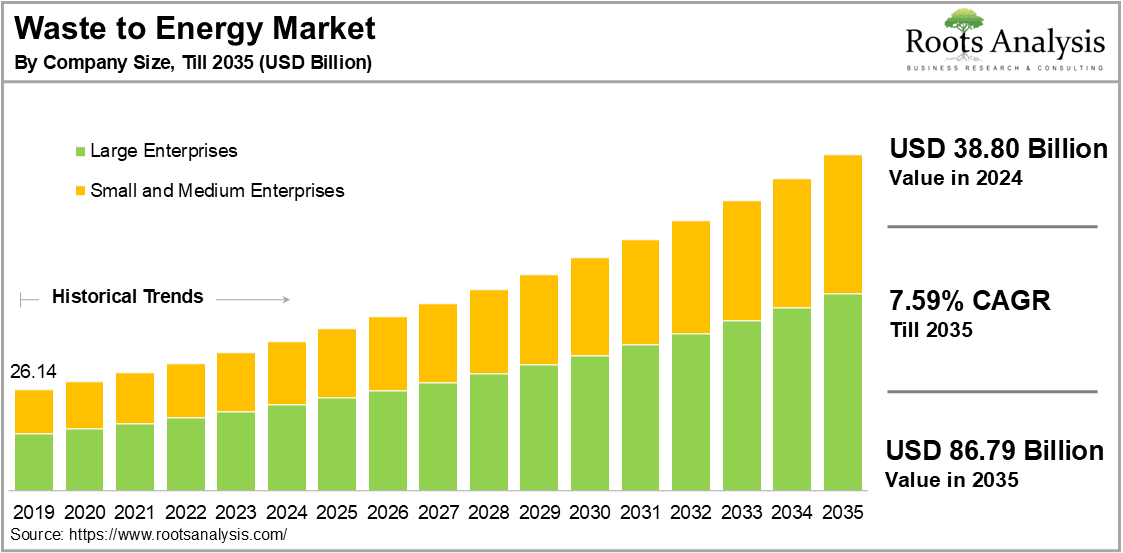
According to the global waste to energy market size forecast, the market is projected to grow from USD 38.80 billion in 2024 to USD 86.79 billion by 2035, representing a CAGR of 7.59%, during the forecast period 2024-2035.
 |
To learn more about this report, request a free sample copy
The new research study consists of waste to energy trends 2025 analysis, detailed global waste to energy growth forecast analysis, and providing actionable strategic recommendations.
Waste-to-Energy (WTE), also referred to as energy from waste, involves using thermochemical and biochemical processes to extract energy from urban waste, yielding electricity, steam, and fuels. These innovative technologies can decrease the original waste volume by as much as 90%, contingent on the waste's composition and the intended use of the energy produced. WTE facilities provide two primary advantages: they offer environmentally sound waste management and disposal solutions while generating clean electricity. The increasing adoption of WTE as a method for managing solid and liquid waste has significantly mitigated the environmental effects of municipal solid waste management, particularly in reducing greenhouse gas emissions.
The surge in global population and economic growth has led to a heightened demand for energy, making WTE facilities crucial in addressing this need. These facilities serve as a dependable source of renewable energy, thereby diminishing dependence on fossil fuels. Additionally, stringent government regulations aimed at curbing landfill usage and decreasing greenhouse gas emissions further bolster the expansion of waste-to-energy initiatives. Consequently, converting waste into energy not only meets energy demands but also aids in adhering to environmental standards.
The waste to energy industry report presents an in-depth analysis of the various companies that are involved in offering waste to energy solutions, across different segments, as defined in the table below:
| Key Report Attributes | Details | |
| Historical Trend | Since 2019 | |
| Forecast Period | 2024-2035 | |
| Market Size Value in 2024 | $ 38.80 Billion | |
| Market Size Value by 2035 | $ 86.79 Billion | |
| CAGR (Till 2035) | 7.59% | |
| Type of Technology |
|
|
| Type of Waste |
|
|
| Type of Form |
|
|
| Areas of Application |
|
|
| Company Size |
|
|
| Geographical Regions |
|
|
| Leading Market Players |
|
|
| PowerPoint Presentation (Complimentary) |
Available | |
| Customization Scope | 15% Free Customization | |
| Excel Data Packs (Complimentary) |
|
|
Based on the types of technology, the global waste to energy market is split into anaerobic digestion, biochemical, incineration, physical, thermochemical and others. Among these categories, the incineration segment growth is expected to be the maximum, capturing a market share of 45.34% by 2035. This can be attributed to its efficiency in reducing waste volume while generating energy through high-temperature combustion. This method has gained widespread adoption and is preferred for its reliability and ability to process various types of waste. On the other hand, the thermochemical technologies segment is expected to witness rapid growth at a significant CAGR of 9.59% during the forecasted period. This growth can be attributed to the use of technologies like gasification and pyrolysis in this segment. The advancements in efficiency and their alignment with increasing demand for sustainable energy solutions are driving the market growth.
Based on the types of waste, the global waste to energy market is split into agricultural waste, municipal solid waste (MSW), and others. Among these categories, the municipal solid waste (MSW) segment growth is expected to be the maximum, capturing a market share of 70.34% in the forecasted period. This can be attributed to the high availability and consistent generation of this waste from households, commercial establishments and institutions. This segment is known for its ability to effectively convert waste into renewable energy while simultaneously reducing landfill use and greenhouse gas emissions. On the other hand, it is worth highlighting that the agricultural waste segment will be witnessing the fastest CAGR of about 8.97% during the forecasted period. This growth can be attributed to the technological advancements that enhance the efficiency of converting agricultural waste into energy, aligning with global trends towards renewable energy sources and sustainable waste management solutions.
The global waste to energy market is segmented into various types of forms, such as electricity, hot water and steam. According to our global waste to energy market analysis, the electricity segment will augment the segment's growth with the largest market share of over 68.56% by the next decade. The market growth can be attributed to the increasing demand for sustainable energy solutions and impact of government policies on waste to energy, promoting renewable energy production from waste. On the other hand, the hot water and steam segment is set to witness the fastest CAGR of around 12.78% during the forecasted period. This growth is driven by advancements in waste to energy technologies and rising applications in industrial processes that require thermal energy.
The global waste to energy market is segmented into various applications of waste to energy solutions, generation of energy, treatment of waste, reduction of waste volume and others. According to our industry analysis, the generation of energy segment will augment the market's growth with a market share of 58.65% by 2035. This growth is driven by the global shift towards sustainable energy solutions and increasing government incentives to promote sustainable practices.
Furthermore, it is worth highlighting that the reduction in waste volume is expected to witness the fastest growing CAGR of around 8.67% in the forecasted period. This growth is driven by advancements in waste processing technologies that not only minimize waste but also contribute to cleaner energy production, thereby supporting sustainability goals.
The global waste to energy market is fragmented into multiple types of enterprise namely large and small and medium enterprise. Currently, the large enterprise segment is anticipated to dominate the segment with 71.05% of the waste to energy market share. However, small and medium enterprise segments are expected to witness a relatively higher (16.25%) waste to energy market growth rate until 2035. This is ascribable to their agility, innovation, focus on niche markets, and ability to adapt to changing customer preferences and market conditions.
This segment highlights the distribution of waste to energy market share by region, such as North America, Europe, Asia, Latin America, Middle East and North Africa, and the rest of the world. According to our regional analysis of waste to energy markets, Asia currently exhibits dominance with 37.69% of overall market share. This growth is driven by increasing economic activities which is further resulting in increased waste production. This has resulted in the establishments of WTE facilities by the government in various Asian countries, further fueling the market growth of waste to energy market.
The “Waste to Energy Market, Till-2035: Industry Trends and Global Forecasts” report features an extensive study of the current market landscape, market size and future of waste to energy projects, during the given forecast period. The market report highlights the efforts of several stakeholders involved in this rapidly emerging segment of the service providers industry. Key takeaways of the waste to energy market report are briefly discussed below.
According to waste to energy industry trends, the market is expected to be driven by the increase in production of clean energy from waste. As the generation of commercial and residential waste increases with increasing population, the waste to energy solutions also have a very important role to play in achieving the transformation to a sustainable energy ecosystem acting as an energy source to reduce GHG emissions. Additionally, the continuously rising demand for energy globally due to the increasing population and rapid industrialization and urbanization is one of the critical drivers of the global market. Furthermore, the use of biofuels as an alternative and renewable source of energy reduces dependency on fossil fuels. Waste-to-energy technologies can play a role in supplying the energy needed for biofuel production, enhancing energy security and further increasing the demand for waste to energy systems.
With the presence of several small and large waste to energy manufacturing companies, the market is experiencing intense competition and changing waste to energy market dynamics. From large multinational companies to local waste to energy manufacturing players, companies are striving to enhance their competitive edge. In terms of market share, large enterprises and multinational companies are dominating the market. With the help of advancements in waste to energy techniques, small manufacturing players are continuously improving their products to cater to niche markets, or they are offering specialized waste to energy solutions.
These industry players are focusing on adopting competitive strategies, such as developing innovative waste to energy solution techniques, forming strategic alliances and partnerships to expand their portfolios and global footprint, investing in recent developments and new feature launches to enhance their products offerings. For instance, in July 2024, Google sourced renewable energy from waste wood to power Singapore data center. In reference to this, Giorgio Fortunato, head of clean energy & power for Asia Pacific, Google stated that we are excited about this project, as it demonstrates how technology and innovation are key to progress towards our clean energy targets, especially in a market with limited clean energy resources like Singapore. This biomass power plant will provide firm, clean, dispatchable power, supporting the goal of sourcing 24/7 carbon-free energy in every grid where they operate.
Despite the strong market growth projection, there are several challenges in the waste to energy sector. The most common challenge is WTE being a costly waste disposal and energy generation solution in comparison to other services. Multiple factors affect the selection of waste-to-energy technology growth, necessitating a tailored approach for each region to implement the most suitable solutions. This complexity has led to a fragmented landscape of policies and regulations within the waste to energy sector, revealing considerable untapped potential.
Moreover, waste to energy is frequently perceived as a more expensive option for waste disposal and energy production compared to fossil fuel-based alternatives. There exists a disconnect in recognizing the environmental and social advantages of waste to energy when compared to established renewable energy sources like wind and solar power. Hence, these factors are obstructing market growth.
With respect to regional waste to energy industry insights, Asia is likely to dominate the market for the forecasted period. This dominance is attributed to the region's rapid urbanization, increasing waste generation, and significant investments in waste-to-energy technologies to address environmental concerns and energy demands. Additionally, the growth is also being driven by unprecedented population growth and urbanization, leading to greater waste production and a pressing need for effective waste management solutions.
Examples of key manufacturers involved in the waste to energy market (which have also been captured in this market report, arranged in alphabetical order) include A2A SpA, Abu Dhabi National Energy, Allseas, AVR, Babcock & Wilcox, Biffa, China Everbright Environment, China Everbright International, China Everbright, Covanta, EDF, Foster Wheeler, Green Conversion Systems, Hitachi Zosen, Huawei, JANSEN Combustion and Boiler, Keppel Seghers, Martin, Mitsubishi Heavy, MVV Energie, Recology, SUEZ, Sims, Stericycle, Velocys, Veolia Environnement, Viridor, Waste Connections, Waste Management, Wheelabrator Technologies, WM Intellectual Property Holdings, Xcel Energy.
At Roots Analysis, we genuinely care about your success and understand that your business requirements are unique. While our waste to energy research reports provides valuable insights, we recognize that they might not cover every aspect you need to make well-informed strategic decisions. To account for that, we offer 15% free report customization tailored to your specific needs. Whether you require additional quantitative analysis, qualitative insights, or any other information related to the waste to energy market, reach out us today at: support@rootsanalysis.com.