Wind Blade Recycling Market
Wind Blade Recycling Market, Till 2035: Distribution by Type of Recycling Method (Chemical Recycling, Mechanical Recycling, and Thermal Recycling), Type of Material (Carbon Fiber and Glass Fiber), Type of End User (Aerospace, Automotive, Cement, Construction, and Others), and Geographical Regions (North America, Europe, Asia, Latin America, and Middle East and North Africa and Rest of the World): Industry Trends and Global Forecast
-
Lowest Price Guaranteed
-
Slides
174 -
Last Updated
May 2025 -
View Count
13812 -
Wind Blade Recycling Market Overview
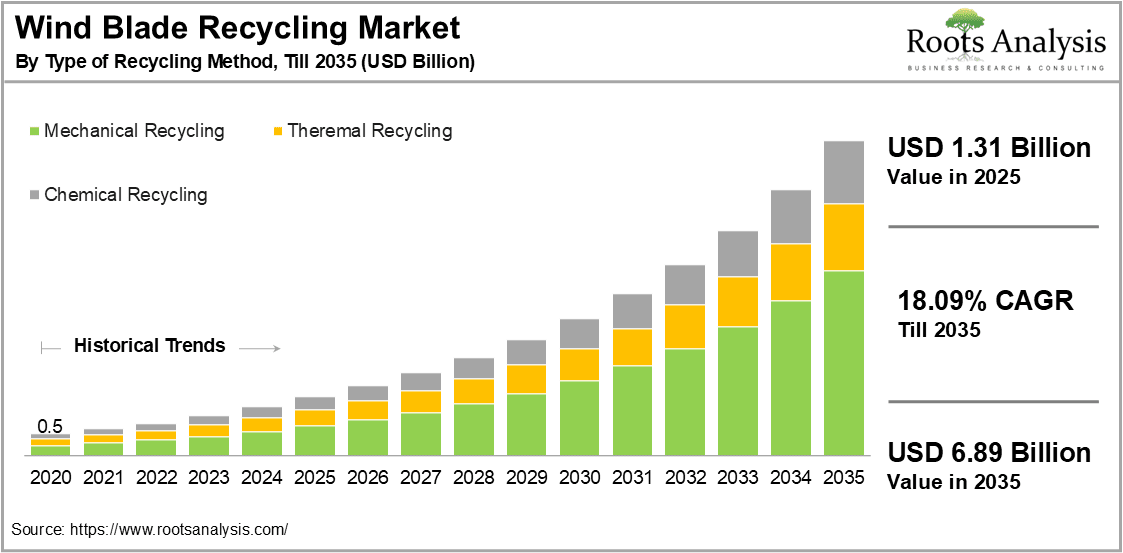
The wind blade recycling market size is projected to grow from USD 1.31 billion in 2025 to USD 6.89 billion by 2035, representing a CAGR of 18.09% during the forecast period till 2035.
 |
To learn more about this report, request a free sample copy
The new research study consists of wind blade recycling market and trends analysis, detailed market forecast analysis, and provide actionable strategic recommendations.
With the tremendous growth of the wind power sector, the wind blade recycling market is expected to witness an explosive expansion. According to Europe’s wind energy agency, WindEurope, about 14,000 wind turbine blades are expected to be dismantled and would generate 40,000 to 60,000 tons of waste within five years in Europe. Such factors are creating new possibilities for the growth of the wind blade recycling industry. Wind blade recycling refers to a process of managing and repurposing decommissioned wind turbine blades at the end of their operational life. The purpose of wind blade recycling is to minimize environmental impact by avoiding landfill disposal and recovering valuable materials for reuse in other industries.
Technology innovation has supported the idea of wind blade recycling by using either mechanical recycling, thermal recycling, or chemical recycling. As wind turbine blades are made of composite materials, it can be valuable for numerous end-use industries. The role of fiberglass and carbon fiber in recycling is pivotal, as these materials are recovered from wind turbine blades and repurposed for applications in construction, automotive, and other industries, supporting the circular economy in the wind energy industry. As a consequence, the increasing number of decommissioned wind turbines and the growing focus on sustainability are highlighting the importance of recycling wind turbine blades.
Additionally, the rising government regulations on wind blade disposal is one of the key factors that has expanded the market outlook. Therefore, industry players and regulatory authorities are actively stretching their efforts for technological advancements. For instance, in October 2024, the US Department of Energy (DEO) invested around $20 million to enhance wind energy recycling technology. The aim of this effort is to help the US in developing solutions to boost the recyclability of wind energy technology. Consequently, with key drivers, future trends in renewable energy and recycling, such as advancements in chemical recycling and repurposing initiatives are projected to amplify the market prospects over this forecast.
Wind Blade Recycling Market Share Insights
The wind blade recycling market report presents an in-depth analysis of the various companies that are involved in offering wind blade recycling, across different segments, as defined in the table below:
Wind Blade Recycling Market: Report Attributes / Market Segmentations
| Key Report Attributes | Details | |
| Historical Trend | Since 2020 | |
| Forecast Period | Till 2035 | |
| Current Market Size | $ 1.31 Billion | |
| Market Size Value by 2035 | $ 6.89 Billion | |
| CAGR (Till 2035) | 18.09% | |
| Type of Recycling Method |
|
|
| Type of Material |
|
|
| Type of End User |
|
|
| Geographical Regions |
|
|
| Leading Market Players | ||
| PowerPoint Presentation (Complimentary) | Available | |
| Customization Scope | 15% Free Customization | |
| Excel Data Packs (Complimentary) |
|
|
Wind Blade Recycling Market Segmentation
Market Share by Type of Recycling Method
This segment of the global wind blade recycling market features different types of recycling methods including chemical recycling, mechanical recycling, and thermal recycling. According to Roots analysis, the mechanical recycling method is predicted to capture the largest (~47%) of the market share by 2035. The mechanical recycling of wind blades is the most common and cost-effective method. The simplicity of the process which entails shredding or grinding wind blades into small pieces, propels its adoption.
Besides this, versatile applications of recycled materials from this process can be used in cement, concrete, or other construction materials, fortifying the segment’s dominance. However, the thermal recycling process is poised to expand to a notable (19.41%) CAGR in the upcoming decade. This growth can be ascribed to the ability to handle large volumes of waste, extract energy, and recover certain materials such as fiber and resins, advancing market development. Furthermore, chemical recycling of wind turbine blades is also anticipated to foster market demand due to its benefits in supporting the circular economy, recovery of high-quality materials, and advancements in technology.
Market Share by Type of Material
The distribution of the market based on the type of material is split into carbon fiber and glass fiber. As per our research, the fiberglass material is projected to hold the highest (~61%) of the market share by 2035. Essentially, the inflating demand for recycled materials is a key driving factor of the segment growth. Fiberglass is extensively utilized in the manufacturing of wind turbine blades, majorly due to its robustness, lightweight properties, and durability.
Further, their unique properties, fiberglass plastics, are gaining higher demand from many applications in the construction industry to the consumer goods industry. On the other hand, the carbon fiber segment is also gaining traction in the market as the material has unique lightweight and resilience features. Hence, the carbon fiber segment is likely to witness a substantial (20.12%) CAGR over this projection period.
Market Share by Type of End User
Based on the type of application, the market is divided into several end users such as aerospace, automotive, cement, construction, and others. According to our global wind blade recycling analysis, the construction industry is expected to occupy the majority (~42%) of the market share by 2035. The segment will likely dominate the market owing to the repurposing retired wind turbine blades in construction projects for various applications from building materials, and insulation to reinforcing concrete, which excites the segment growth. As well as an upsurge in regulatory pressure and demand for cost-effective alternative materials can attributed to the segment’s growth.
Nevertheless, the automotive segment is estimated to grow at a higher CAGR of (20.62%) during this forecast period. The extracted materials like carbon fiber and glass fiber have a great use in the automotive industry and can be utilized in the structural components in the manufacturing of vehicles. Additionally, the automotive industry has many applications of recycled materials from wind blades such as interior panels, dashboards, and exterior components where such materials can be valuable and cost-effective solutions.
Market Share by Geographical Regions
This segment highlights the distribution of the wind blade recycling market across various geographical regions, such as North America, Europe, Asia, Latin America, the Middle East and North Africa, and the rest of the world. In terms of revenue, North America is predicted to capture the highest (~43%) of the market share till 2035. Moreover, the Asia region is expanding at a rapid pace in the market for wind blade recycling due to the growing adoption of wind energy. Being the largest wind energy producer, China and India are playing a pivotal in driving the market expansion with their rising number of decommissioned wind turbine blades. Along with this, increasing government policies and targets for renewable energy are encouraging companies to sustainable waste management practices, creating ample opportunities for the market scope. Therefore, Asia is expected to experience an outstanding (22.10%) CAGR throughout this forecast period.
Wind Blade Recycling Market Key Insights
The “Wind Blade Recycling Market, Till-2035: Industry Trends and Global Forecasts” report features an extensive study of the current market landscape, market size and future opportunities within the market, during the given forecast period. The market report highlights the efforts of several stakeholders involved in this rapidly emerging segment of the service providers industry. Key takeaways of the wind blade recycling market report are briefly discussed below.
Key Drivers of the Wind Blade Recycling Market
Significantly, the growing volume of decommissioned wind turbine blades around the world, especially in the developed regions, is attributed to market growth. Developed regions like North American and European countries have many aging offshore and onshore wind turbine plants which are increasingly being decommissioned. Consequently, this has led to a rising demand for sustainable disposal methods similar to wind blade recycling is strengthening the market progress. Furthermore, the increasing awareness of the environmental impact of wind blade disposal associated with landfills and stringent regulations are some of the considerable growth drivers for the wind blade recycling market which are anticipated to continue to accelerate the market expansion in the future as well.
Wind Blade Recycling Market Competitive Landscape
Numerous market players from prominent recycling companies to innovating startups are boosting the competitive landscape of the industry. Global leaders such as SUEZ, Veolia, and Siemens Gamesa, and others are the leading players that stimulate the market with their expertise in waste management and recycling. Interestingly, the top five players hold the maximum market share.
However, the market share of wind blade recyclers is expected to grow significantly as advancements in recycling technologies and increased sustainability efforts drive demand for eco-friendly solutions. In this context, niche startups are emphasizing technological advancements in recycling technologies for composites that allow the reuse of materials in construction, consumer products, or new turbine blades. Additionally, industry players are increasingly focusing on collaboration and partnership to overcome logistical and technological barriers. These market players are positioning themselves as a sustainability leader by committing to sustainable practices that enhance their competitive edge in securing contracts and investments.
Market Challenges in Wind Blade Recycling Market
The market is progressing, however, some market constraints such as complex material composition and high recycling costs can impact market growth. As wind blades are made of composite materials such as fiberglass and epoxy, are hard to recycle. As well as the high recycling costs due to technology readiness level for wind blade recycling which are still under development and require substantial investment can be expensive as compared to disposal landfills. As a result, high technological innovation costs and material complexity can be leading challenges in wind blade recycling processes which may hamper market growth.
Regional Analysis: North America is Expected to Lead the Market with the Largest Wind Blade Recycling Market Share
With regard to wind blade recycling market regional insight, North America’s aging wind turbines are estimated to foster the market demand in the region and will continue to lead the market for wind blade recycling. The region is one of the early adopters of wind energy systems and their early installed wind turbines are reaching the end of their lifespan. Resulted in, there is an increase in decommissioned blades and recycling, thereby, driving the market growth. In addition, the government's strong emphasis on sustainable waste management and promoting recycling practices are significantly contribute to fueling the market development.
Besides this, ongoing infrastructure development and higher environmental awareness for sustainability and reducing landfill waste are also attributed to the region’s leading position. Moreover, the trend of partnership between wind farm operators and recycling companies is a notable factor that plays a vital role in making strategies for reducing landfill waste from wind turbines bolster the market growth. For instance, Avangrid donated 300 pounds to a startup WindLoop, to test an advanced process for wind turbine blade recycling in June 2024.
Leading Wind Blade Recycling Player
Examples of key wind blade recycling players involved in the market (which have also been captured in this market report, arranged in alphabetical order) include Acciona (Spain), LADBUG (UK), China Longyuan Power (China), Continuum (India), EDF Renewables (France), Enel Group (Italy), Global Fiberglass Solutions (US), Goldwind Science & Technology (China), Holcim (Switzerland), Iberdrola (Spain), Kyysakoski Oy (Finland), MAKEEN Energy (Denmark), Plaswire (Switzerland), REGEN Fiber (US), RenerCycle (Denmark), RESINEXX (Germany), Siemens Gamesa Renewable (Spain), Stena Recycling (Sweden), SUEZ (France), Veolia (France), and Vestas (Denmark). This market report includes an easily searchable excel database of all the companies who have adopted the wind blade recycling market.
Recent Developments in Wind Blade Recycling Market
- In October 2024, EDGE INNOVATION introduced HS750 horizontal shredder to offer efficient and cost-effective material handling and recycling methods.
- In October 2024, The French Institute for Technological Research initiated the ZEBRA (Zero, Waste Blade Research Project and Arkema) along with SUEZ and two other leading companies to develop a recycling and circular economy.
- In September 2024, Siemens Gamesa claimed to introduce the world’s first recyclable offshore wind turbine blade. The company also announced its commercial availability for offshore use with three customers.
Wind Blade Recycling Market Report Coverage
The market report presents an in-depth analysis, highlighting the capabilities of various companies engaged in this domain, across different segments. Amongst other elements, the market report includes:
- A preface providing an introduction to the full report wind blade recycling market, 2020-2024 (Historical Trends) and till-2035 (Forecasted Estimates).
- An outline of the systematic research methodology adopted to conduct the study on the wind blade recycling market providing insights on the various assumptions, methodologies, and quality control measures employed to ensure the accuracy and reliability of our findings.
- An overview of economic factors that impact the overall wind blade recycling market including historical trends, currency fluctuation, foreign exchange impact, recession, and inflation measurement.
- An executive summary of the insights captured during our research. It offers a high-level view on the current state of the wind blade recycling market and their likely evolution in the mid-long term.
- A detailed assessment of the wind blade recycling market landscape, based on several relevant parameters, including year of experience, company size, location of headquarters, and ownership structure.
- Elaborate profiles of prominent players engaged in the wind blade recycling market, featuring information on their year of establishment, location of headquarters, company size, company mission, company footprint, management team, contact details, financial information, operating business segments, wind blade recycling market portfolio, moat analysis, recent developments, and an informed future outlook.
- A qualitative assessment of the various megatrends ongoing in the wind blade recycling industry, including increasing development of recyclable blades and advancements in chemical recycling.
- An analysis highlighting the key unmet needs across the wind blade recycling market, featuring insights generated from real-time data on unmet needs as identified from social media posts, recent publications, industry blogs and the views of key opinion leaders expressed on online platforms.
- An in-depth analysis of various patents that have been filed / granted related to the wind blade recycling market and its components, based on various parameters, such as type of patent, patent publication year, patent age and leading players.
- A detailed analysis of recent developments in the wind blade recycling market domain, based on relevant parameters such as year of initiative, type of initiative (partnerships and collaborations, expansions, funding and product launches), geographical distribution and most active players (in terms of number of recent developments).
- Key winning strategies framework that helps in analyzing the level of competition within an industry, by tracing the key market activities including partnership, funding, expansion of leading players
- A qualitative analysis, highlighting the five competitive forces prevalent in wind blade recycling market, including threats for new entrants, bargaining power of suppliers, bargaining power of customers, threats of substitution and rivalry among existing competitors.
- A discussion on affiliated global wind blade recycling market trends, key drivers and challenges, under a SWOT framework, which are likely to impact the industry’s evolution, along with a Harvey ball analysis, highlighting the relative effect of each SWOT parameter on the overall wind blade recycling market.
- A value chain analysis featuring a discussion on various stakeholders involved in the development of the wind blade recycling market, from suppliers to end-users.
- A detailed estimate of the current market size and the future growth potential of the wind blade recycling market over the next decade. Based on multiple parameters we have provided an informed estimate on the market evolution during the forecast period 2025-2035. The report also features the likely distribution of the current and forecasted opportunity within the wind blade recycling market. Further, in order to account for future uncertainties and to add robustness to our model, we have provided three forecast scenarios, namely conservative, base, and optimistic scenarios, representing different tracks of the industry’s growth.
- Detailed projections of the current and future market across various types of recycling methods such as chemical recycling, mechanical recycling, and thermal recycling.
- Detailed projections of the current and future market across various types of materials such as carbon fiber and glass fiber.
- Detailed projections of the current and future market across various types of end-user such as aerospace, automotive, cement, construction, and others.
- Detailed projections of the current and future wind blade recycling market across various geographical regions, such as North America (US, Canada, Mexico and other North American countries), Europe (Austria, Belgium, Denmark, France, Germany, Ireland, Italy, Netherlands, Norway, Russia, Spain, Sweden, Switzerland, UK and other European countries), Asia (China, India, Japan, Singapore, South Korea and other Asian countries), Middle East and North Africa (Egypt, Iran, Iraq, Israel, Kuwait, Saudi Arabia, UAE and other MENA countries), Latin America (Brazil, Chile, Colombia, Venezuela and other Latin American countries) and rest of the world (Australia, New Zealand and other countries).
Author: Ronit Sharma and Neha Kashyap
Customization Opportunities
At Roots Analysis, we genuinely care about your success and understand that your business requirements are unique. While our market research reports provide valuable insights, we recognize that they might not cover every aspect you need to make well-informed strategic decisions. To account for that, we offer 15% free report customization tailored to your specific needs. Whether you require additional quantitative analysis, qualitative insights, or any other information related to the wind blade recycling market, reach out us today at: support@rootsanalysis.com