
Lowest Price Guaranteed
Slides
181
Last Updated
March 2025
View Count
11480
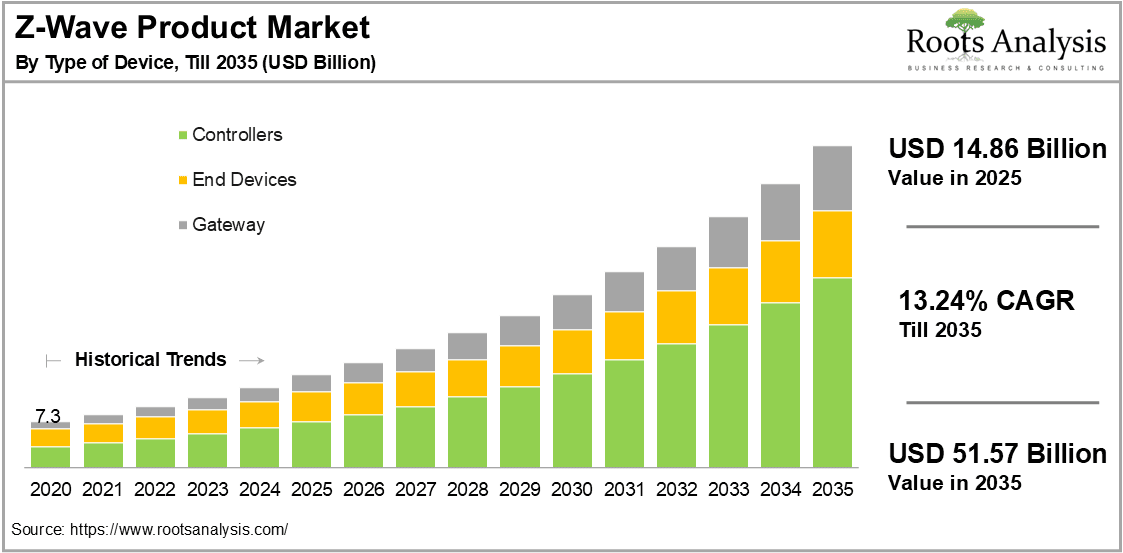
The Z-wave products market size is projected to grow from USD 14.86 billion in 2025 to USD 51.57 billion by 2035, representing a CAGR of 13.24% during the forecast period till 2035.
 |
To learn more about this report, request a free sample copy
The new research study consists of Z-wave products market and trends analysis, detailed market forecast analysis, and provide actionable strategic recommendations.
The increasing penetration of home automation has amplified the importance of Z-wave technology. Z-wave is a type of wireless communication protocol designed specifically for smart home and building automation. This core technology operates on low-energy radio waves and enables secure, reliable communication between devices with a mesh network. With the growth of smart devices, the z-wave product market is excelling. The market encompasses a wide range of devices, from smart home controllers / hubs and smart lighting systems to security surveillance and thermostats and HAVC control, which are expanding z-wave product applications. In addition, the benefits of these products in interoperability, reliability, security, and ease of installation drive the market demand in residential and commercial spaces.
The residential sector is the leading end user in terms of revenue generation, magnifying the market prospects. Additionally, the heightening adoption of IoT devices and smart cities applications similar to smart sensors, cameras, and energy management solutions are driving the excessive demand for z-wave products. Driven by technological advancements and the shift towards commercial automation, integration with voice assistants is becoming an industry trend, enhancing the convenience and accessibility of the products. Moreover, industry players are leveraging the technology by introducing advanced solutions.
For instance, in April 2024, Trident IoT, based in California presented its new Z-Wave Series of system-on-chip (SoC) solutions and modules that support Z-Wave Long Range (ZWLR) for the US and ZWLF European specification. The solution is designed to help accelerate time-to-market for connected device manufacturers. On this product launch, Trident IoT’s co-founder Bill Scheffler stated that our solution provides global manufacturers access to next-gen Z-wave capabilities and boosts IoT product development globally. Overall, the market is expected to thrive with the growing demand for connected and energy-efficient devices, however, the high cost of products can hamper the market and needs to be addressed to retain this growth during this forecast period.
The Z-wave products market report presents an in-depth analysis of the various companies that are involved in offering Z-wave products market, across different segments, as defined in the table below:
| Key Report Attributes | Details | |
| Historical Trend | Since 2020 | |
| Forecast Period | Till 2035 | |
| Current Market Size | $ 14.86 Billion | |
| Market Size Value by 2035 | $ 51.57 Billion | |
| CAGR (Till 2035) | 13.24% | |
| Type of Device |
|
|
| Type of Distribution Channel |
|
|
| Type of Application |
|
|
| Type of End User |
|
|
| Geographical Regions |
|
|
| Leading Market Players |
|
|
| PowerPoint Presentation (Complimentary) |
Available | |
| Customization Scope | 15% Free Customization | |
| Excel Data Packs (Complimentary) |
|
|
The global Z-wave products market is categorized into various devices such as controllers, end devices, and gateway. The controller segment is predicted to capture the highest (~46%) of the market share by 2035. Smart home controllers act as the central hub for managing and automating z-wave-enabled devices. The unified communication of controllers between Z-wave products and home systems allows easy integration with different manufacturers' products. Further, modern smart hubs come with features such as voice control, remote access, and AI-driven automation enhancing the capability with third-party platforms, escalating their popularity.
However, the end device segment which contains a wide range of security sensors, door locks, smart lighting, switches, and many more is expected to grow at an exceptional CAGR of (16.20%) during this forecast period. Among these end devices, smart lighting is high in demand, bolstering the market growth. Smart lighting systems have gained traction due to their energy efficiency and convenience which enable users to control lighting remotely via apps or voice assistants. Influenced by its features, smart lighting along with other innovative end devices are highly being adopted in the residential as well as commercial sectors.
This segment of the market comprises multiple distribution channels incorporating online and offline. As per our research, the online segment is projected to occupy the maximum (~65%) of the market share by 2035. Significantly, the expansion of e-commerce platforms that allow consumers to browse, compare, and purchase Z-wave products from the comfort of their homes contributes to leading the segment. Also, online platforms expand the market penetration in both developed and emerging markets thus, boosting the market outlook.
On the other hand, the offline segment is likely to witness a sustainable (14.21%) growth rate during this projection timeframe. Being a traditional distribution channel, offline stores have substantial advantages that enable consumers to receive in-person guidance, demonstration, and technical assistance from knowledgeable staff. Resulted in, the product demonstration and immediate purchase and availability can be attributed to the growth of the segments.
This Z-wave product segmentation underscores a wide range of applications, split into climate control, energy management, lighting control, security & safety, and smart home appliances. As per market research, the smart home appliances segment is expected to hold the highest (~47%) of the market share by 2035. Smart home appliances are the prominent z-wave product application that incorporates myriads of devices such as door locks, cameras, sensors, controllers, and entertainment systems. Therefore, owing to the widespread adoption of smart home technologies and the versatility benefits offered by z-wave-enabled devices will likely boost the segment growth.
Whereas, the security & safety segment is poised to grow at a substantial CAGR of (15.12%) during this forecast period. This growth can be ascribed to the increasing concern about safety in both residential and commercial spaces. With the mounting occurrence of theft, unauthorized access, and privacy breaches the demand for advanced security solutions in homes, offices, and public spaces will continue to drive the market demand.
Based on the type of end users, the market is bifurcated into commercial and residential sectors. According to our z-wave market analysis, the residential segment is anticipated to hold the largest (~64%) of the market share by 2035. The emerging home automation trend and popularity of smart home solutions essentially drive the segment growth. Residential users are increasingly inclined towards z-wave enabled devices such as smart lighting solutions, thermostats, and z-wave home security solutions to enhance convenience, comfort, and security in their homes, thereby, advancing the market growth.
While the commercial segment is likely to register the fastest (15.26%) CAGR during this projection period. Commercial settings from hotels and retail stores to office spaces remarkably contribute to fostering the growth of the segment. Businesses are shifting to automation in order to improve operational efficiency, reduce energy consumption, and better employee and customer comfort. Therefore, commercial settings are prioritizing connected systems that can easily integrate with lighting, HVAC, and access control systems.
This segment highlights the distribution of the Z-Wave Products Market across various geographical regions, such as North America, Europe, Asia, Latin America, the Middle East and North Africa, and the rest of the world. With regard to z-wave market size and share, North America is predicted to continue to lead the market with (~48%) of the market share till 2035. Moreover, Asia is reflecting a phenomenal growth opportunity in emerging markets. The rapid urbanization and smart city projects in developing nations are leading to an outstanding demand for smarter infrastructure and residential solutions.
Governments are increasingly investing in smart integrated technologies like z-wave for better energy management, security, and connectivity, boosting the market prospects. Furthermore, the current growth rate of the smart home automation market driven by the growing adoption of IoT devices and rising consumers’ disposable income has inflated the demand for z-wave smart home devices in the region. As a result, Asia is estimated to experience an excellent (16.45%) CAGR throughout the forecast period.
The “Z-Wave Products Market, Till-2035: Industry Trends and Global Forecasts” report features an extensive study of the current market landscape, market size and future opportunities within the Z-Wave products market, during the given forecast period. The market report highlights the efforts of several stakeholders involved in this rapidly emerging segment of the service providers industry. Key takeaways of the Z-wave products market report are briefly discussed below.
The heightening popularity of smart home automation is a significant key driver of the Z-wave product market growth. Smart home automation promotes convenience, security, and energy efficiency thus, more and more consumers are adopting z-wave products due to their seamless interoperability, enhanced security, and mesh networking architecture that boosts network range and reliability. Additionally, the growing awareness of energy conservation around the world lifting the demand for Z-wave energy management systems, broadening the market outlook.
With the mounting global concern related to climate change and energy consumption consumer and businesses are becoming more conscious of their environmental impact and need for energy usage. Their consumers are increasingly shifting to energy-efficient options similar to Z-wave products. Besides, the increasing IoT devices and Z-Wave technology integration in residential and commercial settings have also excited the market demand owing to their mounting need for advanced security where z-wave sensors and surveillance systems meet their requirements. Moreover, continuous technological advancements and rising smart city initiatives are further projected to create new z-wave product growth opportunities in the upcoming years.
Several global leading players and emerging small and medium-sized companies operating in the market are changing the Z-Wave competitive landscape. Prominent market players such as Silicon Labs, Fibaro, Aeotec, Honeywell, and others lead the market with their diverse range of z-wave products. These key players are competing in the market by introducing advanced devices with improved efficiency, longer range (ZWLR), and better security features. Additionally, in order to secure significant market share, these companies employ various business tactics including strategic partnerships, acquisitions, and innovation in technology that further support them in expanding the global reach.
The high initial costs of the devices and their interoperability issues can be leading challenges in the expansion of the z-wave product market. The upfront cost of Z-Wave-enabled devices and systems can deter price-sensitive consumers, especially in developing markets. Similarly, the integration of Z-wave devices with other smart home ecosystems and standards like Zigbee, Wi-fi, or Bluetooth and the complexity in installation and maintenance can confine the adoption of the devices which may impede the market growth.
With regard to regional insight, the market for Z-wave products is anticipated to be dominated by North America by accounting for the majority of the global share. This leadership is mainly attributed to the early and high adoption of smart home technology in the region. The established market for smart devices such as lighting controls, home security systems, and energy management solutions fosters the market growth. The region’s robust Internet of Things infrastructure plays a key role in the integration of Z-wave products into smart home ecosystems, driving the market demand. In addition, the savvy population and high consumer awareness of smart home automation benefits such as convenience, energy savings, and better security which elevate consumer demand will continue to retain North America’s dominance in the global marketplace.
Examples of key players involved in the market for Z-wave products (which have also been captured in this market report, arranged in alphabetical order) include ABB (Switzerland), ADT (US), Aeotec (Germany), Everspring (Taiwan), Fakro (Poland), Fibaro (Poland), HomeSeer (US), Honeywell (US), Jasco (US), Jasco Product (US), Leviton (US), Nest (US), Qolsys (US), Schneider Electric (France), SIEMENS (Germany), Sigma Designs (US), Silicon Labs (US), SOMFY (France), Vision Security (Taiwan), Zooz (US), and Z-Wave Lab (Germany). This market report includes an easily searchable excel database of all the companies who have adopted the z-wave products market.
The market report presents an in-depth analysis, highlighting the capabilities of various companies engaged in this domain, across different segments. Amongst other elements, the market report includes:
At Roots Analysis, we genuinely care about your success and understand that your business requirements are unique. While our market research reports provide valuable insights, we recognize that they might not cover every aspect you need to make well-informed strategic decisions. To account for that, we offer 15% free report customization tailored to your specific needs. Whether you require additional quantitative analysis, qualitative insights, or any other information related to the Z-wave products market, reach out us today at: support@rootsanalysis.com