


 Download Free Sample
 Buy Now
Zinc-Air Battery Market Size
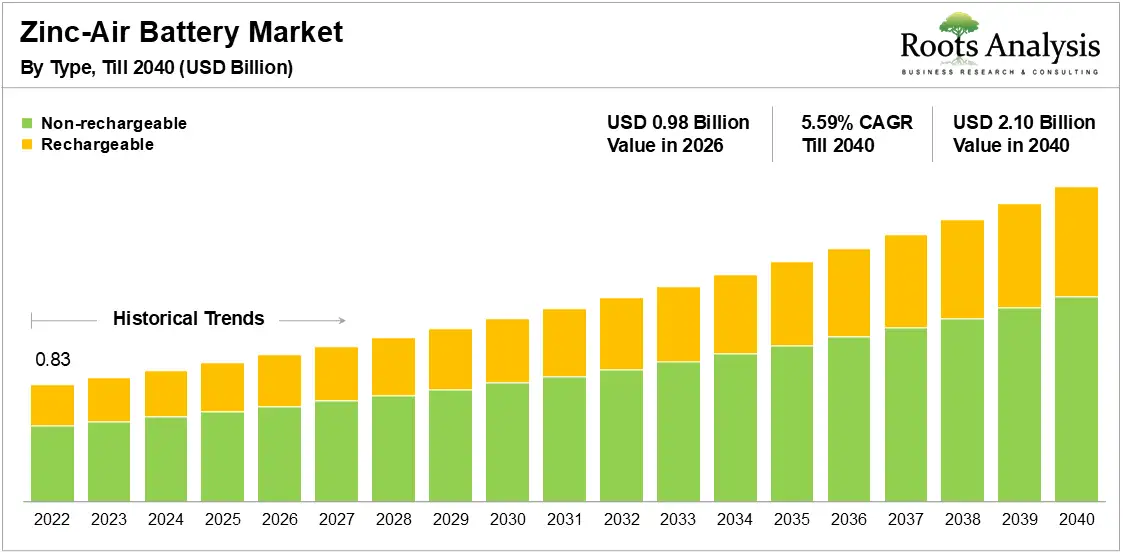
The zinc-air battery market, valued at USD 0.88 billion in 2025, is projected to reach USD 0.98 billion by 2026 and USD 2.10 billion by 2040, with a CAGR of 5.59% during the forecast period 2026 to 2040.
See What’s in the Full Report - Request Your Complimentary Insights!
Zinc-Air Battery Market Report: Key Takeaways
- Based on the type, non-rechargeable zinc air battery dominates due to their cost effectiveness, disposability which leads to reduction in maintenance.
- On the basis of application, hearing aids holds the largest share as these are widely adopted in electronic devices.
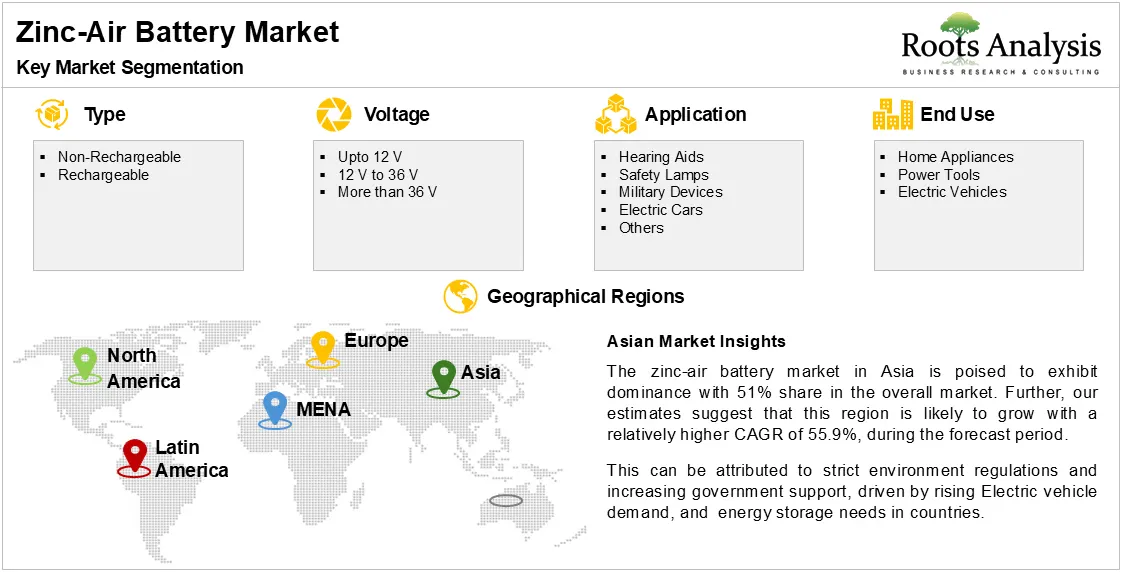
- In terms of leading region, Asia- Pacific holds the largest zinc-air battery market share.
- Key market driver is the high energy density and cost effectiveness in zinc-air battery.
Zinc-Air Battery Market Trends and Overview
Zinc-air batteries (ZAB) are a type of battery that utilizes zinc metal as the negative electrode and oxygen as the positive reactant that enable oxidation reactions at the zinc electrode and reduction reactions at the air electrode. This battery is generally recognized primarily as non-rechargeable system and secondary as rechargeable system.
These batteries are of high energy density zinc-air batteries as an alternative to lithium-ion and are relatively inexpensive to produce in non-rechargeable form. Therefore, with high abundance of zinc, there is growth in energy storage technologies. Notably, zinc is proving to be a safe and low-cost element as compared to lithium and sodium. However, zinc-air battery for energy storage is what battery researchers and innovation hub are hoping to unlock. It offers longer lifespan and lower environmental impact as compared to other chemistries.
Companies like Mitsubishi Heavy Industries invest in e-zinc metals for advanced long duration energy storage. Leveraging its proprietary technology, zinc- air batteries can supply power for long time at low cost. They also have features of higher energy density than lead-acid batteries. By utilizing zinc as the base metal, e-zinc provides products that hold energy for multiple days and can safely & reliably perform in the world’s harshest environment.
Applications of zinc-air batteries as these are highly used in watches, hearing aids and electrical devices, microgrid, consumer needs and healthcare. There is a rising demand for energy storage devices also indorse the usage of zinc-air batteries due to its high energy characteristic. Rechargeable zinc-air batteries have the potential of large-scale energy storage systems, electric cars, flexible electric devices such as small drones.
In response, industry leaders are investing in long-life zinc-air batteries (such as rechargeable zinc-air systems) and forming strategic collaborations to address environmental concerns and regulatory demands. These efforts aim to high energy density, safety and cross-effectiveness over lithium-ion alternatives.
Unlock Deeper Insights – Schedule Your Personalized Workshop Today!
Recent Developments in Zinc-Air Battery Market
- In November 2025, Hindustan Zinc is in collaboration with Rajasthan State Industrial Development & Investment Corporation (RIICO) to purpose zinc park initiative as the city is global hub for manufacturing and metals. This initiative is actively considered by Executive Director, Mr. Aakash Tomar, for product development & alloy innovation and technology advancement.
- In October 2025, The US has energy storage problem which is now solved by new zinc-air battery benefiting them in new cost cutting storage solutions.
- In June 2025, Sthyr Energy raises $1 million funding to develop a mechanically rechargeable zinc-air battery system.
Zinc-Air Battery Market Dynamics
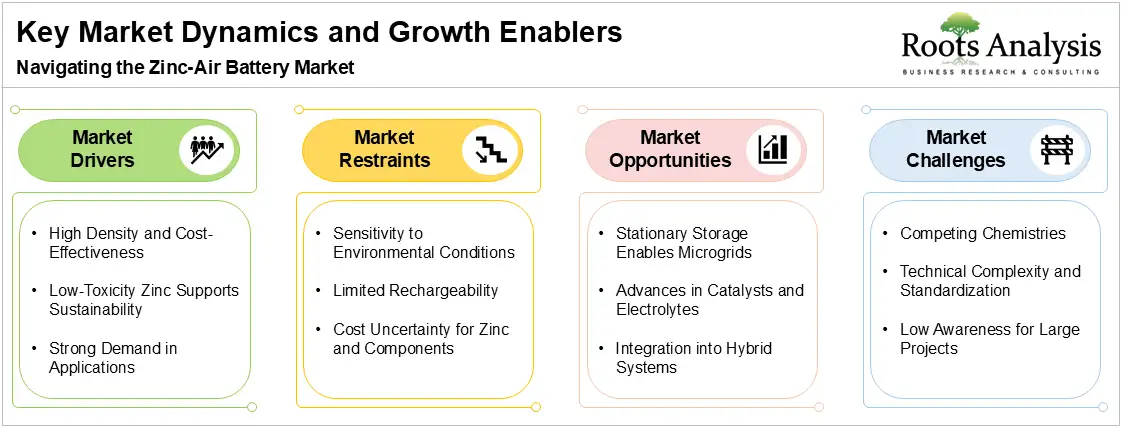
The zinc-air battery market size is set to witness a lucrative growth phase, shaped by a dynamic interplay of drivers, restraints, opportunities, and challenges that will influence its trajectory in the coming years.
Zinc-Air Battery Market Segmentation
The zinc-air battery market report presents an in-depth analysis of the various companies that are involved in offering cost-effective battery across different segments, as in the figure below:
Zinc-Air Battery Market Share Insights
Non-Rechargeable Type Dominate the Industry
Our zinc-air battery market forecast estimates suggest that the non-rechargeable currently hold the maximum market share. Further, this dominance is unlikely to change during the forecast period as rechargeable zinc-air battery market is poised to grow with a higher CAGR 72% by the year 2040.
This market growth is largely a result of the fact that high energy density zinc-air batteries are used to provide steady power for extended time without the need of recharging make them more appealing and accessible in various applications. Because of its scalability this type is a better choice for future developments in zinc-air battery market.
Which Primary Application Utilizes Zinc-Air Battery the most?
Based on zinc-air battery applications, the hearing aids application is projected to maintain its leadership throughout the forecast period. The increasing preference for zinc-air battery for hearing aids is due to their high energy density, stable voltage output and long shelf life making them ideal for reliable operation.
Pay Only for What You Need – The Best Way to Optimize
The dominance of the hearing aids is further attributed by the aging global population and increasing prevalence of hearing impairments. Moreover, these batteries are environmentally friendly, and cost effective compared to lithium-ion batteries.
On the other hand, zinc-air battery for electric vehicles is expected to hold 19% of the global share market, attributed by support from government policies and incentives promoting electric vehicles. As the population grows, the demand for these batteries is increasing in electric vehicles.
Want Information on Specific Region / Segment?
Regional Forecast Estimates: Europe’s Growing Market Fueled by ZABSES Project
Europe holds the second largest zinc-air battery market share with approximately 30% of the global share, underpinned by its stringent environmental regulations and strong commitment to reduce carbon emissions. In the European market, companies are actively involved in research and development for rechargeable zinc-air battery system.
The region also benefits from forward-looking projects like Zinc-Air Battery for Stationary Electricity Storage (ZABSES), which aggressively improve the cyclability and promote cost-effective battery technology.
Companies involved in this project are Varta Micro battery, SunErgy which aim to provide effective research and to optimize electrodes, electrolytes and overall performance of the cell. By this European market is expected to continue its upward trajectory government invest in technologies.
Zinc-Air Battery Market Key Insights
Competitive Landscape of Key Market Players
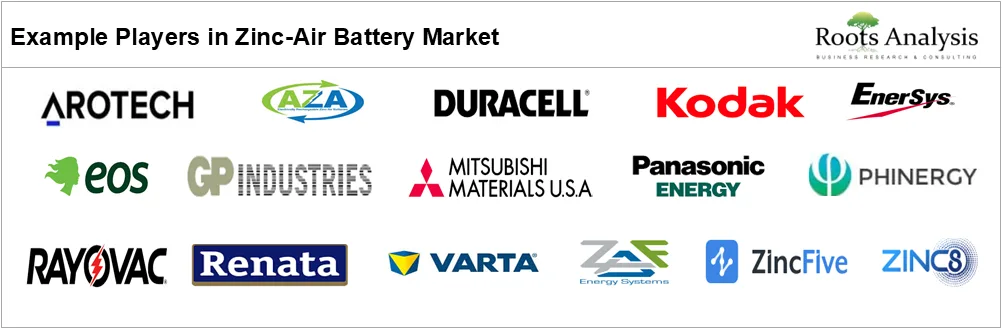
Leading zinc-air battery manufacturers (which have also been captured in this market report, arranged in alphabetical order) include Arotech Corporation, AZA Battery, Duracell (acquired by Berkshire Hathaway), Eastman Kodak , EnerSys, Eos Energy , GP Industrial, Mitsubishi Materials , Panasonic Energy, Phinenergy, Ravoyac (acquired by Energizer Holdings), Renata, Thunderzee, Varta, ZAF Energy System, Zinc five, and Zinc8 Energy Solutions.
These companies are adopting diverse strategies to expand their market share amid tightening environmental regulations and surging demand for zinc-air batteries for medical devices, hearing aids, and portable electronics. Many are investing in advanced rechargeable zinc-aur battery market to yield eco-friendly zinc-air battery solutions.
For instance, Zinc8 Energy continues its advancement in zinc-air battery innovation that redefines long duration energy storage, with its low-cost zinc-air battery that offers more than 8 hours of storage.
How does Zinc-Air Battery Technology Support in Electric Vehicles and Long-Range EVs?
- Zinc-air batteries for electric vehicles provide a supportive environment for adoption of batteries in electric vehicles and reduce carbon emissions.
- Zinc-air battery technology is safer and environmentally friendly as zinc is abundant and non-toxic, these rechargeable zinc air batteries have lower risk of thermal explosion.
- Commercial adoption of zinc-air batteries is progressing due to high energy density, superior safety and user-friendly environment making themselves promising for electric vehicles.
- For long-range EVs, zinc-air batteries can serve as an extending technology complementing lithium-ion batteries, providing extra driving distance without significantly increasing weight or cost.
- However, zinc-air batteries have been adopted commercially in electric vehicles such as electric cars, scooters and buses validating potential and safety benefits.
Cost-effective Zinc-Air Batteries for Large-Scale Renewable Energy Storage
The zinc-air system stores energy by electrochemically plating zinc metal onto an electrode and converting them to zinc-oxide to release electricity during discharging. As there is global push for renewable energy sources, which leads to the sustainability of technologies gaining momentum.
In the growing demand for technological solutions renewable energy sources such as solar, wind and the demand for efficient, cost-effective and environmentally friendly batteries have never been met.
However, recent advancements in material science in electrochemistry have enabled the development of powerful zinc-air batteries that is used in wide range of applications such as zinc-air batteries for grid storage, hearing aid and electric cars.
Zinc-air batteries show potential for 80% of cost saving in comparison to lithium-ion systems that make them suitable for large- scale renewable energy resources.

Recycled Terephthalic Acid Market: Scope of the Report
| Key Report Attributes | Details | |
| Historical Trend | Since 2022 | |
| Forecast Period | Till 2040 | |
| Market Size in 2026 | $ 0.98 Billion | |
| Market Size in 2040 | $ 2.10 Billion | |
| CAGR (Till 2040) | 5.59% | |
| Segments Covered |
|
|
Have Questions? Let’s Get Them Answered.


