


 Download Free Sample
 Buy Now
Market Size
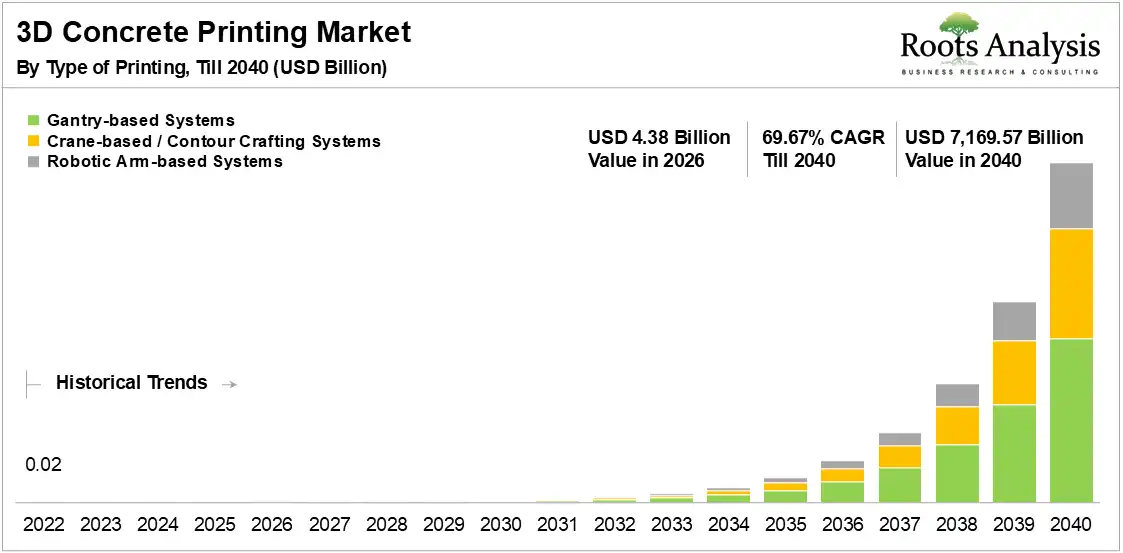
The global 3D concrete printing market, valued at USD 4.38 billion in 2026, is projected to reach USD 509.89 billion in 2035 and USD 7,169.57 billion by 2040, representing a CAGR of 69.67% during the forecast period 2026 to 2040.
See What’s in the Full Report - Request Your Complimentary Insights!
Market Overview
3D concrete printing is a form of cutting-edge construction technology. It utilizes robotic systems to create three-dimensional concrete structures through layer-by-layer material deposition. This technology also employs automated extrusion methods to fabricate building components and geometrics that are difficult to design through traditional construction processes. Traditional construction required manpower, high cost, generate enormous waste, and often have limitation in custom designing.
This technology allows engineers and architects to create parametric structures with high precision. The automated 3D concrete construction eliminates the requirement of intense labor work, minimizing wastage and enables custom designing. Owing to its significance, construction industry, governments and real-estate developers are increasingly adopting 3D concrete printing in construction.
Driven by its high demand, market players are encouraging partnerships, innovations, and collaborations to expand the usage of 3D concrete printing. For instance, in December 2025, CEPT University signed a Memorandum of Understanding (MoU) with Tyasta Manufacturing Solutions launch India’s advanced 3D concrete printing workshops. Given by the increasing demand across construction industry along with industry players initiatives, we believe that 3D concrete printing market will witness an upward trajectory in the upcoming years.
Key Takeaways
- Leading Market Players Competitive Ecosystem: Well-established market players, such as COBOD International, ICON Technology, CyBe Construction and Hyperion Robotics are leading the market. These market players are widely emphasizing on partnerships, investments, and collaborations.
- Regional Analysis and Market Adoption Trends: Rapid urbanization, rising government incentives to adopt 3D concrete printing for public infrastructure projects, and growing focus on smart cities construction projects are likely to fuel the market growth in this region.
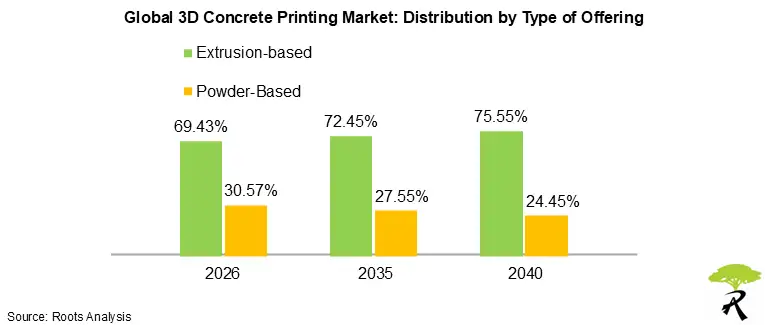
- Factors Propelling Extrusion-based Market Segment: With a share of nearly 70% extrusion-based dominates the market. This dominance is due to the widespread usage of extrusion-based in the construction industry. Extrusion-based technology has the potential of fabricating complex architectural construction, which further propelled the usage of extrusion-based technology.
- Funding and Investment Analysis: Companies like COBOD Internation, Holcim and Aridditive are investing and raising funds for 3D concrete printing industry. Recently, Aridditive recently raised EUR 500,000 in a Pre-Seed funding round which was led by BeAble Capital in participation from Suma Capitak. This funding will be used to accelerate the development of its concrete 3D printing technology.
- Future Opportunities and Market Trends: The future trends include robotics and automation in 3D concrete printing to enhance the accuracy and speed of the printing process and digital designing. In addition, market players also emphasize sustainability and renewable materials.
Recent Developments in 3D Concrete Printing Industry
- In December 2025, the Indian Army collaborated with IIT Hyderabad to operationalize on-site 3D concrete printing technology to construct bunkers, protective structures, and sentry posts in forward areas of Sikkim.
- In November 2025, Alquist announced the expansion of its construction 3D printing in partnership with Walmart and several other commercial retailers. This initiative also include dozens of projects nationwide, indicating the biggest deployment of 3D printed commercial building systems in the US history.
- In July 2025, COBOD International introduced the first commercially available multifunctional construction robot (built on COBOD’s 3D construction printing technology) in collaboration with the Technische Universitat Braunschweig. This robot integrates a telescopic vertical extension unit with a robotic arm that enable the shotcrete 3D printing process to construct complex designs, such as retaining walls, swimming pools, tunnels and reinforces concrete structures.
Unlock Deeper Insights – Schedule Your Personalized Workshop Today!
Key Market Drivers
- Need for Affordable and Infrastructure Delivery: 3D concrete printing technology reduces labor dependences, shortens construction time, and lowers material waste. These capabilities have made it attractive for social projects and rapid infrastructure delivery in urban areas. Furthermore, construction industry is also focusing on 3D concrete printing technology for affordable and rapid residential housing construction, which marks it as a key driver.
- Urbanization and Global Housing Shortages: The increasing urbanization in emerging economies and Asia-Pacific has pulled governments and real estate developers to adapt 3D concrete printing for infrastructure projects for cost-effective buildings. In addition, the increasing housing shortages is pressuring developers to leverage 3D concrete printing for community-scale projects.
- Sustainability, Waste Reduction, and Low-carbon Goals: It is worth noting that 3D concrete printers reduce waste and material use. Moreover, these technologies also support recycled aggregates, low-carbon binders, and align with green-building programs. The growing government initiatives, such as low-emission construction, energy efficiency and eco-friendly 3D printed buildings have further propelled the 3D concrete printing market growth.
Key Market Challenges
- Material Shrinkage, Cracking, and Long-Term Durability: Several research have shown that rapid construction with 3D concrete printers can experience higher shrinkage strains and cracking risk with time. This risk of material shrinkage and cracking causes concern of long-term durability. Therefore, market players are required to improve reinforcement approach and improve mix design to avoid these issues.
- Reinforcement, Structural Design, and Scalability Issues: One of the significance challenge for the industry players is post-integrating reinforcement, such as cables, rebar, and fibers in printed elements. This embedment may impact the code acceptance during 3D concrete printing for infrastructure projects and also create scalability issues.
- Economic Viability Versus Conventional Methods: Although 3D concrete printing technology cut labor cost and time, the overall economics still depend on logistics, utilization rates, local material costs and printer mobility. Therefore, providing consistent cost advantage across different projects types is still a work in progress.
Market Share Insights
Market Share by Type of Printing System: Gantry-based Systems Dominate the Market
Our 3D concrete printing market forecast estimates that gantry-based systems lead the market with a share of 55.66%. This dominance stems from the ability of gantry-based systems to deliver accuracy and speed for large-scale construction projects. Notably, structural accuracy reduces the error chances during construction, making it a preferrable solution for modular and prefabricated building components using 3D concrete printing for faster project delivery.
However, in the future, robotic arm-based systems show robust growth, anticipated registering higher CAGR during the forecast period. Robotic arm-based systems can operate in complex spaces and multiple directions, which increases its demand for intricate detailing and complicate infrastructure designs.
Additionally, the increasing advancements in robotics and automation in 3D concrete printing to enhance speed, precision, and flexibility has further supported the widespread adoption of this technology across construction, real estate developers and government sectors.
Want Information on Specific Region / Segment?
Construction Contractors Accounts for the Largest Share
Based on the 3D concrete printing market report, Construction contractors dominate the market by holding highest market share. This dominance stems from the extensive usage of on-site 3D concrete printing technology for large scale construction projects, housing, and commercial buildings.
Additionally, construction contractors also benefitted from the high speed of 3D concrete printing which helps to complete projects swiftly. These 3D concrete printing also enable construction of complex architectural designs which further fueled its demand across diverse contractors.
It is worth mentioning that prefabrication / modular manufacturers will grow at the fastest CAGR during the forecast period. This lucrative growth is due to the increasing utilization of prefabricated 3D printed concrete elements to create customized building modules. It eliminates the need for heavy machinery and reduces the time spent on-site, which further fuel the demand of 3D concrete printing technology for prefabrication / modular manufacturers.
Geographical Regions Market Analysis: North America Dominates the Market
According to our regional analysis, North America leads the global 3D concrete construction market by occupying 33.98% of the market share. This region benefits from the robust government support to adopt 3D concrete printing for bridges and public infrastructure projects in smart cities. Additionally, the increasing demand for automation to complete construction projects swiftly has fueled the adoption of 3D concrete printing technologies.
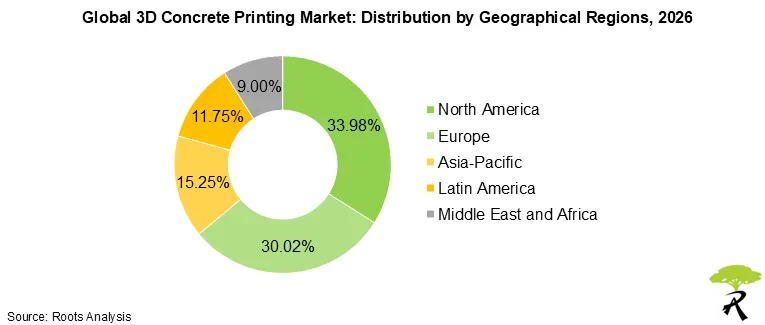
In Asia-Pacific, the market for 3D concrete printing is propelling at a higher CAGR during the forecast period. The increasing commercial development, rapid urbanization, and rising private sector infrastructure investment in affordable housing plans has underscored the demand for 3D concrete printing in Asian regions.
Latest 3D Concrete Printing Market Trends
- Integration With Digital Design, Business Information Modeling, and Prefabrication: With rising emphasis on customized structures, and industrial automation, the market players are widely emphasizing on the integration of 3D concrete printing with digital designs, business information modeling and off-site fabrication. This integration enables the development of customized structures, improving traceability and lifecycle performance.
- Use of Alternative Binders and Recycled Materials: The growing government initiatives to reduce carbon footprints has accelerated the demand for alternative binders, sustainable adhesives, and recycled materials for 3D concrete printing. This initiative has created new opportunities for the market players to initiate green funding and focus on the development of alternative binders.
3D Concrete Printing Market Ecosystem
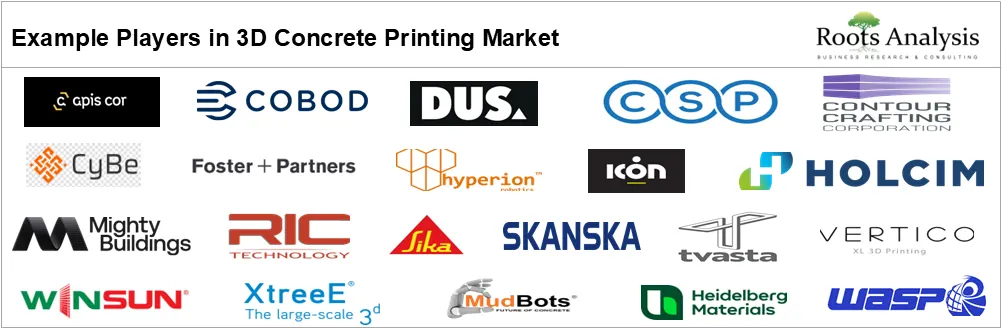
The vehicle telematics market analysis indicates that the market is highly competitive, featuring the presence of tech giants and small industrial players. Some of the notable players active in this industry includes Apis Cor, BetAbram, COBOD International, Contour Crafting, CSP, CyBe Construction, DUS Architects, Foster + Partners, Hyperion Robotics, HOLCIM, Heidelberg Materials, ICON Build, MudBots 3D Concrete Printing, Mighty Buildings, RIC Technology, Sika, Skanska, Tvasta Manufacturing Solutions, Vertico, Winsun, WASP, and XtreeE.
Market Segmentation
3D Concrete Printing Market: Scope of the Report
| Key Report Attributes | Details | |
| Historical Trend | Since 2022 | |
| Forecast Period | Till 2040 | |
| Market Size 2026 | $ 4.38 Billion | |
| Market Size 2040 | $ 7,169.57 Billion | |
| CAGR (Till 2040) | 69.67% | |
| Segments Covered |
|
|
Your Business is Unique – Why Shouldn’t Your Report Be?
Based on the research, we have segmented the 3D concrete printing market forecast into type of printing system, type of material, type of technique, type of concrete, application area, vertical, geographical regions, and key players.
By Type of Printing System
- Gantry-based Systems
- Crane-based / Contour Crafting Systems
- Robotic Arm-based Systems
By Type of Material
- Cement-based Concrete Mixes
- Custom Proprietary Mortars / Binders
- Fiber-reinforced Concrete Mixes
- Geopolymer-based Mixes
By Type of Technique
- Extrusion-based
- Powder-based
By Type of Concrete
- High Performance
- Precast
- Ready-mix
- Shotcrete
- Others
By Application Area
- Architectural & Decorative Elements
- Commercial & Office Buildings
- Emergency & Disaster Relief Shelters
- Public Infrastructure
- Residential Housing
By Vertical
- Construction Contractors
- Defense / Military Agencies
- Educational & Research Institutions
- Government & Public Sector
- Private Real Estate Developers
- Prefabrication / Modular Manufacturers
By Geographical Regions
- North America
- US
- Canada
- Mexico
- Rest of North America
- Europe
- Austria
- Belgium
- Denmark
- France
- Germany
- Ireland
- Italy
- Netherlands
- Norway
- Russia
- Spain
- Sweden
- Switzerland
- UK
- Rest of Europe
- Asia-Pacific
- Australia
- China
- India
- Japan
- New-Zealand
- Singapore
- South Korea
- Rest of Asia-Pacific
- Latin America
- Brazil
- Chile
- Colombia
- Venezuela
- Rest of Latin America
- Middle East and Africa (MEA)
- Egypt
- Iran
- Iraq
- Israel
- Kuwait
- Saudi Arabia
- UAE
- Rest of MEA


