report-pricing-dollar

Sustainable Adhesives Market

Sustainable Adhesives Market: Industry Trends and Global Forecasts, Till 2035- Distribution By Type of Adhesive (Biodegradable, Green, Recyclable, Renewable), Type of Raw Material (Acrylic Based, EVA Based, Plant-Based, Water-Based), Type of Substrate (Glass, Metal, Paper, Plastic, Wood), Type of Chemistry (Acrylic, Anaerobic, Epoxy, Hot Melt, Polyurethane), Area of Application (Automotive, Construction, Electronics, Medical, Packaging), by End-User (Consumer, Industrial, Medical), by Type of Enterprise (Large Enterprises, Small and Medium Enterprises (SMEs)), and Key Geographical Regions (North America, Europe, Asia, Latin America, and Middle East and North Africa and Rest of the World)

  • Lowest Price Guaranteed

  • Slides
    211

  • Last Updated
    August 2025

  • View Count
    9418

Sustainable Adhesives Market Overview

The global sustainable adhesives market, is projected to rise from USD 1.18 billion in 2025 to reach USD 2.07 billion by 2035. The sustainable adhesives market CAGR is represented to be 5.75% during the forecast period.
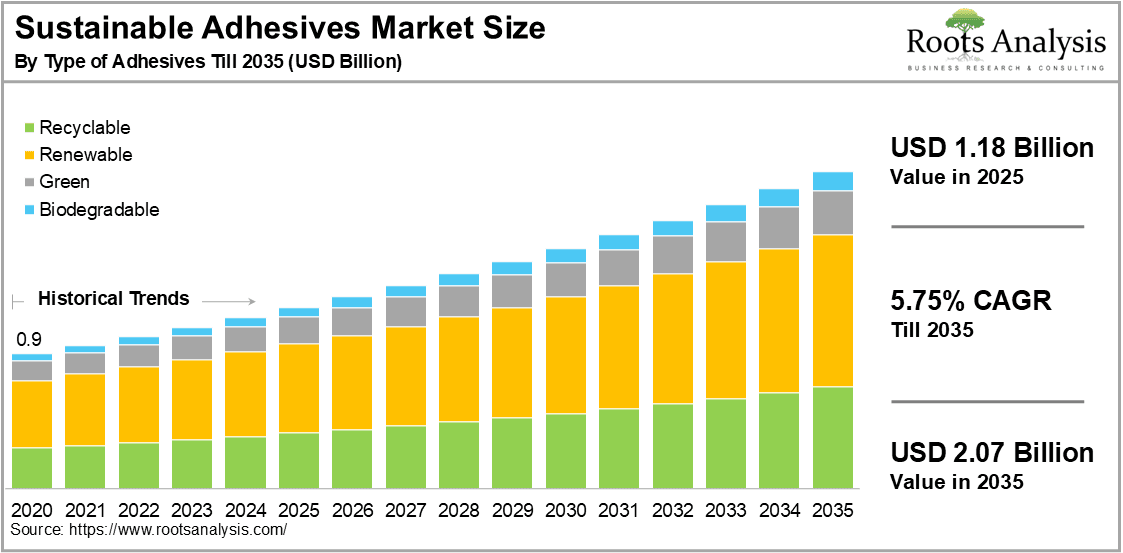
Sustainable Adhesives Market Size by Type of Adhesive

To learn more about this report, request a free sample copy

The new research study consists of global sustainable adhesive industry analysis, mega trends, patent analysis, porter five forces, SWOT analysis, value chain analysis and other strategic frameworks.

Within the green chemistry domain, bioadhesives represent a rapidly growing segment aligned with regulatory and environmental goals. Furhter, sustainable adhesives are bonding agents designed to minimize environmental impact by using renewable, biodegradable, or recyclable materials and reducing harmful emissions compared to traditional adhesives. These adhesives often comply with strict environmental standards and are formulated to be non-toxic, low in volatile organic compounds (VOCs), and compatible with recycling or composting processes.

Sustainable adhesives find applications across diverse industries, including packaging, construction, woodworking, automotive, medical devices, and textiles. In packaging, they enable eco-friendly bonding for cartons, labels, and flexible materials. In construction and woodworking, they provide strong, durable bonds while supporting green building goals. The automotive and medical sectors also use sustainable adhesives to enhance product safety and environmental responsibility.

The sustainable adhesives market demand is driven by several key factors. Rising consumer demand of the eco-friendly adhesives market, stricter government regulations on low VOC adhesives market and hazardous substances and increasing corporate sustainability initiatives are all accelerating adoption. Advances in adhesive technology have improved the performance and versatility of sustainable adhesives, making them viable alternatives for a wide range of applications. Additionally, the push for circular economy practices and green building standards, especially in rapidly developing regions, is further fueling market expansion.

Sustainable Adhesives Market Share Insights

The sustainable adhesives market report 2025 presents an in-depth analysis of the various companies that are involved in offering sustainable adhesives solutions, across different segments, as defined in the table below:

Sustainable Adhesives Market: Report Attributes / Market Segmentations

Key Report Attributes Details
Historical Trend Since 2020
Forecast Period Till 2035
Current Market in 2025 $ 1.18 Billion
Market Size in 2035 $ 2.07 Billion
CAGR till 2035 5.75%
Type of Adhesive
  • Biodegradable
  • Green
  • Recyclable
  • Renewable
Type of Raw Material
  • Acrylic Based
  • EVA Based
  • Plant-Based
  • Water-Based
Type of Substrate
  • Glass
  • Metal
  • Paper
  • Plastic
  • Wood
Type of Chemistry
  • Acrylic
  • Anaerobic
  • Epoxy
  • Hot Melt
  • Polyurethane
Area of Application
  • Automotive
  • Construction
  • Electronics
  • Medical
  • Packaging
By End-Users
  • Consumer
  • Industrial
  • Medical
Type of Enterprise
  • Large Enterprises
  • Small and Medium Enterprises
Geographical Regions
  • North America
    • US
    • Canada
    • Mexico
    • Other North American countries
  • Europe
    • Austria
    • Belgium
    • Denmark
    • France
    • Germany
    • Ireland
    • Italy
    • Netherlands
    • Norway
    • Russia
    • Spain
    • Sweden
    • Switzerland
    • UK
    • Other European countries
  • Asia
    • China
    • India
    • Japan
    • Singapore
    • South Korea
    • Other Asian countries
  • Latin America
    • Brazil
    • Chile
    • Colombia
    • Venezuela
    • Other Latin American countries
  • Middle East and North Africa
    • Egypt
    • Iran
    • Iraq
    • Israel
    • Kuwait
    • Saudi Arabia
    • UAE
    • Other MENA countries
  • Rest of the World
    • Australia
    • New Zealand
    • Other countries
Leading Market Players
  • 3M
  • Adhesive Technologies
  • AkzoNobel
  • Arkema
  • Artience
  • Ashland
  • Avery Dennison
  • BASF SE
  • Bostik
  • DIC
  • Dow
  • DuPont
  • Eastman Chemical
  • Evonik
  • H.B. Fuller
  • Henkel
  • Hexion
  • Huntsman
  • ITW
  • Jowat SE
  • JSR
  • Kaneka
  • LORD
  • Mitsui Chemicals
  • Paramelt
  • Parker Hannifin
  • Reichhold
  • RPM International
  • Sika
  • Solvay
  • Sonneborn
  • Synthos
  • Tesa SE
  • Wacker Chemie
PowerPoint Presentation
(Complimentary)
Available
Customization Scope 10% Free Customization
Excel Data Packs
(Complimentary)
  • Competitive Landscape
  • Company Competitiveness Analysis
  • Patent Analysis
  • Funding Analysis
  • Recent Developments
  • Market Forecast and Opportunity Analysis

Sustainable Adhesives Market Segmentation

Which Type of Adhesive Will Dominate the Sustainable Adhesives Market?

The recyclable adhesives segment is set to take the lead, holding a significant share of 45.21% of the market.

The dominance of this segment is largely a result of their strong alignment with circular economy principles and the increasing demand for materials that facilitate recycling and re-use in industries like packaging and construction.

However, renewable adhesives market share is likely to witness the fastest CAGR (6%) during the forecasted period.

How is the Water-Based Adhesives Segment Dominating Types of Raw Material?

Among the types of sustainable adhesives, the water-based adhesives segment really stands out as the leading segment holding a market share of 44% due to their widespread use, low toxicity, and compliance with environmental regulations.

On the other hand, plant-based adhesives segment is likely to witness the fastest sustainable adhesives CAGR (6.36%) during the forecasted period.

Which Type of Substrate Will have the Fastest CAGR?

Plastic substrates segment is set to witness the fastest CAGR (6.72%) during the forecasted period. The growth can be attributed to the rising use of sustainable adhesives in flexible packaging, consumer goods, and increasing regulatory pressure to replace conventional adhesives with greener alternatives in plastic bonding applications.

On the other hand, paper segment is expected to dominate the market with a significant share of 47% during the forecasted period.

Which Type of Chemistry Will Dominate the Sustainable Adhesives Market?

According to our eco-friendly adhesives industry analysis, the acrylic adhesives segment is set to have the highest market share of about 45% during the forecasted period. The growth can be attributed to due to their versatility, strong bonding properties, and widespread use in packaging, construction, and automotive sectors.

On the other hand, it is worth highlighting that the hot melt adhesives segment is likely to witness the fastest CAGR (6.73%) during the forecasted period.

Which Area of Application Will Gain the Most Traction?

The packaging segment is set to witness the fastest CAGR (8.44%) as well as lead the market with a share of 36% during the market forecast till 2035.

The growth is driven by strong demand for eco-friendly packaging solutions in e-commerce, food, and consumer goods sectors. The non-toxic adhesives market research suggests that the need for recyclable, biodegradable, and non-toxic adhesives in packaging is central to reducing plastic waste and meeting regulatory and consumer expectations.

Which End-User Will have the Fastest CAGR?

The consumer segment is set to witness the fastest CAGR (7.74%) during the forecasted period. The growth is fueled by rising environmental awareness, stricter regulations, and increasing adoption of sustainable products in everyday applications such as household, stationery, and DIY uses.

On the other hand, industrial segment is expected to dominate the market with a significant share of 57% during the forecasted period.

Which Regions or Countries Offer the Highest Growth Potential for Sustainable Adhesives?

According to our sustainable adhesives regional analysis, the North American sustainable adhesives market exhibits dominance by capturing 49.86% of the overall current market share. This is mainly due to both U.S. EPA environmental regulations and strong packaging and construction sectors demand environmentally friendly solutions. Manufacturers across the industry sector maintain active investments to create bio-based and low-VOC adhesive products.

Sustainable Adhesives Market Key Insights

The “Sustainable Adhesives Market: Industry Trends and Global Forecasts, till 2035” report features an extensive study of the current market landscape, market size and future opportunity within the sustainable adhesives market forecast period. The market report highlights the efforts of several stakeholders involved in this rapidly emerging segment of the service providers industry. Key takeaways of the market report are briefly discussed below.

Sustainable Adhesives Market Drivers and Trends

What are the Factors Driving Growth in the Sustainable Adhesives Market?

The sustainable adhesives market is experiencing significant growth due to several key drivers that are shaping its expansion. These drivers include regulatory support, consumer behavior shifts, technological innovations, macroeconomic influences, and emerging industry trends.

  • Regulatory Support: Stringent regulations regarding volatile organic compounds (VOCs) and hazardous substances are driving companies to adopt sustainable adhesives. For instance, the U.S. EPA and EU environmental directives enforce strict standards for environmental sustainability, pushing industries toward eco-friendly solutions.
  • Consumer Behavior Shifts: Consumers are increasingly demanding products with reduced environmental impact, leading to a rise in demand for biodegradable and renewable adhesives. This shift is particularly evident in regions like North America and Europe, where consumers are more environmentally conscious.
  • Technological Innovations: Innovations in bio-based adhesives market and improved performance capabilities of sustainable adhesives are enhancing their appeal across industries. These advancements ensure that sustainable adhesives meet both environmental and performance standards.

What are the main types of sustainable adhesives and their applications across industries?

Main types of sustainable adhesives include water-based, plant-based (bio-based), biodegradable, recyclable, and UV-cured adhesives. These are widely used across industries such as packaging, construction, automotive, woodworking, electronics, medical devices, and textiles, supporting the growth of sustainable bonding solutions market, improving recyclability, and reducing environmental impact.

How do environmental regulations impact the growth of the sustainable adhesives market?

Stringent environmental regulations-such as limits on VOC emissions and hazardous substances-are a major driver for the sustainable adhesives market, compelling manufacturers to develop eco-friendly, low-emission, and recyclable products. These regulations accelerate market growth by encouraging innovation and adoption across industries but also increase compliance costs and complexity for producers.

How are Technological Advancements Influencing the Development of Sustainable Adhesives?

Technological advancements are driving the development of sustainable adhesives by enabling eco-friendly formulations-such as bio-based, recyclable, and biodegradable adhesives-that deliver high performance while reducing environmental impact. Innovations like smart adhesives, automation, and digital manufacturing are also enhancing customization, production efficiency, and recyclability across industries.

What opportunities exist for new entrants in the sustainable adhesives market?

New entrants in the sustainable adhesives market have opportunities to innovate with bio-based, recyclable, and low-VOC formulations, especially for emerging sectors like renewable energy, electronics, and healthcare. The Asia Pacific sustainable adhesives market growth due to rapid industrialization, along with growing demand in packaging, construction, and automotive, also creates strong growth prospects for companies offering high-performance, eco-friendly solutions.

How do sustainable adhesives contribute to reducing environmental impact compared to traditional adhesives?

Sustainable adhesives reduce environmental impact by using bio-based, biodegradable, or recyclable materials, and by minimizing or eliminating harmful solvents and VOCs found in traditional adhesives. The biodegradable adhesives market trends lower carbon emissions, supports recycling and composting, and reduces the release of toxic chemicals into the environment, making products safer and more eco-friendly throughout their lifecycle.

What are the Key Strategies Used by Companies to Gain Sustainable Adhesives Market Share?

Sustainable adhesives companies are using smart strategies to stay ahead. Big players are focusing on sustainable adhesives market opportunities in emerging economies, partnerships, acquisitions, joint ventures, and innovations to strengthen their position in the sustainable adhesives competitive landscape while also investing in R&D to bring innovative and novel products to the market.

For instance, in April 2025, Henkel and Synthomer partnered to cut carbon emissions in adhesives. In reference to this, Stephen Lynen, Synthomer’s President for Adhesive Solutions commented that it’s a proud moment for their company to support Henkel and their customers with novel adhesive solutions based on a significantly reduced carbon footprint.

Sustainable Adhesives Market Challenges

What are the Major Challenges Faced by Manufacturers in the Sustainable Adhesives Market?

The sustainable adhesives market, while growing, faces several challenges that can impede its expansion. Here are 5 major restraints affecting this market:

  1. Regulatory Hurdles: The sustainable adhesives market is heavily influenced by complex regulatory compliance issues. Manufacturers must adhere to strict guidelines on VOCs, hazardous substances, and waste management, which requires significant investments in research, development, and testing.
  2. Technological Limitations: Formulating adhesives that meet both sustainability and performance criteria is a significant technological challenge. Sustainable adhesives must optimize recycling and disposal processes without compromising the recyclability of bonded materials.
  3. Economic Constraints: The high cost of developing and implementing sustainable adhesives can be a barrier, especially for smaller companies. The investment required to comply with regulations and develop new formulations can be cost-prohibitive.

Recent Developments in the Sustainable Adhesives Market

  • In April 2025, Evonik unveiled innovative debonding on demand sustainable adhesives, a new debonding approach which enhances material recyclability and repairability in modern manufacturing processes.
  • In March 2025, Germany’s Covestro announced the opening of their automated lab for coatings & adhesives. The facility will test binders and crosslinkers, running tens of thousands of tests annually to improve efficiency, precision, and sustainability.
  • In January 2025, Arkema launched biobased additives for sustainable coating and adhesives, helping customers meet sustainability and carbon footprint reduction goals.

Sustainable Adhesives Market Report Coverage

The market report presents a guide to understanding different types of sustainable adhesives and their applications, highlighting the capabilities of various companies engaged in this domain, across different segments. Amongst other elements, the market report includes:

  • A preface providing an introduction to the full report, sustainable adhesives market, 2020-2024 (Historical Trends) and 2025-2035 (Forecasted Estimates).
  • An outline of the systematic research methodology adopted to conduct the study on the sustainable adhesives market, providing insights on the various assumptions, methodologies, and quality control measures employed to ensure the accuracy and reliability of our findings.
  • An overview of economic factors that impact the overall sustainable adhesives market, including historical trends, currency fluctuation, foreign exchange impact, recession, and inflation measurement.
  • An executive summary of the insights captured during our research. It offers a high-level view of the current state of the sustainable adhesives market and its likely evolution in the mid-long term.
  • A detailed assessment of the sustainable adhesives market landscape, based on several relevant parameters, including year of experience, company size, location of headquarters, and ownership structure.
  • Elaborate profiles of prominent players engaged in the sustainable adhesives market, featuring information on their year of establishment, location of headquarters, company size, company mission, company footprint, management team, contact details, financial information, operating business segments, sustainable adhesives market portfolio, moat analysis, recent developments, and an informed future of sustainable adhesives systems.
  • A qualitative assessment of the various megatrends ongoing in the sustainable adhesives market, including shift to bio-based and renewable materials, stringent environmental regulations, and corporate sustainability initiatives.
  • An analysis highlighting the key unmet needs across sustainable adhesives market industry, featuring market research on sustainable adhesives industry analysis generated from real-time data on unmet needs as identified from social media posts, recent publications, industry blogs and the views of key opinion leaders expressed on online platforms.
  • An in-depth analysis of various patents that have been filed / granted related to sustainable adhesives market and its components, based on various parameters, such as type of patent, patent publication year, patent age and leading players
  • A detailed analysis of recent developments in the sustainable adhesives market domain, based on relevant parameters such as year of initiative, type of initiative (partnerships and collaborations, expansions, funding and product launches), geographical distribution and most active players (in terms of number of recent developments).
  • Key winning strategies framework that helps in analyzing the level of competition within an industry, by tracing the key market activities including partnership, funding, expansion of leading players
  • A qualitative analysis highlighting the five competitive forces prevalent in sustainable adhesives market industry, including threats for new entrants, bargaining power of suppliers, bargaining power of customers, threats of substitution and rivalry among existing competitors.
  • A discussion on affiliated global sustainable adhesives market trends 2025, key drivers and challenges, under a SWOT framework, which are likely to impact the industry’s evolution, along with a Harvey ball analysis, highlighting the relative effect of each SWOT parameter on the overall sustainable adhesives market.
  • A value chain analysis features a discussion on various stakeholders involved in the development of the sustainable adhesives market, from suppliers to end-users.
  • A detailed estimate of the current market size and the potential growth future of sustainable adhesives market initiatives over the next decade. Based on multiple parameters we have provided an informed estimate on the market evolution during the forecast period 2025-2035. The report also features the likely distribution of the current and forecasted opportunity within the sustainable adhesives market. Further, in order to account for future uncertainties and to add robustness to our model, we have provided three forecast scenarios, namely conservative, base, and optimistic scenarios, representing different tracks of the industry’s growth.
  • Detailed projections of the current and future market across various type of adhesive such as biodegradable, green, recyclable, and renewable.
  • Detailed projections of the current and future market across various type of raw material, such as acrylic based, EVA based, plant-based and water-based.
  • Detailed projections of the current and future market across various type of substrate, such as glass, metal, paper, plastic and wood.
  • Detailed projections of the current and future market across various type of chemistry, such as acrylic, anaerobic, epoxy, hot melt, and polyurethane.
  • Detailed projections of the current and future market across various areas of application, such as automotive, construction, electronics, medical, and packaging.
  • Detailed projections of the current and future market across various end-users, such as consumer, industrial, and medical.
  • Detailed projections of the current and future market across various type of enterprises such as large enterprises and small and medium enterprises.
  • Detailed projections of the current and future sustainable adhesives market across various geographical regions, such as North America (US, Canada, Mexico and other North American countries), Europe (Austria, Belgium, Denmark, France, Germany, Ireland, Italy, Netherlands, Norway, Russia, Spain, Sweden, Switzerland, UK and other European countries), Asia (China, India, Japan, Singapore, South Korea and other Asian countries), Middle East and North Africa (Egypt, Iran, Iraq, Israel, Kuwait, Saudi Arabia, UAE and other MENA countries), Latin America (Brazil, Chile, Colombia, Venezuela and other Latin American countries) and rest of the world (Australia, New Zealand and other countries).

About Authors

Lead Author: Anmol Bali

Lead Reviewer: Ronit Sharma

Chief Editor: Yash Tyagi

Customization Opportunities

At Roots Analysis, we genuinely care about your success and understand that your business requirements are unique. While our sustainable adhesives market research reports provide valuable insights, we recognize that they might not cover every aspect you need to make well-informed strategic decisions. To account for that, we offer 15% free report customization tailored to your specific needs. Whether you require additional quantitative analysis, qualitative insights, or any other information related to the sustainable adhesives market, reach out us today at: support@rootsanalysis.com

Frequently Asked Questions

What are sustainable adhesives?

Sustainable adhesives are bonding agents designed to minimize environmental impact by using renewable, biodegradable, or recyclable materials and reducing harmful emissions compared to traditional adhesives.

What is the current size of the global sustainable adhesives market and its projected growth?

Currently, the sustainable adhesives market size is estimated to be worth $ 1.18 billion, while its project growth (CAGR) is expected to be 5.75% during the forecast period.

Which key players dominate the sustainable adhesives market globally?

3M, Adhesive Technologies, AkzoNobel, Arkema, Artience, Ashland, Avery Dennison, BASF SE, Bostik, DIC, Dow, DuPont, Eastman Chemical, Evonik, H.B. Fuller, Henkel, Hexion, Huntsman, ITW, Jowat SE, JSR, Kaneka, LORD, Mitsui Chemicals, Paramelt, Parker Hannifin, Reichhold, RPM International, Sika, Solvay, Sonneborn, Synthos, Tesa SE, Wacker Chemie.

Which region dominates the sustainable adhesives market?

Currently, North America is dominating the sustainable adhesives market.