


 Download Free Sample
 Buy Now
4D Imaging Radar Market Size
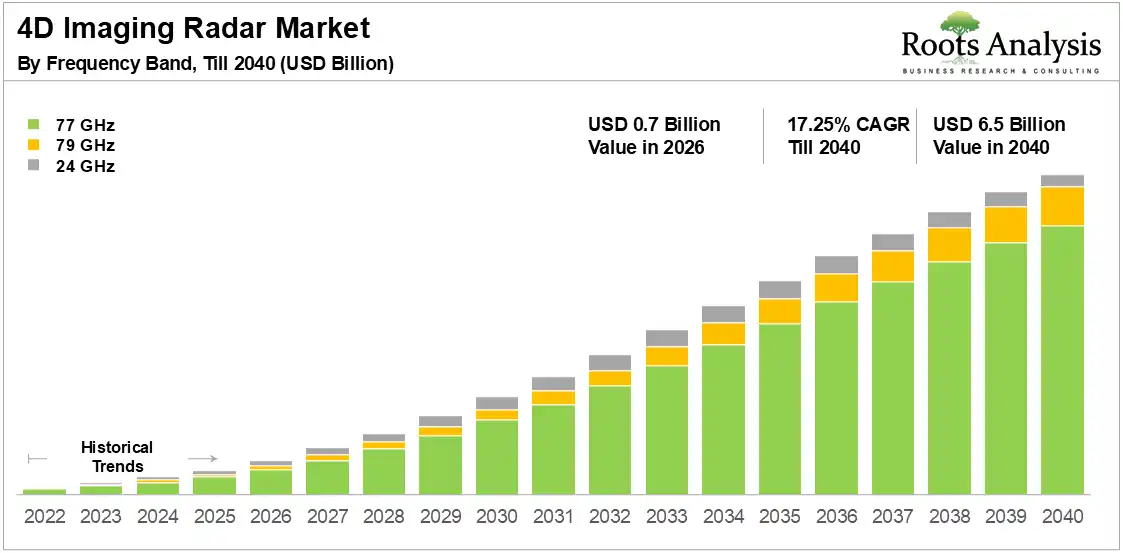
4D imaging radar market size is forecasted to reach USD 6.5 billion by 2040, growing at a 17.25% CAGR from USD 0.7 billion in 2026.
See What’s in the Full Report – Request Your Complimentary Insights!
Market Report: Key Takeaways
- By type of application, Automotive segment leads with 68.5% share in 2026, expanding to 72.4% by 2040, driven by L3/L4 autonomy scaling.
- Processing units lead component segmentation with a 35.0% share, reflecting the growing importance of compute-intensive radar processing and system integration.
- At 72.5% share, the 77 GHz band serves as the industry benchmark for high-resolution radar integration across advanced driver assistance systems.
- North America accounts for over 32.5% of total demand, underscoring strong regional concentration within established automotive ecosystems.
4D Imaging Radar Market Overview
The 4D imaging radar market represents an advanced evolution in sensing technology, delivering high-resolution environmental perception by integrating velocity data with three-dimensional spatial measurements. Unlike conventional radar systems, 4D imaging radar generates dense point-cloud outputs that enhance object detection, classification, and tracking across complex and dynamic environments. Its ability to operate reliably in adverse weather conditions, including fog, rain, and low-light scenarios, positions it as a critical enabler of next-generation safety and autonomy frameworks. As vehicle architectures transition toward higher levels of automation, 4D radar is increasingly regarded as a perception system in advanced driver assistance systems.
Market expansion is primarily driven by the automotive sector, where demand for enhanced situational awareness and regulatory compliance continues to intensify. Passenger vehicle platforms serve as the principal deployment channel, while commercial vehicle integration is gaining momentum due to the operational requirements of fleet safety and continuous logistics operations. Beyond mobility, adoption is gradually extending into industrial automation, defence applications, and healthcare monitoring, reflecting the technology’s versatility in environments where optical sensing may underperform.
Technologically, the market remains anchored in established waveform architectures while progressively incorporating advanced multi-antenna configurations and higher-frequency platforms to improve spatial resolution. Concurrently, value concentration is shifting toward processing units and integrated system-on-chip solutions, underscoring the increasing importance of embedded intelligence and edge computing within modern radar ecosystems.
Pay Only for What You Need – The Best Way to Optimize
4D Imaging Radar Market Trends
Value Chain Analysis
The value chain of the 4D imaging radar market is structured around a multi-layered ecosystem involving semiconductor suppliers, radar technology developers, automotive system integrators, and end-use industries such as automotive, industrial automation, and defense applications. Upstream activities are primarily driven by semiconductor manufacturers and component suppliers that provide essential hardware elements, including radar transceivers, processing units, antennas, and integrated circuits. These components are developed using advanced semiconductor fabrication processes, enabling higher channel density and improved sensing resolution for next-generation radar systems.
In the system development stage, radar technology developers and Tier-1 automotive suppliers integrate these components into complete radar modules and perception systems. These companies focus on system design, signal processing algorithms, and software integration to deliver high-resolution environmental sensing solutions capable of supporting advanced driver-assistance systems and autonomous mobility platforms. Collaboration between radar chipset manufacturers, software developers, and automotive technology providers plays a critical role in optimizing system performance and accelerating product commercialization.
Downstream, automotive OEMs, industrial automation companies, and infrastructure operators deploy these radar solutions within vehicles, robotics platforms, and smart infrastructure systems. End-user adoption is driven by increasing demand for high-precision sensing technologies that can operate reliably in challenging environmental conditions. As the market evolves, value creation is increasingly shifting toward advanced processing capabilities, AI-enabled perception software, and system-level integration that enhance sensing accuracy and operational efficiency across multiple applications.
Segmental Analysis
|
Segment |
Sub-segment |
Market Share (2026) % |
|
Frequency Band |
77 GHz |
72.5% |
|
Application |
Automotive |
68.5% |
|
Component |
Processing Unit |
35% |
|
Technology |
FMCW |
82% |
|
Vehicle Type |
Passenger |
82.5% |
|
Region |
Asia Pacific |
30.5% |
The 4D imaging radar market landscape in 2026 is structurally anchored by dominant positions across key segmentation layers. Within the frequency band category, 77 GHz serves as the primary deployment platform, reflecting regulatory harmonization and suitability for high-resolution automotive radar applications. From an application standpoint, Automotive represents the central demand driver, reinforcing the market’s strong alignment with advanced driver assistance systems and higher levels of vehicle automation.
At the technology level, FMCW remains the foundational architecture, underscoring the industry’s reliance on established waveform platforms for range and velocity detection. In terms of component value distribution, processing units account for the largest share, highlighting the increasing importance of signal processing capability and embedded intelligence within radar systems. This shift toward compute-centric architecture signals a broader transition toward software-defined vehicle frameworks.
From a vehicle type perspective, passenger vehicles constitute the primary commercialization channel, supported by large-scale platform integration. Regionally, Asia Pacific stands as a leading growth hub within the competitive landscape, supported by strong automotive manufacturing ecosystems and accelerating electric vehicle adoption.
4D Imaging Radar Market Competitive Landscape
The competitive landscape of 4D imaging radar market is characterized by a combination of established semiconductors leaders, global automotive Tier-1suppliers, and emerging radar technology startups. Large semiconductor companies such as Texas Instruments, NXP Semiconductors, and Infineon Technologies play a critical role in developing radar chipsets, processors, and system-on-chip platforms. These chipsets enable high-resolution radar sensing for advanced driver-assistance systems and autonomous vehicles. These companies benefit from strong semiconductor manufacturing capabilities, extensive automotive partnerships, and large-scale production capacity, allowing them to maintain a strong technological and commercial presence in the market.
Major automotive technology providers including Continental, Robert Bosch, and ZF Friedrichshafen contribute significantly to the commercialization of 4D imaging radar solutions through the development of integrated radar modules and sensor fusion systems. These companies leverage long-standing relationships with automotive OEMs to deploy radar-based perception technologies in advanced driver-assistance systems and emerging autonomous driving platforms. Their focus on combining radar, camera, and LiDAR technologies strengthens system reliability and enhances environmental perception capabilities.
In addition to established industry participants, several specialized technology firms such as Arbe Robotics, Uhnder, and Vayyar Imaging are advancing innovation in high-resolution radar architectures. These companies focus on digital radar chipsets, imaging radar platforms, and AI-driven signal processing technologies designed to generate dense environmental point clouds for improved object detection and classification. Their innovations are accelerating the development of next-generation sensing solutions capable of supporting complex autonomous mobility and smart infrastructure applications.
Your Business is Unique – Why Shouldn’t Your Report Be?
4D Imaging Radar Market Dynamics
Market Drivers:
- Stringent Safety Regulations Driving Radar Adoption: Increasing global safety mandates requiring improved performance in automatic emergency braking and vulnerable road user detection are accelerating the adoption of high-resolution radar technologies across advanced driver-assistance systems.
- Rising Demand for Redundant Sensing in Autonomous Vehicles: The transition toward conditional and higher levels of vehicle autonomy requires reliable, all-weather perception systems, positioning 4D imaging radar as a critical complementary sensing layer alongside cameras and LiDAR.
- Cost-Efficient High-Resolution Sensing Through Semiconductor Integration: The use of established semiconductor fabrication processes enables 4D imaging radar to deliver advanced sensing capabilities at a scalable cost structure, supporting broader deployment in mass-market automotive platforms.
Market Restraints:
- High Computational Requirements and System Complexity: Dense point-cloud generation in 4D imaging radar requires advanced processing units and sophisticated sensor-fusion algorithms, increasing overall system cost and architectural complexity for automotive integration.
- Intensifying Competition from Alternative Sensing Technologies: Continuous improvements in traditional radar systems and the declining cost of LiDAR technologies are intensifying market competition, requiring 4D radar providers to consistently demonstrate superior performance and value differentiation.
Market Opportunities:
- Expansion Into Industrial and Smart Infrastructure Applications: Growing adoption in robotics, logistics automation, and smart city infrastructure is creating diversified growth opportunities for 4D imaging radar beyond traditional automotive use cases.
- Software-Defined Vehicle Integration Enabling New Revenue Models: Integration into software-defined architectures allows manufacturers to activate additional features after purchase, enabling recurring revenue opportunities through over-the-air software upgrades.
4D Imaging Radar Market Regional Analysis
North America represents a mature market (nearly 32.5% market share) driven by strong investments in autonomous driving technologies and advanced driver-assistance systems. The region benefits from the presence of leading automotive manufacturers, semiconductor companies, and technology developers actively advancing radar sensing capabilities. Supportive regulatory frameworks and significant R&D activity continue to strengthen the region’s role in early technology adoption and innovation.
Europe maintains a significant position in the market due to stringent vehicle safety regulations and the strong presence of premium automotive manufacturers. Regulatory mandates related to advanced safety systems and the transition toward software-defined vehicles are encouraging the adoption of high-resolution radar technologies. The region also benefits from a well-established automotive supply chain and strong collaboration between OEMs and Tier-1 technology suppliers.
Asia-Pacific is emerging as the fastest-evolving regional market, supported by rapid expansion in electric vehicle manufacturing and large-scale automotive production. The presence of cost-efficient electronics manufacturing ecosystems and increasing investments in autonomous mobility technologies are accelerating radar adoption. Growing government support for advanced mobility solutions and smart transportation infrastructure further strengthens the region’s long-term market potential.
The market in Latin America remains in an early stage of development, with adoption primarily concentrated in select automotive applications. Growth is influenced by gradual improvements in vehicle safety standards and increasing penetration of advanced driver-assistance technologies. However, infrastructure limitations and slower technology diffusion continue to moderate the pace of market expansion.
The MENA region is witnessing growing interest in advanced sensing technologies as governments invest in smart mobility initiatives and next-generation transportation infrastructure. Large-scale smart city projects and autonomous transport initiatives are creating opportunities for the deployment of advanced radar solutions. Continued investments in technology-driven urban development are expected to support gradual market expansion in the region.
Want Information on Specific Region / Segment?
4D Imaging Radar Market Key Players
- Infineon Technologies
- NXP Semiconductors
- Continental AG
- Robert Bosch GmbH
- Arbe Robotics
- Uhnder
- ZF Friedrichshafen AG
- Vayyar Imaging
4D Imaging Radar Market Recent Developments
- In November 2025, Arbe Robotics launched its P-AAR (Perception-as-a-Service) platform, enabling new business models for OEMs and Tier 1 suppliers by offering scalable, high-resolution 4D imaging radar data processing and perception software.
- In September 2025, Uhnder, a leading imaging radar semiconductor company, announced a new collaboration with a major Chinese autonomous driving solution provider to integrate its 4D digital radar chips into next-generation ADAS systems for a new electric vehicle model.
- In July 2025, Vayyar Imaging entered a strategic partnership with a European Tier 1 supplier to co-develop cabin monitoring systems that utilize 4D imaging radar technology for enhanced passenger safety and occupancy detection.
4D Imaging Radar Market: Scope of Report
| Key Attributes | Details | |
| Historical Trend | Since 2022 | |
| Market forecast period | Till 2040 | |
| Market size 2026 | USD 0.7 Billion | |
| Market size 2040 | USD 6.5 Billion | |
| CAGR (Till 2040) | 17.25 % | |
| Report coverage |
|
|
| Key companies profiled |
|
|
| Segments covered |
|
|
| Countries covered |
|
|


